The idea in one line
From the two ends and of a baseline of length we measure the angles (at ) and (at ) between the baseline and the direction to the object . The third angle is and, by the law of sines,
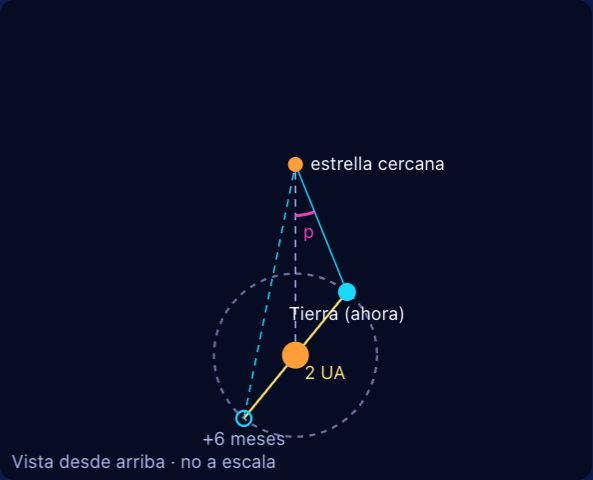
Stellar parallax is the same triangle with au (the Earth’s orbit) and a tiny .
Project phases
Week 1 — Trigonometry and the theodolite
- We review sine, cosine and tangent in the right triangle and the law of sines in any triangle (lesson Parallax and trigonometry).
- We build the theodolite: a 360° protractor (or two 180° ones) glued onto a horizontal board; a sight (drinking straw) pivots on the center. For vertical angles, a second protractor set vertically with a plumb bob.
- Calibration in the classroom: we measure the distance to the wall by triangulation with a 2 m baseline and compare it with the tape. Typical error: 5 to 10 %. We note where it comes from (angle reading to ±1°).
- We choose the target: the top of a hill, a tower or an antenna visible from the playground or the rooftop, that appears on the map.
Week 2 — The measurement outing
- We lay out the baseline as long and as perpendicular to the direction of the target as the playground allows (30 to 100 m). We measure it twice with the tape.
- At : we align the theodolite’s zero with the direction to and read the angle toward the target. At : we align with and read . Each angle is read by three people and averaged.
- We also measure the elevation angle to the top from (with the vertical protractor and the plumb bob) and the observer’s eye height .
- We record everything on the sheet: , , , , , time, conditions, names.
Week 3 — Calculation, map and error
- ; . Example: m, , → , m.
- Height of the hill above the playground: . With : m.
- Comparing with the map: we measure on the map with the scale (or with the distance tool) and, if there are contour lines, the height. Percentage error.
- Error propagation: we repeat the calculation with (the theodolite’s uncertainty). With , one degree is 40 %: the distance comes out between 985 m and 2 290 m. Conclusion: with small angles, the error in dominates; a longer baseline or a more precise instrument is needed. We discuss which of the two is easier to get.
Week 4 — From the baseline to the parsec
- The same geometry in the sky: the baseline is the diameter of the Earth’s orbit, au, and the angle at the star is (the parallax is half of it). With in radians, .
- If is measured in arcseconds, parsecs. For Proxima Centauri, : pc light-years. We check in the simulator Stellar parallax and with the lesson.
- Comparing precisions: our theodolite reads ; Gaia measures : how many times better? (.) Up to what maximum distance would our theodolite “see” a parallax, if the baseline were the Earth’s orbit? ( au: we would not even leave the Solar System.)
- Final report with the sections: method, diagram, data, calculation with uncertainty, comparison with the map, parallax of Proxima and conclusions.
Mathematics in the project
- Law of sines: in any triangle, .
- Elevation angle: , where is the horizontal distance.
- Small angle: for in radians, ; with rad the relative error of the approximation is , negligible.
- Parsec: . A parsec is au because one radian is .
- Error propagation: if is small, (in radians), so a relative error in produces the same relative error in .
Assessment rubric
| Criterion | Developing | Achieved | Advanced |
|---|---|---|---|
| Field measurement | Measures baseline and angles without repeating | Measures the baseline twice and each angle three times; records everything | Designs the baseline to maximize and justifies the choice |
| Trigonometric calculation | Applies the law of sines with help | Calculates and correctly and compares with the map | Propagates the error in and explains why it dominates |
| Extension to parallax | Knows that | Calculates the distance to Proxima and explains the parsec with the triangle | Compares instrument–Gaia precisions and deduces the reach of each |
| Report | Incomplete or without a diagram | Complete, with diagram, data, result and uncertainty | Includes an improvement proposal and a second verification measurement |
Variants and extensions
- No hill in sight: triangulate a tower, a tall tree or a distant building; the method is the same.
- Two baselines: repeat with a baseline twice as long and check that the uncertainty is reduced.
- Kepler (unit 2): with the Keplerian orbit simulator and the lesson Kepler’s three laws, discuss how stellar parallax combines with the third law to measure the masses of double stars.
- Parallax of the Moon: two schools far apart (1 000 km or more) photograph the Moon against the stars at the same instant; the apparent shift (≈ 0.15°) gives the Earth–Moon distance.
Inclusion
- The angles are read out loud and written down in pairs; the theodolite can have raised marks every 10°.
- The baseline can be measured in a flat hallway for students with reduced mobility; the target can be the end of a building visible from the window.
- The calculations are shared out: one person solves with the calculator, another draws to scale on graph paper (the two must agree).
Safety
- Outing to the playground or the rooftop with supervision; on rooftops, away from the edges and with railings.
- Never point the theodolite’s sight or the phone toward the Sun; choose targets far from the Sun’s direction and wear a hat.
- Stakes are driven in carefully and removed when done.