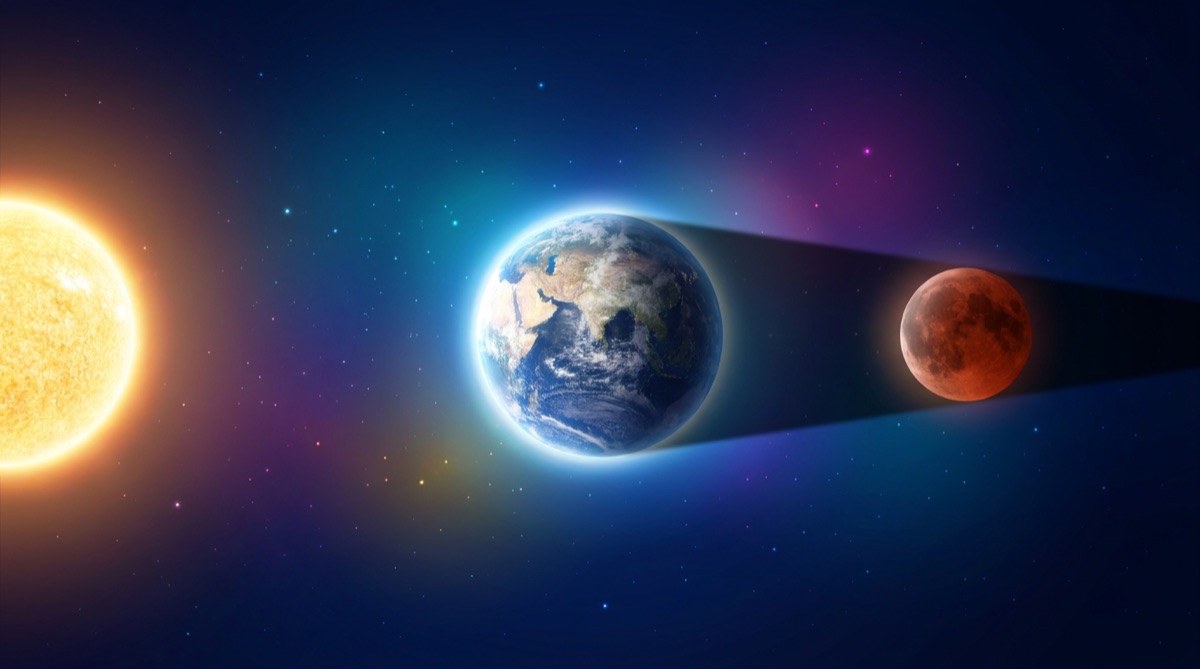
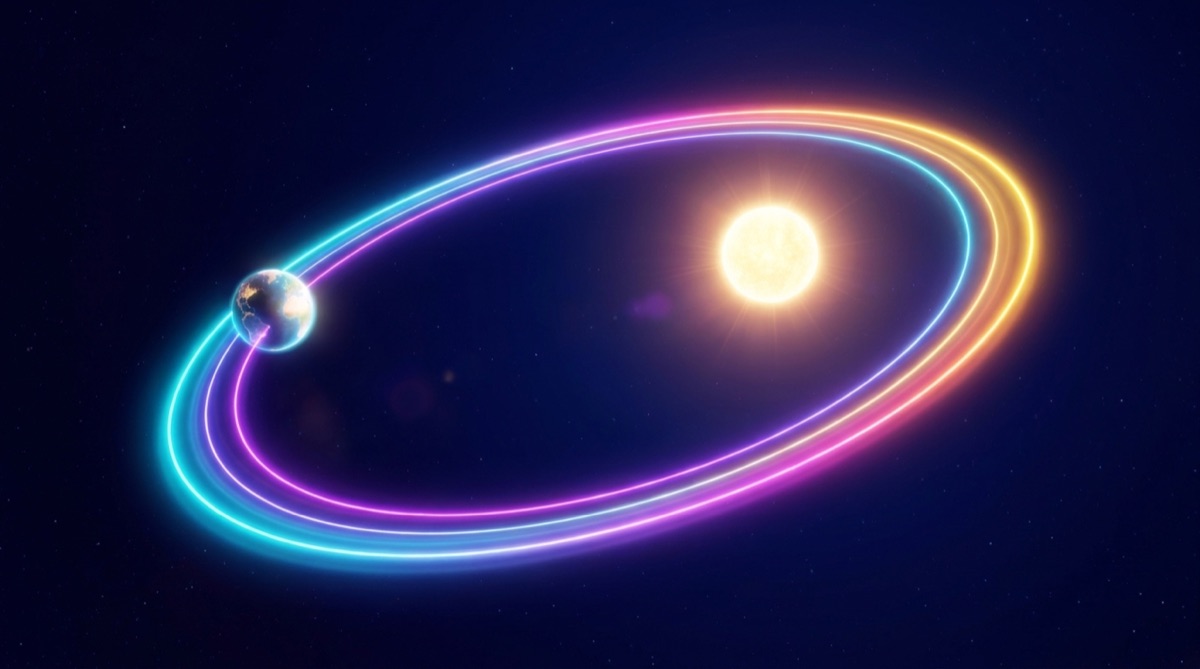
Every month there is a new moon: the Moon passes between the Earth and the Sun. And every month there is a full moon: the Earth lies between the Sun and the Moon. So why is there not a solar eclipse and a lunar eclipse every month? The answer fits in a small number, 5.145°, and a little geometry.
1. Sun–Earth–Moon geometry
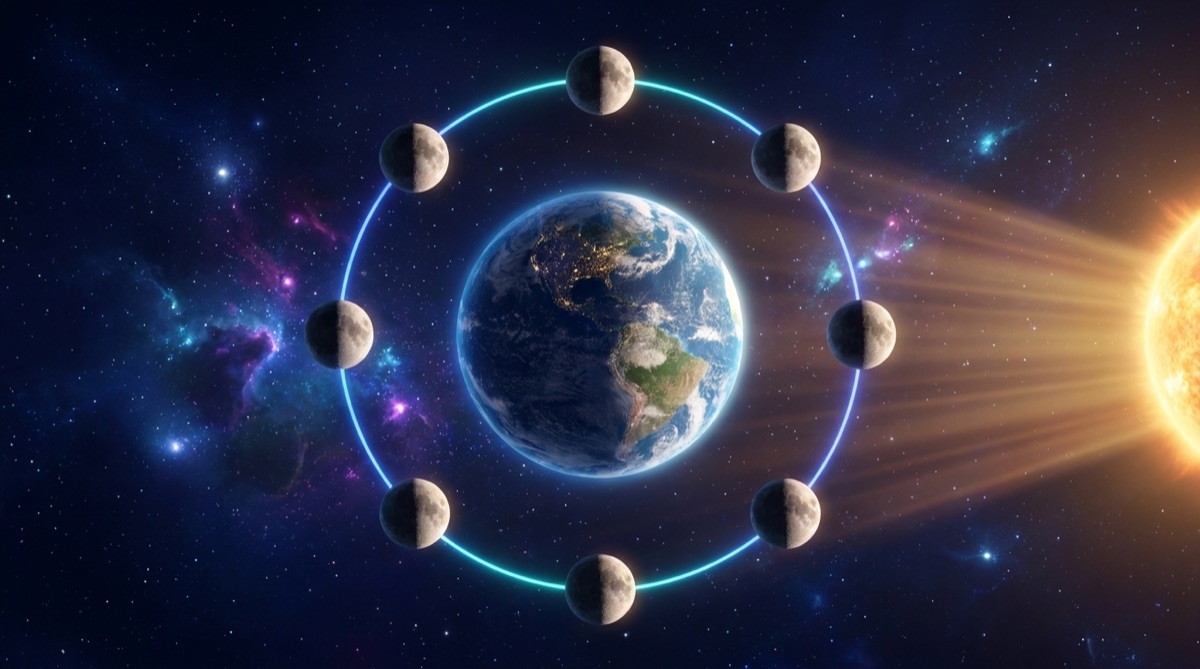
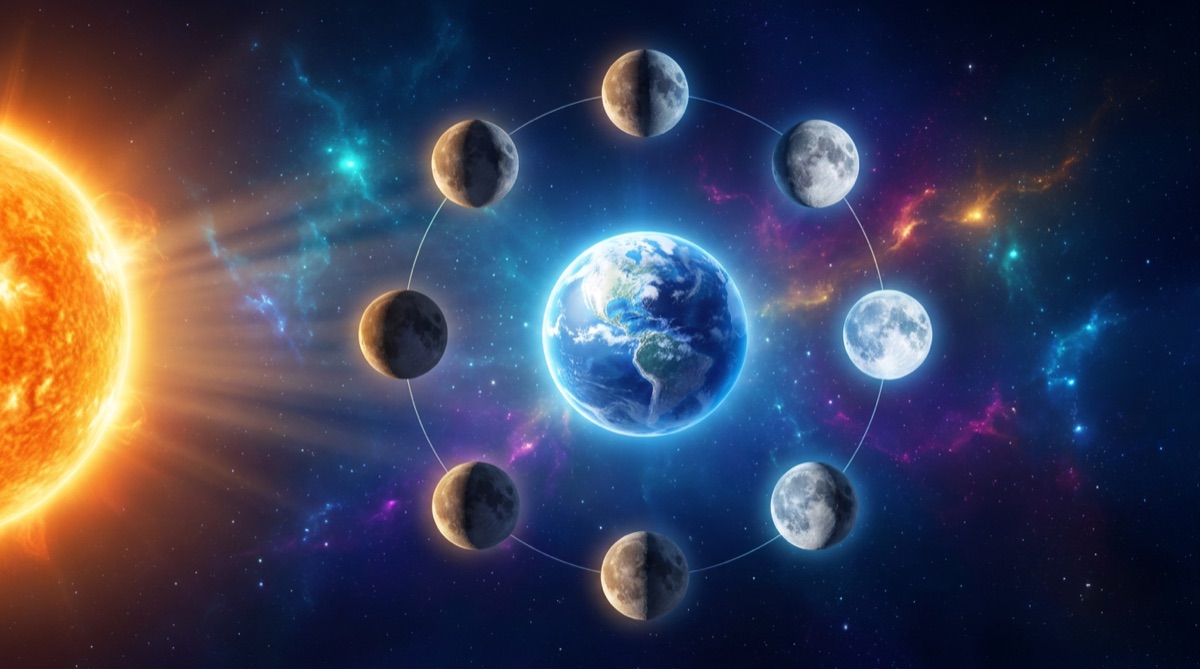
The Sun always illuminates half of the Moon. What changes over the month is which part of that illuminated half faces the Earth, because the Moon goes around us.
Seen from above the north pole, with the Sun far away to the right:
| Position of the Moon | Phase | Illuminated fraction of the disk |
|---|---|---|
| Between the Earth and the Sun | New moon | |
| from the direction of the Sun | First / last quarter | |
| On the side opposite the Sun | Full moon | |
| Intermediate positions | Crescent, gibbous | between and |
Watch the name. At first quarter we see half a disk illuminated, but that half disk is only a quarter of the whole lunar sphere (half of a half). Hence “quarter.”
The Sun is about times farther away than the Moon ( au versus km), so, as far as illumination is concerned, its rays reach the Moon and the Earth practically parallel.
2. Angles that describe the phase
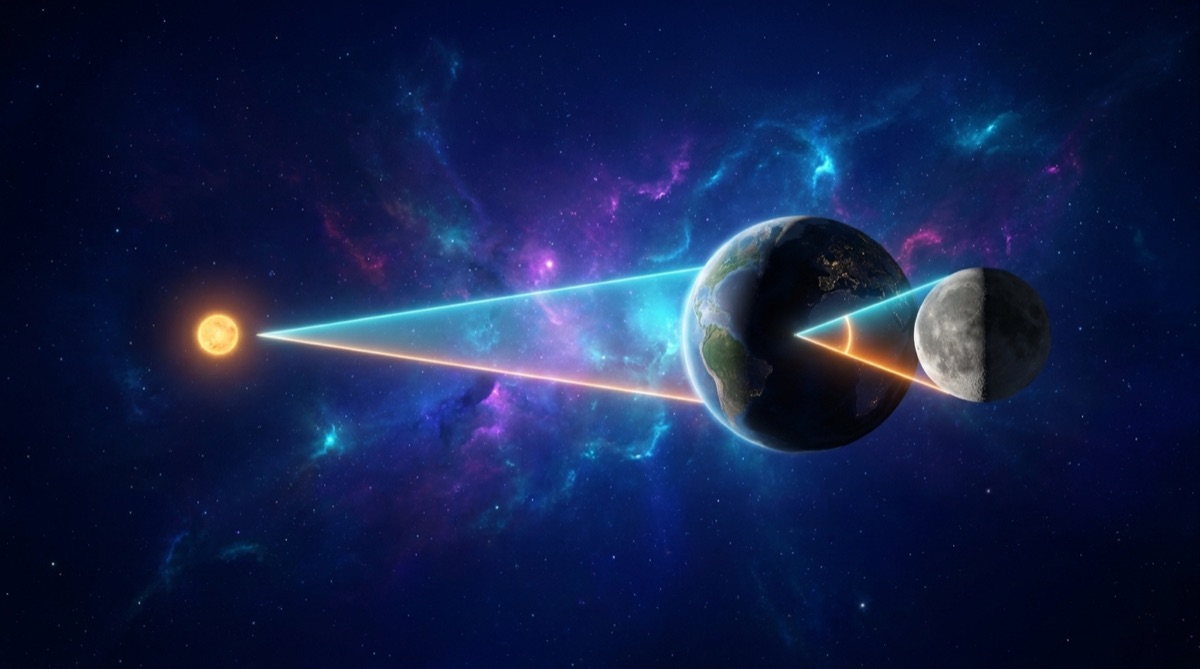
We call:
- Elongation : the Sun–Earth–Moon angle (vertex at the Earth), between the directions in which we see the Sun and the Moon.
- Phase angle : the Sun–Moon–Earth angle (vertex at the Moon).
In the Sun–Earth–Moon triangle the angles add up to . Since the angle at the Sun is tiny (at most ),
Convention: is full moon (Sun behind the observer) and is new moon.
3. Deriving the illuminated fraction
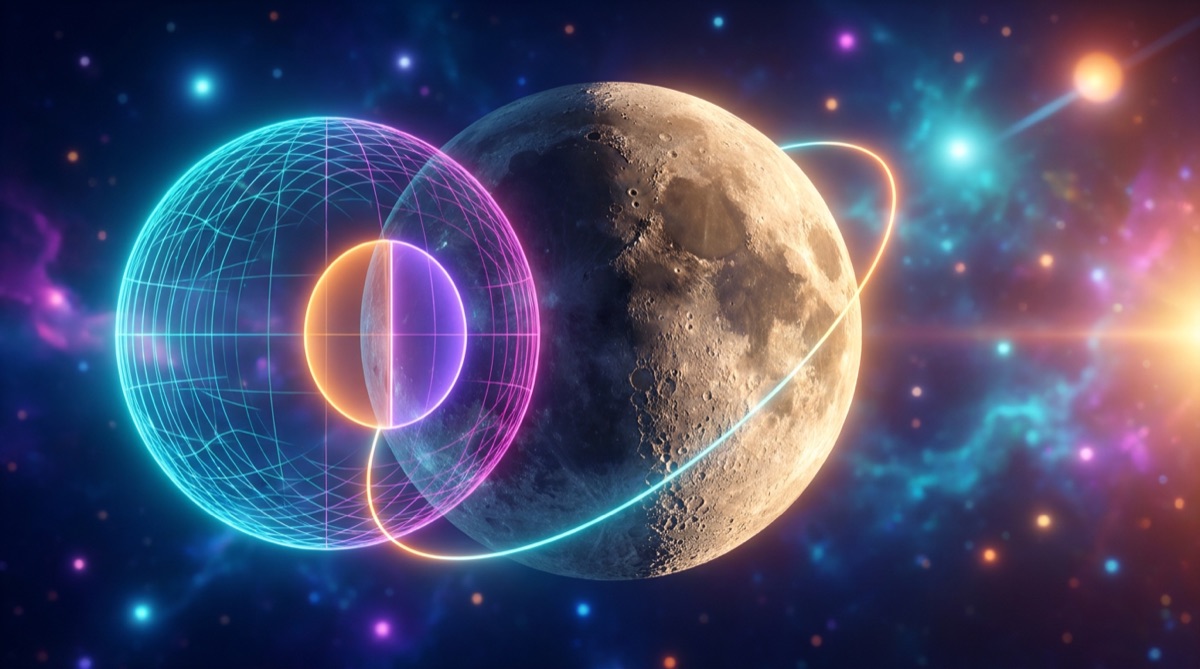
The edge of the illuminated hemisphere, the terminator, is a great circle of radius (the lunar radius) perpendicular to the Moon→Sun direction.
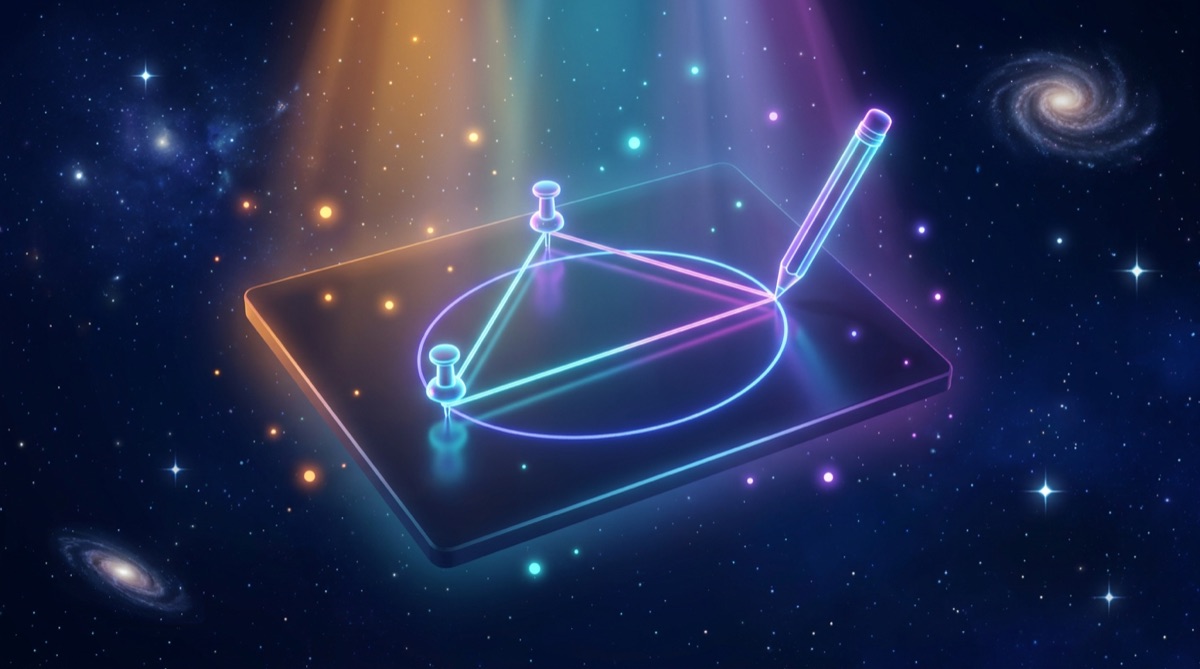
From the Earth we see the lunar disk projected onto a plane perpendicular to the line of sight. The plane of the terminator makes an angle with that plane, so the orthogonal projection of the terminator is an ellipse with semi-major axis (in the direction perpendicular to the Sun–Earth–Moon plane) and semi-minor axis
The illuminated part of the disk consists of:
- a semicircle on the Sun’s side, of area , and
- half an ellipse of area , which is added if is less than (gibbous) or subtracted if is greater than (crescent).
With the sign included in :
Dividing by the area of the disk, , we get the illuminated fraction:
Checks: (full), (quarters), (new). Using , also .
The right-hand panel of the simulator draws exactly this: a semicircle and a half-ellipse with semi-axis .
In real date mode the simulator computes the positions of the Sun (Meeus, ch. 25) and of the Moon (main terms of Meeus, ch. 47) and the exact phase angle with the Earth–Sun distance and Earth–Moon distance (Meeus, eq. 48.3):
where , are the ecliptic longitude and latitude of the Moon and the longitude of the Sun.
Worked example 1
The Moon is from the Sun, to the east. Then and . We see 75% of the disk: waxing gibbous.
Challenges with the simulator
- Drag the Moon until the illuminated fraction reads 0.25. What is ? And ?
- Set real date mode to today’s date. Write down the phase and the ecliptic latitude of the Moon. Step forward day by day to the next new moon: what is on that day? Will there be an eclipse? (Section 5.)
- Find the new moon of January 26, 2028: check that is less than .
4. Sidereal month and synodic month
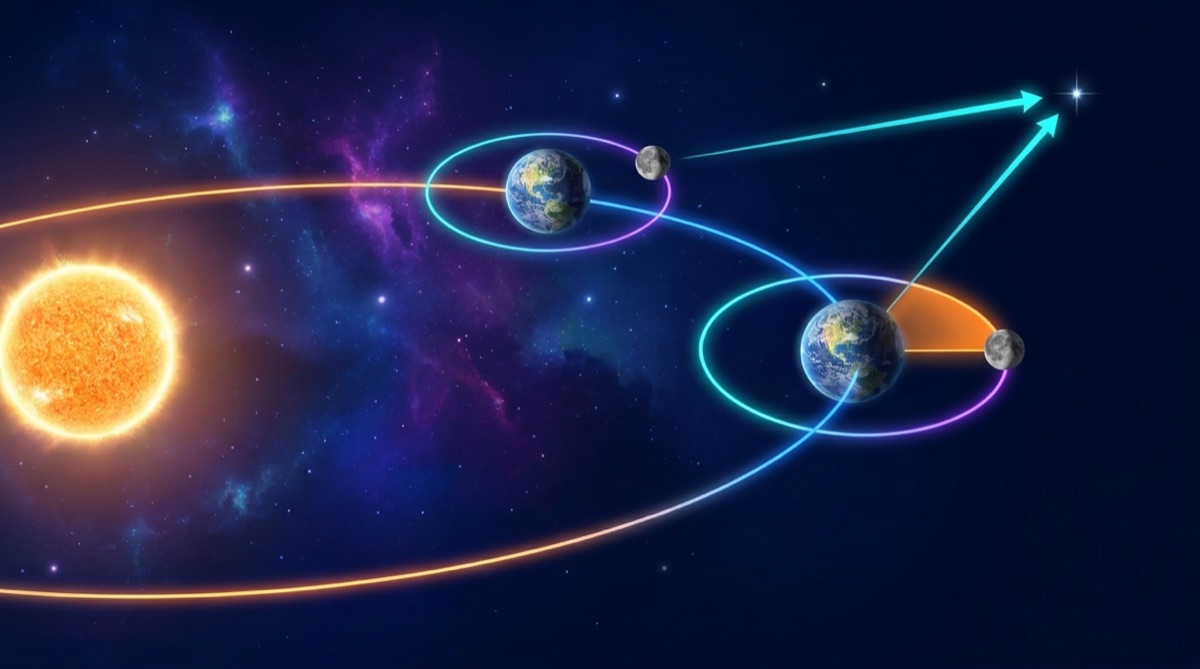
- Sidereal month : the time the Moon takes to return to the same position with respect to the stars: d (NASA).
- Synodic month : the time it takes to return to the same phase, that is, to the same position with respect to the Sun: d (Meeus).
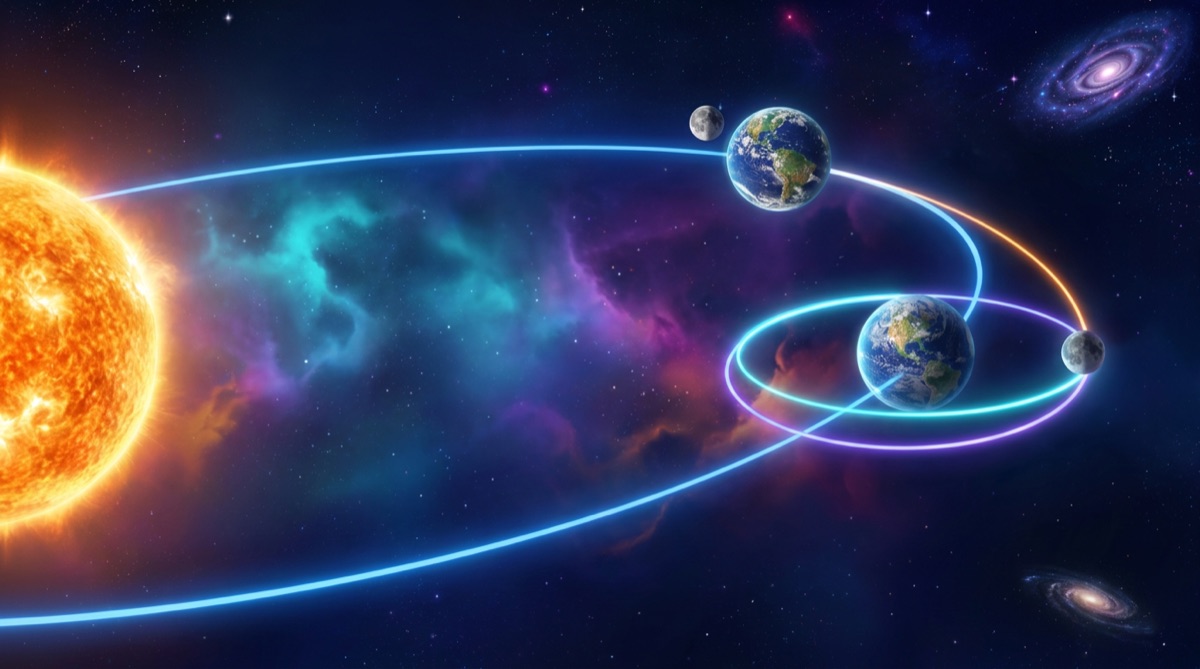
Why is greater than ? While the Moon makes one lap, the Earth moves along its orbit and the Sun appears to move eastward against the stars. The Moon has to “catch up” with it.
Derivation. Measured from the Earth, the Moon turns with angular velocity and the Sun with , where d is the sidereal year. The elongation grows at the relative velocity . A full cycle of phases occurs when the elongation increases by , in a time :
Solving for :
It is the same reasoning as with the hands of a clock: the minute hand catches up with the hour hand every h.
Check with one year: in 365.256 d the Moon makes laps with respect to the stars, but only cycles of phases. The difference, exactly one lap, is the one the Earth made around the Sun.
Worked example 2
If the Earth took 200 days to go around the Sun (with the same sidereal month), how long would the synodic month be?
5. Why are there no eclipses every month?
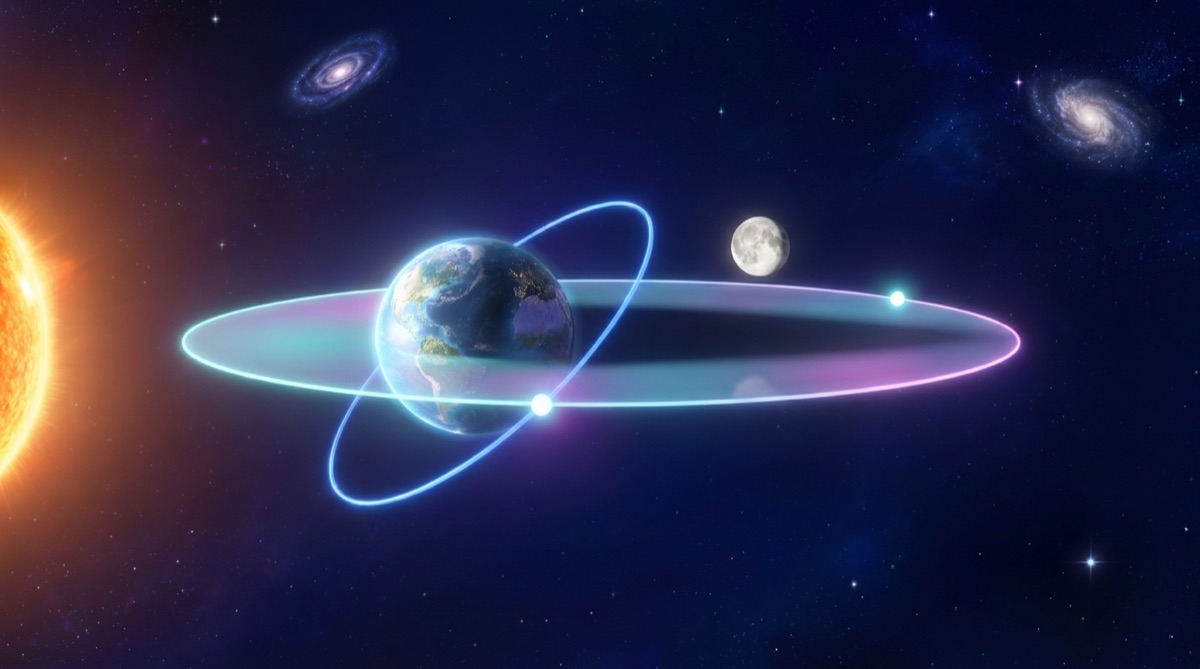
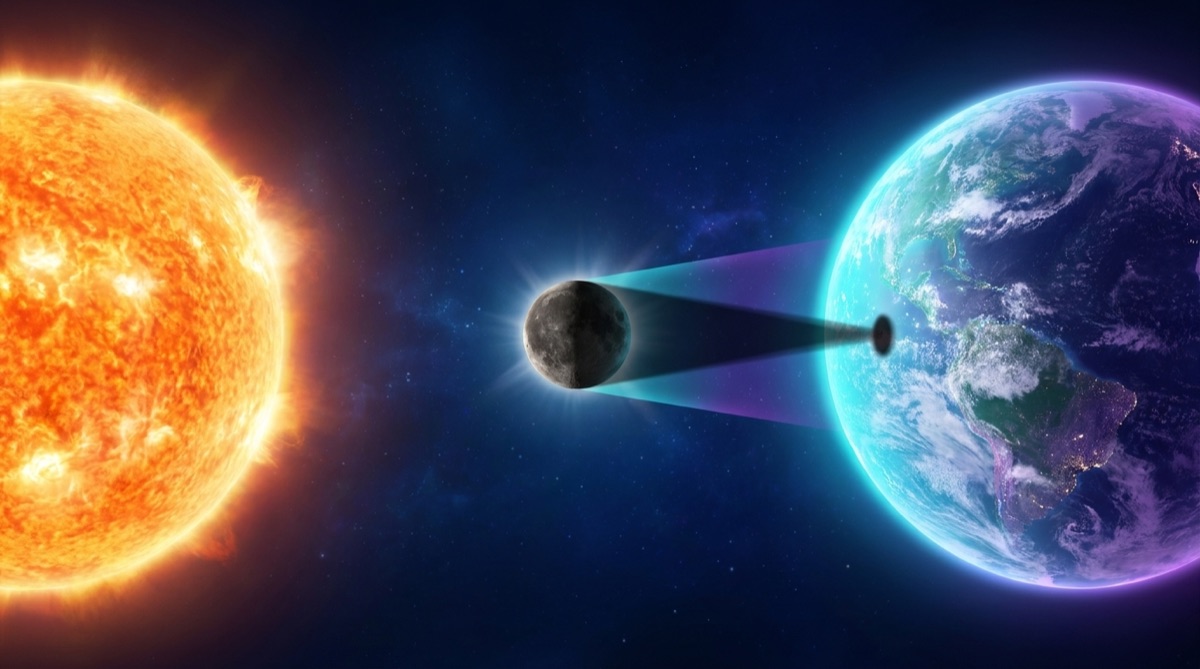
A solar eclipse occurs when the Moon passes in front of the Sun (only at new moon). A lunar eclipse, when the Moon enters the Earth’s shadow (only at full moon). If the lunar orbit lay in the plane of the Earth’s orbit (the ecliptic), we would have both every month.
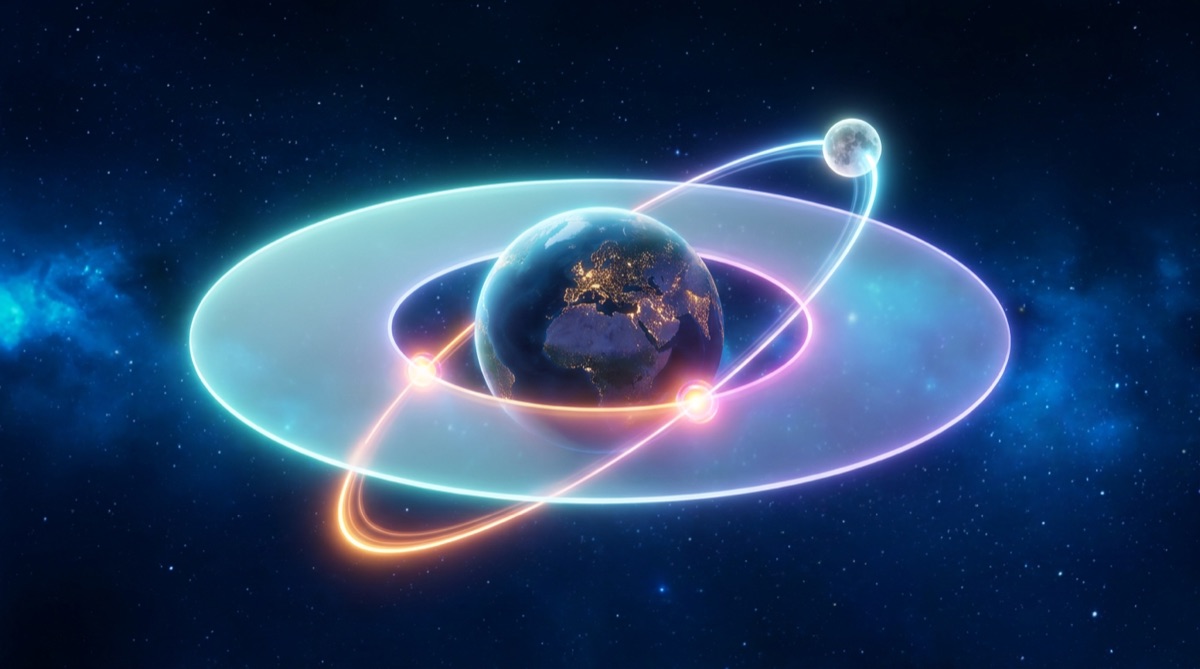
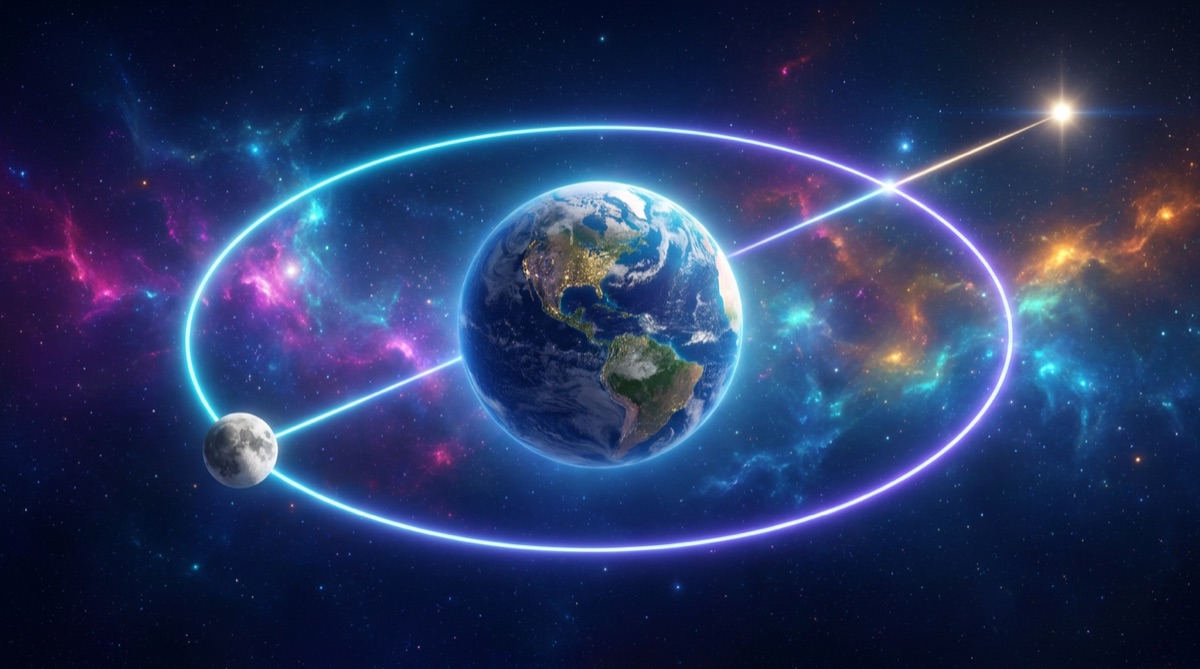
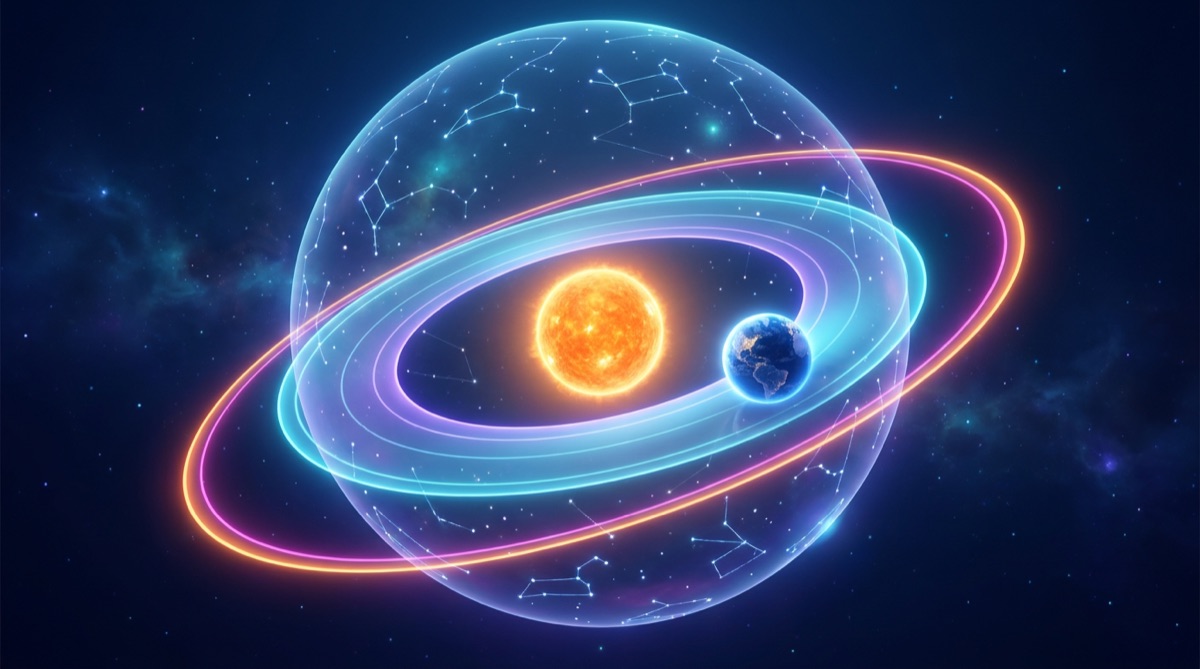
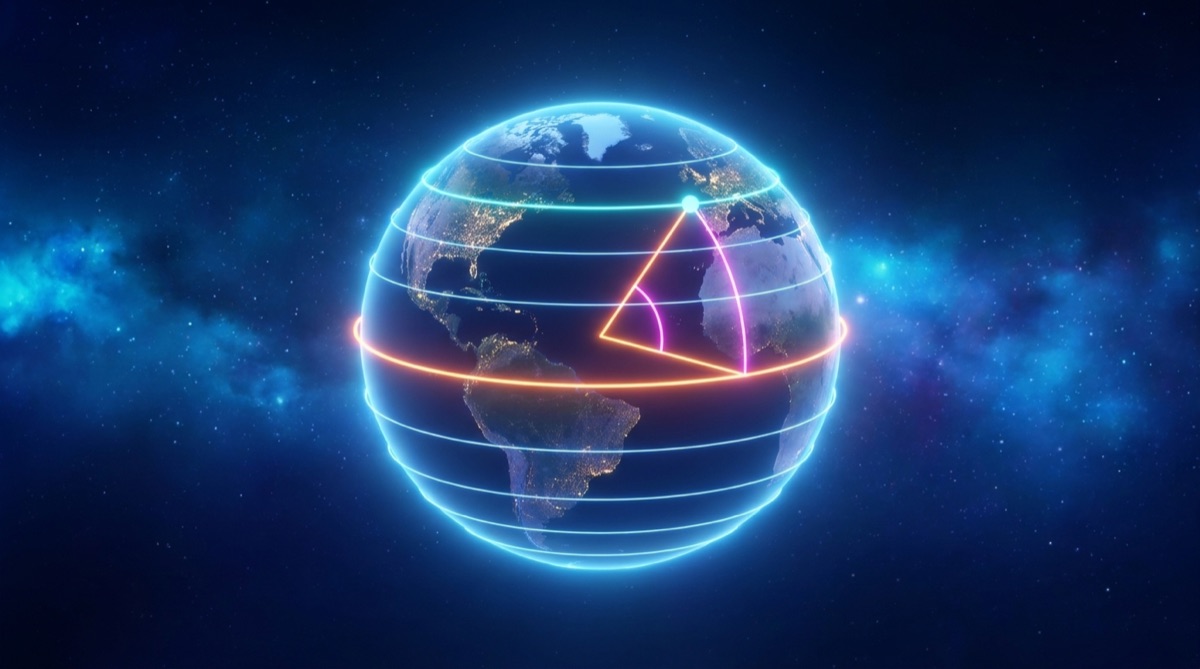
But the lunar orbit is tilted to the ecliptic. The two points where the orbit crosses the ecliptic are the nodes (ascending and descending); the line joining them is the line of nodes.
If is the angular distance of the Moon from the ascending node, measured along its orbit, spherical trigonometry gives the ecliptic latitude of the Moon (its height above the plane of the ecliptic):
Seen from the Earth, the Moon can pass up to above or below the Sun, about ten times its own apparent diameter ()! For an eclipse to occur, at new (or full) moon must be smaller than an eclipse limit, obtained by adding angular radii and parallaxes:
- solar eclipse (at least partial): ;
- umbral lunar eclipse: .
Substituting into for the solar limit:
The new moon has to fall within about 17° of a node. Since at new moon the Sun and the Moon have the same longitude, this means that the Sun must be near a node. That happens twice a year, in the eclipse seasons.
Data from the real model: at the new moon of April 8, 2024 (total solar eclipse visible in Mexico, the United States and Canada), . At the full moon of January 13, 2025, : the Moon passed well above the Earth’s shadow and there was no eclipse. Check it in the simulator with real date mode.
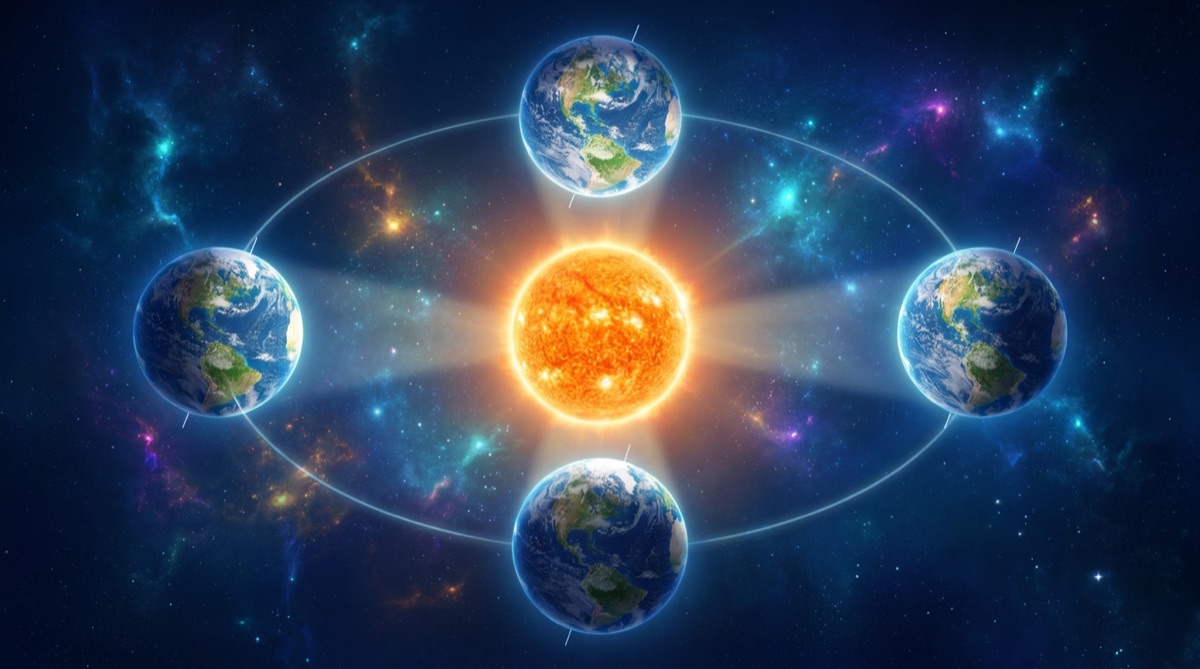
The line of nodes does not stand still: it regresses (nodal precession), completing one turn in about 18.6 years. That is why the eclipse seasons come about 19 days earlier each year: the eclipse year lasts about 346.62 d.
Eclipses visible from Colombia (2026–2029)
According to the NASA GSFC tables (Colombian time UTC ):
| Date | Type | Maximum (Colombian time) | How it looks from Colombia |
|---|---|---|---|
| Aug 27–28, 2026 | Partial lunar (magnitude 0.93) | 23:13 on the 27th | Already happened: almost the whole Moon in the umbra, visible across the country |
| Jan 11–12, 2028 | Partial lunar (magnitude 0.07) | 23:13 on the 11th | A small “bite” on the edge of the Moon |
| Jan 26, 2028 | Annular solar | 8:58 in Leticia, 8:57 in Bogotá | Annular in Leticia (ring from 8:53 to 9:02, about 9 and a half minutes; NASA’s central line passes a few kilometers from the city); partial in the rest of the country: magnitude 0.73 in Bogotá (the Moon covers 73% of the solar diameter), 0.69 in Medellín, 0.76 in Cali, 0.58 in Barranquilla. Only with a solar filter! |
| Jun 25–26, 2029 | Total lunar (magnitude 1.84) | 22:22 on the 25th | Moon high in the sky: full totality from all of Colombia |
| Dec 20, 2029 | Total lunar (magnitude 1.12) | 17:42 | The Moon rises already eclipsed at dusk |
The penumbral eclipses (Feb and Aug 2027) are almost imperceptible to the naked eye. The grade project consists precisely in predicting and verifying one of these eclipses.
6. The Saros cycle
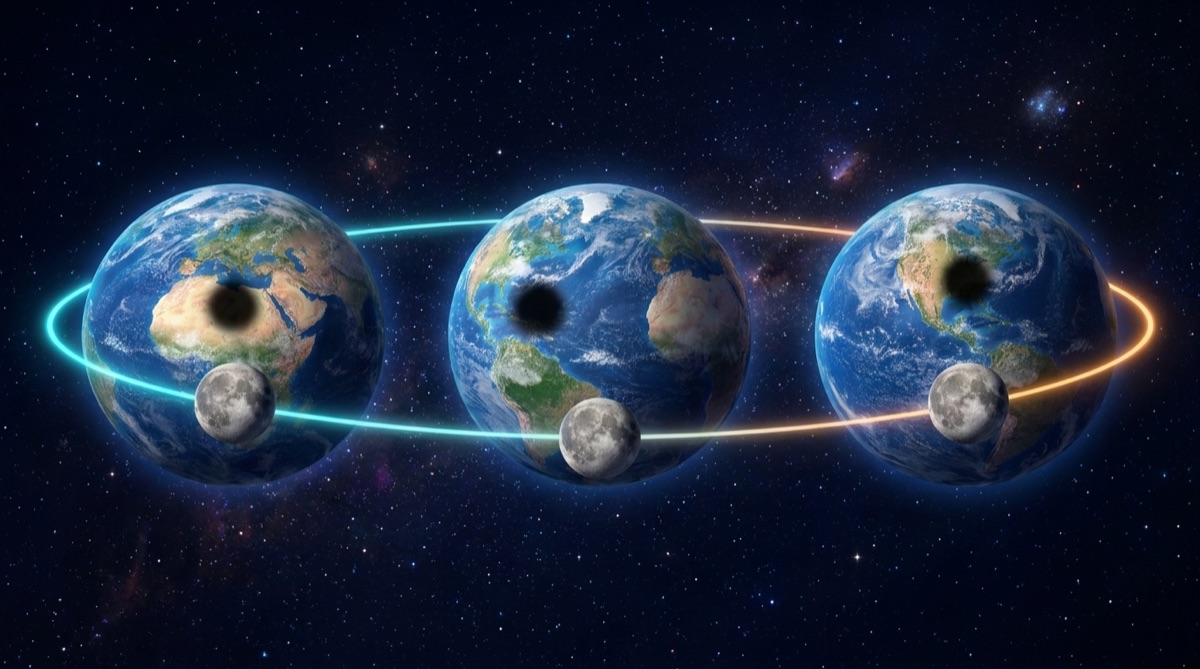
Eclipses repeat when three rhythms coincide:
| Period | Length (d) | Multiple | Total (d) |
|---|---|---|---|
| Synodic month (phase) | 29.530589 | 223 | 6585.32 |
| Draconic month (node to node) | 27.212221 | 242 | 6585.36 |
| Anomalistic month (perigee to perigee) | 27.554550 | 239 | 6585.54 |
After 223 synodic months = 6585.32 d (the Saros, ≈ 18 years and 11 days), the Moon is back at the same phase, almost at the same node and almost at the same distance. An eclipse repeats with very similar characteristics. The fraction d ≈ 8 h makes the Earth turn about more: the next eclipse of the series is seen about 116° farther west.
Activity: eclipses with a ball and a hoop
You need: a bare lamp (Sun), a ball about 10 cm across (Earth), a small 2.5 cm ball on a stick (Moon), a wire or cardboard hoop about 60 cm in diameter (lunar orbit), a protractor.
- Darken the room. Place the lamp about 3 m from the Earth, at the same height.
- Move the Moon around the Earth in the horizontal plane through the lamp. Observe: on each lap there is a new moon that blocks the lamp (solar eclipse on the Earth) and a full moon that enters the Earth’s shadow (lunar eclipse). With the orbit in the plane of the ecliptic there would be two eclipses a month.
- Now tilt the hoop 5° (measure with the protractor) from the horizontal, with the line of nodes pointing toward the lamp. Make one lap: are there eclipses? At which points of the orbit?
- Turn the hoop a quarter turn around the vertical axis (the line of nodes is now perpendicular to the direction of the lamp), without changing the tilt. Make another lap: does the Moon pass above or below the shadow? Measure with a ruler how far the full moon misses the Earth’s shadow.
- To simulate the year, the lamp “moves”: turn the hoop 90° every three months. Count how many times a year the line of nodes points at the lamp.
Final question: with the real tilt of and the Moon at 384 400 km, how far can the Moon stray from the plane of the ecliptic in kilometers? (Hint: use .) Compare it with the radius of the Earth.
Exercises
Basic level
- Calculate for . Is proportional to ?
Show solution
. It is not proportional: it depends on the cosine.
- One night the Moon is from the Sun. What percentage of the disk is illuminated?
Show solution
, : 25% (waxing or waning crescent).
- How many synodic months are there in a year? Why does the 12-month calendar not match the phases exactly?
Show solution
synodic months. Twelve lunations last d, about 11 days less than the year: that is why the phases shift about 11 days each year with respect to the calendar.
Intermediate level
- Prove that and that, for close to (very thin Moon), with in radians.
Show solution
With we get . If , , so .
- If the Earth took 200 days to go around the Sun (with the same sidereal month, 27.32 d), how long would the synodic month be? And if it took only 27.32 days?
Show solution
d. If , : the Moon would never change phase (always the same position with respect to the Sun).
- Use to find how far from the node the full moon must be for an umbral lunar eclipse ( less than ).
Show solution
.
Challenge level
- The Sun moves away from the node at a rate of . With on each side of the node, how long does a solar eclipse season last? Can there be a season without a solar eclipse?
Show solution
The window spans ; at the Sun takes d to cross it. Since d is more than d, in every season at least one new moon falls inside: there is always at least one solar eclipse (sometimes two, partial ones).
- The total eclipse of April 8, 2024 occurred around 18:18 UTC. Add one Saros and predict the date of the next eclipse of the series.
Show solution
d = 18 years (with 4 leap days: 2028, 2032, 2036, 2040) + 11.32 d. From 2024-04-08 18:18 UTC to 2042-04-08 there are d; d ≈ 11 d 8 h remain: April 20, 2042, around 02 h UTC. (Indeed, the NASA tables list a total solar eclipse on April 20, 2042, of the same Saros series.)
- The lunar eclipse of August 27–28, 2026 had umbral magnitude 0.93. Add one Saros and give the date and approximate time (UTC) of the next one in the series. Will it be visible from Colombia? Reason with the westward shift.
Show solution
UTC d. Leap years between 2027 and 2044: 2028, 2032, 2036, 2040, 2044 (5 days) → 18 years d; d remain: September 7, 2044, around 12 h UTC (7 h Colombian time). At that time it is daytime in Colombia (the Moon is below the horizon): the eclipse will be seen farther west, over Asia and the Pacific. A lunar eclipse is visible from the entire night hemisphere, so the 8 h shift decides who sees it.
✦ Mini-quiz
Key takeaways
- The Sun always illuminates half the Moon; the phase is the part of that half that we see: .
- Sidereal month d (with respect to the stars); synodic month d (with respect to the Sun): .
- The lunar orbit is tilted 5.145°: there is an eclipse only if the new or full moon falls within about 17° (solar) or 11° (lunar) of a node.
- Two eclipse seasons a year, which come 19 days earlier each year.
- Saros: 6 585.32 d = 223 synodic months; the eclipse repeats 116° farther west.
- Next ones from Colombia: annular in Leticia on January 26, 2028; total lunar on the night of June 25, 2029.
🍎 Teacher guide
- Time
- 3 sessions of 55 min
- Colombian national standard (MEN)
- Mathematics, Grades 8 to 9: “I use geometric representations to solve and formulate problems in mathematics and in other disciplines”; “I conjecture and verify properties of congruence and similarity between two-dimensional figures and between three-dimensional objects in solving problems”; “I identify relations between properties of graphs and properties of algebraic equations”. Natural Sciences, Grades 8 to 9: “I propose models to predict the results of my experiments”; “I use mathematics as a tool to model, analyze and present data”; “I recognize that scientific models change over time and that several can be valid simultaneously”.
- Evidence of learning
- Explains the phases and the two types of eclipse with the lamp–ball model, calculates k for a given phase angle, solves 1/S = 1/P − 1/E for one of the variables, and explains with the 5.145° tilt and the nodes why a given month had no eclipse (challenge for the “Eclipse Hunter” badge).
Materials
- Bare lamp, 10 cm ball, small ball on a stick, 60 cm wire or cardboard hoop
- Protractor and ruler
- Scientific calculators (cosine and sine)
- Computer or tablet with the simulator
- NASA GSFC eclipse table, printed or on screen
Suggested sequence
Session 1. Phases (55 min). Opening: the hook question. Development: sections 1 and 2 with the lamp and the ball; section 3 only up to the formula and its checks (the derivation with the ellipse can be left as reading for those who want to go deeper); example 1 and simulator challenge 1; exercises 1 and 2. Closing: table of illuminated fractions for and its graph.
Session 2. The two months (55 min). Opening: the clock analogy (minute hand and hour hand). Development: derivation of , check with the year, example 2 and exercises 3 and 5. Closing: exercise 4 as a challenge.
Session 3. Eclipses (55 min). Opening: tilted-hoop activity (steps 1 to 4). Development: section 5 (nodes, limits, seasons) and simulator challenges 2 and 3; table of upcoming eclipses visible from Colombia; Saros and exercise 8. Closing: mini-quiz. Grade project: each group chooses an eclipse from the table, calculates its local time, finds out the altitude of the Moon or the Sun at that moment (lesson on celestial coordinates) and prepares the observation.
Note on the data. The local circumstances of the 2028 annular eclipse were computed with the Besselian elements published by NASA GSFC (F. Espenak) and agree with its path table: the central line passes 4°10′ S, 69°50′ W at 13:58 UT, that is, over Leticia. The times may vary by a few seconds depending on the lunar limb profile; it is advisable to repeat the calculation with NASA GSFC’s Javascript Solar Eclipse Explorer before planning an outing.
Common mistakes
- Believing that the phases are the Earth's shadow on the Moon. Show with the lamp that the Earth's shadow only touches the Moon during a lunar eclipse.
- Thinking that the “quarter” is a quarter of the disk. Use ½ of ½ with the ball.
- Assuming that the sidereal and synodic months are the same. Do the check with one year: 13.37 laps versus 12.37 cycles.
- Believing that there is always a solar eclipse at new moon. Tilt the hoop 5° and see that the Moon passes above or below the Sun most months.
- Looking at a solar eclipse without protection. Insist on certified filters or projection; never sunglasses or X-ray film.