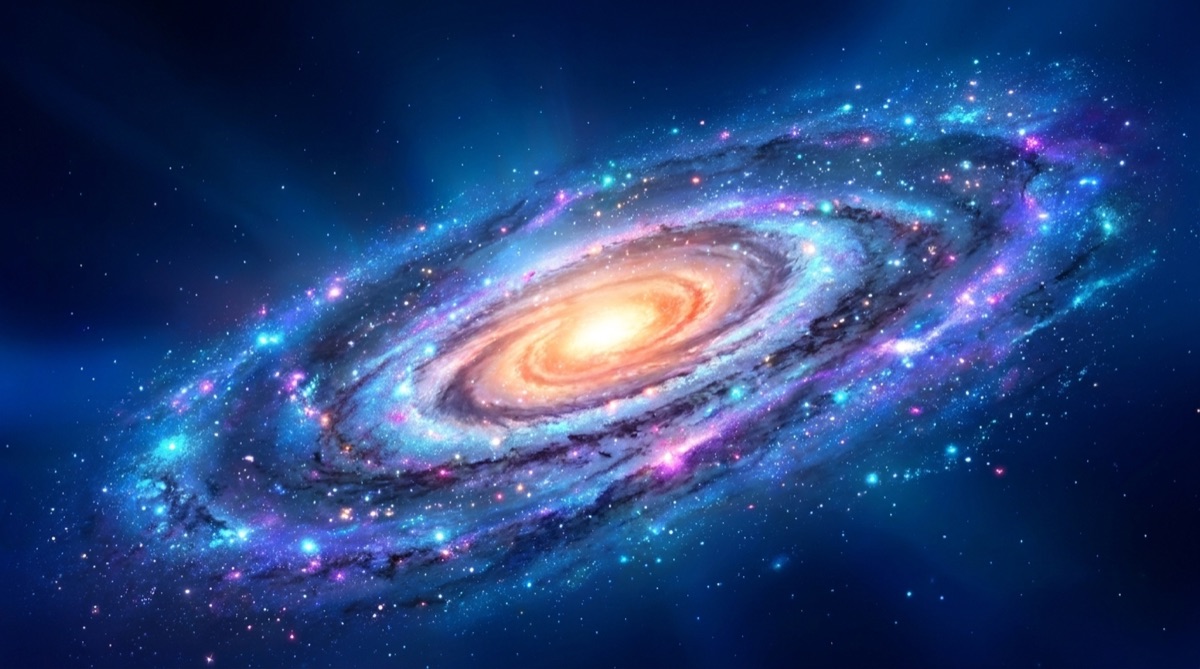
On a moonless night in June or July, in the Tatacoa Desert (Huila, Colombia), a band of pale light crosses the sky from side to side and passes almost through the zenith. The Muisca and the ancient Greeks saw it just the same; the Greeks called it galaxías kýklos, “circle of milk”, and that is where galaxy comes from. That band is our own galaxy seen from the inside: a disk of a hundred billion stars in which the Sun is just one more grain. In this lesson we are going to put numbers on it, and use them to discover that most of the galaxy cannot be seen.
1. The Milky Way from the inside
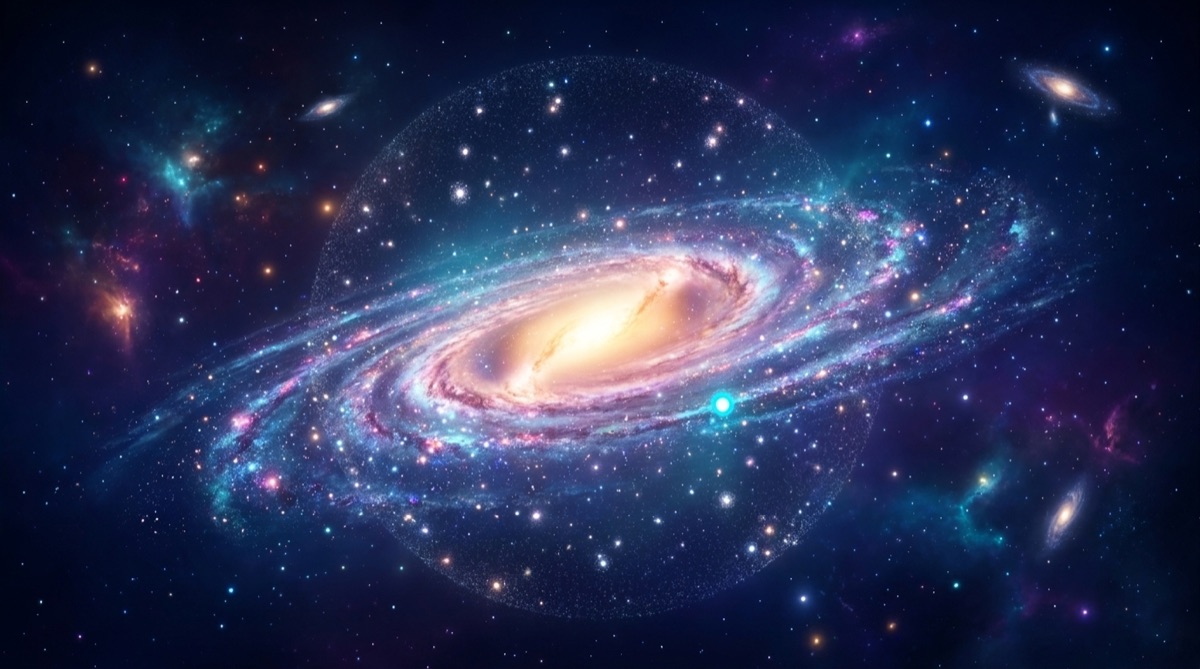
We live in a flat disk. When we look along the disk we see an enormous number of stars piled up: the band. When we look perpendicular to the disk we see few. The parts of the galaxy are:
- The disk: about 30 kpc across (≈ 100 000 light-years) and barely 0.3 kpc thick (≈ 1000 light-years): the proportions of a CD. It contains gas, dust and the young stars, organized in spiral arms. The Sun is in it, kpc from the center (26 700 light-years), close to the midplane.
- The central bulge, elongated into a bar: old, yellowish stars. It is what makes the band so wide and bright in the constellation Sagittarius.
- The center, in Sagittarius: a black hole of , Sagittarius A*, whose mass was measured by following the orbits of stars around it.
- The halo: a faint sphere of old stars and some 150 globular clusters that envelops the disk. And, as we will see, a much larger halo of dark matter.
The center of the galaxy has declination −29°, so it culminates at an altitude of , where is the latitude of the place. From London (latitude 51.5° N), its maximum altitude above the horizon is 9°. It is an advantage of living near the equator or in the southern hemisphere: from Europe it never rises above 20–30°.
Orders of magnitude
Galactic astronomy is the art of orders of magnitude: a well-placed power of 10 is worth more than three misplaced decimals. This is the Milky Way’s data sheet:
| Quantity | Value | In scientific notation |
|---|---|---|
| Number of stars | 100 to 400 billion | to |
| Diameter of the stellar disk | 100 000 light-years ≈ 30 kpc | km |
| Thickness of the thin disk | ≈ 1000 light-years ≈ 0.3 kpc | km |
| Sun–center distance | 8178 pc ≈ 26 700 light-years | km |
| Speed of the Sun around the center | 229 km/s | km/s |
| Orbital period of the Sun | ≈ 220 million years | years |
| Mass in stars | ≈ 50 billion suns | |
| Total mass (with dark matter) | ≈ 1 trillion suns | |
| Mass of the central black hole | 4.3 million suns |
Worked example 1: how do we know there are 10¹¹ stars? Nobody has counted them. The mass in stars of the disk and the bulge is measured (≈ , from their light and from how they move) and divided by the typical mass of a star. Most are red dwarfs of 0.2–0.5 : with an average of 0.5 , . If the average were 0.2, we would get . That is why we say “between one hundred and four hundred billion”: the order of magnitude, , is what is well established.
Worked example 2: the galactic year. The Sun travels a circle of radius pc at km/s. With km,
About 220 million years (220–240 are usually quoted, depending on the adopted values of and ). Since it was born, 4567 million years ago, the Sun has completed orbits. The last time it was at this point of its orbit, the dinosaurs were beginning to dominate the Earth.
Worked example 3: the galaxy to scale. If the Sun (diameter m) were a grain of sand 1 mm across, the scale would be 1 mm for every m. Proxima Centauri, at 1.30 pc m, would be mm km away, like from Bogotá to Zipaquirá. And the disk of the galaxy, m, would measure mm km, almost twice the Earth–Moon distance. Galaxies are, above all, empty space: grains of sand separated by tens of kilometers.
2. A zoo of galaxies: the Hubble types
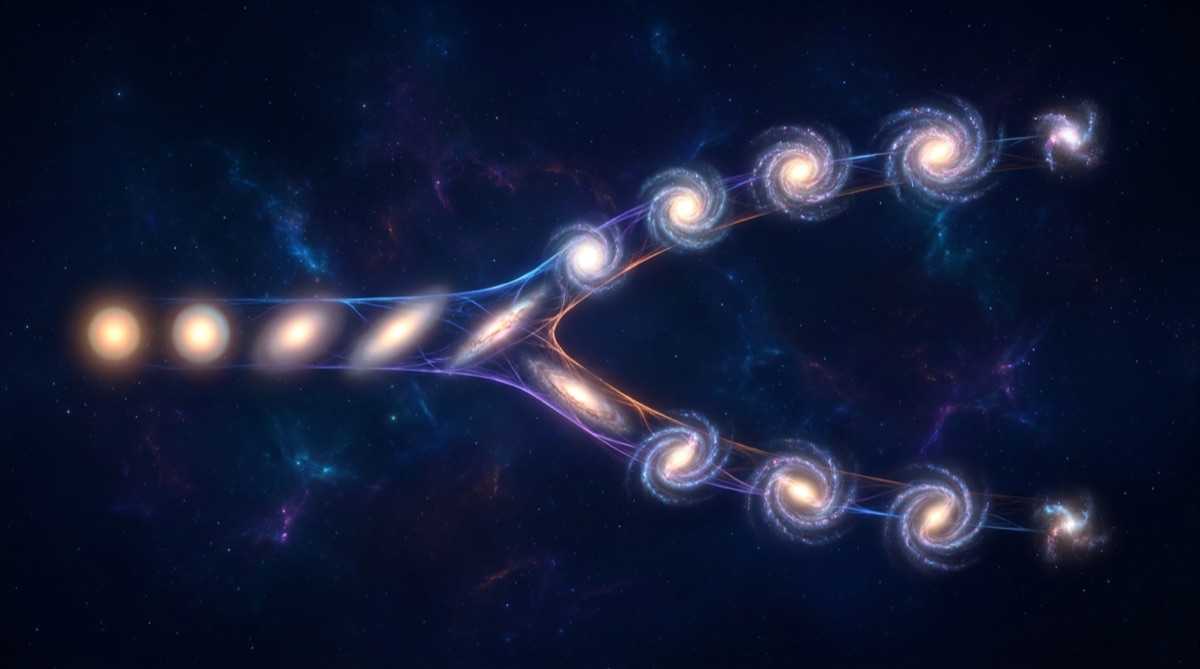
Until 1924 nobody knew whether the “spiral nebulae” were part of the Milky Way or other island universes. Edwin Hubble settled the question by measuring the distance to Andromeda with Cepheid stars, and in 1926 he proposed a classification that is still in use:
- Ellipticals (E0–E7): balls or footballs of old stars, with no gas and no arms; the number indicates how flattened they look (E0 round, E7 very elongated). They range from dwarfs to giants like M87, in the Virgo Cluster.
- Spirals (Sa, Sb, Sc): a disk with arms and a central bulge. From Sa to Sc the bulge is smaller and the arms more open. Andromeda (M31) is an Sb.
- Barred spirals (SBa, SBb, SBc): the same, but the arms emerge from the ends of a bar that crosses the center. The Milky Way is a barred spiral.
- Irregulars (Irr): no definite shape, rich in gas and young stars. The Magellanic Clouds, visible from the southern hemisphere and from tropical latitudes (in Colombia, from the south of the country), are the classic example (the Large Cloud actually has a bar, halfway to the SB types).
Hubble drew the classes as a tuning fork: the handle with the ellipticals and two prongs with the normal and the barred spirals. He himself warned that it was not an evolutionary sequence, and today we know it runs opposite to what the drawing suggests: many ellipticals are the result of collisions between spirals.
3. The neighborhood: the Local Group
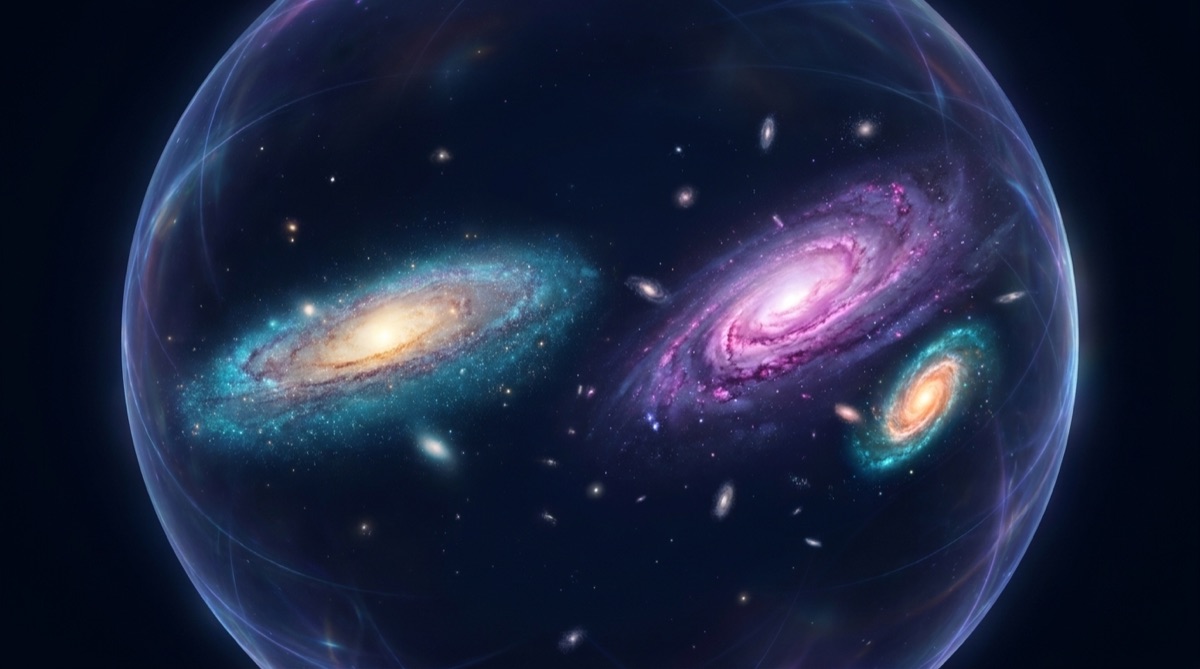
The Milky Way is not alone. It belongs to the Local Group, with more than a hundred known galaxies within a radius of 3 Mpc, almost all of them dwarfs. The two big ones are the Milky Way and Andromeda (M31), somewhat larger than ours:
| Galaxy | Type | Distance | Note |
|---|---|---|---|
| Large Magellanic Cloud | Irregular (with a bar) | 49.6 kpc ≈ 162 000 light-years | satellite of the Milky Way; from London its maximum altitude is never rises; best seen around January |
| Andromeda (M31) | Spiral Sb | 785 kpc ≈ 2.5 million light-years | the nearest large galaxy; visible to the naked eye under dark skies as an elongated smudge |
(The third largest is the Triangulum Galaxy, M33, an Sc spiral next to Andromeda.)
Worked example 4: the light from Andromeda. light-years. The light you see today left Andromeda 2.5 million years ago, when the first Homo lived in Africa. It is the most distant thing the human eye can see.
Andromeda is approaching: its spectrum shows a blueshift of −301 km/s relative to the Sun (lesson Spectra and the Doppler effect), which, after subtracting the Sun’s motion within the Milky Way, amounts to about −110 km/s between the two galaxies. Models predict a first close encounter in about 4.5 billion years; if Andromeda’s sideways velocity (measured with Gaia) is small, the two will end up merged into a large elliptical. A 2025 analysis that includes the Large Magellanic Cloud and M33 gives a merger probability close to 50 % within the next 10 billion years: it is not settled yet.
4. The galaxy rotates: the rotation curve
In the Solar System almost all the mass is in the Sun, and the planets orbit according to Newton’s gravity:
where is the orbital speed, the radius of the orbit, the central mass and . Mercury (0.39 au) moves at 47.4 km/s and Neptune (30 au) at 5.4 km/s: multiplying the distance by 77, the speed drops by times. This is the Keplerian fall-off.
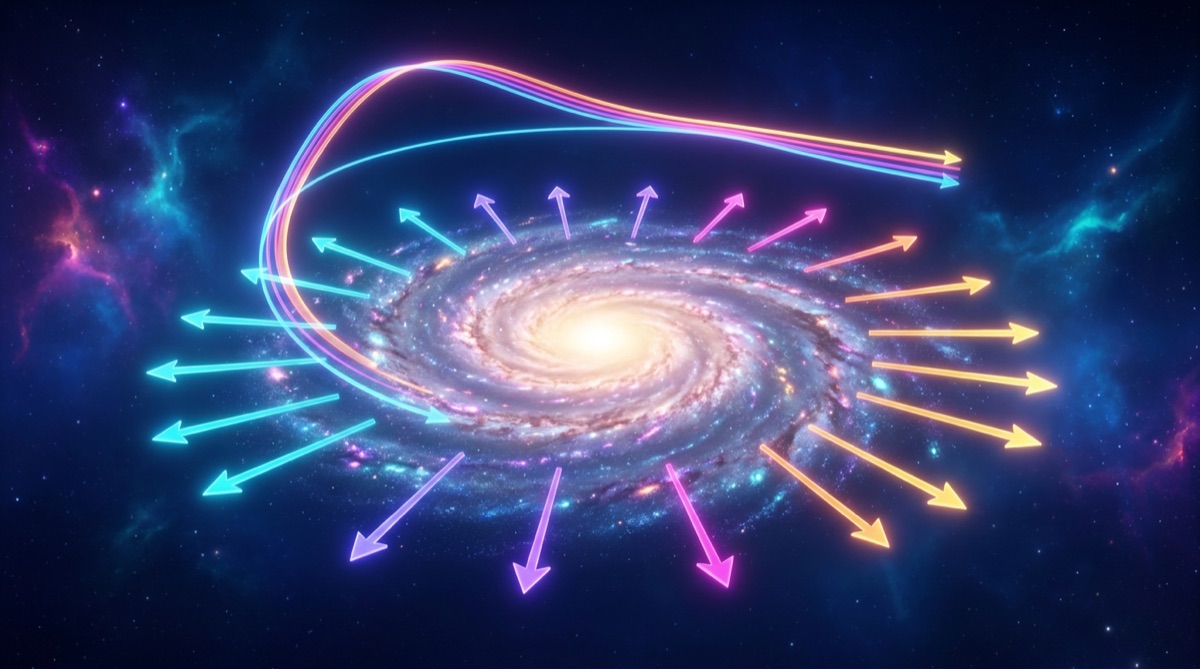
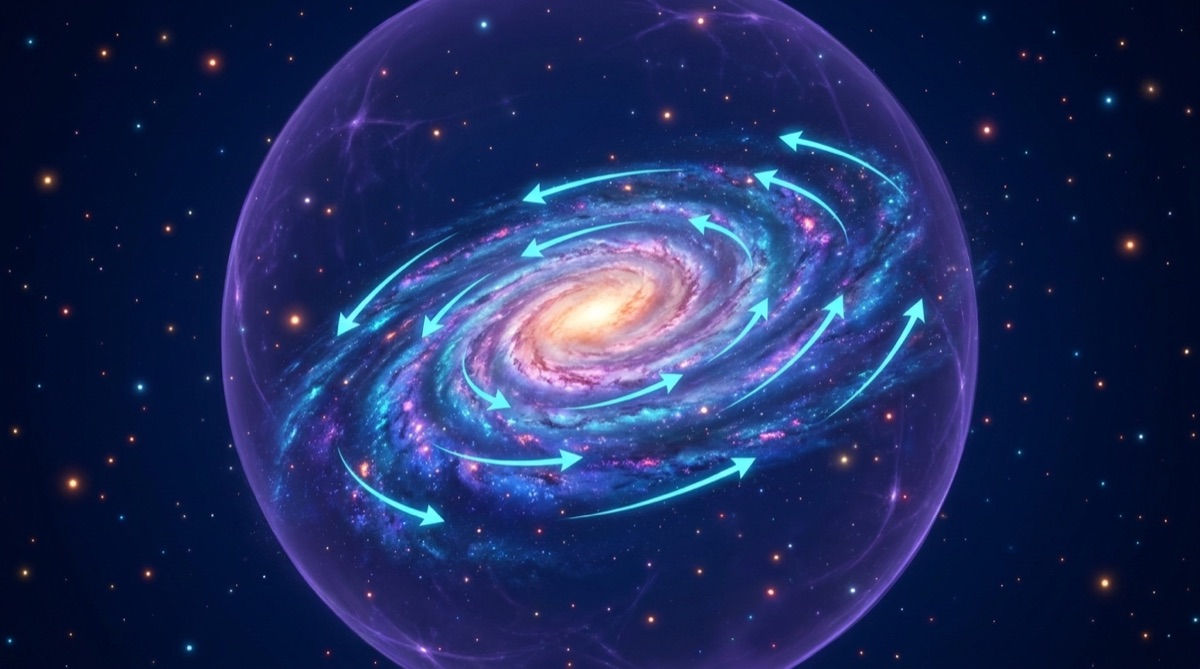
If the mass of the Milky Way were where its light is (concentrated in the bulge and the inner disk), the distant stars should move slower and slower. What is measured with the Doppler effect is something else: from 5 to 25 kpc the speed stays almost constant, around 200–230 km/s, dropping by barely 1.7 km/s per kpc. It is a flat rotation curve. Vera Rubin and Kent Ford found it in Andromeda in 1970 and then in dozens of spirals.
Weighing the galaxy with the curve
Solving the equation above for , the mass enclosed within a radius is
Worked example 5: the mass inside the Sun’s orbit. km/s m/s, m:
Worked example 6: at 25 kpc. There km/s and m:
If the mass were a point mass (all of it inside the Sun’s orbit), at 25 kpc the speed would have dropped to km/s. But it moves at 200. Between 8 and 25 kpc the enclosed mass has more than doubled, in a region where there are almost no stars or gas: a constant requires . That mass that does not shine is the dark matter. For the whole galaxy, the dark halo weighs of the order of , ten times more than all the stars put together. And it is not a local quirk: according to the measurements of the cosmic background (Planck 2018), of every six kilograms of matter in the universe, five are dark.
We do not know what it is. We know what it is not: it is not dead stars, nor gas, nor dust in sufficient quantity (they have been searched for). The most studied hypothesis is a new particle that neither emits nor absorbs light. Until it is detected, the flat rotation curve remains the most direct evidence, and the one any student can understand with .
Simulator: building the rotation curve
The simulator computes the circular velocity of the Milky Way by adding three components (bulge, disk and dark-matter halo) and compares it with the measurement by Eilers et al. (2019), shown as a dashed line.
- Keep the Milky Way with halo model. Read the velocity at the Sun’s position and at 25 kpc (they are in the description of the plot) and compare them with examples 5 and 6.
- Switch to Visible matter only (bulge + disk). What happens to the curve beyond 10 kpc? Does it look like the data?
- Switch to Point mass: Keplerian curve and check that the velocity falls as : read at 5 kpc and at 20 kpc; the ratio must be .
- Go back to the model with halo and move the virial mass of the halo: how much is needed to reproduce the 200 km/s at 25 kpc?
- In the top view, watch the row of marked stars: since they all move at almost the same linear speed, the inner ones complete their orbit sooner and the row winds up. This is differential rotation, the reason why spiral arms cannot be “fixed rows” of stars.
- total (quadrature)
- bulge (Hernquist)
- exponential disk
- halo NFW
- Keplerian v ∝ R^−½ from R☉
- Eilers et al. 2019 (5–25 kpc)
Activity: counting the stars of the Milky Way with a tube
Counting every visible star one by one is impossible; sampling and multiplying is not. It is the same idea used to estimate the stars of the galaxy.
You need:
- a moonless night and a dark site (ideally a sky like that of La Tatacoa, a páramo or a farm in the countryside; in the city it works worse, but comparing sites is part of the experiment);
- a cardboard toilet-paper tube (about 10 cm long and 4 cm in diameter), a ruler;
- a flashlight with red light (red cellophane over an ordinary flashlight), a notebook and a pencil;
- 20 minutes of patience for your eyes to adapt to the dark (without looking at your phone).
- Measure the length and the diameter of the tube. The tube shows a “patch” of sky whose fraction of the visible hemisphere is . With cm and cm: .
- Once your eyes have adapted, point the tube in 10 directions spread across the sky (zenith, the four cardinal points at mid altitude, four in between, one more at random) and count the stars you see in each patch. Also note whether the patch falls on the band of the Milky Way.
- Compute the average of stars per patch and multiply it by 50 (or by with your measurements): that is your estimate of the stars visible above the horizon. Under a very dark sky you will get between 1500 and 3000; in a city, a few dozen.
- Compare the patches on the band with those off it: how many times more stars do they have? That difference is the disk seen edge-on.
- If no dark sky is available, repeat the count with a planetarium program (Stellarium, free) with the horizon of your town and different levels of light pollution.
Final question: your count gives a few thousand stars and the galaxy has . What fraction do you see? Express the result as a power of 10 and explain which two reasons (distance and brightness, and dust in the disk) make the rest invisible.
Exercises
Basic level
- Convert the distance from the Sun to the Galactic center, 8178 pc, to light-years and to kilometers (1 pc = 3.2616 light-years km).
Show solution
light-years; km.
- How long does light take to cross the disk of the Milky Way from side to side? And to go through it from top to bottom, across its thickness?
Show solution
Diameter: 100 000 light-years → 100 000 years. Thickness: 1000 light-years → 1000 years. If a star on the other side of the disk exploded today, we would find out in a thousand centuries.
- Write in scientific notation how many times more stars the galaxy has () than Colombia has inhabitants ().
Show solution
: almost two thousand stars for every Colombian.
Intermediate level
- Repeat example 2 with kpc and km/s, the values used in the 1990s. How much does the period change? How many “orbits” has the Sun completed with each pair of values?
Show solution
s years (hence the “230–240 million” of many books). Orbits: versus 21. The order of magnitude does not change.
- In Andromeda, the rotation curve gives km/s at kpc. Compute the enclosed mass in .
Show solution
m; kg within 30 kpc.
- If all the mass of the Milky Way were inside 8.2 kpc, how fast would a star orbit at 50 kpc? Compare with the ≈ 200 km/s measured for distant satellites and globular clusters.
Show solution
km/s. Measuring ~200 km/s requires the mass within 50 kpc to be times the mass inside the Sun’s orbit: more dark matter.
Challenge level
- Estimate the density of stars in the disk: stars in a cylinder of radius 15 kpc and thickness 0.3 kpc. Express the result in stars per pc³ and compute the mean separation between stars, . Compare with the distance to Proxima Centauri (1.30 pc).
Show solution
; ; pc. Of the order of the distance to Proxima: the Sun sits in a typical neighborhood of the disk (actually a somewhat less dense one, because the stars concentrate toward the center).
- Andromeda is 785 kpc away and approaching at 110 km/s. If the velocity were constant, when would it arrive? Models give about 4.5 billion years for the first encounter. Why less than your calculation?
Show solution
s years. The mutual gravity accelerates the fall: the velocity grows with time and the trip takes less (about 4.5 billion years). The constant-velocity calculation is only an upper bound.
- In a dwarf galaxy of the Local Group, the stars located 1 kpc from the center orbit at 10 km/s. Compute and compare it with the mass of all the visible stars of the dwarf, . (The dwarf galaxies of the Local Group are the most dark-matter-dominated objects known.)
Show solution
m; kg : about 20 times the mass in stars. In the most extreme dwarfs the ratio exceeds 100.
✦ Mini-quiz
Remember
- Milky Way: a disk ~30 kpc across (100 000 light-years) and ~0.3 kpc thick, a bulge with a bar, a halo; stars, in stars and in total. It is a barred spiral.
- The Sun is at kpc (26 700 light-years), moves at 229 km/s and completes one orbit every ≈ 220 million years: about 21 since it was born.
- Hubble types: ellipticals E0–E7, spirals Sa–Sc, barred SBa–SBc, irregulars. It is not an evolutionary sequence.
- Local Group: Andromeda (Sb) at 785 kpc = 2.5 million light-years, approaching at ~110 km/s; Large Magellanic Cloud at 49.6 kpc.
- Flat rotation curve ⇒ : dark matter, ~5/6 of the matter in the universe.
🍎 Teacher guide
- Time
- 3 sessions of 55 min + one night outing
- Colombian national standard (MEN)
- Mathematics, Grades 8 to 9: “I use scientific notation to represent measurements of quantities of different magnitudes”; “I identify and use exponentiation, roots and logarithms to represent mathematical and non-mathematical situations and to solve problems”; “I identify relationships between properties of graphs and properties of algebraic equations”; “I generalize valid calculation procedures to find the area of plane regions and the volume of solids”. Natural Sciences, Grades 8 to 9: “I use mathematics as a tool to model, analyze and present data”; “I record my observations and results using diagrams, graphs and tables”; “I recognize that scientific models change over time and that several may be valid at the same time”; “I communicate the inquiry process and its results using graphs, tables, arithmetic and algebraic equations”. Natural Sciences, Grades 6 to 7 (revisited): “I explain the planetary model in terms of gravitational forces”.
- Evidence of learning
- Expresses the dimensions, masses and times of the Milky Way in scientific notation and converts them between pc, light-years and km; computes the orbital period of the Sun and the enclosed mass with M = v²R/G; classifies galaxies with the Hubble scheme; argues with the simulator and with the calculation at 25 kpc why a flat rotation curve requires dark matter; estimates the number of visible stars by sampling with the tube.
Materials
- Cardboard tube, ruler, red flashlight and notebook (per group)
- Scientific calculator
- Computer or tablet with the galactic rotation simulator and, optionally, Stellarium
- Printed images of M87, M31, NGC 1300 and the Large Magellanic Cloud to classify
Suggested sequence
Session 1. The Milky Way in numbers (55 min). Hook with the photo of the Milky Way over La Tatacoa (5 min). Structure and orders-of-magnitude data sheet; examples 1 and 3 in groups (25 min). Galactic year (example 2) with unit conversion (15 min). Exercises 1–3 (10 min).
Session 2. Other galaxies (55 min). Classify four printed images before seeing the Hubble scheme, then compare (20 min). Local Group, Andromeda and its light (example 4) (15 min). Exercises 4 and 8 (20 min).
Session 3. The rotation curve (55 min). Kepler in the Solar System (Mercury/Neptune) and the expectation (10 min). Examples 5 and 6 with the calculator (15 min). Simulator, challenges 1–4 (20 min). Mini-quiz (10 min). Challenges 7 and 9 as homework.
Night outing (1 h, with parents or guardians). Count with the tube; if not possible, Stellarium in class. Deliverable: table of the 10 patches, total estimate and band/off-band comparison.
Common mistakes
- Believing that the band of the Milky Way is "something else" apart from our galaxy, or that the Sun is at the center. Draw the disk edge-on with the Sun at 8 kpc and explain the band as perspective.
- Confusing light-year (distance) with year (time). Exercise 2 and question 6 of the mini-quiz.
- Treating the figures (10¹¹ stars, 100 000 light-years) as exact. Insist on the order of magnitude and on example 1: the 10¹¹ is established, the factor 1–4 is not.
- Thinking that dark matter is an assumption without evidence. The calculation M = v²R/G at 8 and at 25 kpc is the evidence; what is unknown is its nature, not its existence.
- Reading the Hubble tuning fork as a timeline (elliptical → spiral). Make clear that it is a classification by shape.