At the pier in Buenaventura, on Colombia’s Pacific coast, the sea rises and falls more than four meters during the big tides: the boats that wake up afloat are sitting on the mud by noon. In Cartagena, 600 km away in a straight line, the tide barely moves the water half a meter, and when it exceeds 23 cm above the reference level there is already flooding in Manga and Bocagrande. The cause of both is the same, the Moon, and the explanation fits in a subtraction of fractions. But careful: the tide is not due to the Moon pulling on the water. It is due to the Moon pulling on it unequally.
1. The key idea: gravity is not uniform
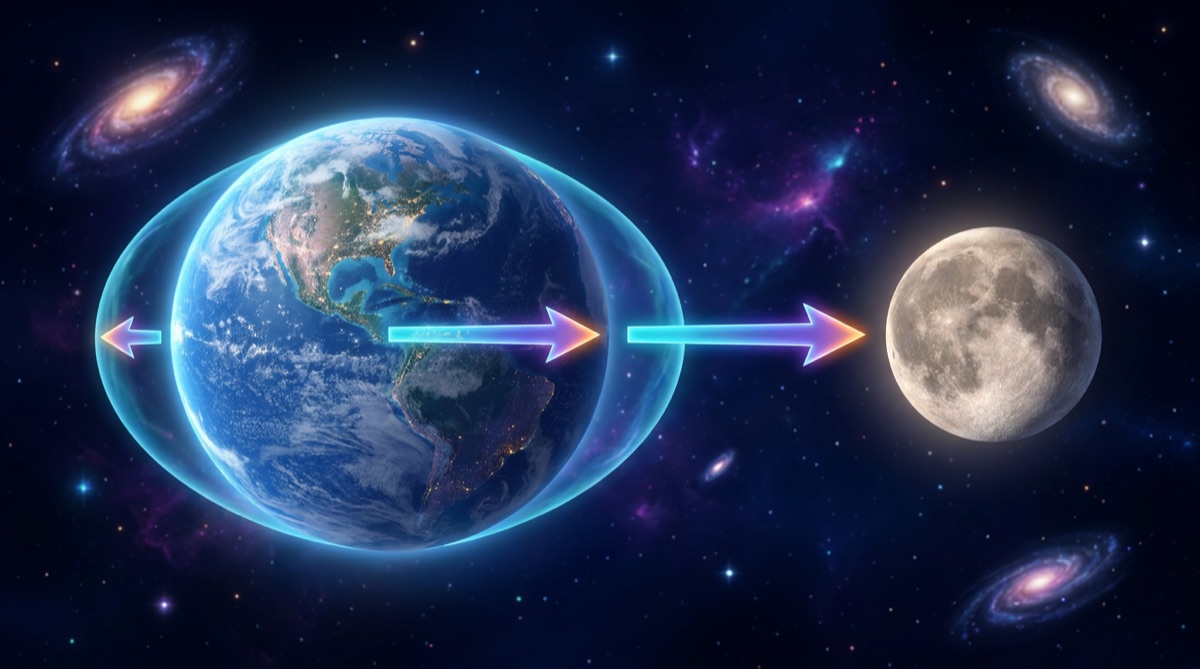
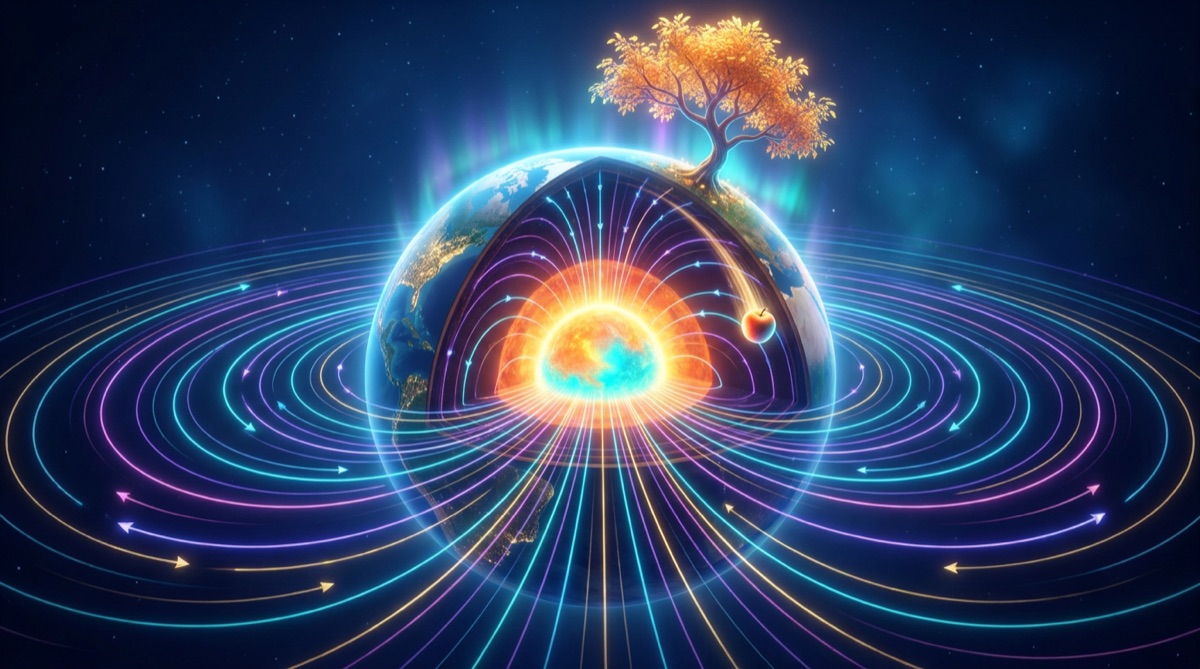
The Moon attracts Earth according to Newton’s law, , where is the gravitational parameter of the Moon () and the distance to the lunar center. But Earth is not a point: it has radius m, and its center is m from the Moon. The side facing the Moon is at ; the opposite side, at .
| Point | Distance to the Moon | Acceleration (m/s²) |
|---|---|---|
| Near side | m | |
| Center of Earth | m | |
| Far side | m |
The whole Earth “falls” toward the Moon with the acceleration of its center (that is, in fact, what keeps the two in orbit around their center of mass). What deforms Earth is the difference with respect to the center:
- near side: m/s², toward the Moon;
- far side: m/s², that is, away from the Moon.
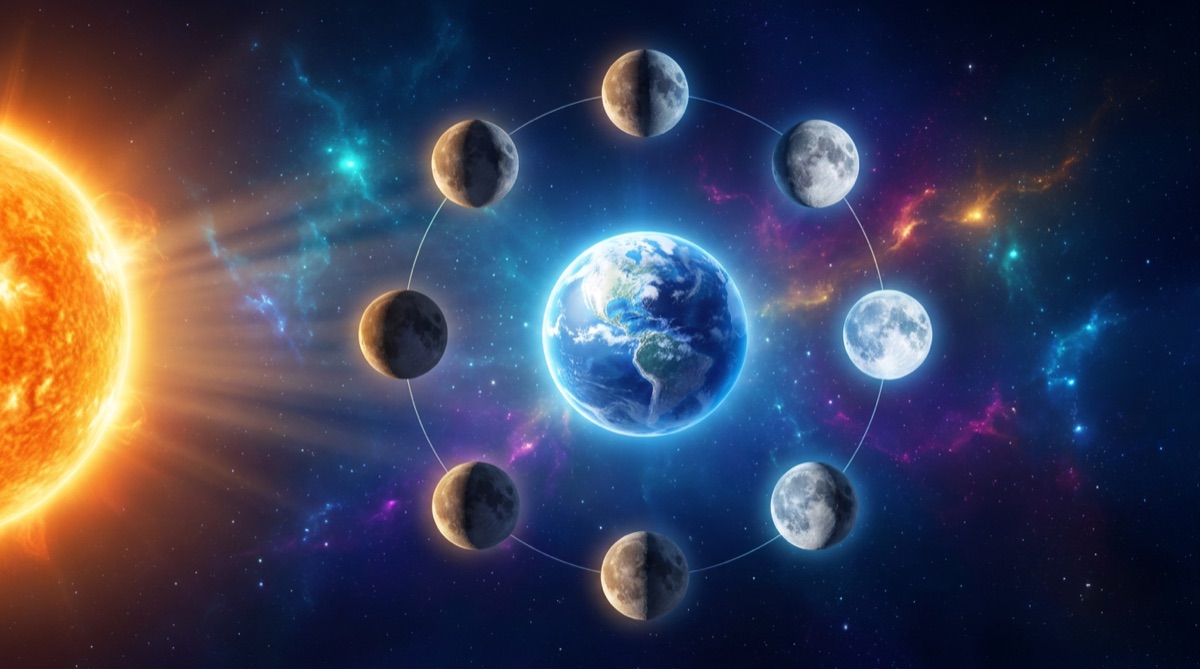
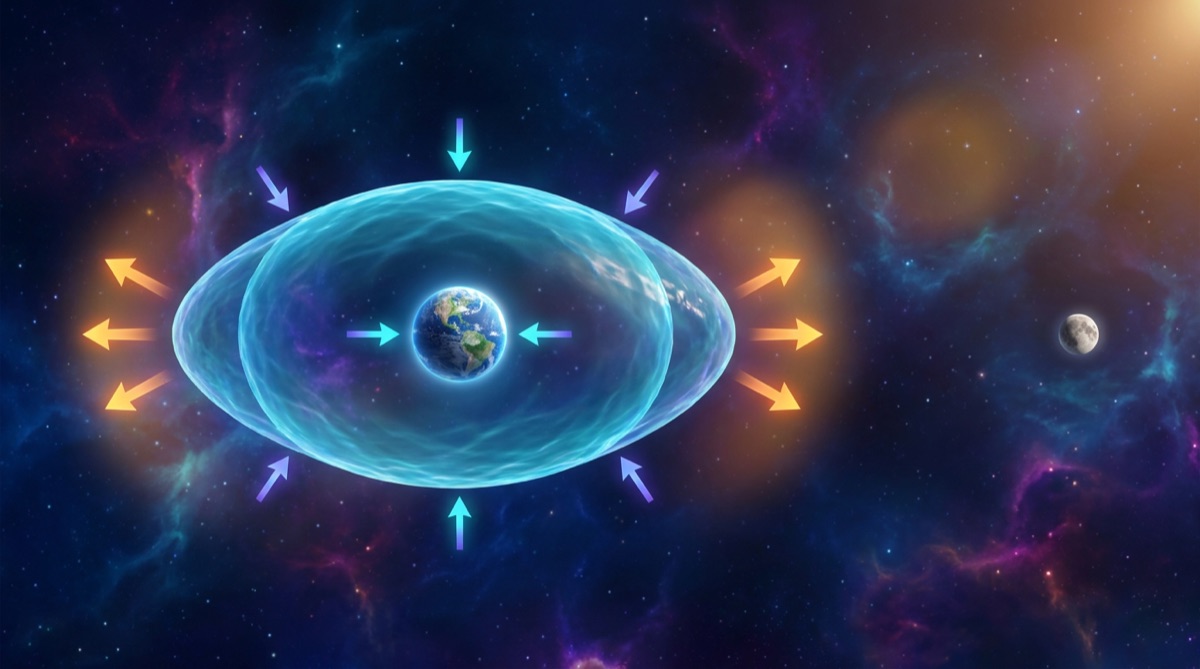
That difference is called the tidal acceleration . The near side is pulled toward the Moon more than the center; the center is pulled more than the far side, which “lags behind”. Seen from Earth, the water bulges on both sides: that is why there are two high tides a day and not one.
2. The formula: derivation without calculus
Let us subtract the accelerations of the near side and the center:
Since is much smaller than (), we can neglect against in the numerator and against in the denominator:
where is the mass of the body producing the tide, the distance to its center and the radius of the body that suffers it. Notice the cube: the force of gravity falls off as , but the tide, which is a difference of forces, falls off as . That is the reason for everything that follows.
How much error did we make? The exact value for the near side is and the formula gives m/s²: 2.6 % less. It can be shown that the relative error is approximately : for the approximation is excellent.
Worked example 1: how small the tide is
m/s² versus m/s²: the lunar tide is one ten-millionth of Earth’s gravity. A 60 kg person “weighs” N less when the Moon is overhead: the weight of a grain of sand. Over an entire ocean, however, that ten-millionth moves meters of water.
And sideways?
At the points 90° from the direction of the Moon, the lunar attraction points toward the center of the Moon, which is no longer “straight ahead” but slightly to the side. The component of that attraction toward the Earth–Moon axis equals, with the same kind of approximation, : half of and directed inward. The tide stretches Earth along the Earth–Moon axis and squeezes it in the perpendicular plane: a rugby ball whose axis points at the Moon.
3. Moon versus Sun: 2.2 to 1
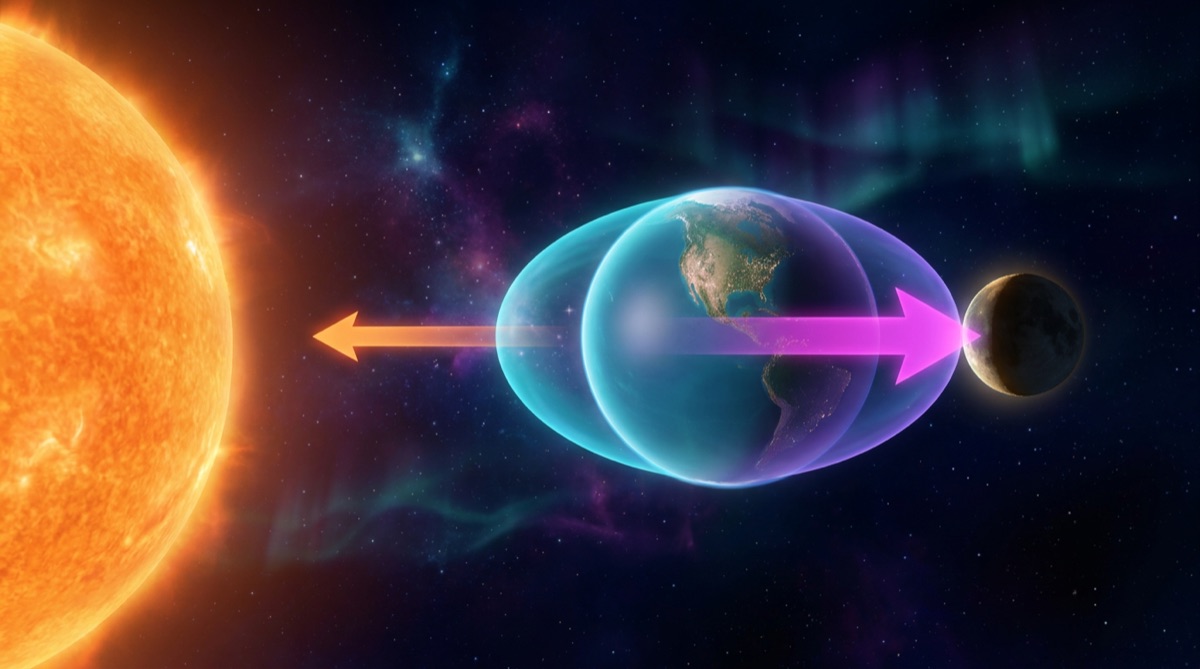
The Sun attracts Earth 180 times more strongly than the Moon:
So why is the tide ruled by the Moon? Because the tide goes as :
Worked example 2. Directly with the formula: Sun, m/s²; Moon, m/s². Ratio . The Sun loses its factor of 180 in force because it is 389 times farther away and the cube of 389 is 59 million.
Spring and neap tides
The two tides add as vectors. When the Sun, Earth and the Moon are aligned (new moon and full moon), the two bulges coincide: these are the spring tides (syzygies), with amplitude proportional to . When the Moon is 90° from the Sun (quarters), the solar bulge falls where the lunar one has its minimum and they subtract: neap tides (quadratures), amplitude . Theoretical ratio:
IDEAM (Colombia’s hydrology and meteorology institute), with 50 years of tide-gauge records, measures in Buenaventura a mean amplitude of 485 cm at syzygy and 174 cm at quadrature: ratio 2.8. In Tumaco, 374 and 125 cm: ratio 3.0. In Cartagena, 60 and 24 cm: ratio 2.5. The model of a secondary-school lesson gets the ratio right; what it does not predict is the height, as we will see.
Challenge with the simulator. Set the Real date mode to today’s date and advance day by day until the next new or full moon: those are the days of spring tide. Then look for the next quarter: neap tide. Compare with the forecast of high and low tides that DIMAR (Colombia’s maritime authority) publishes for Buenaventura or Cartagena (dimar.mil.co): the highest tides of the month should fall one or two days after the syzygy (the ocean takes time to respond).
4. The rhythm: 12 h 25 min
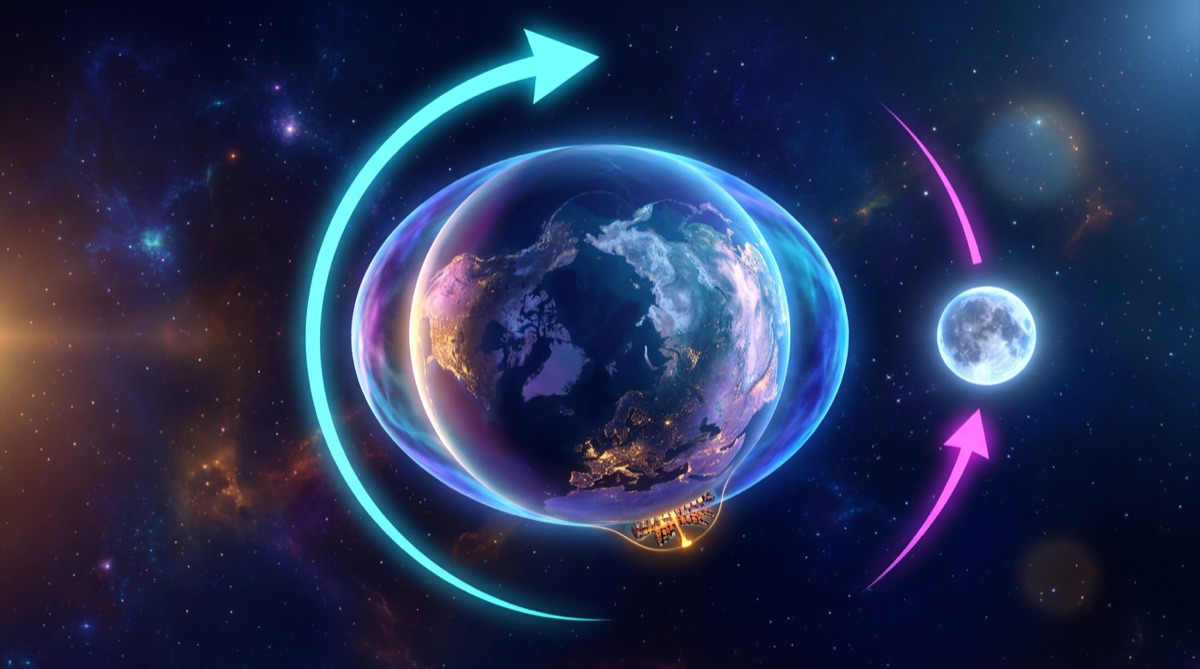
Earth turns beneath the two bulges, so each point passes through two high tides and two low tides per rotation. But the Moon advances in its orbit while Earth turns: the lunar day (from one passage of the Moon across the meridian to the next) lasts
so that high tides repeat every 12 h 25 min and each day they arrive about 50 minutes later. In Buenaventura and Tumaco the tide is semidiurnal (two almost equal highs and two lows): IDEAM finds that the dominant component is the lunar semidiurnal M2, of 150 cm in Buenaventura. In the Caribbean, on the other hand, the tide is mixed diurnal: the diurnal component K1 dominates (9.5 cm in Cartagena) and there is often a single high tide per day.
5. From the formula to the pier: the equilibrium tide and the real one

If the ocean covered the whole Earth and responded instantly, the water would settle until the slope of its surface compensated . The resulting height has to be proportional to (the relative deformation is of the order of the relative force); the exact calculation, done at university level, gives a difference between high and low tide of
for the Moon and m for the Sun: the equilibrium tide. At spring tide, m; at neap tide, m.
Real tides differ from one port to another because the water does not respond instantly: each ocean basin, each gulf and each estuary oscillates with its own periods, like the water in a bathtub, and amplifies or damps the tidal wave.
| Place | Spring tide (syzygy) | Neap tide (quadrature) | Type |
|---|---|---|---|
| Equilibrium tide (theory) | 0.79 m | 0.29 m | — |
| Buenaventura (IDEAM) | 4.85 m | 1.74 m | semidiurnal |
| Tumaco (IDEAM) | 3.74 m | 1.25 m | semidiurnal |
| Cartagena (IDEAM) | 0.60 m | 0.24 m | mixed diurnal |
| Islas del Rosario (IDEAM) | 0.50 m | 0.14 m | mixed diurnal |
On the Colombian Pacific the wide continental shelf and the deep bays (Buenaventura, Málaga) amplify the Pacific Ocean’s wave to five or six times the equilibrium tide; DIMAR forecast high tides of 4.23 m in Buenaventura and 3.41 m in Tumaco for May 31, 2026. The Caribbean, an almost closed sea, barely reaches it. The world record is in the Bay of Fundy (Canada), according to NOAA, where the funnel of the bay goes into resonance with the 12 h 25 min period.
Activity: reading the tide on your coast
You need: the month’s table of high and low tides for Buenaventura, Tumaco or Cartagena (DIMAR publishes the forecast at dimar.mil.co; the IDEAM tables also work), graph paper or a spreadsheet, a calendar with the phases of the Moon (or the simulator in Real date mode) and a calculator.
- Copy into a table, for 15 consecutive days, the time and height of each high tide and each low tide.
- Plot height (vertical axis) against time in hours from the start (horizontal axis) and join the points. How many high tides are there per day? Are they equal to each other? (Semidiurnal if there are two similar ones; mixed diurnal if there is one or two very unequal ones.)
- Measure the interval between consecutive high tides over several days and average it. Compare with 12 h 25 min (or 24 h 50 min if the tide is diurnal).
- Compute the range (high tide − low tide) for each day and mark on the graph the days of new moon, full moon and quarters. Where are the largest and smallest ranges? How many days after the syzygy does the maximum range arrive?
- Divide the maximum range by the minimum and compare it with the theoretical ratio 2.7 and with IDEAM’s ratio for your port.
Final question: the range in Buenaventura is about six times that of the equilibrium tide, and Cartagena’s is smaller. If the formula is the same for the whole Earth, what does that difference tell us about the role of the ocean and the coast?
Exercises
Basic
- Compute the tidal acceleration of the Moon on Earth at perigee ( km) and at apogee ( km). By what percentage does it change?
Show solution
Perigee: m/s². Apogee: m/s². It changes by 39 %: spring tides that coincide with perigee (the so-called “supermoon” tides) are clearly larger.
- Explain with the table in section 1 why there is also a high tide on the side of Earth opposite the Moon.
Show solution
The far side is attracted with m/s², less than the center (). Relative to the center, which is what we see from Earth, the far side “lags behind” with m/s²: a net acceleration that points away from the Moon and raises the water.
- If the Moon were twice as far away, how many times smaller would the tide be? And the total gravitational force?
Show solution
Tide: times smaller. Force: times smaller.
Intermediate
- Show that the ratio between spring tide and neap tide is , where , and compute what value of would exactly reproduce the ratio 2.8 measured in Buenaventura.
Show solution
Spring , neap . If : , very close to the theoretical 2.18. (The slight difference is because the ocean’s response to the lunar and solar components is not identical.)
- A tide gauge records high tide at 03:10 on Monday. Predict the times of the next six high tides with the 12 h 25 min period.
Show solution
15:35 (Mon), 04:00 (Tue), 16:25 (Tue), 04:50 (Wed), 17:15 (Wed), 05:40 (Thu). Each day the morning high tide arrives 50 min later.
- Compute the exact relative error of the approximation for the near side: with .
Show solution
The ratio simplifies to : the approximate formula underestimates the exact value by 2.5 %, as stated in section 2.
Challenge
- The volcanoes of Io. Io (radius 1821.5 km) orbits Jupiter ( m³/s²) at 421 800 km. Compute the tidal acceleration of Jupiter on Io and compare it with that of the Moon on Earth. What happens to a body that is kneaded like this on every 1.77-day orbit, knowing that its orbit is slightly eccentric?
Show solution
m/s², 5600 times the lunar tide on Earth. Since the orbit is eccentric, changes on every orbit and the tidal bulge rises and falls: that continuous kneading heats the interior by friction and makes Io the body with the most active volcanoes in the Solar System.
- The tide also slows Earth’s rotation (the bulges, dragged along by the rotation, run slightly ahead of the Moon, and the Moon “pulls” them backward). The energy lost by the rotation is gained by the lunar orbit, which grows. Using Kepler’s third law, explain whether the lunar month gets longer or shorter as the Moon recedes, and what will happen to the spring/neap ratio in the distant future if grows and does not.
Show solution
: if grows, the month gets longer. If grows, decreases and drops toward 1; the ratio grows: neap tides would tend to disappear while spring tides remain. (If some day were less than 1, the Sun would rule and spring tides would still occur at syzygy, but with the Moon as the “helper”.)
✦ Mini-quiz
Key takeaways
- The tide is the difference in attraction between points on Earth: (error for the Moon).
- Two bulges: the near side is attracted more than the center and the far side less. Period between high tides: 12 h 25 min.
- Moon m/s², Sun m/s²: ratio 2.2. The Sun pulls 180 times harder but loses by the cube of 389.
- Spring (syzygy) and neap (quadrature): theoretical ratio 2.7; IDEAM measures 2.8 in Buenaventura and 2.5 in Cartagena.
- Equilibrium tide ≈ 0.8 m at syzygy; the real one depends on the basin: Buenaventura 4.85 m, Tumaco 3.74 m, Cartagena 0.60 m.
🍎 Teacher guide
- Time
- 2 sessions of 55 min
- Colombian national standard (MEN)
- Natural Sciences, Grades 10 to 11, physical environment: “I relate mass, distance and the force of gravitational attraction between objects”, “I establish relations between the gravitational field model and the law of universal gravitation” and “I explain the behavior of fluids in motion and at rest”; I approach knowledge as a natural scientist: “I use mathematics to model, analyze and present data and models in the form of equations, functions and conversions”. Mathematics, Grades 10 to 11, spatial thinking: “I describe and model periodic phenomena of the real world using trigonometric relations and functions” and “I use geometric arguments to solve and formulate problems in mathematical contexts and in other sciences”; metric thinking: “I justify results obtained through processes of successive approximation, ranges of variation and limits in measurement situations”.
- Evidence of learning
- Computes the tidal accelerations of the Moon and the Sun with the derived formula, obtains the 2.2 ratio and the spring/neap ratio 2.7, explains with the acceleration table why there are two bulges, and from a real DIMAR tide table plots, measures the 12 h 25 min period and relates the maximum ranges to the phases of the Moon.
Materials
- Scientific calculator
- Table of the month's high and low tides (DIMAR), printed or on screen
- Graph paper or computer with a spreadsheet
- Lunar calendar or the phases simulator
- Ball and rugby ball (or elongated balloon) for the model of the bulges
Suggested sequence
Session 1. The force that stretches (55 min). Opening: photos of the same pier at high and low tide, hook question (5 min). Development: table of the three accelerations (the students compute it) and algebraic derivation of with its error (25 min); example 1 and model with the rugby ball (10 min). Closing: exercises 2 and 3 (15 min).
Session 2. Moon, Sun and Colombia (55 min). Opening: who rules, the Sun or the Moon? Calculation of the 2.2 (10 min). Development: spring and neap tides, 12 h 25 min period, IDEAM table and equilibrium tide (15 min); activity with the DIMAR table in groups (20 min). Closing: mini-quiz (10 min). Challenge 7 (Io) connects with the lesson on weighing the planets; challenge 8, with Kepler’s third law.
Common mistakes
- Believing that the Moon “lifts” the water and that this is why there is a single high tide. Use the table of the three accelerations and subtract with respect to the center.
- Thinking that the Sun produces more tide because it pulls harder. Separate force (1/d²) from tide (1/d³) with the calculation of the factor 389³.
- Expecting the formula to predict the height at the Buenaventura pier. Distinguish equilibrium tide (0.8 m) from real tide (basin, resonance).
- Confusing the 12 h period with the 12 h 25 min one. Derive the 24 h 50 min lunar day from the synodic month.
- Mixing units (km and m) in the cube of the distance. Require SI and check the order of magnitude 10⁻⁶ m/s².