Tonight, look at two stars: one shines brightly and the other can barely be seen. Is the bright one more powerful, or simply closer? To answer that we have to separate two ideas: how much light a source emits and how much light reaches us. The relation between the two is one of the most useful laws in all of physics, and it is pure geometry.
1. Light spreads out: the inverse-square law
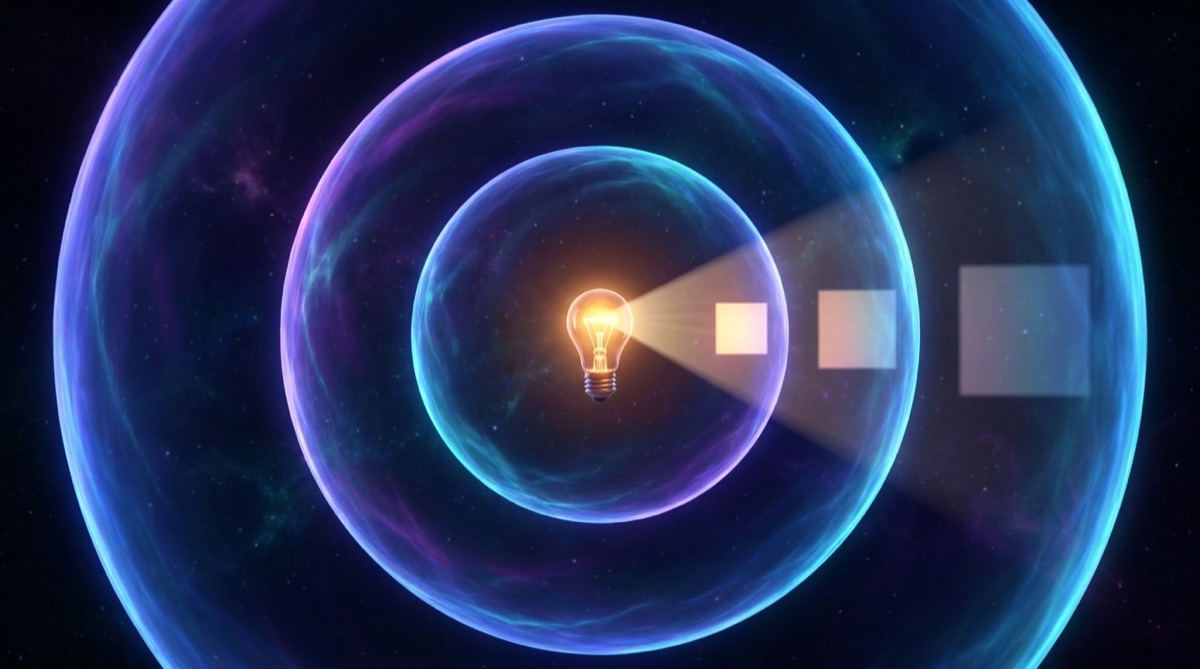
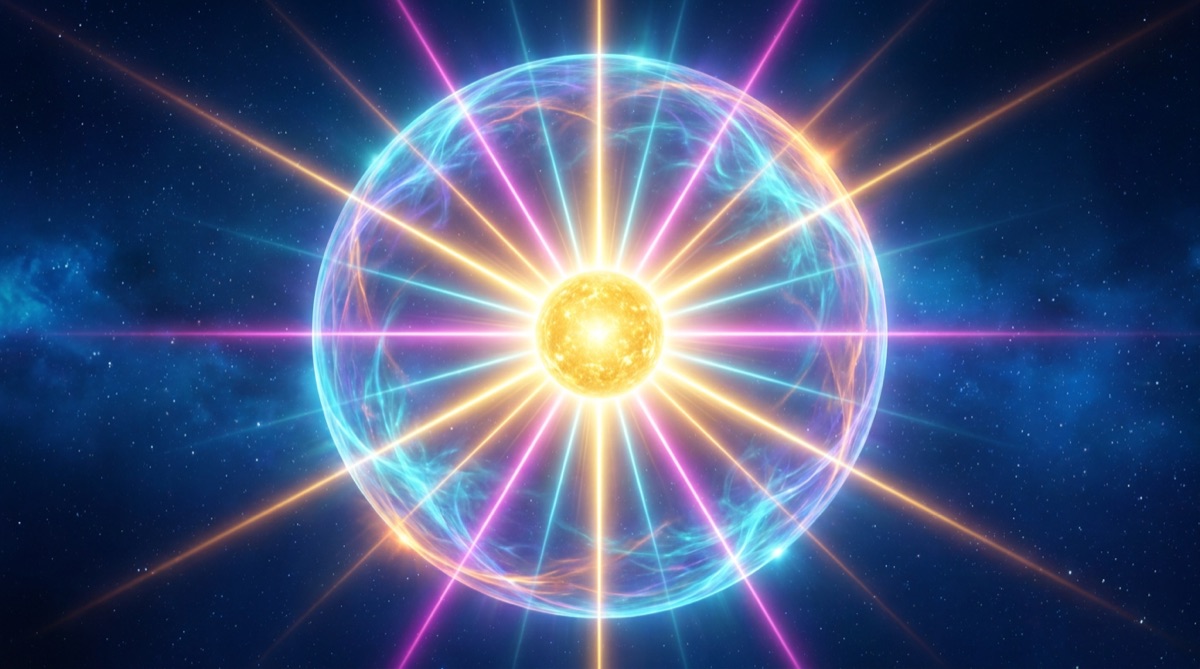
Imagine a light bulb at the center of an enormous transparent sphere. All the light leaving the bulb passes through the surface of the sphere. If the sphere has radius , its area is . Let us call:
- the luminosity: the energy the source emits every second, in watts (W);
- the flux or received brightness: the energy that arrives every second on each square meter, in W/m²;
- the distance between the source and the observer, in meters.
Since the light spreads evenly over the whole sphere, the flux is the luminosity divided by the area:
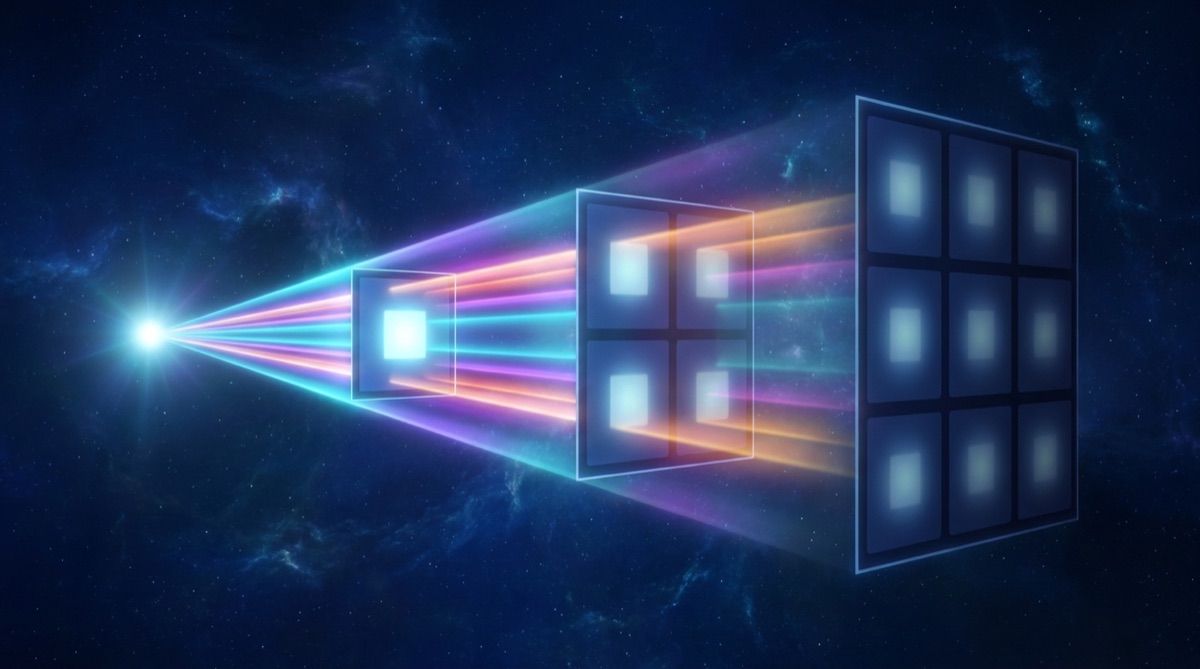
If you double the distance, the area of the sphere is multiplied by and the same light is spread over four times more surface: the brightness is divided by 4. If you triple it, it is divided by .
| Distance | ||||
|---|---|---|---|---|
| Area of the sphere | ||||
| Brightness |
This is the inverse-square law. It holds for light, but also for the sound from a loudspeaker, the signal from an antenna and the force of gravity.
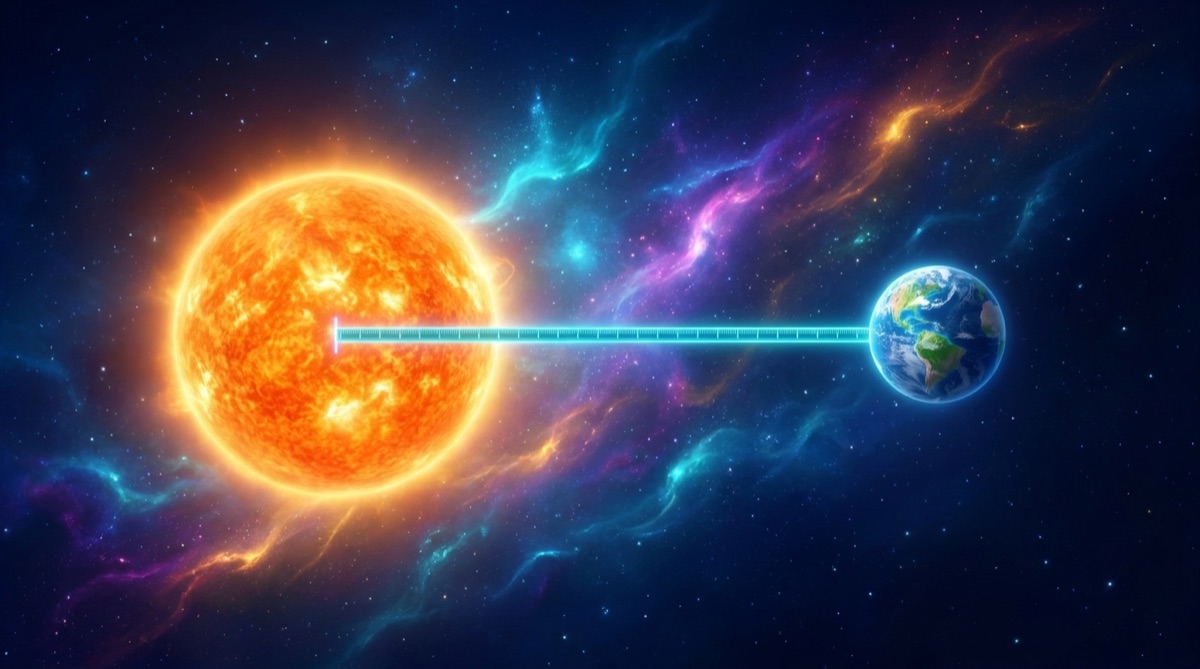
Worked example 1: the solar constant. The Sun has . Earth is at (au = astronomical unit, the mean Earth–Sun distance):
It is the solar constant: each square meter facing the Sun, outside the atmosphere, receives about 1361 W, like thirteen 100 W light bulbs. Satellites actually measure it: (Kopp and Lean, 2011). That the calculation matches the measurement is the proof that the law works.
Worked example 2: solving for the distance. At what distance from the Sun does the flux drop to ? Solving the formula for , . But there is a shortcut: since , comparing with Earth,
a little beyond Neptune. There a solar panel produces a thousand times less than on Earth; that is why the probes that go that far carry nuclear generators.
2. Power functions
The formula is a particular case of a very important family, the power functions:
where is the variable, a constant and the exponent (positive, negative or fractional). The brightness is with : a power function with exponent .
| Exponent | Example | If doubles, … |
|---|---|---|
| perimeter of a square of side : | doubles (direct proportionality) | |
| area of a square: | is multiplied by 4 | |
| volume of a cube: | is multiplied by 8 | |
| time of a trip at speed : | is divided by 2 (inverse proportionality) | |
| brightness at distance : | is divided by 4 |
The general rule: if is multiplied by , then is multiplied by . With negative , “multiplying by ” means dividing: . That is why graphs with negative drop quickly at first, then more and more slowly, and never reach zero: the light of a distant star is extremely faint, but never zero.
How to discover the exponent in a table. Take two rows where doubles and look at how much changes: if it is multiplied by 4, ; if it is divided by 4, ; if it is divided by 2, . In the flashlight activity you will do exactly this with your own data.
Worked example 3: how much Sun each planet receives. With the distance in au, the flux is (we compare with Earth, where ). Using NASA’s mean distances:
| Planet | (au) | (W/m²) | |
|---|---|---|---|
| Mercury | 0.387 | 0.150 | 9090 |
| Venus | 0.723 | 0.523 | 2600 |
| Earth | 1.000 | 1.000 | 1361 |
| Mars | 1.524 | 2.322 | 586 |
| Jupiter | 5.204 | 27.08 | 50.3 |
| Saturn | 9.572 | 91.62 | 14.9 |
| Uranus | 19.16 | 367.3 | 3.7 |
| Neptune | 30.18 | 910.8 | 1.5 |
On Mars, a solar panel gives less than half of what it gives on Earth; on Neptune, almost a thousand times less. Look at the column: the flux falls much faster than the distance.
Worked example 4: the Sun seen from another star. If we put the Sun at 1 parsec ( m, about 206 000 au; it is the unit of Grade 10), its flux would be
that is, times the solar constant. That is why the stars, which are suns, look like points: the inverse-square law with enormous distances.
Simulator: distances and brightness in the Solar System
Open the simulator’s Distances mode. You will see the planets at their real distance from the Sun (with logarithmic zoom) and a “light rocket” that shows how long light takes to reach each one.
- Write down the distance in au of Mars and of Jupiter and check the values in the table with the formula .
- Launch the light rocket. The time light takes to reach Jupiter is about 3.4 times what it takes to reach Mars (). By how much is the brightness divided between Mars and Jupiter? Compare: time is a power function with exponent 1; brightness, with exponent ().
- Challenge: use the zoom to find the place where the Sun would be seen with only (worked example 2). Is it inside or outside the orbit of Neptune?
Activity: the flashlight and the grid
Materials: a small flashlight (or a phone’s light), a sheet of grid paper taped to the wall, a tape measure and, if you have one, a second phone with a free lux meter app.
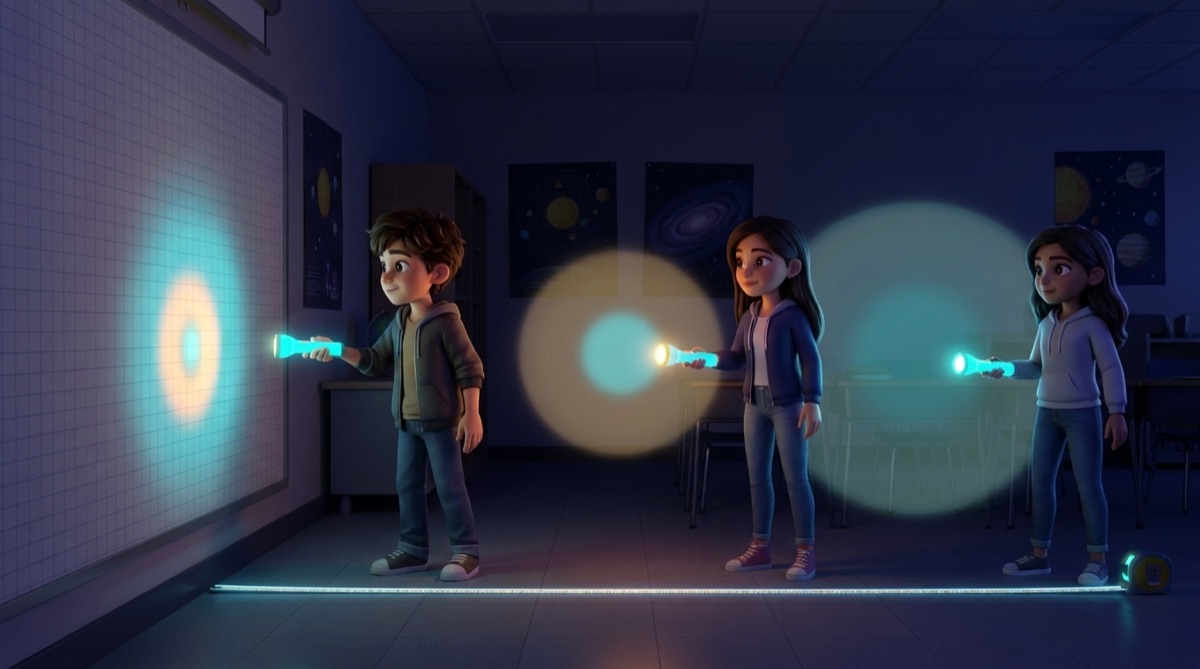
- Darken the classroom. Put the flashlight 20 cm from the sheet, pointing straight at it, and count how many squares are lit by the circle of light. Write down the number as .
- Move the flashlight back to 40 cm and count again: . Then to 60 cm: .
- Complete the table: is close to 4? Is close to 9? The same light is spread over more squares, so each square receives less: .
- With the lux meter: measure the illuminance (in lux) at 20, 30, 40, 60 and 80 cm. Compute for each row. If the law holds, that product is (almost) constant.
- Plot against . Is it a straight line? Now plot against : you should get a straight line through the origin.
| (cm) | 20 | 30 | 40 | 60 | 80 |
|---|---|---|---|---|---|
| (lux) | |||||
Final question: if you wanted the sheet to receive one quarter of the light it receives at 20 cm, at what distance would you put the flashlight? And to receive one ninth?
How do we put a number on the brightness of a star?
We have used watts per square meter, but astronomers measure the brightness of stars with a scale that is two thousand years old, the magnitudes, in which a difference of 5 magnitudes corresponds to a factor of 100 in flux. That scale is exponential, and to handle it we need a new tool: the logarithm. All of that, and how it is used to measure distances to the stars, is in the next lesson: Stellar magnitudes and the first idea of a logarithm.
Exercises
Basic level
- A lamp lights a table from 1 m. If you raise it to 2 m, what fraction of the light does the table receive now? And at 5 m? And at 1.5 m?
Show solution
At 2 m it receives ; at 5 m, ; at 1.5 m, , a little less than half.
- A table says: ; ; . What is the exponent of the power function ? And ?
Show solution
When doubles, is divided by 4: . With , . Check: .
- Jupiter is 5.2 au from the Sun. How much solar power does each square meter receive there? Use 1361 W/m² at 1 au.
Show solution
.
Intermediate level
- A 2 m² solar panel produces, outside the atmosphere, 20 % of the energy it receives. How many watts does it give in Earth’s orbit? And in that of Mars (586 W/m²)?
Show solution
Earth: W. Mars: W, less than half.
- A light source looks 9 times fainter than another identical one. How many times farther away is it?
Show solution
If is divided by 9, is multiplied by 9, so is multiplied by .
- At what distance from the Sun (in au) is the flux ? Which planet is near there?
Show solution
: between Mars and Jupiter, in the asteroid belt.
Challenge level
- Two stars emit the same luminosity, but one looks 10 000 times fainter than the other. How many times farther away is it? And if, in addition, the faint one is at 100 pc, how far away is the bright one?
Show solution
times farther away. The bright one is at pc.
- A friend says: “If you double the distance, the light is reduced to half.” Explain to them with the drawing of the sphere why they are wrong and what the correct fraction is.
Show solution
The light spreads over a surface, and the area of the sphere grows with the square of the radius: when doubles there is times more area, so each square meter receives , not . Their rule would be that of a power function with ; the correct one has .
- The star Vega is at 7.68 pc and emits in visible light about 48 times more than the Sun. How many times fainter does Vega look than the Sun at 1 pc (worked example 4)? Hint: combine the factor of 48 with the inverse-square law.
Show solution
By luminosity, times brighter; by distance, times. Total: : Vega at 7.68 pc would look 19 % fainter than the Sun placed at 1 pc. Luminosity and distance almost cancel out.
✦ Mini-quiz
Key takeaways
- Light spreads over a sphere of area : .
- Double the distance, a quarter of the brightness; triple the distance, a ninth: the inverse-square law.
- A power function is ; if is multiplied by , is multiplied by .
- The solar constant is ; with in au, any planet receives .
- A star looks faint for two mixed reasons: low luminosity or great distance. Separating them is the topic of the next lesson.
🍎 Teacher guide
- Time
- 2 sessions of 55 min
- Colombian national standard (MEN)
- Mathematics, Grades 8 to 9: “I model situations of variation with polynomial functions”; “I identify the relation between changes in the parameters of the algebraic representation of a family of functions and the changes in the graphs that represent them”; “I use scientific notation to represent measurements of quantities of different magnitudes”. Natural Sciences, Grades 8 to 9: “I recognize and differentiate models to explain the nature and behavior of light”; “I use mathematics as a tool to model, analyze and present data”; “I take measurements with instruments suited to the characteristics and magnitudes of the objects of study and express them in the corresponding units”.
- Evidence of learning
- Explains with the drawing of the sphere why brightness falls as 1/d², computes the solar flux on a planet from its distance in au, identifies the exponent of a power function in a table and obtains in the activity an approximately constant product E·d².
Materials
- Flashlight or phone light
- Grid paper and adhesive tape
- Tape measure
- Phone with a lux meter app (optional)
- Scientific calculator
- Computer or tablet with the Solar System to scale simulator (optional)
Suggested sequence
Session 1. Light spreads out (55 min). Opening (10 min): hook question and drawing of the bulb in the sphere. Development (30 min): derivation of , table of , , and worked example of the solar constant (compare with the satellite measurement). Flashlight and grid activity in groups. Closing (15 min): exercises 1 and 3 and the final question of the activity.
Session 2. Power functions (55 min). Opening (10 min): review with exercise 2 (discovering the exponent). Development (30 min): table of exponents, rule "", planet table with the simulator in Distances mode and the light rocket challenge. Closing (15 min): exercises 5 and 6, mini-quiz and reading of the bridge toward magnitudes.
Differentiation. Challenge 9 for those who are ahead (it anticipates the absolute magnitude of the next lesson). For those who need support, work only with distances that are whole multiples (2, 3, 10) before using decimals.
Common mistakes
- Thinking that doubling the distance reduces the light to half. The grid activity corrects it with the count: four times more squares.
- Confusing luminosity (what is emitted, W) with flux (what arrives, W/m²). Insist on the units and on the analogy of paint spread over a larger wall.
- Believing that power functions with a negative exponent reach zero. Show in the planet table that Neptune receives little, but not nothing.
- Forgetting to square the distance when using 1361/d². Always ask for the d² column in the table.