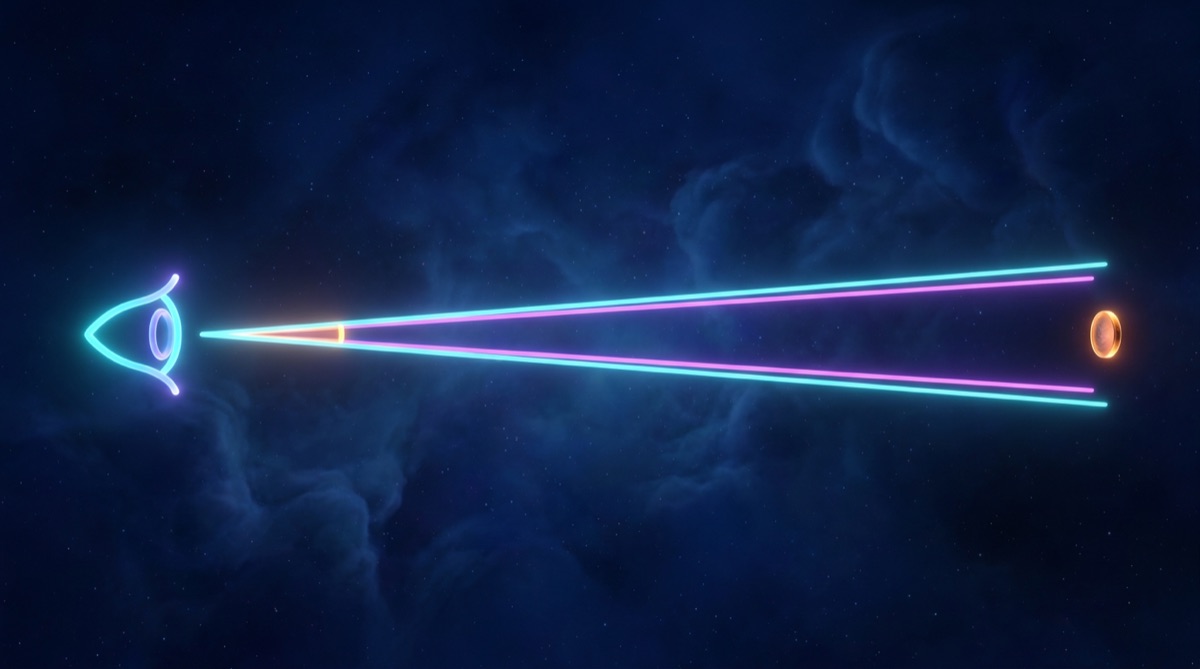
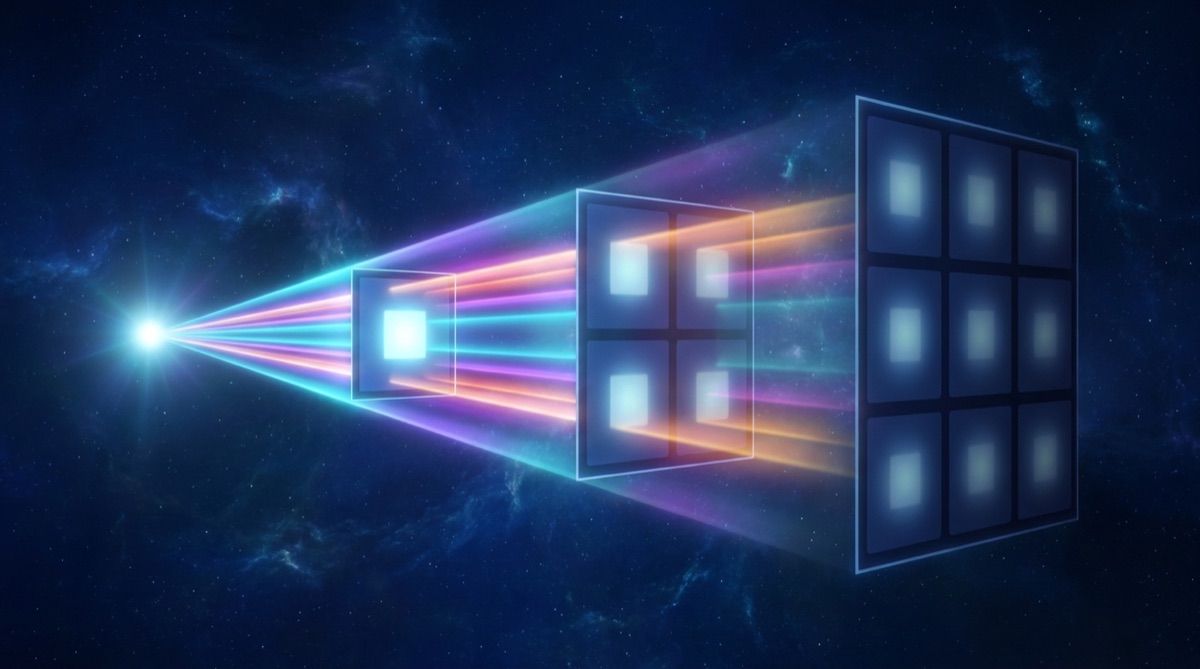
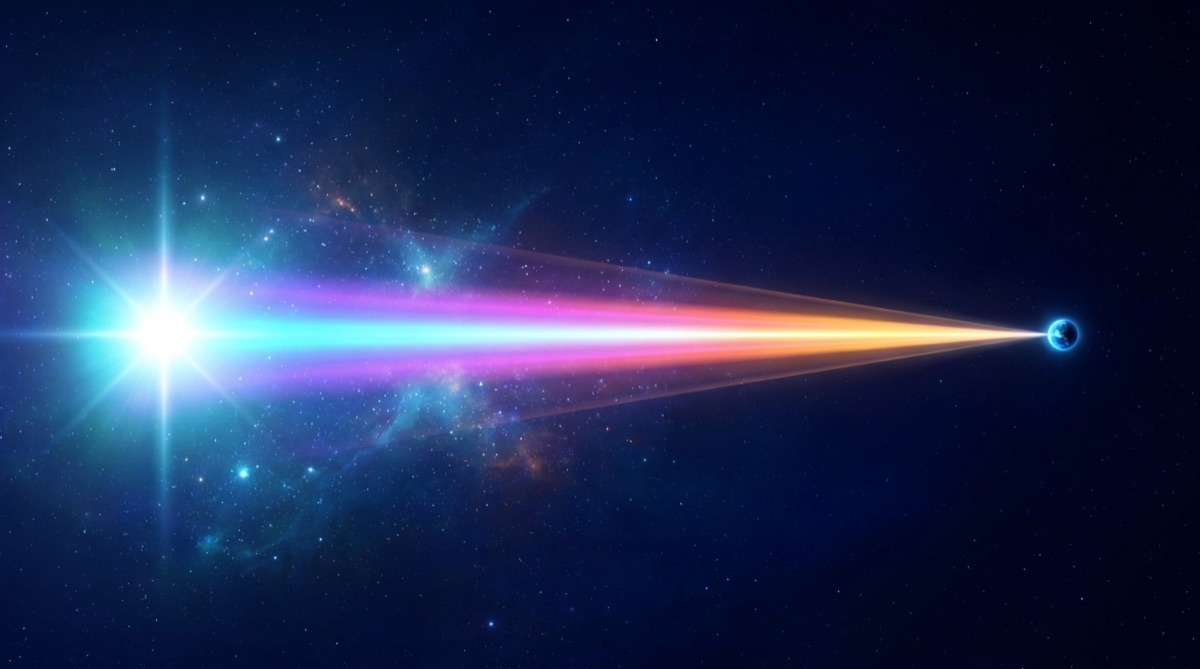
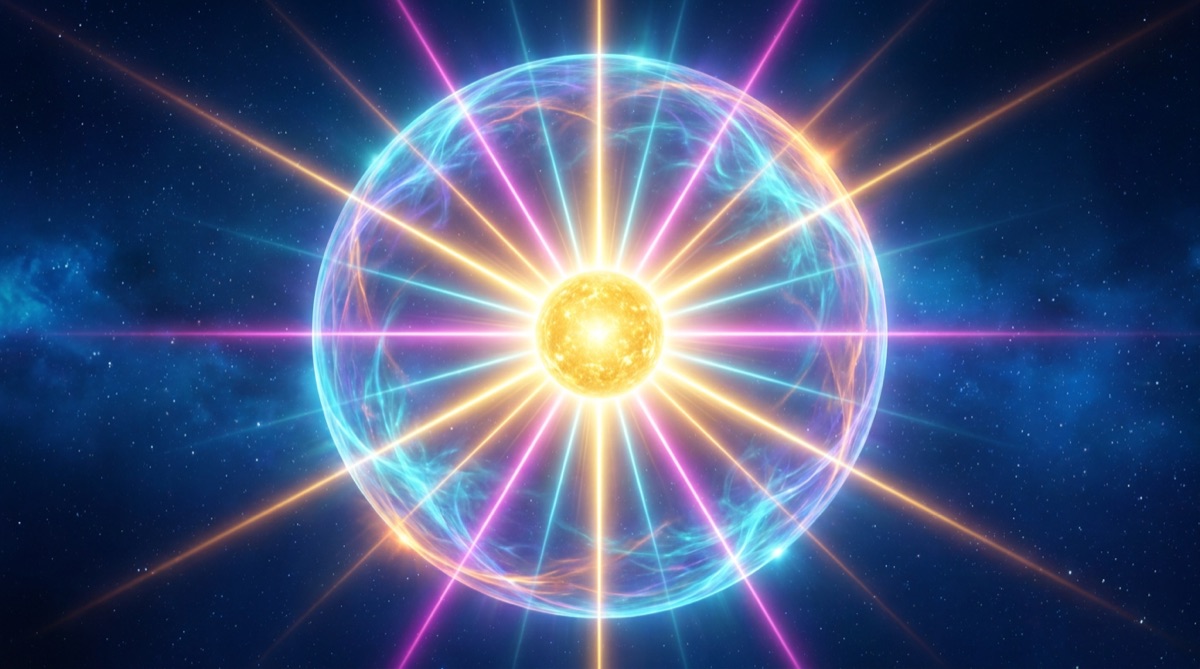
On a moonless night in the Tatacoa Desert (Huila, Colombia) you can see thousands of stars. The same night, from the center of a big city, barely a few dozen. How many times fainter is the faintest star you see in the countryside compared with the faintest one you see in the city? To answer, astronomers use a brightness scale with more than two thousand years of history, the magnitude scale, and a mathematical tool that you will learn today: the logarithm.
In the previous lesson we saw that the flux (energy per second and per square meter that reaches us) falls with the square of the distance. Now we are going to put a number on brightness just as astronomers do.
1. Pogson’s scale
From Hipparchus to Pogson
Around 130 BCE, Hipparchus of Nicaea classified the naked-eye stars into six classes: the brightest were of first magnitude and the faintest he could see, of sixth. That is why, on this scale, a larger number means a fainter star. It is a “backwards” scale, like the places in a race: first is best.
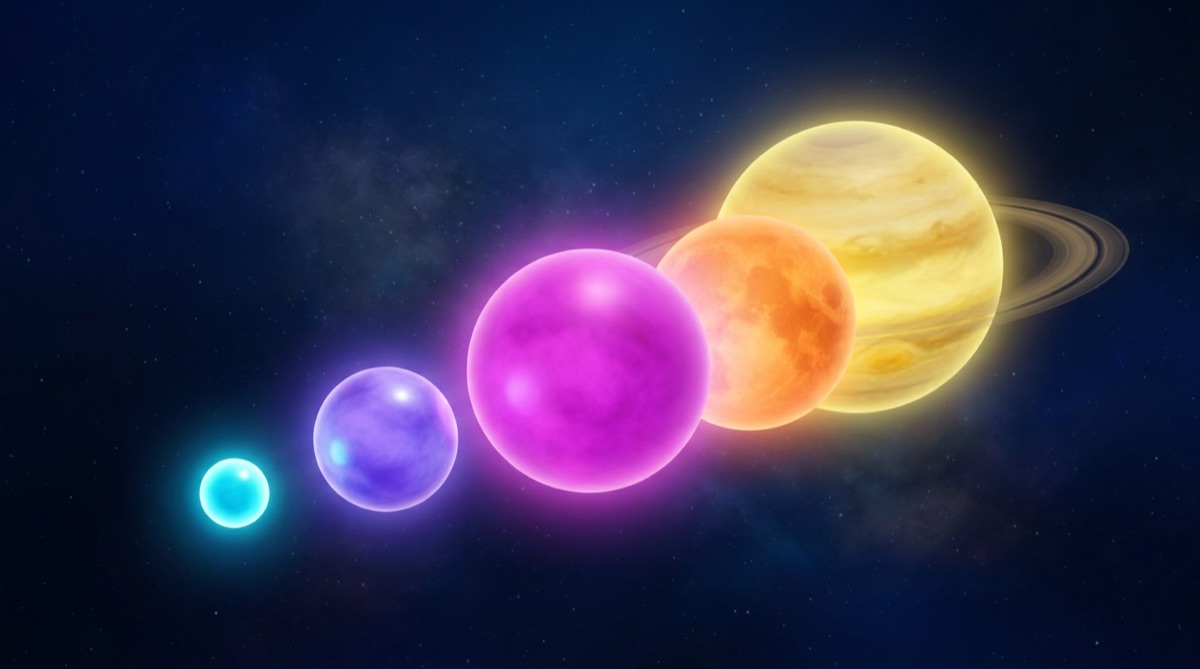
In 1856 Norman Pogson measured that a magnitude 1 star sends us about 100 times more light than a magnitude 6 one, and proposed fixing it by definition: a difference of 5 magnitudes is exactly a factor of 100 in flux. Since 5 steps of one magnitude give a factor of 100, each step multiplies by
That is, going up one magnitude divides the flux by 2.512; going up two, by ; going up five, by .
The formula
If two objects have apparent magnitudes and and we receive fluxes and from them:
- : apparent magnitude, the brightness seen from Earth (no units).
- : received flux, in W/m².
- The exponent carries (and not ) because, if is smaller, object 1 is brighter and the ratio must be greater than 1.
The scale allows negative numbers for very bright objects. These magnitudes are measured in the visual band V (the yellow-green light to which the eye is most sensitive):
| Object | Apparent magnitude | Source |
|---|---|---|
| Sun | −26.76 | Willmer (2018) |
| Full Moon | −12.74 | NASA Moon Fact Sheet |
| Sirius (the brightest star of the night) | −1.46 | SIMBAD |
| Vega | 0.03 | SIMBAD |
| Betelgeuse (variable; see below) | 0.42 | SIMBAD |
| Polaris, the North Star | 2.02 | SIMBAD |
| Faintest naked-eye star, dark sky | ≈ 6 to 6.5 | Bortle (2001) |
| Faintest naked-eye star, big city | ≈ 4 | Bortle (2001) |
Worked example 1. How many times brighter does Sirius () look than Vega ()?
Sirius looks almost four times brighter than Vega.
Worked example 2. How many times more light do we receive from the Sun () than from the full Moon ()? The difference is magnitudes. Since : ten magnitudes are and magnitudes are . Total: times. That is why the full Moon does not burn our skin.
Worked example 3 (a star that changed). Betelgeuse, the red star on Orion’s shoulder, usually has . Between February 7 and 13, 2020 it dropped to (the “Great Dimming”). By how much did it fade? Difference , so : we were receiving one third of its usual light, something visible to the naked eye from almost anywhere in the world.
2. Exponents and the first idea of a logarithm

Adding in the exponent is multiplying
Look at the table of powers of 10:
| −2 | −1 | 0 | 1 | 2 | 3 | 6 | |
|---|---|---|---|---|---|---|---|
| 0.01 | 0.1 | 1 | 10 | 100 | 1000 | 1 000 000 |
Every time you add 1 to , the result is multiplied by 10. A function where the variable is in the exponent, like , is called an exponential function, and that is its hallmark: additions in the input become multiplications in the output. The magnitude scale is exactly like that, with base 2.512: each magnitude you add divides the flux by 2.512.
The logarithm is an exponent
Now the question in reverse: “to what exponent must 10 be raised to get 1000?”. The answer is 3, and that is the base-10 logarithm of 1000:
Thus, , , and . For numbers that are not
exact powers of 10 the calculator (log key) gives us the exponent: , because
; , because 50 lies between and .
Two rules, which come from the rules of exponents ( and ):
The logarithm turns products into sums and powers into products. Check it: .
Pogson’s formula with logarithms
Let us write the formula of section 1 in base 10. Since :
Taking the base-10 logarithm of both sides (power rule) and solving:
The minus sign repeats the usual idea: more flux, smaller magnitude. This version is for going from fluxes to magnitudes; the one in section 1, for going from magnitudes to fluxes.
Worked example 4. One star sends us 1000 times more light than another. How many magnitudes separate them? : the bright one has 7.5 magnitudes less.
Worked example 5 (the badge challenge). How many times brighter is a magnitude 1 star than a magnitude 6 one? times. And between magnitude 1 and magnitude 11: .
3. Absolute magnitude and distance modulus
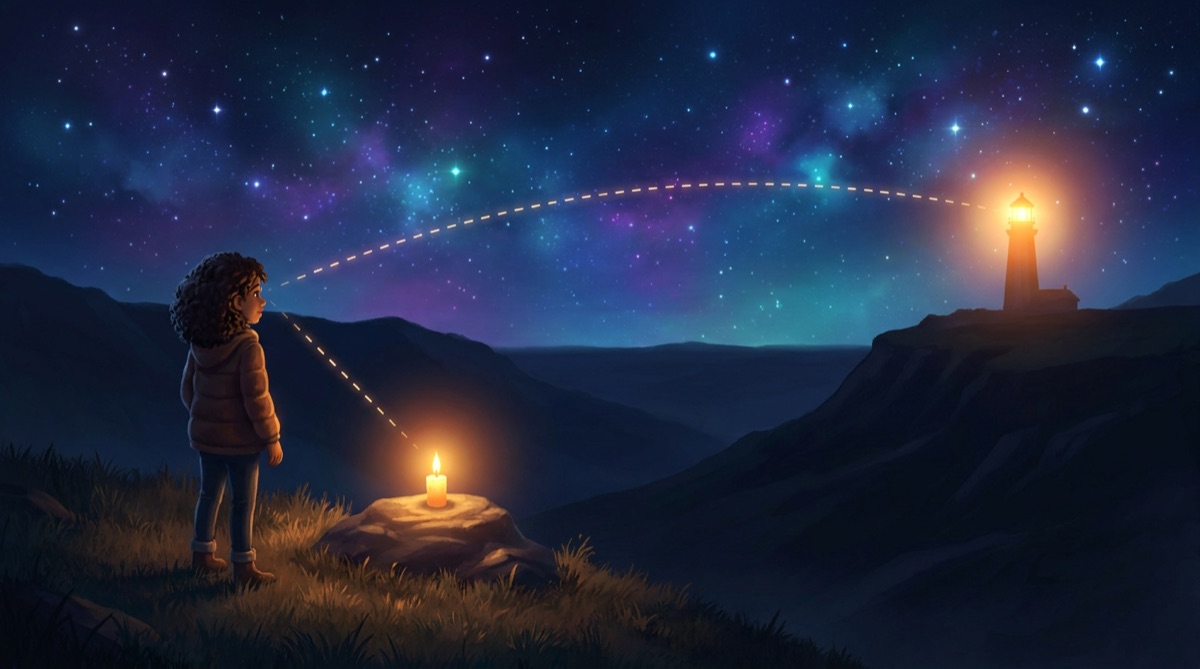
The apparent magnitude mixes two things: how much light the star emits and at what distance it is. A nearby candle can look the same as a distant floodlight. To compare stars “for real”, astronomers imagine placing them all at the same distance: 10 parsecs (pc), about 32.6 light-years. The magnitude a star would have at 10 pc is its absolute magnitude .
By the inverse-square law, a star at distance sends us a flux times the one it would send from 10 pc. Putting this into Pogson’s formula and using the power rule of the logarithm:
- : apparent magnitude (measured from Earth).
- : absolute magnitude (intrinsic brightness).
- : distance in parsecs. The quantity is called the distance modulus.
| 1 pc | 10 pc | 100 pc | 1000 pc | 10 000 pc | |
|---|---|---|---|---|---|
| −5 | 0 | 5 | 10 | 15 |
Every time the distance is multiplied by 10, the distance modulus adds 5: products turned into sums, the logarithm again. And the other way around, if we know and measure :
Worked example 6. The Sun has (Willmer 2018). If we put it at 100 pc it would be seen with : invisible to the naked eye, barely within reach of binoculars.
Worked example 7. Sirius is at pc (its Hipparcos parallax is 379.21 milliarcseconds; the parsec is studied in Grade 10). Its absolute magnitude is
Compared with the Sun (): magnitudes, that is . Sirius emits about 22 times more visible light than the Sun. It looks so bright for both reasons: it is luminous and it is close.
Worked example 8. Betelgeuse looks less bright than Sirius ( versus ), but it is about 168 pc away. Its distance modulus is , so . Compared with the Sun: magnitudes, times more visible light. (The distance to Betelgeuse has a large uncertainty, so this figure is only indicative.)
A note on rigor: the bolometric magnitude. V magnitudes only count visible light. If all the emitted energy is counted we speak of the bolometric magnitude. In 2015 the IAU fixed its zero point: a star with emits W. With W, the Sun has . Check it with the calculator.
Simulator: from parallax to absolute magnitude
The parallax simulator gives the distance to nearby stars. Combine it with the apparent magnitude from the table to find the absolute magnitude:
- Choose Sirius from the list. Read in parsecs and check worked example 7.
- Choose Vega ( pc, ). Compute and then . Is Vega more or less luminous than Sirius? And than the Sun?
- Choose Betelgeuse. Move the distance to 100 pc and to 200 pc: how much does change? That is what the uncertainty in the distance does to the luminosity.
- Challenge: how far away would Vega have to be placed to look like Polaris ()? Hint: the distance is multiplied by .
Measurable with error ≤ 20 %? naked eye (~1′): no · Hipparcos (~1 mas): yes · Gaia (~tens of µas): yes
Precisions as approximate orders of magnitude (naked eye 60″, Hipparcos 1 mas, Gaia 20 µas). Preset distances are rounded. 1″ = 4.85×10^-6 rad.
Dark skies and light pollution in Colombia

The limiting magnitude is the magnitude of the faintest star you can see with the naked eye. It depends on your eyesight, but above all on the brightness of the sky. The Bortle scale (2001) classifies it from 1 (excellent sky) to 9 (center of a big city):
| Bortle class | Type of sky | Naked-eye limiting magnitude |
|---|---|---|
| 1 | Excellent dark sky | 7.6 to 8.0 |
| 3 | Rural | 6.6 to 7.0 |
| 4 | Rural with distant lights | 6.3 to 6.5 |
| 5 | Suburban | 5.6 to 6.0 |
| 7 | Suburban–urban transition | 4.6 to 5.0 |
| 8 | City | 4.1 to 4.5 |
| 9 | Center of a big city | 4.0 or less |
In the Tatacoa Desert, during the totality of the lunar eclipse of April 14–15, 2014 (that is, without moonlight), a sky brightness of 21.15 magnitudes per square arcsecond was measured, which corresponds to class 4 (Góez Therán and Vargas Domínguez, 2021), although from there the lights of Neiva can already be seen. In 2020 the desert received the international Starlight certification as an astronomical destination.
Let us do the calculation from the opening question. Take the typical limiting magnitude of a class 4 sky like that of Tatacoa, about , and that of a class 9 sky like the center of a big city (Bogotá, for example), about . The difference, magnitudes, is equivalent to a factor : the faintest star you see in the desert is nine times fainter than the faintest one you see in the city. And since there are many more faint stars than bright ones, that factor of 9 in flux becomes a much larger factor in the number of stars: Yale’s Bright Star Catalogue lists 9110 objects down to magnitude 6.5 for the whole sky, but down to magnitude 4 there are barely a few hundred.
Activity: a ladder of magnitudes with paper
Materials: a flashlight or a phone’s light, 8 sheets of wax paper (or tracing paper) of the same kind, a phone with a free lux meter app (light sensor) and a dark box or tunnel.
- Fix the flashlight about 30 cm from the light sensor of the second phone, in a dark place. Write down the reading without paper: that is .
- Put one sheet of wax paper between the flashlight and the sensor. Write down the reading .
- Add sheets one at a time up to 8 and write down .
- Compute the ratio , , … Is it more or less constant? Let us call it (what each sheet lets through).
- Draw two graphs: against and against . The first is a falling exponential curve; the second should be a straight line: each sheet subtracts the same amount, , from the logarithm.
- Define the “magnitude” of each reading as . How many sheets are needed to go up 5 magnitudes (divide the light by 100)? Compare with the prediction .
Final question: if each sheet let through exactly 40 % of the light (), how many sheets would be equivalent to one magnitude? And to five?
Sky variant: on a clear night, count the stars you see inside a fixed area of the sky (for example, Orion’s quadrilateral or Crux, the Southern Cross) from your neighborhood and from a dark place, and compare. The international Globe at Night program offers charts with the limiting magnitude to do it in an orderly way.
Exercises
Basic level
- Compute without a calculator: , , and .
Show solution
; ; ; .
- Two stars differ by 5 magnitudes. How many times brighter does the one with the smaller magnitude look? And if they differ by 10? And by 15?
Show solution
100 times; times; times. Every 5 magnitudes, another factor of 100.
- Order from brightest to faintest: Polaris (), Sirius (), the Sun (), Vega () and a magnitude 6 star.
Show solution
Sun, Sirius, Vega, Polaris, the magnitude 6 one. Remember: smaller magnitude, more brightness.
Intermediate level
- A magnitude 1 star and a magnitude 3 one: how many times brighter is the first? Give two decimal places.
Show solution
times.
- What is the distance modulus of a star at 1000 pc? And at 0.1 pc? And at 25 pc?
Show solution
; ; .
- Vega is at 7.68 pc and is seen with . Compute its absolute magnitude and compare it with the Sun’s ().
Show solution
, so . Compared with the Sun: magnitudes, times more visible light.
- A star has (like the Sun) and is seen with . How far away is it?
Show solution
pc.
Challenge level
- The Sun is seen with and Sirius with . Compute how many times more flux we receive from the Sun and write it in scientific notation.
Show solution
Difference magnitudes: times (about thirteen billion).
- A friend says: “If a star is at twice the distance, its magnitude increases by 2.” Is she right? Correct her with and .
Show solution
No. When doubles, the distance modulus increases by magnitudes, not by 2. (Check by the other route: the flux is divided by 4 and .)
- Hipparchus could see stars down to magnitude 6. An amateur 20 cm telescope reaches magnitude 14. How many times fainter is the faintest star the telescope sees than the faintest one Hipparchus saw? And what is the relation with the area of the mirror (20 cm) versus that of the pupil (about 7 mm)?
Show solution
magnitudes: times. The area of the mirror is times that of the pupil, which explains about 7.3 magnitudes (); the rest comes from the observing time and the absence of stray light. It is, once again, a power function (the area) turned into a sum of magnitudes.
✦ Mini-quiz
Key takeaways
- Larger magnitude = fainter star. The scale comes from Hipparchus and Pogson made it exact.
- 5 magnitudes = a factor of 100 in flux; 1 magnitude = a factor of 2.512 .
- and, the other way around, .
- The logarithm is an exponent: . It turns products into sums and powers into products.
- : every “×10” in distance adds 5 to the distance modulus.
- The sky of a big city lets you see down to magnitude ≈ 4; a dark sky like Tatacoa, down to ≈ 6.5.
🍎 Teacher guide
- Time
- 2 sessions of 55 min + paper activity (can be done at home)
- Colombian national standard (MEN)
- Mathematics, Grades 8 to 9: “I identify and use exponentiation, roots and logarithms to represent mathematical and non-mathematical situations and to solve problems”; “I analyze in Cartesian graphical representations the change behaviors of specific functions belonging to families of polynomial, rational, exponential and logarithmic functions”; “I use scientific notation to represent measurements of quantities of different magnitudes”. Natural Sciences, Grades 8 to 9: “I use mathematics as a tool to model, analyze and present data”; “I recognize and differentiate models to explain the nature and behavior of light”; “I record my observations and results using diagrams, graphs and tables”.
- Evidence of learning
- Converts magnitude differences into flux ratios (and vice versa) using powers of 10, explains in their own words that the logarithm is an exponent, computes an absolute magnitude from m and d, and obtains in the activity a straight line when plotting log F against the number of sheets.
Materials
- Scientific calculator (log key)
- Flashlight or phone light
- 8 sheets of wax or tracing paper
- Phone with a lux meter app
- Box or dark room
- Computer or tablet with the parallax simulator (optional)
Suggested sequence
Session 1. From Hipparchus to Pogson (55 min). Opening (10 min): hook question and brainstorming on how many stars can be seen from the school. Development (35 min): history of the scale, table of magnitudes, rule of 5 magnitudes and worked examples 1 to 3; table of powers of 10 and definition of the logarithm as an exponent. Closing (10 min): exercises 1 to 3 in pairs.
Session 2. Logarithms and distances (55 min). Opening (10 min): review with example 5 (badge challenge). Development (30 min): Pogson’s formula with logarithms, absolute magnitude and distance modulus with the parallax simulator (Sirius, Vega, Betelgeuse); exercises 4 to 7. Closing (15 min): light pollution section with the Bortle scale and mini-quiz.
Paper activity (at home or in a third session). The groups hand in the table of readings, the two graphs and the answer to the final question. It is the main evidence for the standard on exponential and logarithmic functions.
Differentiation. For those who go faster: exercises 8 to 10 and the note on the bolometric magnitude. For those who need support: work only with magnitude differences that are multiples of 5 before using the calculator.
Common mistakes
- Believing that the scale is linear (“magnitude 2 is twice as faint as magnitude 1”). Insist with the table of powers: each magnitude multiplies by 2.512, it does not add.
- Forgetting that the scale runs backwards. Use the analogy of the places in a race: “first” is best.
- Confusing apparent with absolute magnitude. Repeat the nearby candle / distant floodlight comparison before the formula.
- Thinking that log₁₀(a + b) = log₁₀ a + log₁₀ b. The rule is for the product; check it with 10 + 100 versus 10 × 100.
- Using the distance in light-years in m − M = 5 log₁₀(d/10 pc). The formula requires parsecs (1 pc = 3.26 light-years).