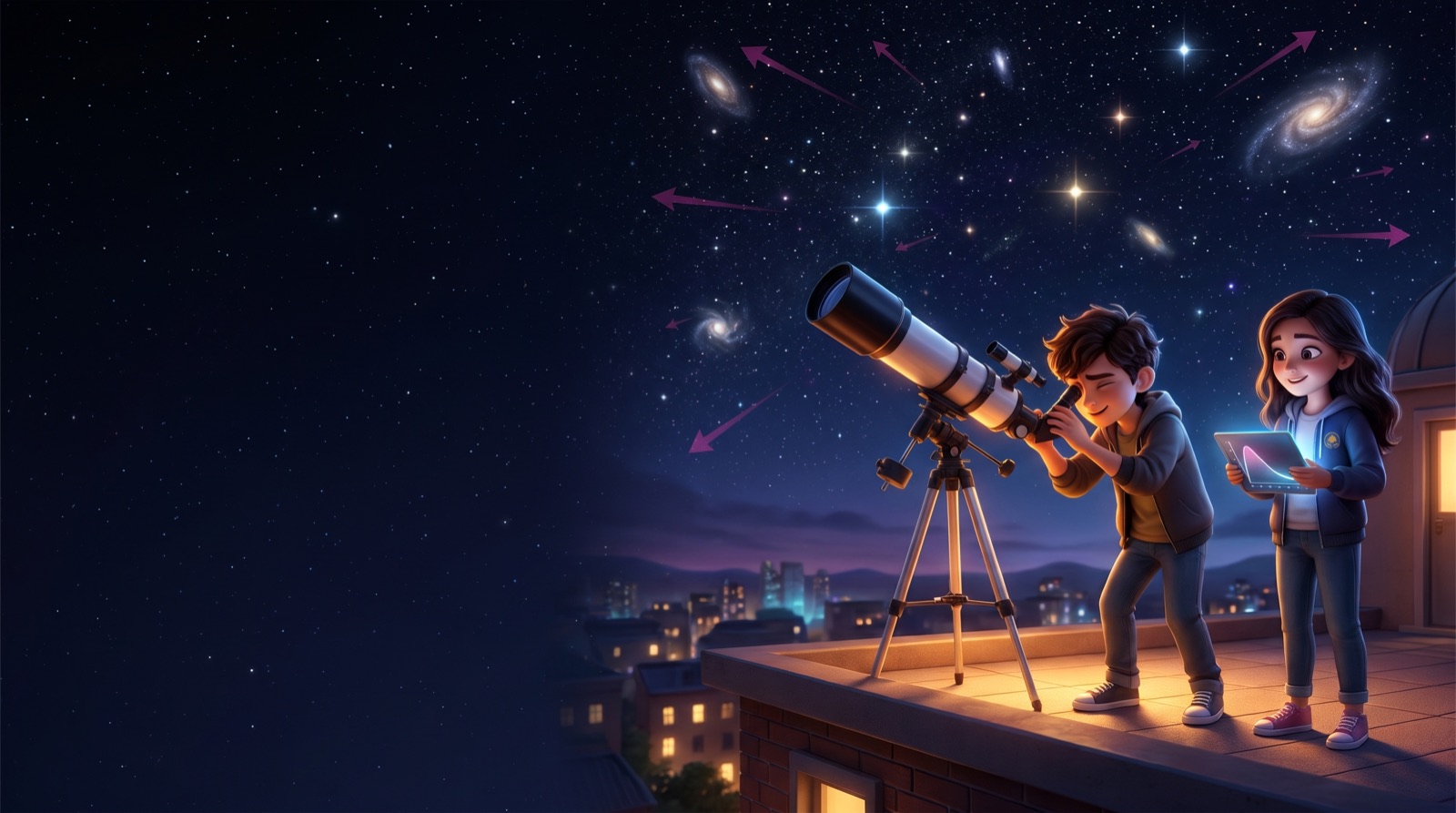
 14 years old · Grades 8 and 9 · Secondary Education
Grade 9
“Why do distant stars look so faint?”
Units of the year
- Unit 1
Brightness and distance
- Inverse-square law
- Power functions
- 📘 Brightness and distance: the inverse-square law · 100 min
- Unit 2
Stellar magnitudes
- Pogson's scale
- Exponents and a first idea of the logarithm
- Unit 3
The universe is expanding
- Hubble's law
- Linear regression with data
- 📘 The universe is expanding · 110 min
Math you will use
Power and exponential functionsInverse proportionalityLinear regressionIntroduction to the logarithm
Complementary lessons
-
Celestial coordinates
Altitude and azimuth, right ascension and declination: why Polaris sits at the altitude of your latitude, why both hemispheres of the sky can be seen near the equator, and where the Moon travels on the celestial sphere.
⏱ 120 min
-
Solar time and sidereal time
Why the stars rise 3 min 56 s earlier every night: the sidereal day of 23 h 56 min 4 s, the Earth's 366.25 turns in a year of 365.25 days, clock arithmetic (modulo 24), Colombia's legal time (UTC−5) and the equation of time, with the planisphere to check it.
⏱ 110 min
-
The Milky Way and other galaxies
Our galaxy in orders of magnitude: 10¹¹ stars, 100 000 light-years across, the Sun 8.2 kpc from the center completing one orbit every 220 million years; the Hubble types, the Local Group with Andromeda 2.5 million light-years away, and the flat rotation curve that gives away the dark matter. With the Milky Way as seen from La Tatacoa.
⏱ 165 min
-
Hunting exoplanets with transits
When a planet passes in front of its star, it covers a tiny bit of it. With areas of circles and ratios we measure its size: δ = (Rp/R⋆)².
⏱ 100 min
-
Spectra and the Doppler effect
The lines of the spectrum are the barcode of each element: the Balmer series of hydrogen, Kirchhoff's laws and the proportion Δλ/λ = v/c that measures the velocity of a star, the rotation of the Sun and the redshift of galaxies. With a CD we build a spectroscope.
⏱ 165 min
Simulators
-
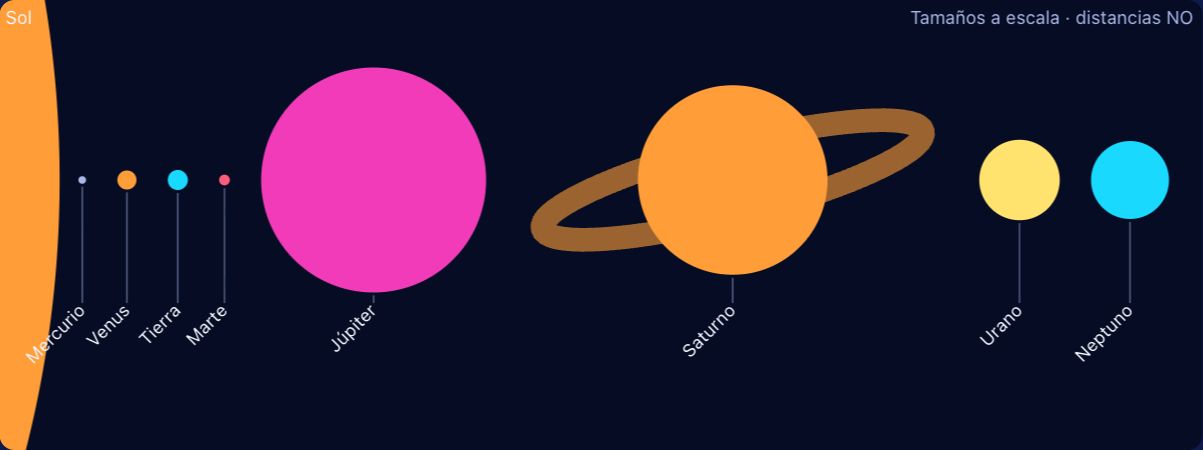
The Solar System to scale
Real sizes of the planets, distances with logarithmic zoom and a “light rocket” (×1, ×60, ×3600), a schoolyard model with everyday objects, and your weight and age on other worlds.
-
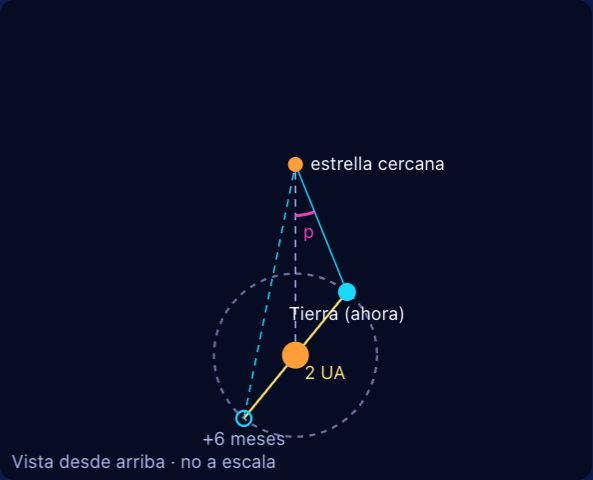
Stellar parallax
Top view of the Earth–Sun–star triangle and the telescope view: the nearby star traces its parallax ellipse against the fixed background; distance, ecliptic latitude, exaggeration and measurability with the naked eye, Hipparcos and Gaia.
-
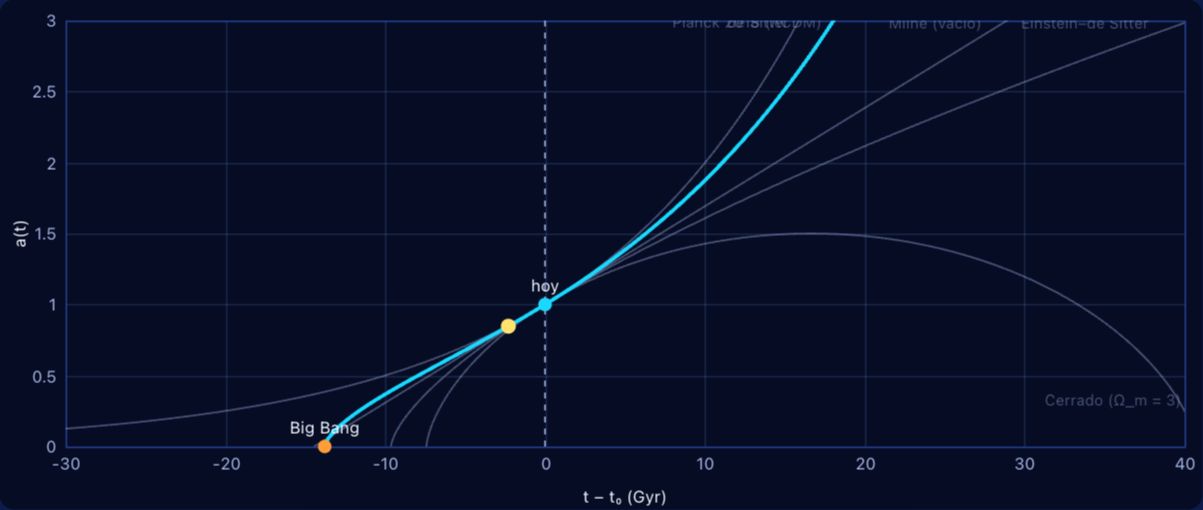
Expansion of the universe
a(t) for different Ω_m, Ω_Λ and H₀ (past and future): Big Bang, recollapse or bounce; interactive (Ω_m, Ω_Λ) plane; age, q₀ and curvature.
-
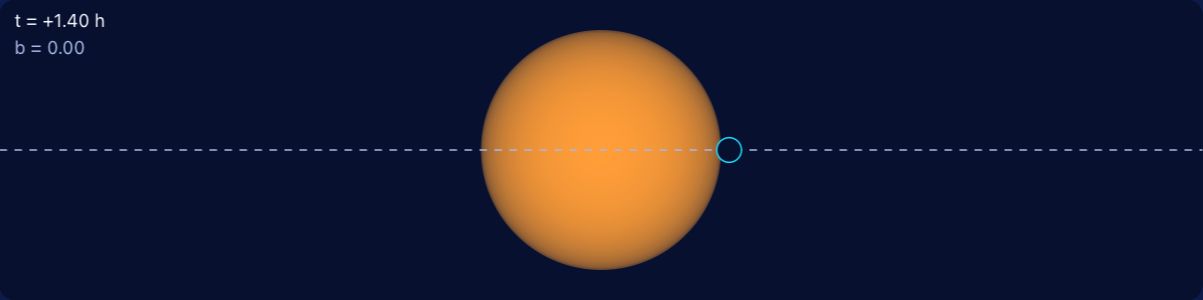
Light curve of a transit
A planet crossing a star with limb darkening and a real-time light curve with noisy synthetic data: depth, T₁₄, T₂₃, impact parameter, stellar density and S/N.
-
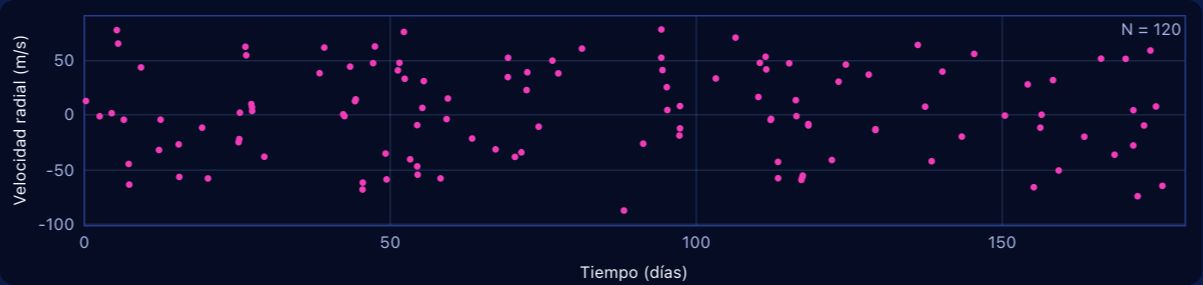
Periodogram: hunting periods in irregular data
A variable star (Cepheid, RR Lyrae) or an exoplanet by radial velocity with irregular observations (only at night, with gaps): Lomb–Scargle periodogram with the 1 % FAP line, daily aliases and spectral window, and the curve folded in phase with the detected period or the one you choose.
Estimate the age of the universe with galaxy data and a best-fit line.
Full project sheet: 4 weeks, materials, phases and rubric →
Calculate how many times brighter a magnitude 1 star is than a magnitude 6 star.