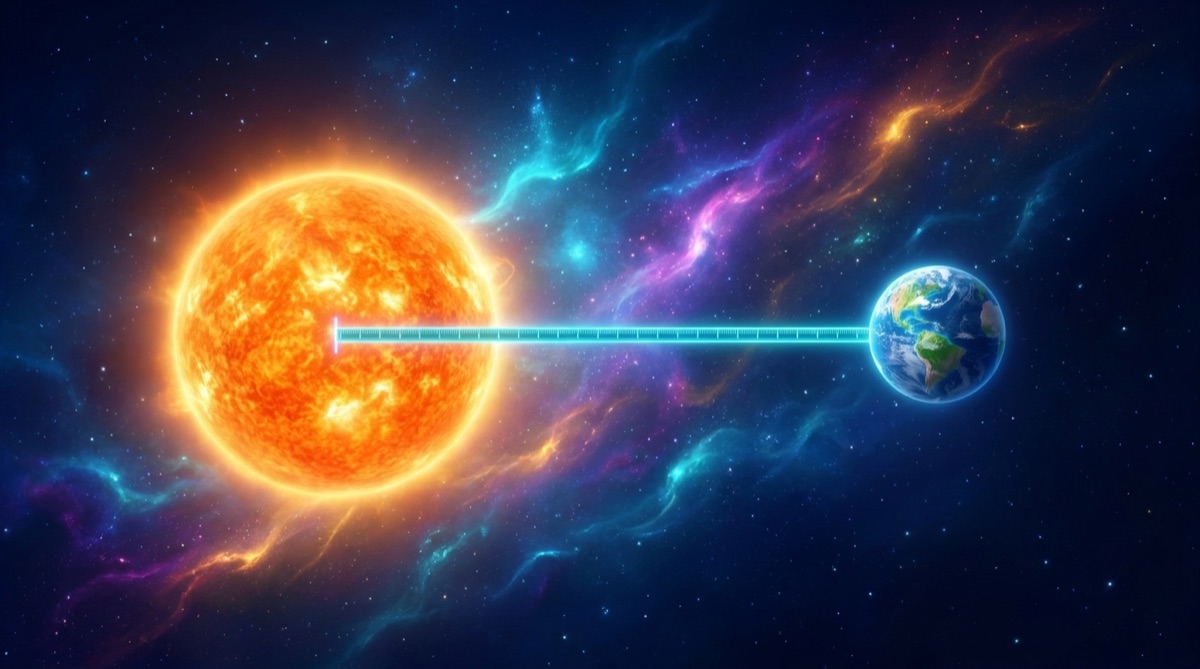
The Moon is about km away. The Sun, about km. The nearest star after the Sun, about km. Counting zeros like that is awkward and dangerous: it is very easy to miss one. Astronomers use powers of 10.
1. Powers of 10

A power of 10 is the number 10 multiplied by itself several times. The exponent says how many times:
With a negative exponent, we divide:
Properties (with and integers):
2. Scientific notation
A number is in scientific notation if it is written as
The number (the mantissa) carries the significant figures; the exponent says “where the decimal point goes.”
Worked example 1: writing in scientific notation
- (the decimal point moved 5 places to the left).
- .
- (the decimal point moved 4 places to the right).
Worked example 2: multiplying and dividing
Multiply (or divide) the parts and add (or subtract) the exponents:
Look at the last step: and do not satisfy , so the decimal point and the exponent are readjusted.
Worked example 3: adding and subtracting
To add, you need the same exponent: . If the exponents are very different, the small one hardly counts: .
3. Distance units in astronomy
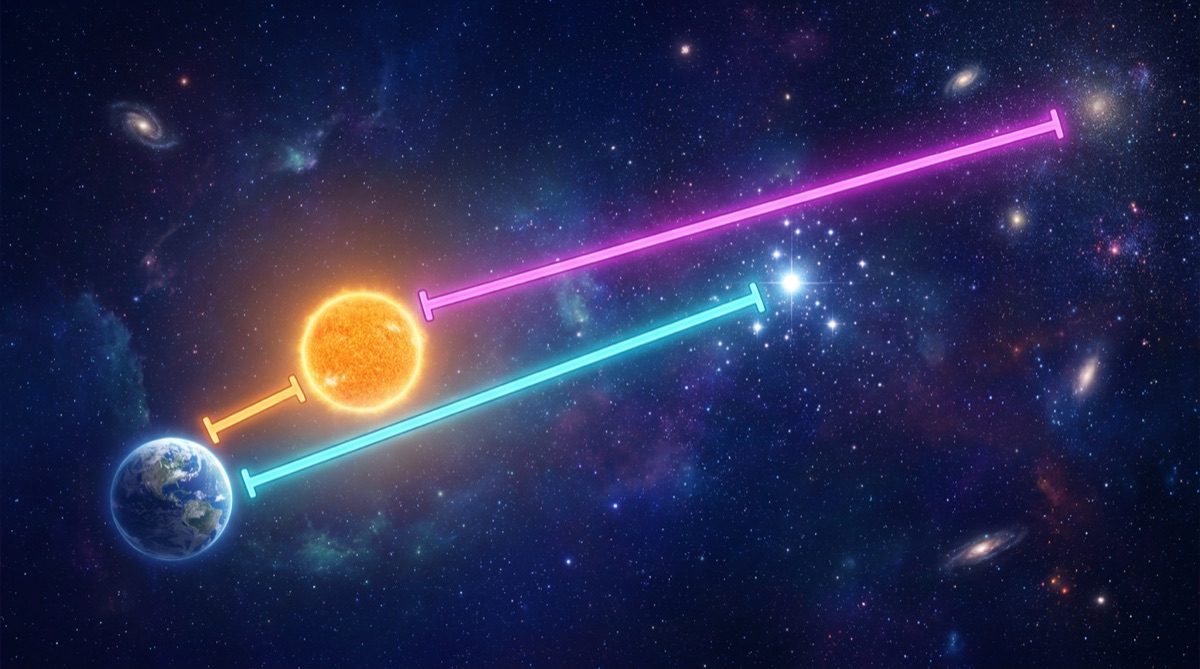
The kilometer falls short. Astronomers use three more units (lesson 6 of this module studies them in depth):
| Unit | Symbol | Definition | In kilometers |
|---|---|---|---|
| Astronomical unit | au | Mean Earth–Sun distance (fixed exactly by the IAU in 2012: m) | km |
| Light-year | ly | Distance light travels in one Julian year (365.25 days) | km |
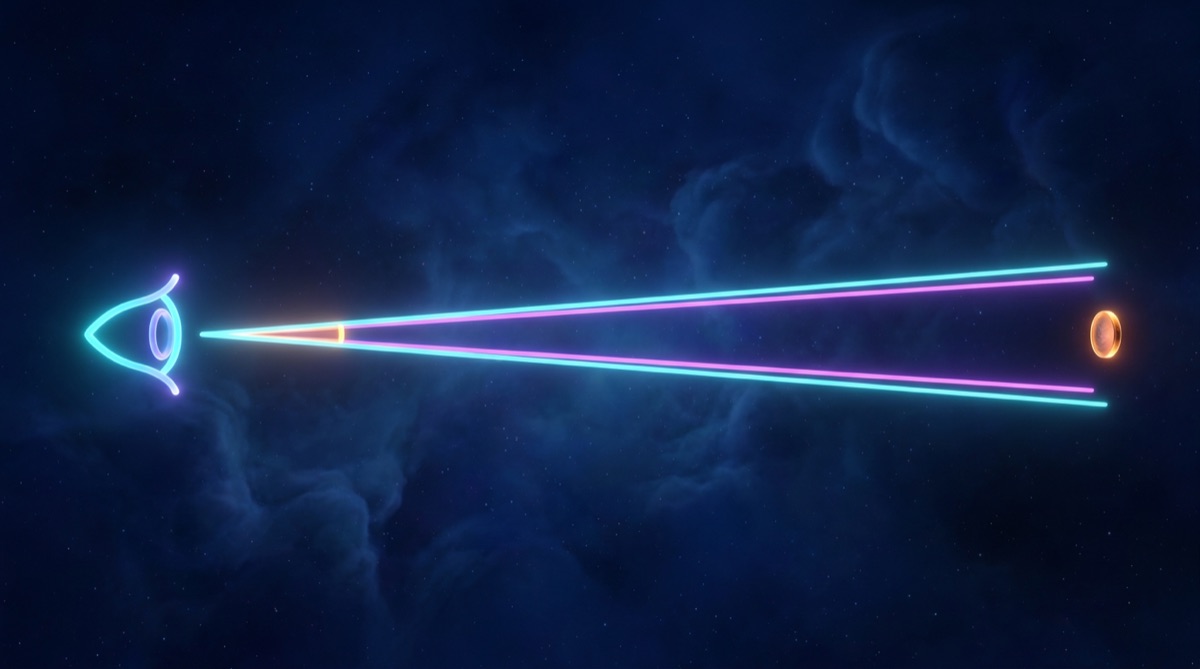
| Parsec | pc | Distance at which 1 au is seen under an angle of 1 arcsecond ( au) | km |
Useful equivalences (rounded): ; .
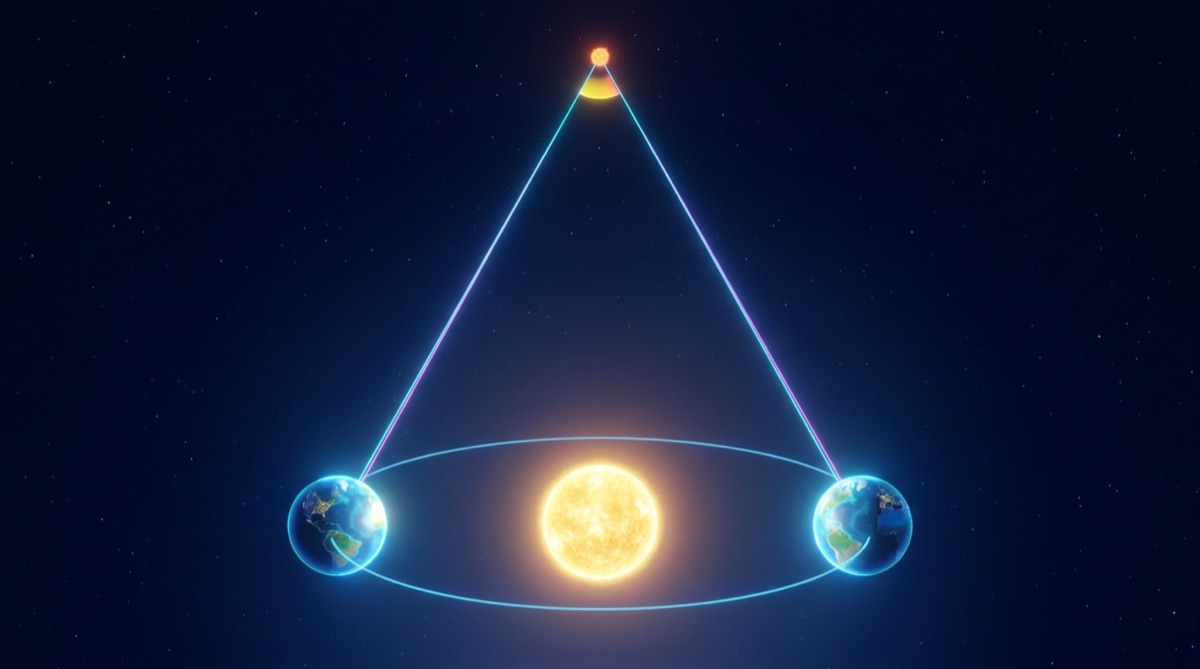
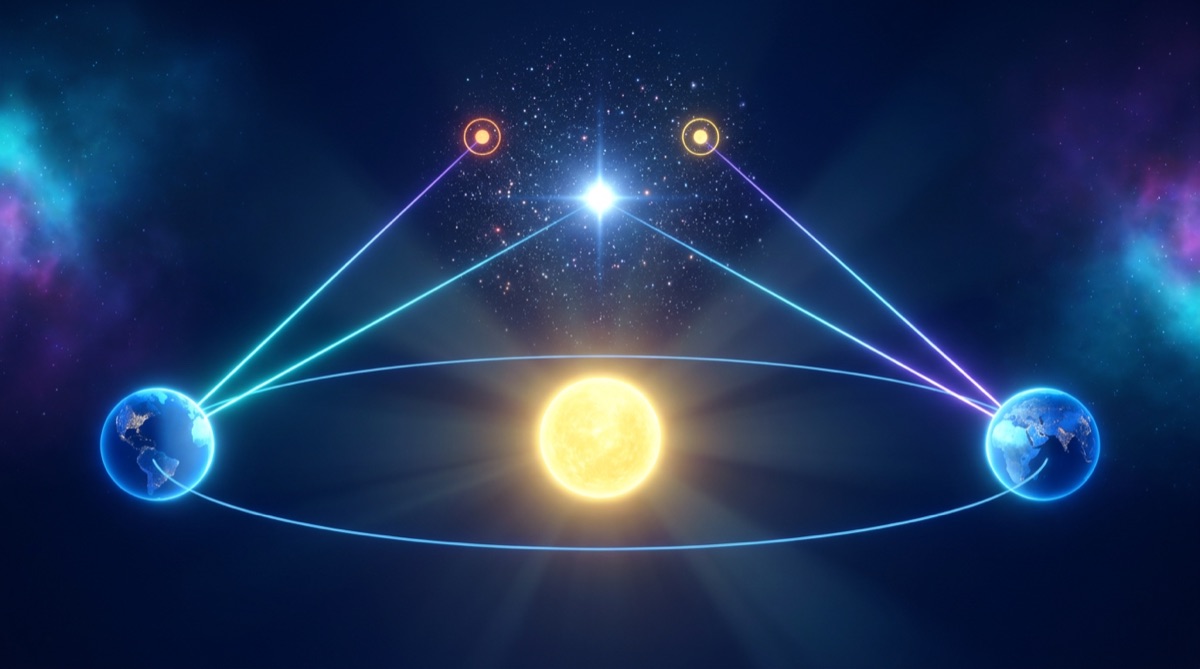
The parsec comes from parallax (lesson 1 of this module).
Worked example 4: converting with a conversion factor
Jupiter is au from the Sun. How many km is that?
The fraction equals 1 (top and bottom are the same length), so we can multiply by it without changing the distance. The unit “au” cancels out.
Worked example 5: the nearest star
Proxima Centauri is about ly away.
4. A journey in powers of ten: from the atom to the observable universe

Each row is about ten times (or more) larger than the previous one. The figures are rounded; what matters is the exponent, the order of magnitude.
| Object or distance | Approximate size | Power of 10 (m) |
|---|---|---|
| Nucleus of an atom | m | |
| A hydrogen atom | m | |
| A bacterium | m | |
| Thickness of a hair | m | |
| A child at your school | m | |
| A soccer field | m | |
| A large city, side to side | tens of km | |
| Colombia, north to south | km | |
| Diameter of the Earth | km | |
| Earth–Moon distance | km | |
| Diameter of the Sun | km | |
| Earth–Sun distance (1 au) | km | |
| Sun–Neptune distance ( au) | km | |
| Voyager 1 probe (2026, au) | km | |
| Nearest star ( ly) | km | |
| Diameter of the Milky Way ( ly) | km | |
| Andromeda Galaxy ( million ly) | km | |
| Radius of the observable universe ( million ly) | km |
From an atomic nucleus to the edge of the observable universe there are about 40 orders of magnitude; from a child to the edge of the universe, 26: you would have to multiply by 10 twenty-six times.
Careful. The size of the Milky Way depends on where you put the “edge” (the disk does not end abruptly), which is why it is written (“of the order of”). The position of Voyager 1 changes every day: it moves about au per year.
5. Explore with the simulator

- Choose the Sun as a 1.6 cm marble. Read how far away the Earth ends up, and how far Neptune. Write both in scientific notation, in meters.
- Divide Neptune’s distance by the Earth’s. What number do you get? Does it depend on the size chosen for the Sun? Explain why.
- Switch to a 1 m sphere and calculate how many kilometers away Proxima Centauri would be: the scale is and the star is m away.
Activity: the school’s powers-of-ten line
You need: a 10 m rope or ribbon, 20 cards, markers, adhesive tape, the table from section 4.
- Mark the rope every 25 cm: each mark is one more power of 10 (, , …, ). Careful! Here the rope is not to scale: between neighboring marks the real size is multiplied by 10.
- Write one card per row of the table (object, size and power) and hang it at its mark. Add at least three objects of your own: the height of the school, the distance to the capital of your department (province), the length of your country from east to west…
- Research a figure missing from the table (for example, the diameter of Jupiter or the distance to Saturn), write it in scientific notation with its source and hang it up.
- Walk along the rope reading aloud: “here the Earth fits; ten Earths later…”. How many marks separate the Earth from the Sun? And the Sun from Proxima Centauri?
Final question: if the rope were at true scale with 1 cm for the child, how long would it be out to the observable universe? (Hint: cm km.)
Exercises
Level 1 — practice
- Write in scientific notation: (a) km; (b) m; (c) km/s.
Show solution
(a) km; (b) m; (c) km/s.
- Write in decimal form: (a) ; (b) .
Show solution
(a) ; (b) .
- Calculate and leave in scientific notation: (a) ; (b) ; (c) .
Show solution
(a) ; (b) ; (c) .
Level 2 — apply
- Saturn is about au from the Sun. Express it in km.
Show solution
km.
- How many Earths (diameter km) fit, one after another, between the Earth and the Moon?
Show solution
Earths.
- Sirius is about ly away. How many parsecs is that? How many km?
Show solution
pc; km.
- If Voyager 1 is about au away, what fraction of a light-year is that? Write it in scientific notation.
Show solution
ly (less than three thousandths of a light-year).
Level 3 — challenges
- Solar system model. If the Sun were a ball m in diameter, how far away would the Earth be and how big would it be? And how far away would Proxima Centauri be? (Use the data from the table.)
Show solution
The scale is . Earth: at m, with a diameter of m mm (a chickpea). Proxima Centauri: at m km, more than twice the real diameter of the Earth!
- How many orders of magnitude are there between the diameter of the Earth and the distance to Andromeda? And between an atom and a child?
Show solution
: fifteen orders of magnitude. : ten orders of magnitude.
- A common mistake is to write . Explain what the mistake is and give the correct result.
Show solution
When multiplying powers of the same base, the exponents are added, not multiplied: .
✦ Mini-quiz
Key takeaways
- Scientific notation: with . Multiply: add exponents. Divide: subtract exponents. Readjust the mantissa at the end.
- is a small, positive number: .
- km; km; km ly.
- An order of magnitude is a factor of 10. From the atom to the observable universe there are about 40.
🍎 Teacher guide
- Time
- 2 sessions of 55 min + setting up the powers-of-ten line
- Colombian national standard (MEN)
- Mathematics, Grades 6 to 7: “I solve and formulate problems whose solution requires exponentiation or roots”; “I justify arithmetic procedures using the relations and properties of the operations”; “I identify relations between different units used to measure quantities of the same magnitude”; “I solve and formulate problems that require estimation techniques”. Natural Sciences, Grades 6 to 7: “I use mathematics as a tool to organize, analyze and present data”; “I look for information in different sources”; “I evaluate the quality of the information, choose what is relevant and give the corresponding credit”.
- Evidence of learning
- Converts between scientific and decimal notation in both directions, works out products and quotients readjusting the mantissa, converts distances between km, au, ly and pc, and correctly places at least ten objects on the powers-of-ten line, citing the source of the new data.
Materials
- Scientific calculators
- 10 m rope or ribbon, cards, markers and adhesive tape
- Printed powers-of-ten table
- Computer or tablet with the simulator
- Ball and chickpea for exercise 8 in the schoolyard (optional)
Suggested sequence
Session 1. Powers and scientific notation (55 min). Opener: write the distance to Proxima Centauri in km on the board with all its zeros and ask students to read it; motivate the need for a notation. Development: sections 1 and 2 with examples 1 to 3; exercises 1 to 3 in pairs. Closing: simulator challenge 1.
Session 2. Units and orders of magnitude (55 min). Opener: table of units (section 3) and examples 4 and 5. Development: the powers-of-ten journey table; exercises 4 to 7; simulator challenges 2 and 3. Closing: exercise 8 in the schoolyard (ball and chickpea) and mini-quiz.
Project (one week). Setting up the powers-of-ten line in the hallway with researched and cited cards; it connects with the “Master of Powers” badge (ten cosmic distances in scientific notation).
Connection. Lesson 6 of this module goes deeper into the official definitions of au, light-year and parsec; lesson 3 (Grade 8) develops the light-year from the linear function .
Common mistakes
- Multiplying the exponents when multiplying powers (10³ × 10⁴ = 10¹²). Go back to the definition: count the tens.
- Believing that 10⁻³ is negative. Write it as a fraction and as a decimal.
- Leaving mantissas outside [1, 10) (15 × 10⁷). Always ask for the final readjustment.
- Taking the light-year as a unit of time. Rephrase: “light takes that many years to get here from there”.
- Thinking that the rope in the activity is to scale. Make clear that each mark multiplies by 10 and ask for the calculation of the final question.