1. Motivation: three clocks that do not keep the same time

To point a telescope at a star one needs to know how far the Earth has turned; to integrate the orbit of an asteroid one needs a uniform time in which Newton’s (or Einstein’s) equations hold; and for a wall clock to be of any use, noon must fall close to 12. No single clock satisfies those three needs: the Earth’s rotation is irregular (and slowing down), atomic clocks are uniform but know nothing about the Sun, and relativity makes a clock on the Earth’s surface and one at the barycenter of the Solar System tick at different rates. Hence the family of scales in this lesson.
A word of caution: many of the quantities below cannot be computed, only measured: the offset UT1 − UTC is published weekly by the IERS (Bulletin A) and leap seconds are announced six months in advance (Bulletin C). The values in this lesson are those in force on October 29, 2026, and they have an expiration date.
2. The family of scales

2.1 Atomic scales: TAI and UTC
- TAI (International Atomic Time): weighted average of more than 400 atomic clocks, realized by the BIPM. It is uniform by construction; its unit is the SI second on the geoid.
- UTC (Coordinated Universal Time): runs at the rate of TAI but is kept within 0.9 s of UT1 by inserting leap seconds (always at the end of a June 30 or a December 31). Since January 1, 1972 the difference is an integer number of seconds:
Between 1972 and 2016, 27 leap seconds were inserted (starting from 10 s in 1972); the full list is in SEGUNDOS_INTERCALARES of src/lib/math/tiempo.ts. Since 2017 there has been none: the Earth’s rotation has sped up slightly and UT1 − UTC is now negative and decreasing, so that a possible leap second would be negative, something that has never happened. The General Conference on Weights and Measures decided in 2022 to abandon leap seconds by 2035 at the latest.
2.2 Dynamical scales: TT, TDB, TCG, TCB
- TT (Terrestrial Time): the proper time of an ideal clock on the geoid, that is, the time in which geocentric ephemerides are expressed. It is realized from TAI with a fixed historical offset:
(IAU 2000 Resolution B1.9 defines it with relativistic precision: TT differs from TCG, Geocentric Coordinate Time, by the constant rate .)
- TDB (Barycentric Dynamical Time): the argument of the planetary ephemerides (JPL DE). Defined by IAU 2006 Resolution B3 as a linear transformation of TCB: with , s and . The difference TDB − TT is periodic, of amplitude ms, dominated by the eccentricity of the Earth’s orbit (variable gravitational and kinematic time dilation):
with in Julian millennia of TT since J2000.0 (leading terms of Fairhead & Bretagnon 1990, as given in SOFA dtdb; tdbMenosTt includes six terms). For almost all observational astronomy TDB ≈ TT.
2.3 Rotational scales: UT1 and ΔT
- UT1: defined by the Earth rotation angle (§5). It is the scale the observer needs, and it is irregular: it fluctuates because of tides, winds, the core… and slows down in the long run (the length of the day grows by about 1.8 ms per century on historical average, Stephenson, Morrison & Hohenkerk 2016; tidal friction alone would give 2.3 ms).
- UT1 − UTC (DUT1): measured by the IERS with VLBI and published in Bulletin A. Value for October 22, 2026: s; prediction for November 10: s.
- ΔT = TT − UT1: the quantity that must be added to universal time to obtain ephemeris time. Today
Historically ΔT was around 1900, s in 1958 (hence the constant s, which made TT continuous with the old ephemeris time scale at the instant TAI began), s in 2000 and s in 2026; for dates before 1620 it is known only from ancient eclipses, with uncertainties of minutes or hours (Morrison & Stephenson). That uncertainty is what limits, for example, knowing where an eclipse of the year 1000 was visible.
3. Julian day

3.1 Definition
The Julian day (JD) counts days (and fraction) from noon on January 1, 4713 BCE of the proleptic Julian calendar. It is a continuous number, without months or leap years, ideal as the argument of polynomials. It can refer to any scale: JD(UTC), JD(TT), JD(UT1)… Reference points:
The MJD (modified Julian date) starts at midnight (of November 17, 1858) and has fewer digits; it is the one used by the IERS bulletins (MJD 61335 = October 22, 2026). A Julian century is 36 525 days, and the usual variable in the formulas is
3.2 Algorithm (Meeus eq. 7.1)
For the Gregorian calendar, with , , (day with fraction): if , set , (so that February is the last month of the year and the leap day falls at the end). With and (the Gregorian century correction),
The term generates the sequence of accumulated days 31, 30, 31, 30, 31, 31, 30, 31, 30, 31, 31 from March to January (the avoids rounding errors); the distributes the leap years. It is implemented in jdDesdeCalendario, with its inverse calendarioDesdeJD; the test checks Meeus’s example 7.a (1957 October 4.81 → 2436116.31, the launch of Sputnik) and J2000.0.
4. Solar day and sidereal day
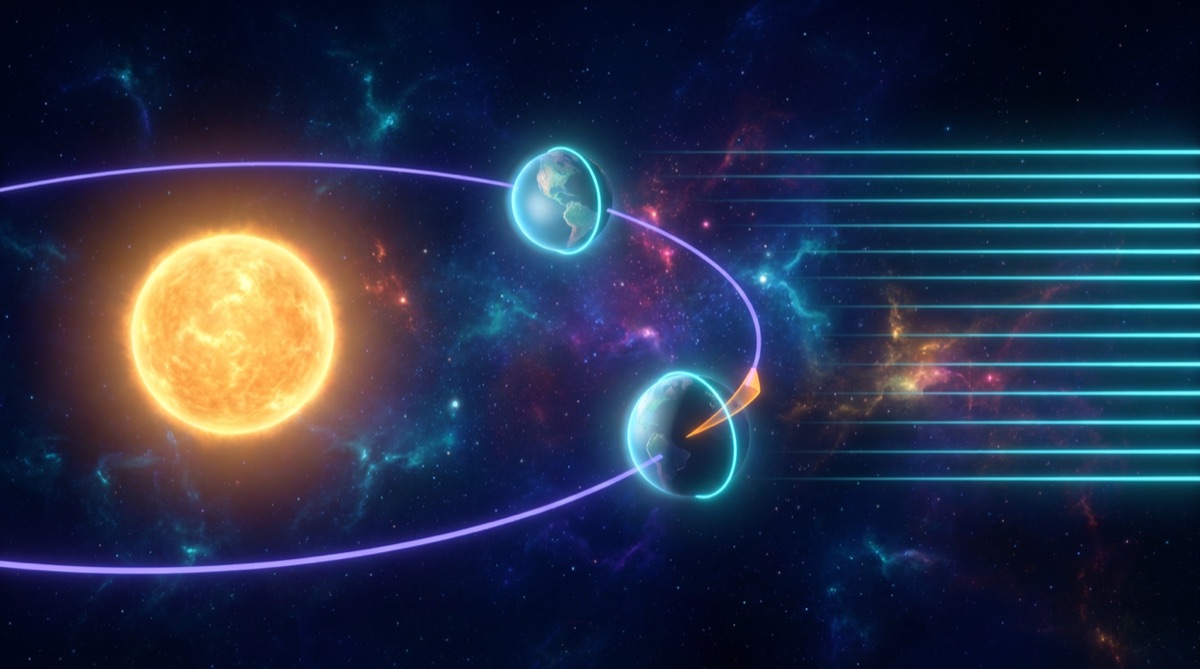
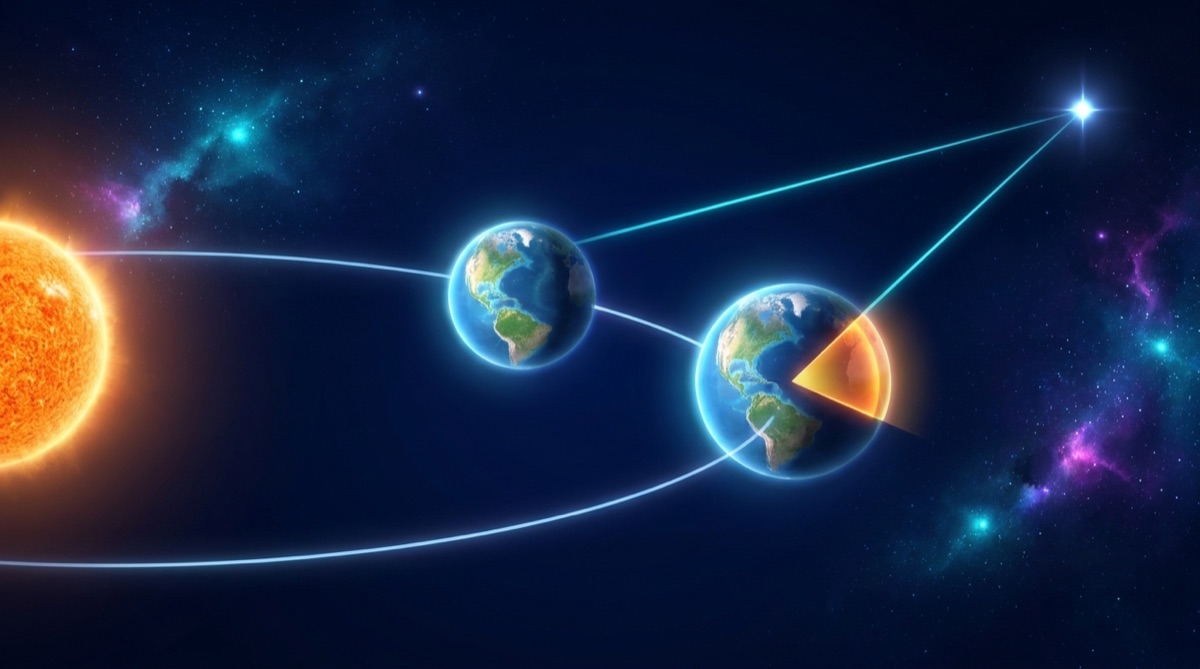
The Earth completes one turn with respect to the stars in a sidereal day; with respect to the Sun, in a solar day, somewhat longer because the Earth advances in its orbit by per day and must turn through that extra angle. If a tropical year contains solar days, it contains exactly sidereal rotations (one extra turn for the trip around the Sun):
The IAU fixes the rate precisely in the definition of the rotation angle (§5): revolutions per UT1 day, which gives a stellar day (one turn with respect to the non-rotating celestial intermediate origin) of s. The mean sidereal day (one turn with respect to the mean equinox, which precesses) is s shorter, s, because the equinox drifts westward and the Earth reaches it sooner. Both values are computed by tiempo.ts from the IAU constants and checked by the test.
5. Earth rotation angle and sidereal time

5.1 ERA
Since the IAU 2000 resolutions, the rotation of the Earth is described by the Earth rotation angle (ERA), , the angle between the celestial intermediate origin (CIO) and the terrestrial intermediate origin, linear in UT1 by definition (IERS Conventions 2010, eq. 5.15):
This is the very definition of UT1. At J2000.0, .
5.2 GMST (IAU 2006)
Greenwich mean sidereal time is the hour angle of the mean equinox of date. Since the equinox precesses with respect to the CIO, GMST = ERA + (accumulated precession in right ascension), a polynomial in Julian centuries of TT (Capitaine, Wallace & Chapront 2005; SOFA gmst06):
with . The term per century ( per year s of time per year) is the general precession in right ascension. Note the double argument: UT1 for the rotation, TT for the precession; using UT1 in the polynomial introduces an error of arcseconds, negligible, but using UTC instead of UT1 in the ERA introduces an error of ms of time today, and up to 0.9 s in the worst case. It is the first systematic error made by anyone who “uses the computer’s clock.”
5.3 The classical formula (Meeus eq. 12.4)
In practice, at arcsecond precision, one uses the polynomial form in degrees derived from the IAU 1982 expression (Aoki et al. 1982), which is the one implemented by gmst in src/lib/math/coordinates.ts and in the previous lesson:
The two expressions differ by less than 4 ms of time (0.06″) between 1987 and 2030 (test tiempo.test.ts): the difference is due to the IAU 1976 versus IAU 2006 precession constants. For teaching purposes, and for the simulator, Meeus’s formula is sufficient.
5.4 GAST and local sidereal time
Apparent sidereal time (GAST) refers the hour angle to the true equinox, affected by nutation: , where is the equation of the equinoxes (up to s of time; next lesson). Local sidereal time is obtained by adding the observer’s longitude, positive eastward: ; the hour angle of a body is then .
6. Worked example

Instant: 2026 October 22, 0 00 00 UTC. Observer: Bogotá, (city center). IERS data: TAI − UTC = 37 s; UT1 − UTC = −0.04286 s (Bulletin A, observed value for that day).
- Julian day. , , : , ; , . ; (matching the bulletin).
- Scales. s, hence . s. . ms (orbital phase: in late October the Earth is approaching perihelion).
- ERA. ; revolutions ; the fractional part gives .
- GMST. ; polynomial . . With Meeus’s formula: (4 ms more).
- GAST. With the nutation of date (next lesson; Meeus’s short series) and : equation of the equinoxes s. .
- Local. . ; .
Interpretation: at midnight UTC (19 h Bogotá time) the bodies with culminate in Bogotá. All values are reproduced with tiempo.ts and reduccion.ts; the dominant error in the result is that of the short nutation series (, i.e. 0.03 s).
7. Error analysis: what matters and what does not

| Source | Size | Effect on the hour angle |
|---|---|---|
| Using UTC instead of UT1 | s (today 0.043 s) | up to (today ) |
| Ignoring ΔT in the TT argument of the ephemerides | 69 s | the Moon moves /s: ; the Sun, |
| Ignoring TDB − TT | ms | for the Moon |
| Meeus GMST instead of IAU 2006 | 4 ms | |
| Ignoring the equation of the equinoxes (GMST instead of GAST) | s | up to |
| Rounding the longitude to |
Moral: for arcsecond precision what matters is ΔT (in the ephemerides), the equation of the equinoxes and the observer’s longitude, not the difference between GMST formulas nor TDB − TT.
What to observe. The simulator computes local sidereal time with Meeus’s formula from the system’s UTC time (without ΔT or DUT1). Set the date of the example and check which right ascension culminates at 19:00 Bogotá time. Then advance exactly 24 h: the sky has moved ahead by .
Problems
1. (Sidereal day). Prove that if the tropical year has mean solar days, it contains exactly sidereal days, and compute the sidereal day with . Why does the IAU value of the stellar day (86164.0989 s) not coincide exactly with that result?
Show solution
Let be the angular velocity of rotation with respect to the stars and the mean orbital angular velocity (same sense). The Sun returns to the meridian when the Earth has turned plus the orbital angle traversed: , hence . In one year, the number of sidereal turns is . Thus s: the mean sidereal day (the turn with respect to the equinox, which is what the tropical year measures), in agreement with the value deduced from the IAU constants. The stellar day (turn with respect to a non-rotating origin) is obtained with the sidereal year, d: s, which is ms more than the IAU value s. The discrepancy reveals the hidden assumption of the argument: that the mean solar day lasts exactly SI seconds, when today it lasts – ms longer; the IAU constants refer to UT1 days, and was chosen so that UT1 would be continuous with the old definition based on GMST.
2. (Julian day algorithm). Prove that , for (March to February), generates the accumulated days at the beginning of each month counted from March 1, and explain why the 0.0001 is necessary.
Show solution
for : . The integer parts minus 122 are , and the consecutive differences are : the lengths of March, April, …, January. It works because distributes one extra day every five thirds of a month, which is exactly the 31–30 alternation with the July–August exception (both of 31), which falls where the accumulated fraction goes from 0.8 to 0.4. The cases and give exactly and : in binary arithmetic may evaluate to and the floor would give 152; the prevents this without affecting any other value (the margin to the next integer is ).
3. (ΔT and the Moon). The Moon advances in right ascension by per second of time. A program computes the position of the Moon for 03:00:00 UTC on October 22, 2026 using as the argument of the ephemeris (which expects TT). What error does it make? And if it uses UT1? And for the year 1600, with s?
Show solution
Error /s. With UTC: (more than the diameter of a large crater; at magnification it is noticeable). With UT1: s, practically the same (); the difference between UTC and UT1 (0.04 s) costs only . In 1600: , but the uncertainty of ΔT at that epoch is several seconds, so even with the correction one cannot get below a few arcseconds. For the Sun (/s) the current error would be : small, but larger than the precision of any modern ephemeris.
4. (Equation of the equinoxes). Prove that the displacement of the true equinox with respect to the mean equinox, measured along the equator, is to first order, and bound its maximum value in seconds of time.
Show solution
The nutation in longitude displaces the equinox along the ecliptic. In the infinitesimal spherical triangle formed by the mean equinox , the true equinox (at distance along the ecliptic) and the foot of the perpendicular from to the equator, the angle at is , hence the leg along the equator measures (and the other, , is a displacement in declination that does not affect the hour angle). Since and : s of time (1 s of time ). In the worked example it equals s.
5. (Secular drift). The length of the day increases by about ms per century (average over the last 2700 years, Stephenson, Morrison & Hohenkerk 2016). Prove that ΔT then grows quadratically with time and estimate ΔT for the year with the parabola . Compare with the value a linear extrapolation from today would give.
Show solution
If the excess length of the day is with ms/century (and in centuries), the accumulated lag of the rotational clock is . With century: s: hence the coefficient s per century². For : centuries, s h. A linear extrapolation from today (between 2000 and 2026 ΔT grew by s/yr, and in recent years hardly at all) would give s, with the wrong sign: the physics (tidal braking) demands the parabola. The vertex at 1820 is the epoch when the day lasted exactly 86 400 SI seconds, because of the way the second was defined.
6. (Computational). Write a function that, given year, month, day, hour, minute and second UTC and the longitude, returns JD, MJD, JD(TT), ERA, GMST (IAU 2006 and Meeus), their difference in ms, and the LMST. Verify with Meeus’s example 12.a (1987 April 10, 0 UT → GMST ) and with the worked example of §6. Then plot the difference IAU 2006 − Meeus between 1900 and 2100.
Show solution
import numpy as np
def jd(Y, M, D, h=0, m=0, s=0):
    D += (h + m/60 + s/3600)/24
    if M <= 2: Y, M = Y-1, M+12
    A = Y//100; B = 2 - A + A//4
    return int(365.25*(Y+4716)) + int(30.6001*(M+1)) + D + B - 1524.5
def era(jd_ut1):
    Tu = jd_ut1 - 2451545.0
    return 2*np.pi*((0.7790572732640 + 1.00273781191135448*Tu) % 1)
def gmst06(jd_ut1, jd_tt):
    t = (jd_tt - 2451545.0)/36525
    p = 0.014506 + t*(4612.156534 + t*(1.3915817 + t*(-0.00000044 + t*(-0.000029956 - 0.0000000368*t))))
    return (era(jd_ut1) + np.radians(p/3600)) % (2*np.pi)
def gmst_meeus(jd_ut1):
    d = jd_ut1 - 2451545.0; T = d/36525
    return np.radians((280.46061837 + 360.98564736629*d + 0.000387933*T**2 - T**3/38710000) % 360)
def hms(x):
    h = x*12/np.pi; return f"{int(h)}h {int(h%1*60)}m {(h*60)%1*60:.4f}s"
TAI_UTC, DUT1 = 37.0, -0.04286
j = jd(2026, 10, 22); j_tt = j + (32.184 + TAI_UTC)/86400; j_ut1 = j + DUT1/86400
print(hms(gmst06(j_ut1, j_tt)), hms(gmst_meeus(j_ut1)))
print(hms(gmst_meeus(jd(1987, 4, 10))))   # 13h 10m 46.3668s
For 1987 one must use TAI − UTC s (in force since July 1985) and the DUT1 of the epoch ( s; for Meeus’s example UT1 = UT is taken directly). The plot of the difference is a smooth curve: ms from 1950 to 2050, growing quadratically outside that interval because of the different term in the two formulas.
✦ Self-assessment
Further reading
- Explanatory Supplement to the Astronomical Almanac, 3rd ed. (2013), ch. 3: the complete reference on time scales, with the history of ET, TDT and TDB; ch. 6 for ERA, GMST and the relation to precession.
- IERS Conventions (2010), ch. 5 (eq. 5.15, ERA) and ch. 10 (relativistic time scales); Bulletins A and C at iers.org.
- Capitaine, Wallace & Chapront (2005), A&A 432, 355: derivation of the expression GMST(ERA, t) compatible with IAU 2006.
- Meeus (1998), chs. 7, 10 and 12: the algorithms as they are programmed, with numerical examples that serve as tests.
- Stephenson, F. R., Morrison, L. V. & Hohenkerk, C. Y. (2016). Measurement of the Earth’s rotation: 720 BC to AD 2015. Proc. R. Soc. A 472, 20160404: the historical determination of ΔT from eclipses.
- SOFA, Time Scale and Calendar Tools: diagram of the scales and conversion routines that are the de facto standard.
🍎 Teacher guide
- Time
- 2 classes of 90 min
- Learning outcome
- On completion, the student converts between UTC, TAI, TT, TDB and UT1 with the current offsets, computes the Julian day and the local sidereal time with the IAU 2006 and classical formulas, and quantifies the error of each approximation.
- Evidence of learning
- Submission of problem 6 (program verified against Meeus 12.a and against the worked example) together with the error table of §7 redone for the date of the class with the values of the current Bulletin A.
Materials
- Access to iers.org to download the day's Bulletins A and C
- Python 3 or a spreadsheet
- Reference code: src/lib/math/tiempo.ts and its test
- The portal's interactive Planisphere simulator
Suggested sequence
Class 1 (90 min). Opening (15 min): open the IERS Bulletins A and C live and read the day’s TAI − UTC and UT1 − UTC; discuss why one is an integer and the other is not. Development (60 min): map of scales (§2) with the chain UTC → TAI → TT → TDB and UTC → UT1; Julian day with the proof of problem 2; solar and sidereal day (problem 1). Closing (15 min): each student computes by hand the JD and the ΔT of their date of birth.
Class 2 (90 min). Opening (10 min): “how far has the Earth turned since J2000.0?” (ERA). Development (60 min): ERA, GMST IAU 2006 and Meeus’s formula; worked example of §6 step by step; error table of §7. Workshop: problem 6 with verification against Meeus 12.a. Closing (20 min): problems 3 and 4; mini-quiz. Homework: problem 5 and update the table of §7 with the values of the day’s Bulletin A.
Common mistakes
- Believing that UTC "is" universal time. Show UT1 − UTC in Bulletin A and the history of leap seconds.
- Adding 69 s to everything. Only the ephemerides (TT) need it; the rotation angle requires UT1, which is within tenths of a second of UTC.
- Confusing the sidereal day (equinox) with the stellar day (CIO), or the sidereal day with the sidereal year. Do problem 1 in full.
- Using TT in the ERA or UT1 in the precession polynomial without knowing which of the two errors matters (the first does: 69 s of rotation = 17′; the second does not).
- Forgetting that ΔT for historical dates is uncertain: always ask for an error bar, not a value, for dates before 1620.