How do you measure the distance to something you cannot touch, walk around, or reach with a beam of light that bounces back? For the nearest stars we use parallax: the small shift in position they show as the Earth moves from one side of its orbit to the other. But beyond a few thousand light-years, that shift is too small. At the start of the 20th century, nobody knew whether the “spiral nebulae” were inside our galaxy or were whole galaxies at unimaginable distances. The answer began with a woman measuring tiny specks on glass plates.
The Harvard computers
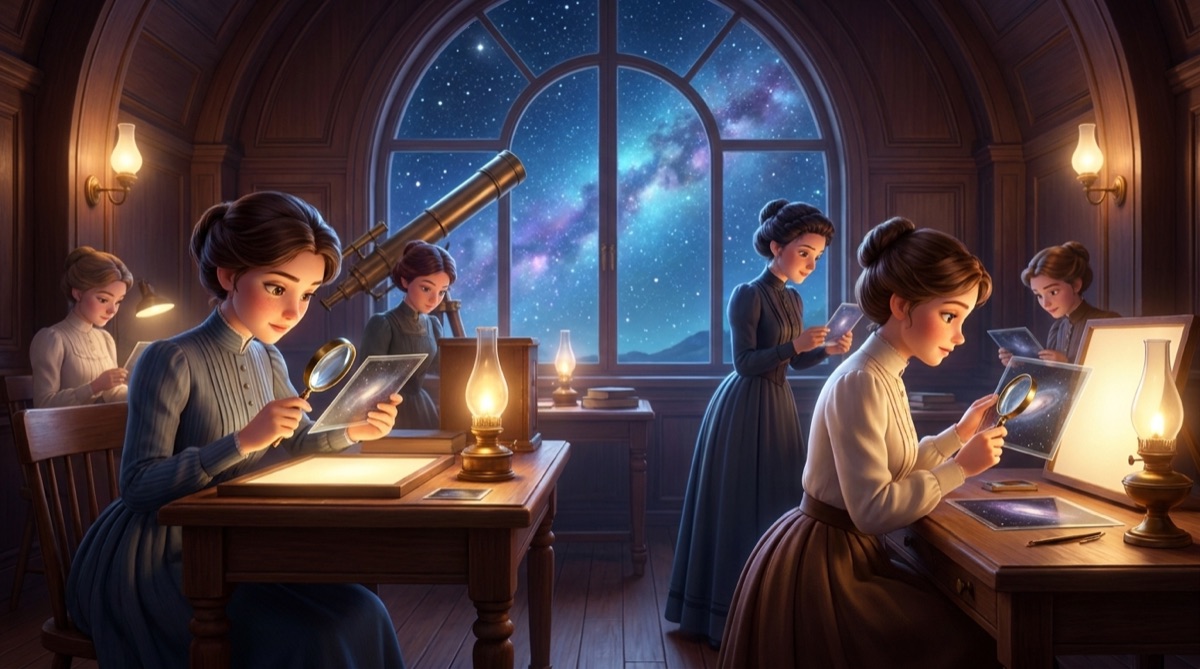
Henrietta Swan Leavitt (1868–1921) joined the Harvard College Observatory in 1895. The director, Edward Pickering, had hired a group of women (they were called computers) to examine the thousands of photographic plates arriving from the observatory Harvard ran in Arequipa, Peru. They were paid little and were not expected to do science of their own. Leavitt, who had been deaf since her youth, was given the task of looking for variable stars: stars whose brightness changes over time.
She focused on the Magellanic Clouds, two small galaxies that accompany the Milky Way and can only be seen from the southern hemisphere. Comparing plates from different nights, she found 1 777 variables, which she published in 1908. Already in that paper she slipped in a sentence that would change everything: the brighter variables seemed to have longer periods.
Three pages in 1912
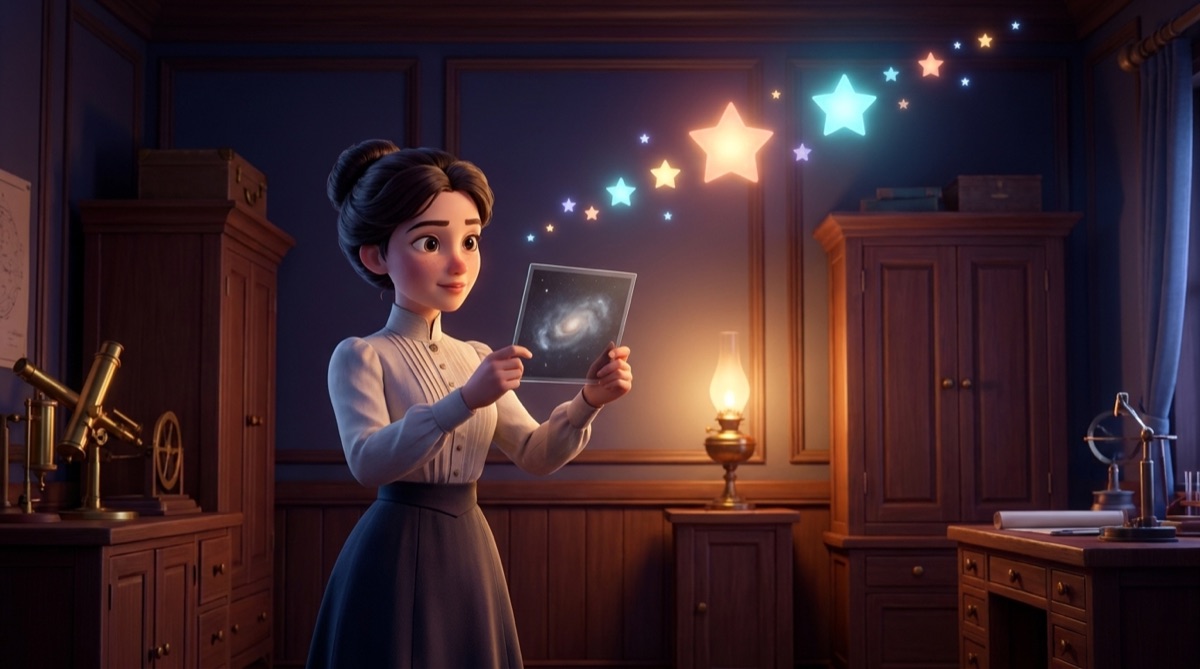
In 1912, Leavitt picked 25 of those stars, all in the Small Magellanic Cloud and all of the same type, the Cepheids: stars that swell and shrink in a regular rhythm, going from brighter to fainter and back again over a period ranging from one to more than a hundred days. She sorted them by period and noted their brightness. The result was an almost perfect line: the longer the period, the brighter the star.
The decisive fact was that all 25 were in the same small galaxy, that is, at approximately the same distance from us. So if one looked brighter than another, it was not because it was closer: it was because it really gave off more light. Leavitt wrote it with the caution of the time: since the variables are “probably at nearly the same distance”, their periods are related to their “actual emission of light”.
The paper bears Pickering’s name, as was customary for the observatory’s work, but its first line makes clear that it was prepared by Miss Leavitt. It is three pages long. Today the relation is called Leavitt’s law.
The key equation
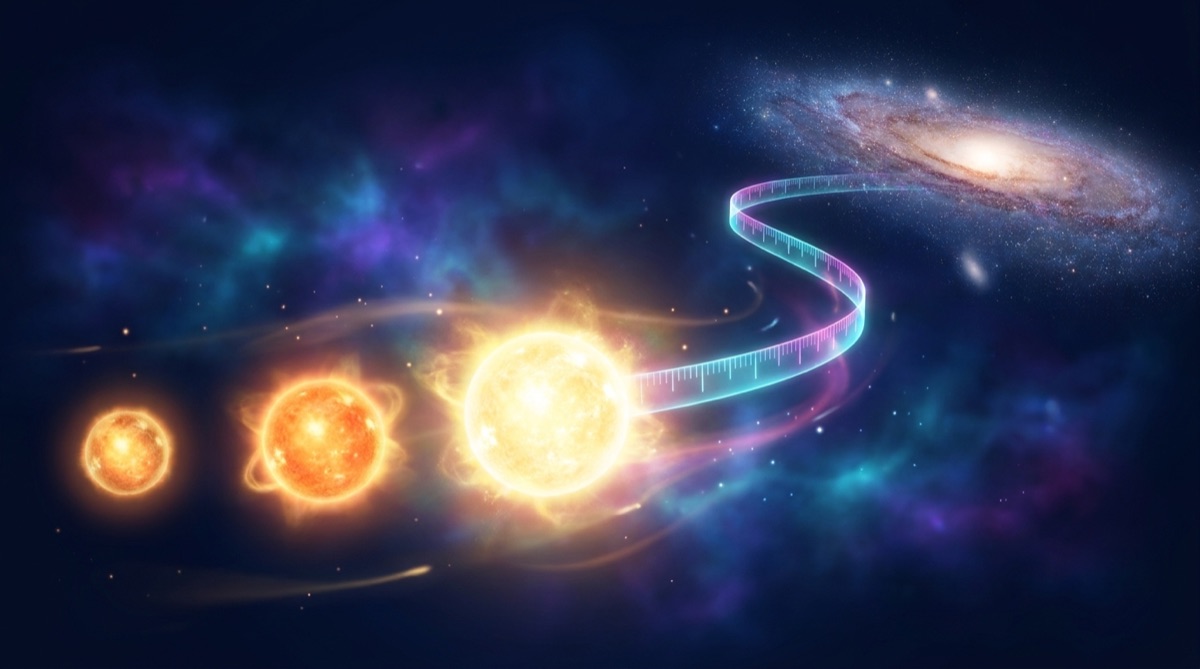
What Leavitt found can be written like this:
where is the true brightness of the Cepheid (its absolute magnitude), its period in days, and and are two fixed numbers obtained from Cepheids of known distance. In words: measure how long the star takes to pulse and you will know how much light it gives off. And if you know how much light it emits and see how much reaches you, the difference tells you the distance, because light fades with the square of the distance. A Cepheid is a light bulb with its wattage written in the rhythm of its flicker.
Leavitt could not calibrate the relation (she did not know the distance to the Magellanic Cloud), but in 1913 Ejnar Hertzsprung used nearby Cepheids, with measured parallax, to pin down and . Since then, every Cepheid in the universe carries its own measuring tape.
How do we know?
Cepheids opened the door to galactic distances within a decade. Harlow Shapley used them to measure the size of the Milky Way. And in 1923, Edwin Hubble found a Cepheid in the Andromeda “nebula” with the 2.5 m telescope at Mount Wilson; applying Leavitt’s law he obtained a distance of nearly a million light-years, far outside our galaxy. Andromeda was another galaxy, and the universe, all at once, became immensely bigger. A few years later, with Cepheids in more galaxies, Hubble discovered that the universe is expanding.
A century later we still depend on her. The SH0ES project, which measures the expansion rate of the universe with the Hubble telescope, relies on Cepheids in 42 galaxies as the first rung of its “distance ladder”. Every time you read that a galaxy is so many millions of light-years away, there is a Cepheid in the chain of reasoning.
Leavitt died of cancer in 1921, at the age of 53. In 1925, the Swedish mathematician Gösta Mittag-Leffler wrote to her to propose her for the Nobel Prize; he did not know she had died four years earlier. The prize is not awarded posthumously.
Key takeaways
- Cepheids are stars that pulse with a regular period, from days to months.
- Leavitt discovered in 1912 that the period reveals the true luminosity; measuring the period and the apparent brightness gives the distance.
- It worked because her 25 stars were all in the same small galaxy, at the same distance.
- With that law, Hubble showed in 1923–1929 that Andromeda is another galaxy and that the universe is expanding.
The inverse-square law and magnitudes, the other half of this story, are in the lessons Brightness, distance and magnitudes and Magnitudes and logarithms. Parallax, the first rung of the ladder, is in Parallax and trigonometry. And the role of Cepheids in the expansion of the universe, in The universe is expanding.