The idea in one line
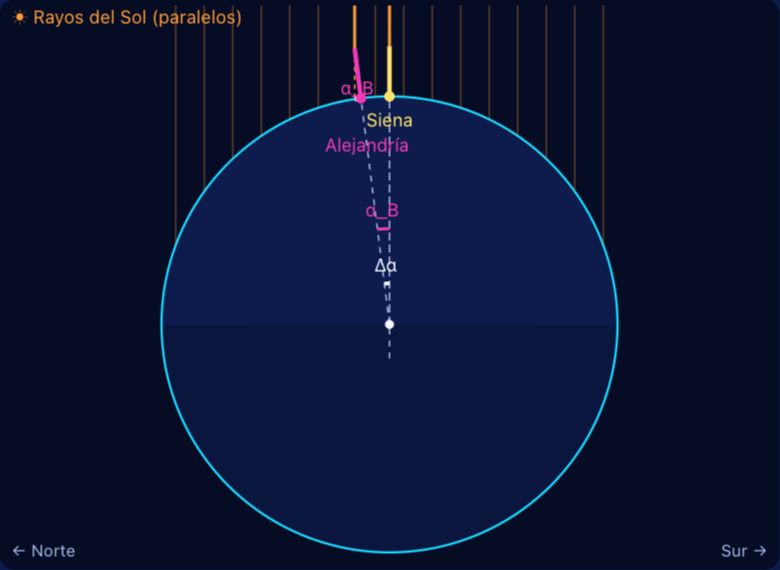
The Sun’s rays reach the whole Earth parallel to one another. In two cities on the same meridian, the angle between the shadow and the gnomon differs by exactly the angle that separates the two cities as seen from the center of the Earth (alternate interior angles). If the distance between them is ,
where is the Earth’s circumference and its radius. It does not have to be the equinox: it is enough that both schools measure on the same day, each at its own solar noon, because the Sun’s tilt is the same for both and cancels out when subtracting.
Project phases
Week 1 — Geometry and partner school
- With the lesson Angles, parallel lines and shadows we show with drawings that alternate interior angles are equal and that, therefore, the difference between the shadow angles is the central angle between the cities.
- We read the story in Eratosthenes measured the Earth and reproduce his calculation: of a circle and 5 000 stadia.
- We look for the partner school: as far north or south as possible and with a similar longitude (difference under 1°). We agree by email on the measurement date (a day with a clear forecast in both cities) and a plan B one week later.
- We write down the coordinates of both schools (atlas or digital map) and calculate the north–south distance between them: latitude difference × 111.2 km/°. This distance is kept “in a sealed envelope” until Week 4 (optional: it can also be measured on the map with its scale).
Week 2 — The gnomon and the trial run
- We build the gnomon and check with the plumb line that it is vertical and with the level that the ground is horizontal. We measure its height to the millimeter.
- Noon trial: starting 40 minutes before the expected noon (in Colombia, between 11:15 and 12:30 depending on the city and the date) we mark the tip of the shadow every 3 minutes. The shortest one is the solar-noon shadow; we note its time.
- With the simulator Eratosthenes measures the Earth we rehearse the calculation with data from two cities and see how the result changes if the angle is off by half a degree.
- We agree with the partner on the format of the data sheet: date, time of the shortest shadow, , (shadow), direction of the shadow, name of the person who measured, sky conditions.
Week 3 — Measurement day
- Each school measures at its solar noon the shortest shadow and the height of the gnomon. We repeat the measurement of three times with different people and take the average.
- We calculate the angle between the Sun’s ray and the gnomon: we draw to scale the right triangle with legs and on graph paper and measure the angle at the tip of the shadow with the protractor (or we use the table from the lesson; in Grade 7, ).
- We note whether the shadow points north or south: if it points the same way in both cities, is the difference of the angles; if it points opposite ways (the Sun is between the two latitudes), it is the sum.
- We send the data sheet to the partner the same day.
Week 4 — The calculation
- With the two angles we calculate and, opening the envelope, with we calculate and .
- Example with the lesson’s data: Bogotá and Santa Marta, km and : km and km.
- We compare with the reference value km: absolute error and percentage error . Goal: less than 10 %.
- Error propagation: we recalculate with . With , half a degree is almost 8 %: the result changes by that same proportion. That is the main source of error in the method.
Week 5 — Joint report and video call
- We write the report with the sections: question, method, data from both schools, calculation, error and its causes (verticality, blurred edge of the shadow, time, distance), conclusions.
- Video call with the partner: each school presents its data and we compare results. If each one calculated separately, do they agree? (They should: it is the same calculation.)
- We discuss the lesson’s question: to measure we used a map made by people who already knew the size of the Earth; how would we measure without a map? (A vehicle’s odometer, travel time, GPS…)
Week 6 — Poster and wrap-up
- Poster for the school: “We measured the Earth: ___ km (error ___ %)”, with a drawing of the two gnomons, the parallel rays and the central angle.
- We collect ideas for the next measurement: what would we improve? (A taller gnomon, more repetitions, a clearer day, a more distant partner.)
- Optional: send the data to next year’s Eratosthenes lesson as the school’s own worked example.
Mathematics in the project
- Alternate interior angles: two parallel lines (the Sun’s rays) cut by a transversal (the extension of a gnomon to the center of the Earth) form equal alternate interior angles. That is why is, at the same time, the difference between the shadow angles and the central angle.
- Proportion: is to as is to . It is a rule of three: .
- From to : , with .
- Percentage error: .
- Sensitivity: if changes by , changes by approximately the same (in the opposite direction), because is inversely proportional to .
Assessment rubric
| Criterion | Developing | Achieved | Advanced |
|---|---|---|---|
| Geometry of the method | Repeats the formula without justifying it | Explains with a drawing why alternate interior angles give the central angle | Explains why the equinox is not needed and when the angles are added or subtracted |
| Measurement | Measures once, without checking verticality | Checks vertical and horizontal, repeats three times and finds solar noon | Records everything (time, direction, sky) and estimates the uncertainty of and |
| Calculation and error | Obtains with help | Calculates , and the percentage error correctly | Analyzes the propagation of and ranks the causes of error by importance |
| Communication and collaboration | Takes little part in the exchange | Delivers the complete joint report and presents in the video call | Proposes concrete, verifiable improvements for a new measurement |
Variants and extensions
- Without a partner: practice the full method with the ball from the lesson (activity “Eratosthenes with a ball”) or use the lesson’s data for Bogotá or Santa Marta as the second city.
- Three or more schools: with several pairs you get several values of ; calculate the average and the spread.
- Grade 7: repeat with and express in scientific notation ( km); compare with the current value and discuss significant figures.
- Length of the day: on the same day, each school records the time of sunrise and sunset and compares: the lesson on the length of the day explains the difference.
Inclusion
- The shadow is marked with chalk and measured with the tape: tasks shared among the person who marks, the one who reads the tape, the one who writes and the one who keeps time; everyone rotates.
- The gnomon can be mounted on a table accessible to students in wheelchairs; the shadow falls just the same on a horizontal sheet of poster board.
- The scale drawing of the triangle makes it possible to find the angle without a calculator or trigonometry; the table is another route.
- The report may take different formats: written, video, infographic or oral presentation.
Safety
- Never look directly at the Sun. The method uses the shadow, not the Sun. Do not look through lenses, binoculars or a phone without a certified filter either.
- Work at noon under intense sun: hat, water, sunscreen and short shifts; the wait between marks is spent in the shade.
- If a tall gnomon is built, it must be well anchored so the wind does not knock it over.