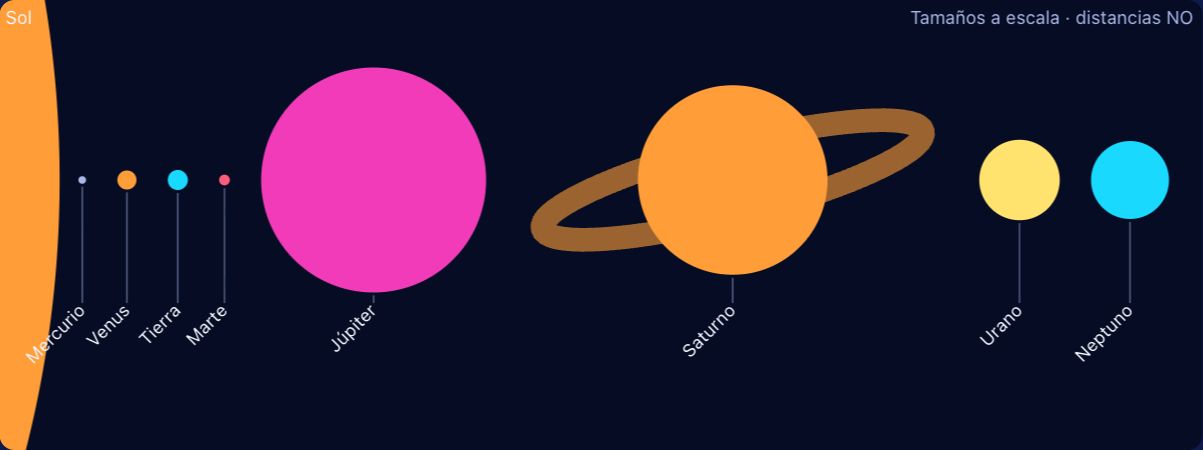
The card data
| No. | Object or distance | Value | In meters | Power |
|---|---|---|---|---|
| 1 | A Grade 7 student | 1.5 m | ||
| 2 | Length of a soccer field | 100 m | ||
| 3 | Bogotá, north to south | ≈ 30 km | ||
| 4 | Colombia, north to south | ≈ 1 800 km | ||
| 5 | Diameter of the Earth | 12 742 km | ||
| 6 | Earth–Moon distance | 384 400 km | ||
| 7 | Diameter of the Sun | 1 391 400 km | ||
| 8 | Earth–Sun distance | 1 au | ||
| 9 | Sun–Neptune distance | 30 au | ||
| 10 | One light-year | 1 ly | ||
| 11 | Proxima Centauri | 4.25 ly = 1.30 pc | ||
| 12 | Diameter of the Milky Way | ≈ 100 000 ly | ||
| 13 | Andromeda Galaxy | ≈ 2.5 million ly | ||
| 14 | Virgo Cluster (center) | ≈ 16.5 Mpc ≈ 54 million ly | ||
| 15 | Radius of the observable universe | ≈ 46 500 million ly |
(Card 14 is optional: its distance, 16.5 Mpc according to Mei et al. 2007, can be replaced by another object the class chooses, always with a source.)
Project phases
Week 1 — Powers and scientific notation
- We review with the lesson Scientific notation and distances: , = one million, and how to move the decimal point to write .
- Each pair receives one object from the table and converts it to meters: for example, 384 400 km = 384 400 × 1 000 m = m.
- Orders-of-magnitude game: without a calculator, we order the 15 cards just by looking at the exponent. How many “times 10” are there between the Moon and the Sun? (: a thousand times.)
- We decide the scale of the line: 30 cm for each power of 10. From to there are 26 steps: m, plus margins: about 8.5 m of hallway.
Week 2 — Astronomical units
- With the lesson Astronomical unit, light-year and parsec we convert each card to the most convenient unit: within the Solar System, au; for stars, light-years and parsecs; for galaxies, millions of light-years or Mpc.
- Example: Proxima is at m; in light-years, ly; in parsecs, pc.
- We build the class conversion table: 1 au, 1 ly and 1 pc in meters, in km and in terms of one another (1 pc = 3.26 ly = 206 265 au).
- We write the cards: drawing, name, value in the original unit, meters in scientific notation and astronomical unit.
Week 3 — We set up the line
- We stick the tape along the hallway and place a label every 30 cm: , , …, .
- Where exactly does each card go? A card of goes between and . Since the scale multiplies by 10 in each segment, it does not go “3.84 tenths” of the way along: it goes where the accumulated factor is 3.84. For Grade 7 the practical rule is enough: 2 goes at 30 % of the segment, 3 at 48 %, 5 at 70 %, 8 at 90 % (these are the common logarithms of 2, 3, 5 and 8, which will be studied in Grade 9). We place the cards using that rule.
- Cross-check: each pair verifies the position of another card with the calculator.
- We add a “surprise” card on the left: m, an atom, 3 m further back (the line also works toward the small).
Week 4 — Tour and wrap-up
- Guided tour for other classes: each pair presents its card in 1 minute and answers “how many times 10 is it from the previous card?”.
- Challenges on the line: how many 30 cm steps are there between the Earth and the Moon, and between the Moon and the Sun? Why does the whole Solar System take up only 1 m of the 8?
- Assessment: each student hands in a sheet with 10 cosmic distances in scientific notation, 5 conversions between units and an explanation of why the line “compresses” the universe.
- The line stays installed as a school exhibit.
Mathematics in the project
- Scientific notation: with . The exponent is the order of magnitude.
- Multiplying powers: ; dividing: (ten billion times between Proxima and the edge of the observable universe).
- Unit conversion: multiply by the equivalence written as a fraction equal to 1: m.
- Multiplicative scale: on the line, adding 30 cm means multiplying by 10. That is why 15 objects that differ by 26 orders of magnitude fit in 8 m. This idea is that of the logarithm, which is formalized in Grade 9.
Assessment rubric
| Criterion | Developing | Achieved | Advanced |
|---|---|---|---|
| Scientific notation | Writes whole powers of 10 | Writes any distance as with | Operates with powers to compare two distances (“a thousand times more”) |
| Unit conversion | Converts km to m | Converts between m, au, ly and pc with the class table | Justifies the conversion with fractions equal to 1 and significant figures |
| Position on the line | Places the card in the right segment | Places the card within the segment using the practical rule | Explains why the scale is multiplicative and what would happen with a linear scale |
| Card and presentation | Incomplete card or no source | Correct card with source and clear presentation | Answers questions from the audience with calculations on the spot |
Variants and extensions
- Linear scale for contrast: mark in the playground where the Moon would be if the Earth measured 1 cm (at 30 cm) and where the Sun would be (at 117 m): the comparison with the logarithmic line shows what each scale “hides”.
- Toward the small: extend the line down to m (atomic nucleus) using the lesson’s table.
- Light time: add to each card how long light takes (Moon 1.3 s; Sun 8.3 min; Neptune 4.2 h; Proxima 4.25 years).
- Connection with Grade 6: card 5 (diameter of the Earth) can use the value measured in the project Measuring the Earth with another school.
Inclusion
- The power labels can be in relief or braille; the line is walked by touch, counting the 30 cm segments.
- The cards combine drawing, number and word: each student chooses which one to present with.
- Pair work with roles (calculator and verifier) that are swapped.
- For those who struggle with exponents, use “zero” cards (each card = ×10) to build the powers physically.
Safety
- The line is installed in a hallway without blocking passage or emergency exits; masking tape, not permanent adhesives.
- To stick labels up high, use only stable ladders with an adult.
- This project does not include observing the Sun; remember that you never look directly at the Sun.