Her life

Hypatia was the daughter of Theon of Alexandria, the last known mathematician of the Museum, author of commentaries on the Almagest and of the edition of Euclid’s Elements that Europe read until the 19th century. We do not know when she was born: the sources allow dates between 350 and 370, and the historian Maria Dzielska, author of the most thorough study of her, favors 355. She trained with her father in mathematics and astronomy and soon surpassed him as a teacher.
By around the year 400 she was leading a school of Neoplatonic philosophy in Alexandria, in the line of Plotinus, where she taught geometry, astronomy and philosophy to young men from the leading families of Egypt and Libya, pagans and Christians alike. Her pupils revered her. The best known, Synesius of Cyrene, who would become bishop of Ptolemais, wrote her letters for years calling her “mother, sister, teacher and benefactress”. The sources describe her as a woman of great learning, austere, who went about the city in the philosopher’s cloak and was consulted by the magistrates.
That public influence made her a target. In 412 Cyril was appointed bishop of Alexandria and came into conflict with the imperial prefect Orestes, a friend and adviser of Hypatia. A rumor spread that she was preventing a reconciliation. In March 415 a mob led by a lector named Peter dragged her from her carriage, took her to the Caesareum and killed her. The account is given by Socrates Scholasticus, a contemporary Christian historian, who condemns the crime without reservation.
Teacher of Alexandria
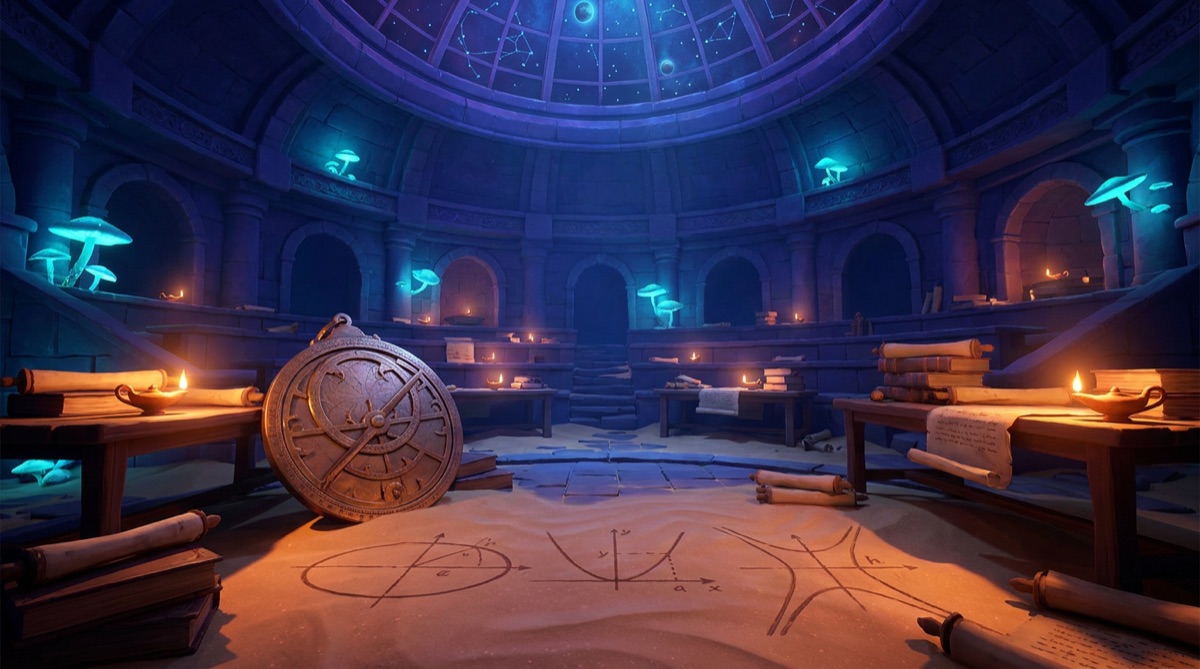
No writing of Hypatia’s has come down to us under her name, but we know a fair amount about what she did. The title of Theon’s commentary on Book III of the Almagest, the one dealing with the motion of the Sun and the length of the year, says that the edition was “revised by my daughter Hypatia, the philosopher”. In other words, Hypatia edited Ptolemy’s text, corrected his calculations and prepared it for teaching: technical work that required mastery of trigonometry and of the solar models.
The Byzantine lexicon Suda also attributes to her commentaries on Diophantus’s Arithmetica, the great treatise on algebra of antiquity, and on Apollonius’s Conics, the geometry of ellipses, parabolas and hyperbolas that Kepler and Newton would need twelve hundred years later. The one on Apollonius is lost; of the one on Diophantus, traces may survive in the Arabic version of the work. An “Astronomical Canon” is also attributed to her, probably an edition of Ptolemy’s Handy Tables.
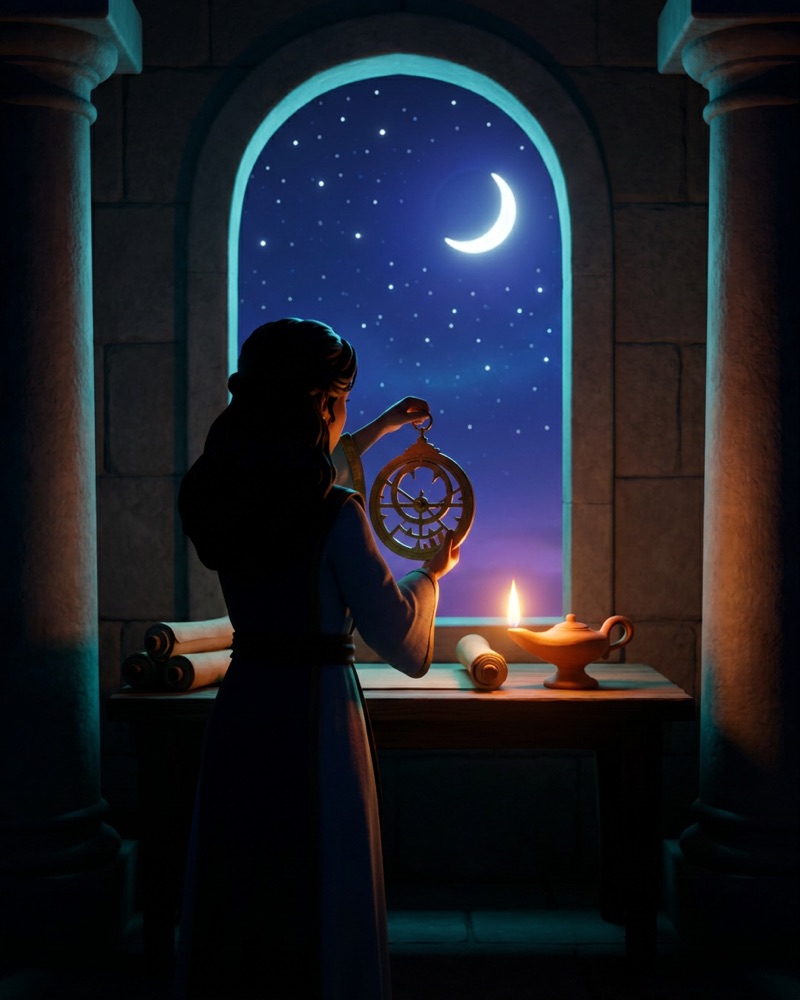
Synesius’s letters show the other side of her teaching: that of instruments. In On the Gift of the Astrolabe, Synesius relates that he himself designed a plane astrolabe of silver following Hypatia’s teachings, and that the instrument projected the celestial sphere onto a disk according to the geometry Ptolemy had described in the Planisphaerium. In another letter he asks her for help in building a hydroscope, a graduated float for measuring the density of liquids. Hypatia did not invent either device, as is sometimes said, but she knew how to build and explain them, and in the 5th century that was knowing astronomy for real.
That no original research of hers survives does not make her any less. The science of her time was above all about preserving, correcting and passing on, and Hypatia was the last great teacher of that chain in Alexandria: the one who put Ptolemy, Diophantus and Apollonius in order so that they could go on being read.
Her legacy

Her murder shocked even her contemporaries. Over time, Hypatia became a symbol: for the thinkers of the 18th-century Enlightenment, of reason against fanaticism; for Charles Kingsley’s novel (1853), “the last of the Hellenes”; for 20th-century feminism, of the woman scientist. Every age has told her story in its own way, and it is worth separating what is documented from what is invented. She did not die defending the Library of Alexandria, which no longer existed in her time; she was not young when she was killed, but a woman of about sixty; and her murderers did not put an end to Greek science, which went on being taught in Alexandria for two more centuries.
What is certain is that Hypatia was, according to every source, the wisest person in her city, respected by Christians and pagans, and that she taught mathematical astronomy at a time when almost no one understood it. In her honor, a crater on the Moon, the asteroid (238) Hypatia and, on UNESCO’s initiative, numerous programs devoted to women in science bear her name.