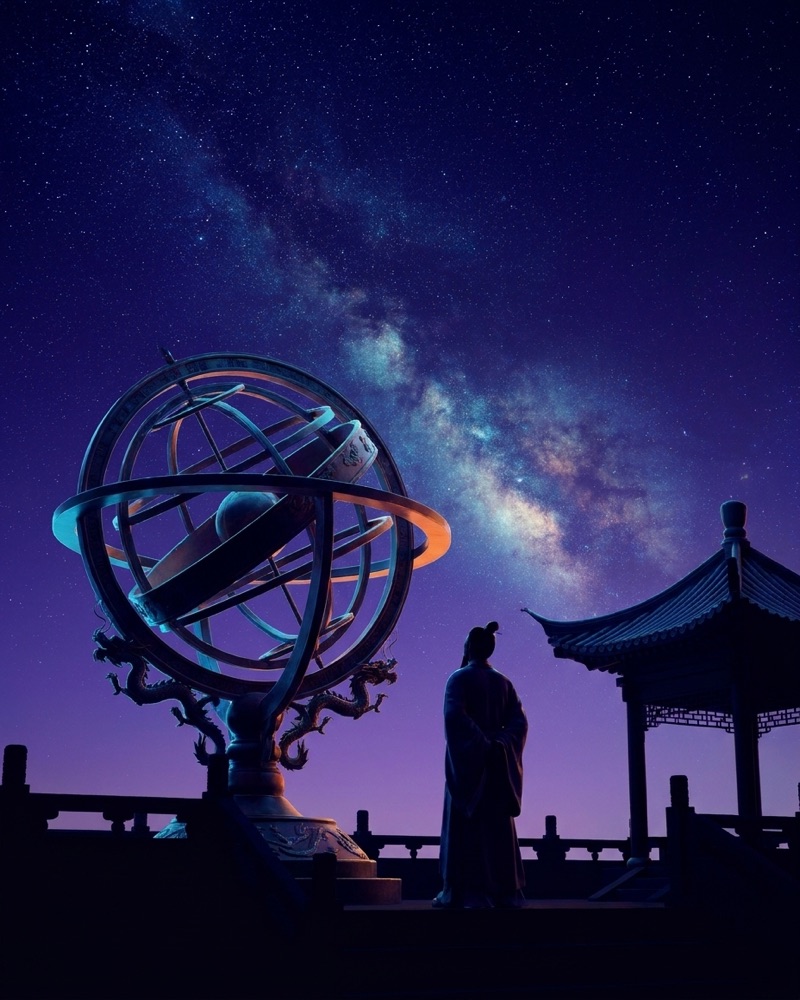
His life
Zhang Heng was born in the year 78 in Xi’e, near present-day Nanyang, in the Chinese province of Henan, into a family of officials that had come down in the world. As a young man he traveled to the two capitals of the Han dynasty, Chang’an and Luoyang, to study at the imperial academy, and he first made his name as a poet: his Rhapsody on the Two Capitals is one of the most celebrated literary works of the period.
Around 115, Emperor An appointed him taishi ling, “grand astrologer” or chief astronomer of the court, a post that combined the observation of the sky, the maintenance of the calendar and the recording of omens. He held it twice, from 115 to 120 and from 126 to 132, and in 123 he took part in the correction of the calendar to bring it into line with his observations. Later he was palace attendant under Emperor Shun and governor of the Hejian commandery, where he made enemies by pursuing corruption. He died in Luoyang in 139. His biographers in the Hou Hanshu describe him as a quiet man without political ambition, who preferred books and devices.
A sky like an egg
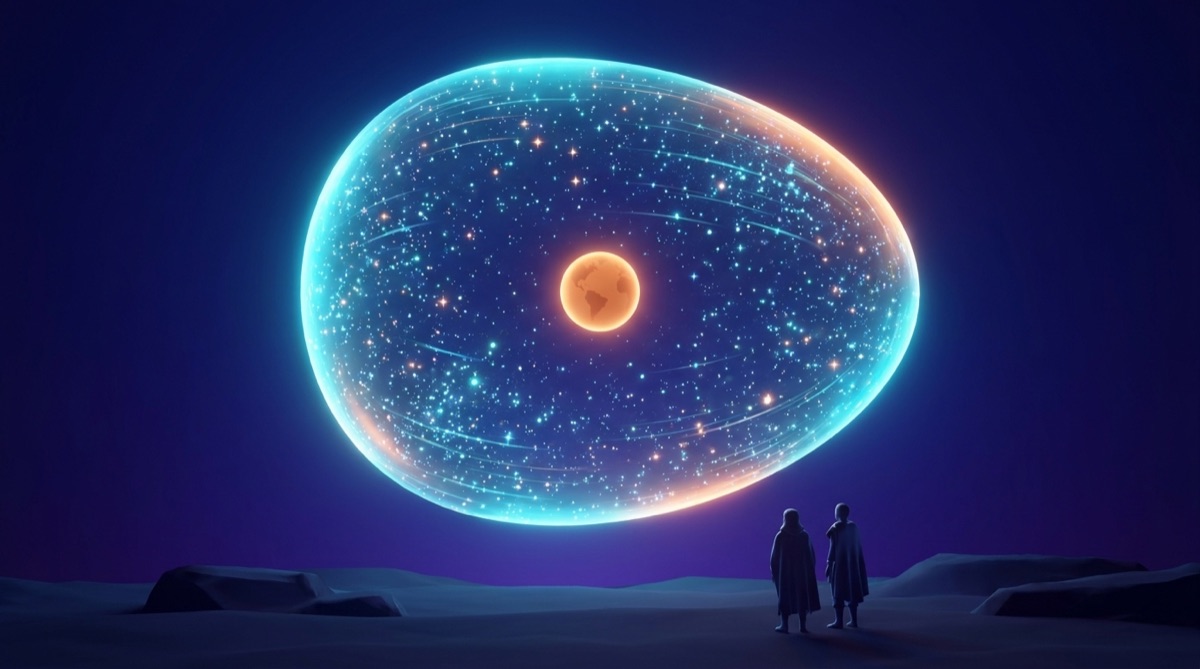
The Chinese astronomy of the time debated two cosmologies: the sky as a dome over a flat Earth (gaitian) and the sky as a complete sphere (huntian). Zhang Heng was the great champion of the second. In his treatise Ling Xian (c. 120), of which only fragments survive, he wrote that “the heavens are like a hen’s egg and as round as a crossbow bullet; the Earth is like the yolk, alone in the center”. The sky turned on an axis that passed through the two poles, and half of its sphere was always below the horizon.
In the same text Zhang Heng explains that the Moon has no light of its own: “it is like a mirror, reflecting the light of the Sun”. When the Earth comes between the two, the Moon enters the shadow and a lunar eclipse occurs. It is a correct explanation, written in the same period in which Ptolemy was working in Alexandria and independently of the Greek tradition. He also counted the stars: 124 groups or asterisms and about 2 500 stars visible to the naked eye, not counting those seen by the sailors of the south, a figure surprisingly close to the real one for a place like Luoyang.
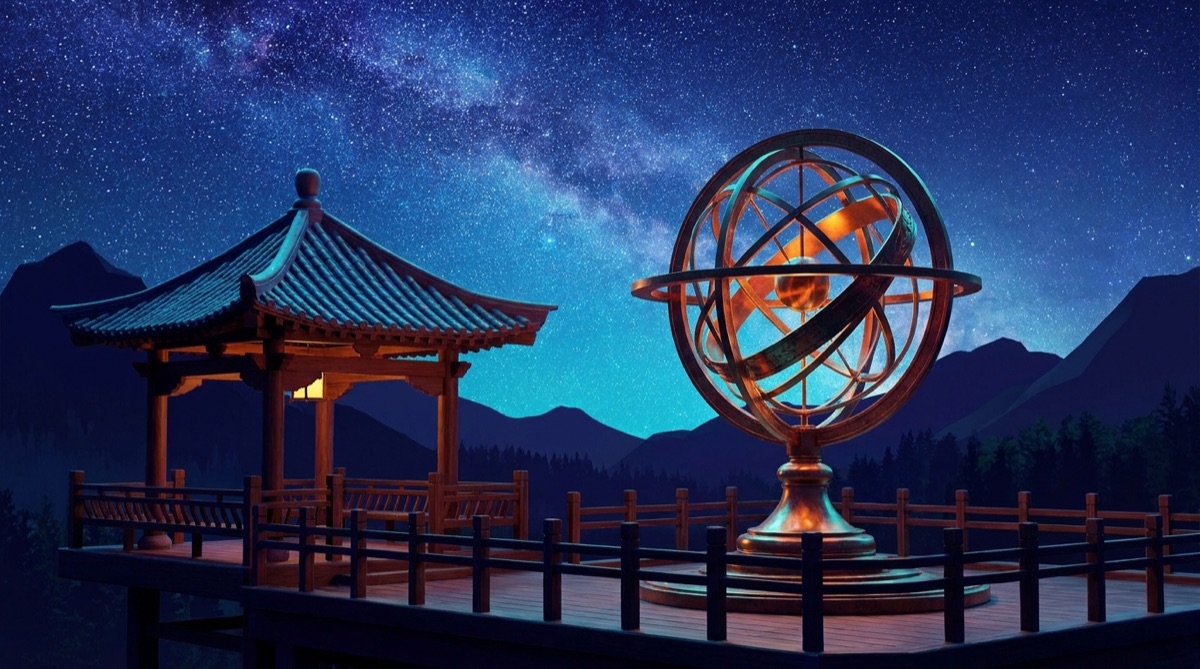
To reproduce that sky he built a bronze armillary sphere: graduated rings representing the equator, the ecliptic and the horizon, with a sighting tube to measure the position of a celestial body. According to the Hou Hanshu and the study by Joseph Needham, Zhang Heng coupled the sphere to a water clock (a clepsydra) so that it turned by itself, at the same rate as the sky, and anyone could read on it which stars were rising or setting. It is the first water-driven astronomical mechanism of which there is any record, and the remote ancestor of Su Song’s clock tower, a millennium later.
The bronze seismoscope

In 132 Zhang Heng presented at court his most famous invention, although it is not astronomical: the houfeng didong yi, “instrument for observing the winds and the movements of the earth”. It was a bronze vessel about two meters in diameter with eight dragons on the outside, one for each compass direction, each with a ball in its mouth and a bronze toad beneath. When the shock of an earthquake arrived, an inner mechanism (probably a pendulum) released the ball of the dragon that pointed toward the source, and the sound of the ball in the toad gave the alarm.
The Hou Hanshu tells that one day a ball fell without anyone in Luoyang having felt anything, and the courtiers mocked; days later a messenger arrived with news of an earthquake in Longxi, several hundred kilometers to the west, in the direction indicated. The original device was lost, and modern reconstructions debate how it worked inside, but the idea of detecting the direction of a distant tremor did not reappear in the world until the 18th century.
His legacy
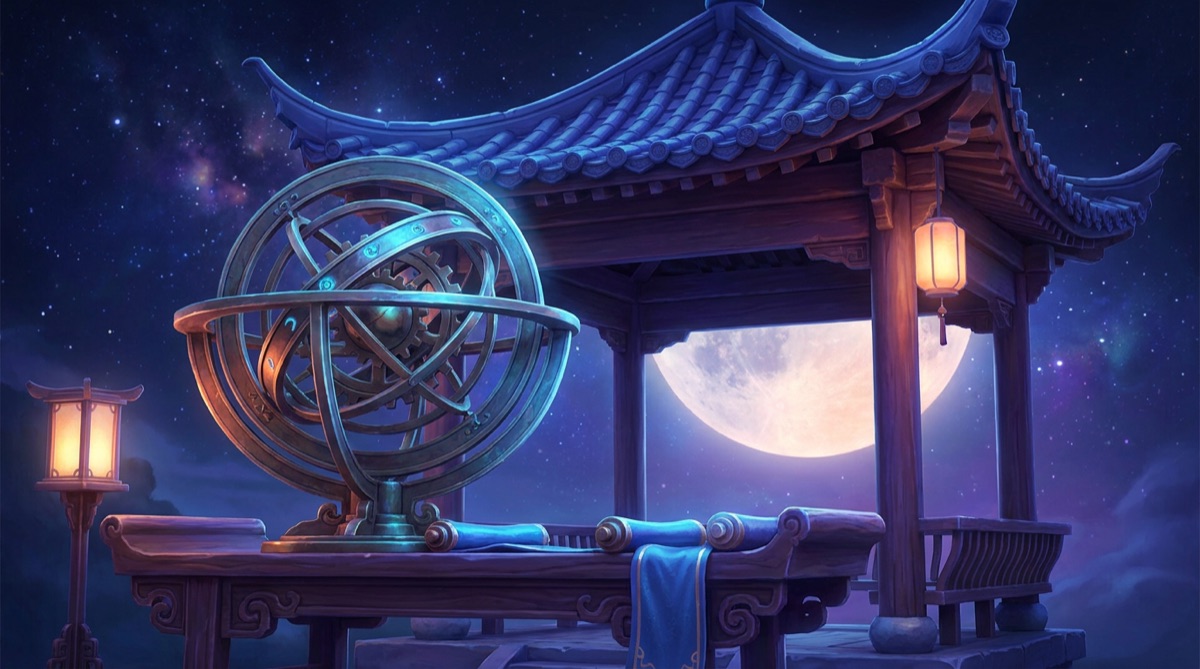
Zhang Heng is, in China, what Archimedes is in the West: the scholar who united theory with machines. His cosmology of the celestial sphere was the dominant one in Chinese astronomy until the arrival of the Jesuits in the 17th century, and his armillary spheres, perfected over centuries, became precision instruments like those of Guo Shoujing in 1276. He is also credited with an odometer and improvements to grid maps, and in mathematics he proposed , the first Chinese value obtained by reasoning rather than by measurement.
In his honor a crater on the Moon, the asteroid (1802) Zhang Heng and, in 2018, the Chinese satellite Zhangheng-1 bear his name, the last one devoted precisely to studying from space the electromagnetic signals associated with earthquakes.