His life

We know very little about Aristarchus, and almost all of it secondhand. He was born on the island of Samos, in the Aegean Sea, around 310 BCE, and according to the doxographer Aëtius he was a pupil of Strato of Lampsacus, the physicist who headed Aristotle’s Lyceum. That places him in the intellectual world of Athens and, probably, of the Alexandria of the first Ptolemies, where the Museum and the Library were beginning to gather the best mathematicians of the Greek world.
Ptolemy, in the Almagest, cites an observation of his of the summer solstice of 280 BCE: it is the only certain date of his life. Vitruvius includes him among the inventors of sundials and credits him with the skaphe, a hemispherical bowl with a needle at the center whose shadow marks the hour and the season. He died around 230 BCE.
His only surviving work is a short treatise, On the Sizes and Distances of the Sun and Moon. The other book, the one that would make him famous, has been lost, and we know of it only because Archimedes summarized it in The Sand Reckoner.
Measuring the Sun with a half Moon
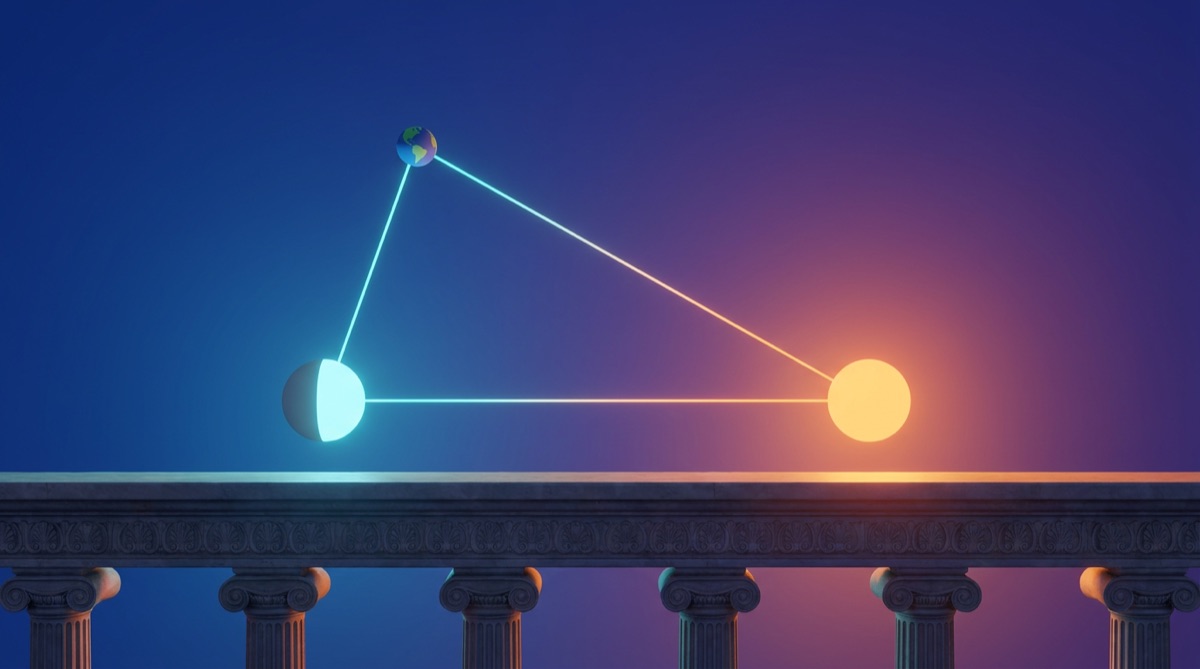
Aristarchus’ treatise is an exercise in pure geometry applied to the sky. It starts from a simple idea: when the Moon is exactly at quarter, half lit, the Sun, the Moon and Earth form a triangle with a right angle at the Moon. It is enough to measure the angle between the Moon and the Sun as seen from Earth to know the shape of the triangle and, with it, how many times farther away the Sun is than the Moon.
Aristarchus estimated that angle at 87°, “less than a quadrant by one-thirtieth of a quadrant”, and deduced that the Sun is between 18 and 20 times farther away than the Moon. Since the Greeks did not yet have trigonometric tables, he bounded the result with geometric inequalities; today we would write it as the ratio of the two distances, . The true angle is 89° 50′, and the Sun is about 390 times farther away than the Moon. The error was not in the reasoning but in the measurement: by eye it is almost impossible to know at what instant the Moon is exactly half lit, and a deviation of three degrees changes the result twentyfold.
In the same spirit he used lunar eclipses: the width of Earth’s shadow, which he estimated at about twice the lunar diameter, allowed him to compare the sizes of the three bodies. He concluded that the diameter of the Sun is between six and seven times that of Earth (in reality it is 109 times) and that the Moon measures a little more than a third of Earth, a value fairly close to the true one (0.27). What mattered was not the figures but the method: for the first time someone showed that the distances of the sky can be calculated with a triangle and a few measurements.
Earth around the Sun

In The Sand Reckoner, Archimedes wants to calculate how many grains of sand would fit in the universe and needs the largest model he knows. He finds it in Aristarchus: his hypotheses are “that the fixed stars and the sun remain unmoved, that the earth revolves about the sun in the circumference of a circle” and that the sphere of the stars is so enormous that Earth’s orbit is, by comparison, like a point. It is the first known description of a heliocentric system and, in passing, an answer to the classic objection: if Earth moves, the stars should change their apparent position over the year, and they do not. Aristarchus replied that they are too far away for it to be noticed; that shift, the stellar parallax, was only measured in 1838.
A passage of Plutarch adds that the Stoic Cleanthes thought Aristarchus ought to be charged with impiety for “moving the hearth of the universe”, although the transmitted text is ambiguous and some editors read the sentence the other way around. Be that as it may, the idea found hardly any followers: only Seleucus of Seleucia, a century later, defended it as something more than a hypothesis. A central Sun had no practical advantages over the geocentric models and clashed with Aristotle’s physics, and astronomers set it aside.
His legacy
Aristarchus was rediscovered when he was needed. Copernicus knew of the report of a moving Earth and mentioned Aristarchus in the manuscript of De revolutionibus, although the passage was removed from the printed edition of 1543. A century later, Galileo and Kepler cited him as a precedent, and since then he has been called “the ancient Copernican”.
His calculation of distances is taught today almost exactly as it was 2 300 years ago, and repeating it is a good exercise in trigonometry: in the lesson Aristarchus: Earth–Moon–Sun distances you can see how a small error in the angle turns into a large error in the distance, which is the most valuable lesson of his work. A crater on the Moon, one of the brightest on the disk, and the asteroid (3999) Aristarchus bear his name.