His life
Aryabhata is the first Indian astronomer whose name, work and date we know, because he himself wrote it down: “when three yugas and sixty times sixty years had elapsed, twenty-three years had passed since my birth”. That sentence corresponds to the year 499 of our era, so he was born in 476. We do not know where. His commentator Bhaskara I calls him “the one from Ashmaka”, a region in central India, and another tradition places him in Kerala; what is certain is that he worked in Kusumapura, near Pataliputra (present-day Patna), the capital of the Gupta Empire, and that he headed a school there.
Gupta India was a crossroads: the Vedic astronomy of the nakshatras, the Babylonian texts that had arrived through trade, and the Greek astronomy of epicycles, translated into Sanskrit in the preceding centuries. Aryabhata fused all of that into a system of his own, written in verse so that it could be memorized. He died around 550.
Earth rotates

The Aryabhatiya has 121 verses in four parts: an introduction with the astronomical constants and the table of sines, a section on mathematics, another on the reckoning of time and a last one on the celestial sphere and eclipses. It is a book compressed to the extreme: each verse is a rule that the teacher had to explain.
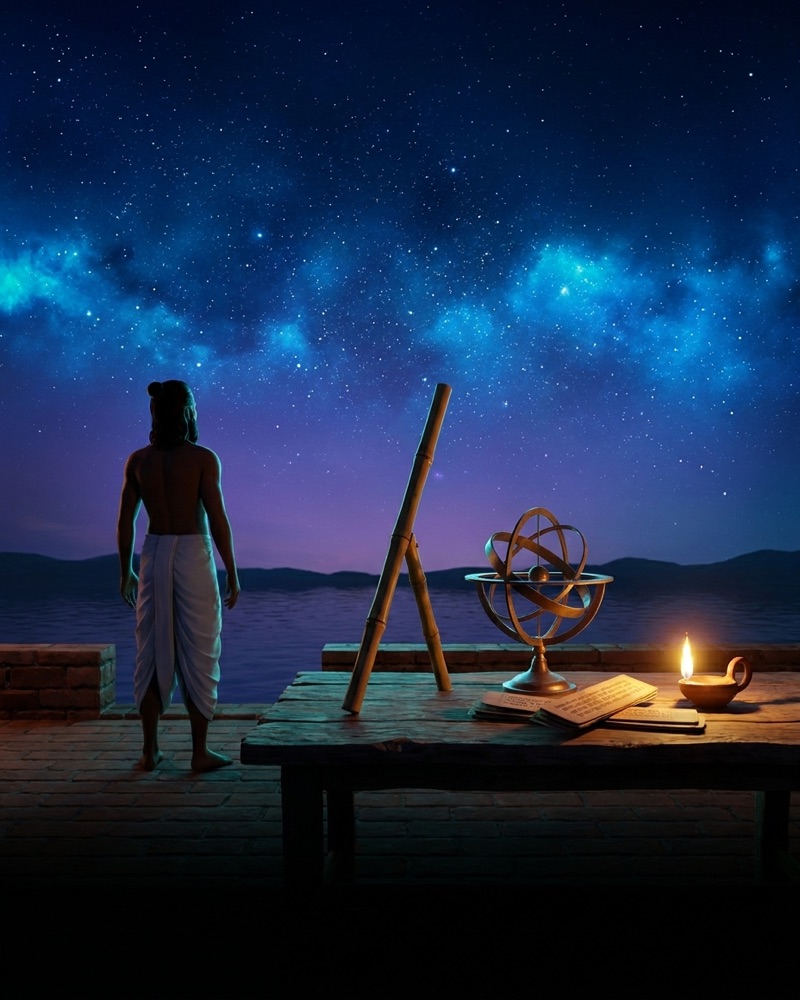
His most famous statement is in the section on the sphere: “just as a man in a boat moving forward sees the stationary objects on the shore moving backward, so does the man at Lanka see the fixed stars moving toward the west”. That is, the sky does not turn: Earth turns, and the daily motion of the stars is only apparent. Aryabhata even gave the duration of that rotation with respect to the stars, 23 hours 56 minutes and 4.1 seconds, a value that agrees with the current one. The idea was so daring that his successors rejected it: Brahmagupta, a century later, disputed it, and later commentators went so far as to reinterpret the verse to make it say the opposite.
Equally modern is his explanation of eclipses. Popular tradition attributed them to the demon Rahu, who devoured the Sun or the Moon. Aryabhata wrote that the Moon, the planets and Earth shine by the light of the Sun, that half of each is in shadow, and that a lunar eclipse occurs when the Moon enters Earth’s shadow and a solar eclipse when the Moon comes between. He also gave the rules for calculating their duration and size.
To predict the positions of the planets he used epicycles, like the Greeks, though of his own kind (two per planet, one for the solar inequality and another for the planetary one). His sidereal year, 365 days 6 hours 12 minutes and 30 seconds, is about three minutes and twenty seconds too long, and the circumference of Earth he proposes, in yojanas, comes close to the true value if the usual length of that unit is taken.
Sines and a figure for π
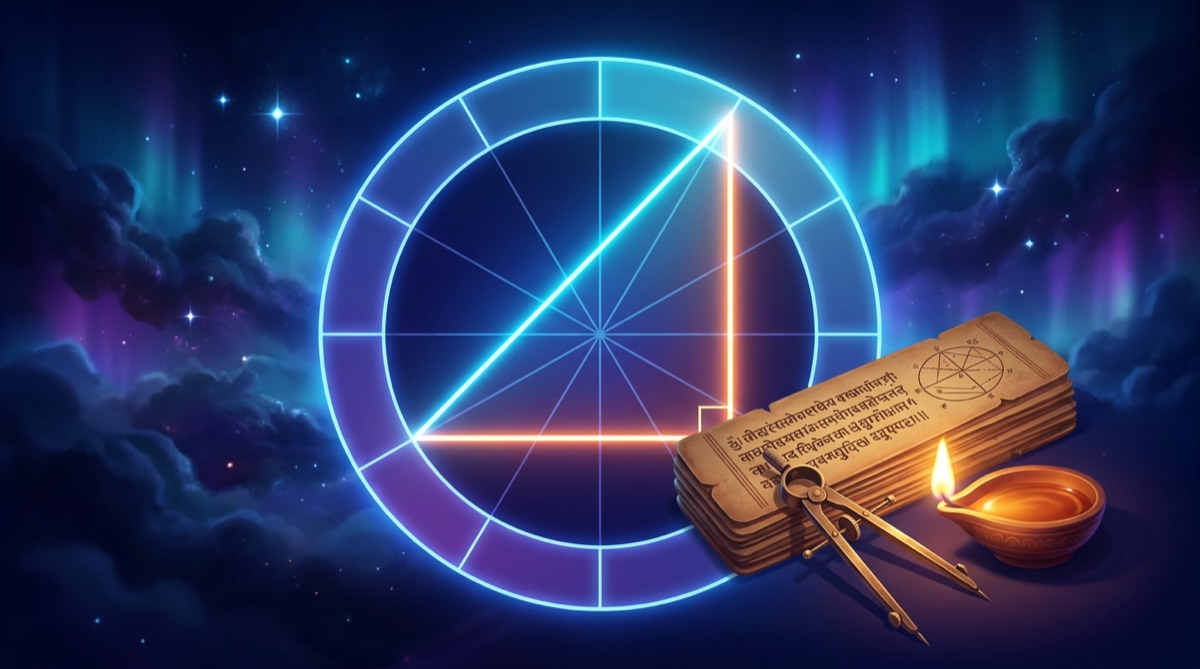
Aryabhata’s astronomy demanded trigonometry, and there he made a decisive change. The Greeks tabulated chords of arcs; Aryabhata tabulated half-chords, which he called jya (“bowstring”), and with them he computed in a single verse a table of 24 values, in steps of 3° 45′. The half-chord is exactly our sine: when the word passed into Arabic (jiba) and then into Latin (sinus), the name we use was born. He also introduced the versed sine, .
In the mathematics section he gives the rule: “add four to one hundred, multiply by eight and add sixty-two thousand; the result is approximately the circumference of a circle of diameter twenty thousand”. That is
correct to the fourth decimal place, the best value of his time. And he adds the word asanna, “approximate”, which some historians read as an intuition that π cannot be written exactly as a fraction. The same treatise contains rules for square and cube roots, progressions, first-degree equations with integer solutions (the kuttaka method, the “pulverizer”) and a system for writing large numbers with syllables.
His legacy

All later Indian mathematical astronomy, from Brahmagupta to the Kerala school, starts from the Aryabhatiya, commented on, criticized and taught without interruption for more than a thousand years. Around 820 it was translated into Arabic in Baghdad; al-Khwarizmi used his value of π and his sines, and by that route, through the Arabic tables and the Toledo translations, the trigonometry of the sine reached Europe. The very concept of “sine” is, in the end, a gift of his.
His idea of a rotating Earth had to wait until Copernicus to be accepted. But India did not forget him: its first satellite, launched on April 19, 1975, was named Aryabhata, and a lunar crater bears his name.