Project phases
Week 1 — The daytime sky
- Trip to the playground (10 minutes, wearing hats and without looking at the Sun). We sit in the shade and look up: what color is the sky? Are there clouds? How many? We count them together, pointing at them one by one.
- Feeling the Sun. We put one hand in the sun and the other in the shade. Which one is warmer? We say it in words: “warmer”, “cooler”.
- Drawing what we saw. Each child draws the daytime sky on a sheet of paper. When they finish, each one names one thing they drew.
- Sorting. We pin the drawings on the board and ask: what shows up again and again? (Sun, clouds, birds, airplanes.) We count them.
Week 2 — The night sky
- Family homework. Each child takes home the “Sky diary” sheet. With an adult, they look at the sky one night from a window or the yard and draw what they see: the Moon (what shape?), stars (many or few?), clouds.
- Sharing. In the classroom, each child shows their night drawing. We ask: who saw the Moon? How many saw stars? We count the raised hands.
- The Moon changes. We compare the Moon drawings from different nights: round, half, like a fingernail. We line them up from fattest to thinnest.
- What do we do at night? A sequence of three cards: eating, bathing, sleeping. We put them in order: before, after.
Week 3 — The Earth spins and we build the mural
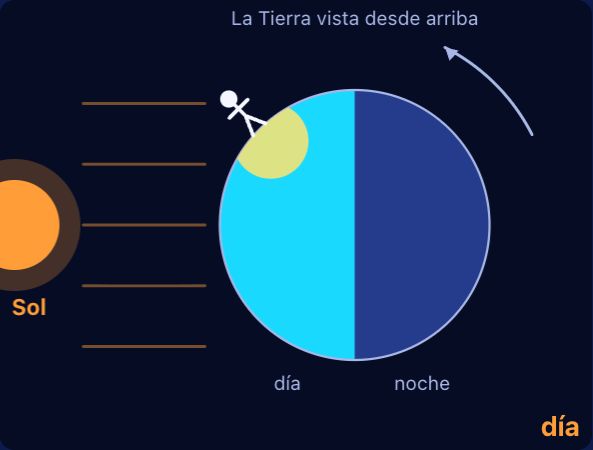
- The flashlight-and-orange game. We turn off the lights. The flashlight is the Sun and the orange is the Earth; the toothpick is us. When the toothpick faces the flashlight it is daytime; we slowly turn the orange and the toothpick ends up in the shadow: it is night. Each child takes a turn spinning the orange and saying “day!” or “night!”.
- Building the mural. We glue the light sheet on the left (day) and the dark one on the right (night). Each child decides which half their drawing goes in. The cotton clouds can go on both. Underneath, the routine sequence: morning, afternoon, night.
- Counting the mural. How many suns are there? How many moons? How many stars? We write the numbers next to them.
- Presentation. We invite another class or the families. Each child explains one part of the mural or does the flashlight demonstration.
Mathematics in the project
- Counting up to 20: clouds in the playground, stars in the drawing, drawings in each half of the mural.
- Sorting: each drawing goes under “day”, “night” or “both”. We make a table with three columns and put one mark per drawing.
- Comparing: the Sun looks big; the stars look small. (The teacher can mention that the stars are suns that are very, very far away.)
- Sequences: the routine cards are put in order using the words before and after.
Assessment rubric
| Criterion | Developing | Achieved | Advanced |
|---|---|---|---|
| Observes and describes the sky | Names one thing (Sun or Moon) | Names three or more things and says whether it is day or night | Also describes colors, shapes and changes (the Moon “got thin”) |
| Sorts day / night | Sorts with help | Puts each drawing in the right half and explains why | Recognizes what is seen at both times (clouds, sometimes the Moon) |
| Explains day and night with the flashlight | Spins the orange but does not explain | Says it is day on the lit side and night in the shadow | Explains that the Earth spins and that the Sun does not “switch off” |
| Counts and compares | Counts to 10 with support | Counts to 20 and compares (more / fewer) | Records the counts in the table without help |
Variants and extensions
- Sound mural: record each child on the teacher’s phone saying a sentence about their drawing and play the recordings during the presentation.
- Spinning mural: instead of two halves, glue the drawings on a cardboard circle that spins on a pushpin: the half facing a paper “sun” is in daytime.
- Connect with the simulator: the teacher projects Day, night and the seasons and the children shout “day!” or “night!” as Colombia passes through the light or the shadow.
Inclusion
- For children with low vision, use materials with texture (cotton for clouds, corrugated paper for the Sun, sequins for stars) and describe each element of the mural out loud.
- For those who do not yet draw recognizable shapes, offer cutouts and templates to glue.
- The night homework can be done from a window, in a wheelchair or in an adult’s arms; if the sky cannot be seen (clouds, city lights), it is fine to draw “what we could not see” and tell why.
- Accept answers in the child’s home language or with gestures; what matters is the observation.
Safety
- Never look directly at the Sun, not even for a second: it damages the eyes. In the playground we look at the sky away from the Sun and wear hats.
- The flashlight is never pointed at anyone’s eyes.
- Nighttime observation is done always with an adult, in a safe and familiar place.
- Blunt-tip scissors and non-toxic glue.