Project phases
Week 1 — We build the gnomon
- What is a shadow? We play shadow games with a flashlight and our hands. We ask: does the shadow come out on the side of the light or on the opposite side?
- The stick. We push the stick into the bucket of sand so it stands straight. We check it by hanging a stone from a thread next to it: the stick and the thread must be parallel. Our stick has a name: it is the gnomon.
- The spot. We choose a flat spot in the playground that is in the sun all morning and all afternoon. We mark with chalk where the bucket goes, so we always put it in the same place.
- Trial run. We go out once, mark the tip of the shadow with chalk and cut a piece of string as long as the shadow. We glue it in the diary with the time.
Week 2 — We measure three times a day
- For three days we go out to the playground at 8:00, at 12:00 and at 15:00 (or whatever times the schedule allows; what matters is one in the morning, one at noon and one in the afternoon).
- Each time: we mark the tip of the shadow with chalk, cut a string as long as the shadow and write down which way it points (toward the classroom, toward the sports court…).
- We glue the strings in the diary, in order: morning, noon, afternoon. Those who already know how measure the string with the ruler and write the centimeters.
- At the end of the day we ask: which string is the shortest? And the longest?
Week 3 — The table and the chart
- We make a tally table on poster board: rows “morning”, “noon”, “afternoon”; columns “day 1”, “day 2”, “day 3”. In each box we write the measurement (in hand spans, in ant steps or in centimeters).
- With paper strips as long as each string we build a bar chart for each day: three bars, one per time.
- We look for the pattern: every day the middle bar is the lowest. We say it out loud: “long, short, long”.
- We look at which way the shadows pointed: in the morning to one side, in the afternoon to the opposite side. Where was the Sun each time? (We work it out: the shadow points away from the Sun.)
Week 4 — At what time is the shadow shortest?
- One day we go out every 15 minutes between 11:15 and 12:45, marking the tip of the shadow with chalk and writing the time next to it. The mark closest to the stick is the time of the shortest shadow: that is the Sun’s noon at our school.
- We make a poster: “At our school the shortest shadow is at ___”.
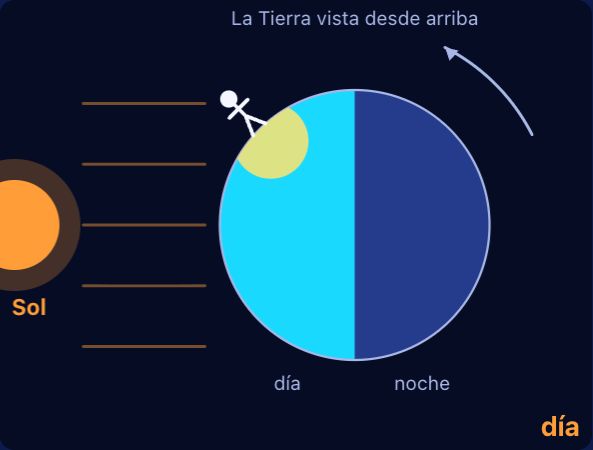
- With the simulator Day, night and the seasons the teacher shows how the Earth spins and why the Sun seems to rise, pass high overhead and go down.
- Presentation to the families: the diary, the chart and the poster. Each child explains one part.
Mathematics in the project
- Measuring without a ruler: the string is our unit. To compare two shadows we lay the two strings side by side, lined up at one end.
- Measuring with a ruler: those who already know centimeters write the measurement in the table. The numbers are usually between 10 and 300 cm.
- Tally table: it lets us see the pattern at a glance: the “noon” row always has the smallest numbers.
- Pattern: long, short, long, long, short, long… what comes next?
Assessment rubric
| Criterion | Developing | Achieved | Advanced |
|---|---|---|---|
| Measures and records the shadow | Marks the shadow with help | Cuts the string to the right length and glues it in the day’s order | Measures with the ruler and writes the centimeters without help |
| Organizes the data in the table | Fills in one box with help | Fills in the whole table for the day | Reads the table and answers “which day had the longest shadow?” |
| Discovers the pattern | Says which string is the shortest | Says that the noon shadow is always the shortest | Explains that the Sun is highest at noon and that the shadow points away from it |
| Takes part and communicates | Takes part in the trips outside | Explains one part of the project to other people | Asks new questions (what if it rains? what about another city?) |
Variants and extensions
- Class sundial: leave the chalk marks for each time and write the time next to them: the next day, the shadow “tells the time” (see the lesson Shadows and the sundial).
- A month of shadows: repeat the noon measurement once a week for a month and see whether the string changes length (in Colombia it changes little, but it does change).
- A stick in another city: ask a partner school in another city to measure on the same day: is their noon shadow longer or shorter? That is the seed of the Grade 6 project, Measuring the Earth with another school.
Inclusion
- The strings can be touched: a child with low vision compares the lengths with their hands and takes part in the same way.
- The gnomon can go on a table so a child in a wheelchair can reach it; the shadow is marked the same way.
- Roles rotate: who marks with chalk, who cuts the string, who writes the time, who says which way it points.
- For children who do not yet write numbers, measurements are recorded with strings and with the words “long” and “short”.
Safety
- We never look at the Sun to find out where it is: we work it out from the shadow. That is precisely the point of the project.
- Hats, water and short trips outside (5 to 10 minutes). The noon measurements are done quickly, and we wait in the shade.
- The stick stays in the bucket and is not carried around while running.