Project phases
Week 1 — We get the diary ready
- What shape is the Moon today? Each child draws the Moon from memory. We compare: not everyone draws the same thing. Who is right? We are going to find out by looking.
- The diary. We hand out the 35-box calendar. In each box there is a circle traced with the coin. Each night we will color the lit part yellow and leave the dark part white. If it is cloudy, we draw a cloud; if we did not look, we leave the box empty.
- Which way to look? With the compass rose in the playground we remember east and west. The Moon, like the Sun, rises in the east and sets in the west. After full Moon you have to look late at night or early in the morning; before full Moon it is seen in the afternoon, sometimes by day.
- Note for the family: the observation takes two minutes, with an adult, from the window, the balcony or the yard.
Weeks 2 to 5 — We observe every night
- Each night, the child looks at the Moon and colors their box: the yellow part is the part that shines. They also write the time and whether they saw it in the east, overhead or in the west.
- In the weekly classroom session we line up the diaries and compare: did we all see the same shape on the same day? (Yes: the Moon is the same for everyone.)
- On cloudy days we fill in the box with the simulator Phases of the Moon, which shows the shape for that day. We mark those boxes with a cloud to remember it was not an observation.
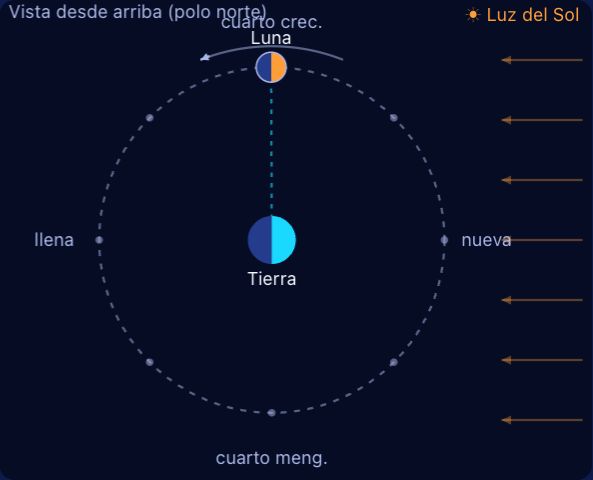
- Phases game (once): a white ball is the Moon, the flashlight is the Sun and a child in the middle is the Earth. The child turns around holding the ball: when the ball is between them and the flashlight, they cannot see the bright part (new Moon); when they have turned halfway, they see it whole (full Moon); at a quarter turn they see half.
Week 5 — We discover the cycle
- We look in the diary for the first full Moon box and the next full Moon. We count the boxes between one and the other: we get 29 or 30 days. That is the lunar month.
- We cut out eight boxes and put them in order on a cycle line: new, waxing crescent (a fingernail), first quarter (half), waxing gibbous (almost full), full, waning gibbous, last quarter, waning crescent. We glue them on poster board with their names.
- Bar chart: how many nights were clear, how many cloudy and how many had no observation. Which bar is tallest?
- Presentation: each child shows their diary and names the 8 phases on the cycle line.
Mathematics in the project
- Fractions with the Moon: the full Moon is one whole; the first quarter shows half (½) of the disk lit. It is called “quarter” because the Moon has gone a quarter of the way around the Earth. The waning and waxing crescents show less than half; the gibbous Moon, more than half.
- Counting on the calendar: from full Moon to full Moon there are 29 or 30 boxes. We count them two ways: one by one, and by rows (one row = 7 days; 4 rows = 28 days, plus 1 or 2).
- Turns: in the phases game, a quarter turn = first quarter; half a turn = full Moon; three quarters = last quarter; a full turn = new Moon again.
Assessment rubric
| Criterion | Developing | Achieved | Advanced |
|---|---|---|---|
| Observes and records | Has fewer than 10 boxes with a drawing | Has 20 or more boxes (drawn or with a cloud) in the right order | Also writes the time and which way they saw the Moon |
| Names the phases | Recognizes full and new | Orders and names the 8 phases on the cycle line | Explains with the ball and the flashlight why each phase is seen |
| Uses fractions | Says “half Moon” | Connects first quarter with half the disk and a quarter turn | Compares: gibbous is “more than half”, crescent “less than half” |
| Counts the cycle | Counts with help | Counts 29 or 30 days between two full Moons | Predicts the date of the next full Moon by adding 29 or 30 days |
Variants and extensions
- The daytime Moon: a week before full Moon, look for the Moon in the afternoon in the playground (it is in the eastern sky). Surprise: the Moon can be seen by day too.
- Photo diary: if a family has a phone, photograph the Moon every night from the same spot and compare the size of the lit part.
- Class calendar: after the project, mark the next full Moons on the classroom calendar by adding 29 or 30 days (and check).
Inclusion
- A child with low vision can keep the diary with a modeling-clay Moon: each night an adult describes the shape and the child models it; in class they are compared by touch.
- If the family cannot observe at night, the observation is done in the afternoon during the first half of the cycle (the waxing Moon can be seen from about 15:00) or completed with the simulator at school.
- The diary can be filled with stickers of the 8 phases instead of drawings.
Safety
- Nighttime observation always with an adult and from a safe place (window, balcony, yard).
- If you look for the Moon by day, never look toward the Sun; the afternoon Moon is far from it, toward the east.
- Do not use binoculars or telescopes by day without an adult who knows how to handle them: pointing them at the Sun by mistake causes blindness.