Card data
The teams copy these data (source: NASA and JPL, see references). The teacher may add a “fun fact” row per planet, but always with a source.
| Body | Type | Diameter (km) | Distance from the Sun (millions of km) |
|---|---|---|---|
| Mercury | rocky | 4 879 | 58 |
| Venus | rocky | 12 104 | 108 |
| Earth | rocky | 12 756 | 150 |
| Mars | rocky | 6 792 | 228 |
| Jupiter | gas giant | 142 984 | 778 |
| Saturn | gas giant | 120 536 | 1 427 |
| Uranus | ice giant | 51 118 | 2 871 |
| Neptune | ice giant | 49 528 | 4 498 |
| Moon (Earth’s) | rocky | 3 475 | 150 (it goes around with the Earth) |
Project phases
Week 1 — What is a planet? We investigate
- Brainstorm: what do we know about the planets? We write everything down, even the doubtful bits, to check later.
- Teams: 9 teams (or 8, and the teacher does the Moon). Each team gets its body and the data table.
- Reading large numbers: with the lesson Big numbers we read out loud “four thousand eight hundred seventy-nine” and break it down: 4 thousands, 8 hundreds, 7 tens, 9 ones.
- Sorting: each team says whether its planet is rocky, gaseous or icy and why (it has ground to stand on, or it is made of gas, or it is made of ice and gas).
Week 2 — We design the card
- Each card has: name, drawing of the planet in its colors, type, diameter, distance from the Sun and a fun fact with its source.
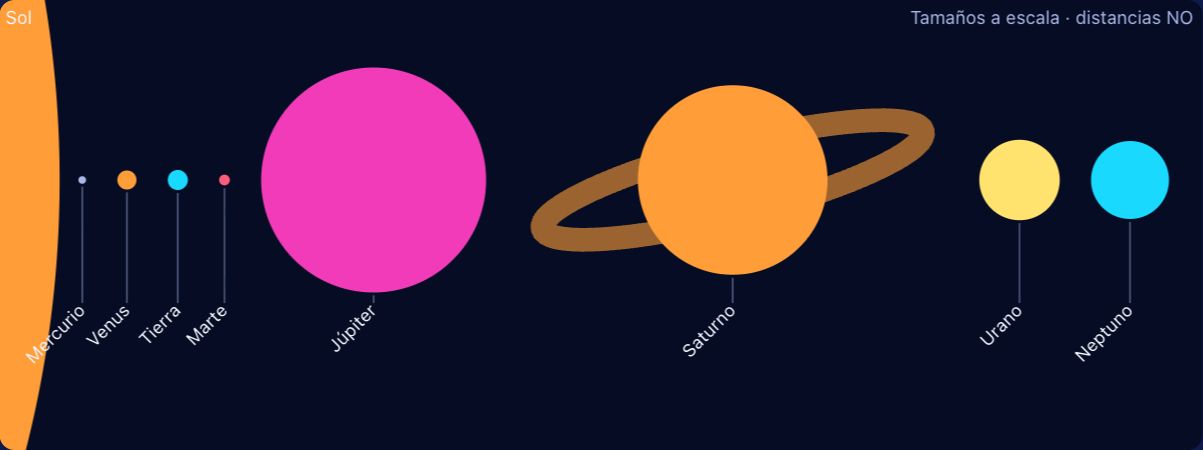
- The drawing to scale (simple): Jupiter is the biggest, so its drawing fills the whole card; the Earth is about 11 times smaller (142 984 ÷ 12 756 ≈ 11), so it is drawn as a small coin.
- Cross-check: each team checks another team’s numbers against the table. If there is a mistake, it is corrected before sleeving.
- We sleeve the cards with plastic or clear tape.
Week 3 — The class table and the games
- Two-way table on a large sheet of poster board: one row per body, columns “type”, “diameter”, “distance”. Each team writes its row.
- Ordering by size: the teams line up with their cards, from smallest to biggest. We check with the numbers: 3 475 < 4 879 < 6 792 < 12 104 < 12 756 < 49 528 < 51 118 < 120 536 < 142 984.
- Ordering by distance: now from closest to the Sun to farthest. Does the order change? (Yes: the biggest is not the farthest.)
- “Who is bigger?” tournament: two players each draw a card and compare the diameter; the bigger one wins. Variant: compare distances.
Week 4 — Exhibition
- We set up the planet gallery in the hallway, with the cards in order of distance from the Sun and the class table.
- With the simulator The Solar System to scale we check that the small planets are close to the Sun and the giants far away.
- Each team presents its planet in one minute to another class.
- We go back to the Week 1 brainstorm: what did we believe that was false? We cross it out and write what is correct.
Mathematics in the project
- Place value: 142 984 is read “one hundred forty-two thousand nine hundred eighty-four”. To compare it with 120 536 we first look at the hundred thousands (equal: 1), then the ten thousands (4 against 2): 142 984 wins.
- Comparing: we write the comparisons with signs: 12 756 > 6 792; 58 < 4 498.
- Two-way table: to answer “what is the diameter of Saturn?” we find the row “Saturn” and the column “diameter”.
- Two criteria at once: which planets are rocky and bigger than Mars? (Venus and the Earth.)
Assessment rubric
| Criterion | Developing | Achieved | Advanced |
|---|---|---|---|
| Reads and writes large numbers | Reads up to the hundreds | Reads and breaks down 4- and 5-digit numbers | Reads 6-digit numbers and compares them explaining place value |
| Sorts the planets | Names some rocky planet | Sorts all 8 into rocky, gaseous and icy | Explains one difference (you cannot “stand” on Jupiter) |
| Orders and compares | Orders 3 planets with help | Orders all 8 by size and by distance using the numbers | Uses the > and < signs and notices that the two orders do not match |
| Card and table | Incomplete card or with mistakes | Complete card with correct data and source | Card with an approximately scaled drawing and a correct row in the class table |
Variants and extensions
- Moon cards: advanced teams make cards for the Moon, Phobos, Europa or Titan, always with the NASA source.
- Clue game: “I am rocky, smaller than Venus and bigger than Mercury. Who am I?” (Mars.)
- Connection with Grade 4: the cards are used in the project The Solar System on the sports court.
Inclusion
- Cards with relief (cardboard, sandpaper, cotton) to tell rocky from gaseous by touch; the numbers can also be raised with hot glue.
- Mixed teams with roles: researcher, illustrator, number writer, reviewer.
- For those who struggle with reading numbers, use place-value cards (thousands, hundreds, tens, ones cards) to build each number.
Safety
- Blunt-tip scissors; the teacher supervises sleeving with tape.
- If the playground is used for the gallery, make sure the cards are not in direct sun (they fade) and that the children wear hats.
- This project does not require observing the Sun; remind everyone anyway that you never look directly at the Sun.