The scale of the model
If the Sun (1.4 million km) is a 1.6 cm marble, then every million kilometers is worth, in the model,
That is the model’s factor. To find where each planet goes, we multiply its distance from the Sun (in millions of km) by 1.15 cm.
| Planet | Real distance (millions of km) | Calculation | Distance in the model |
|---|---|---|---|
| Mercury | 58 | 58 × 1.15 = 66.7 cm | 67 cm |
| Venus | 108 | 108 × 1.15 = 124.2 cm | 1.24 m |
| Earth | 150 | 150 × 1.15 = 172.5 cm | 1.7 m |
| Mars | 228 | 228 × 1.15 = 262.2 cm | 2.6 m |
| Jupiter | 778 | 778 × 1.15 = 894.7 cm | 8.9 m |
| Saturn | 1 427 | 1 427 × 1.15 = 1 641 cm | 16.4 m |
| Uranus | 2 871 | 2 871 × 1.15 = 3 302 cm | 33 m |
| Neptune | 4 498 | 4 498 × 1.15 = 5 173 cm | 52 m |
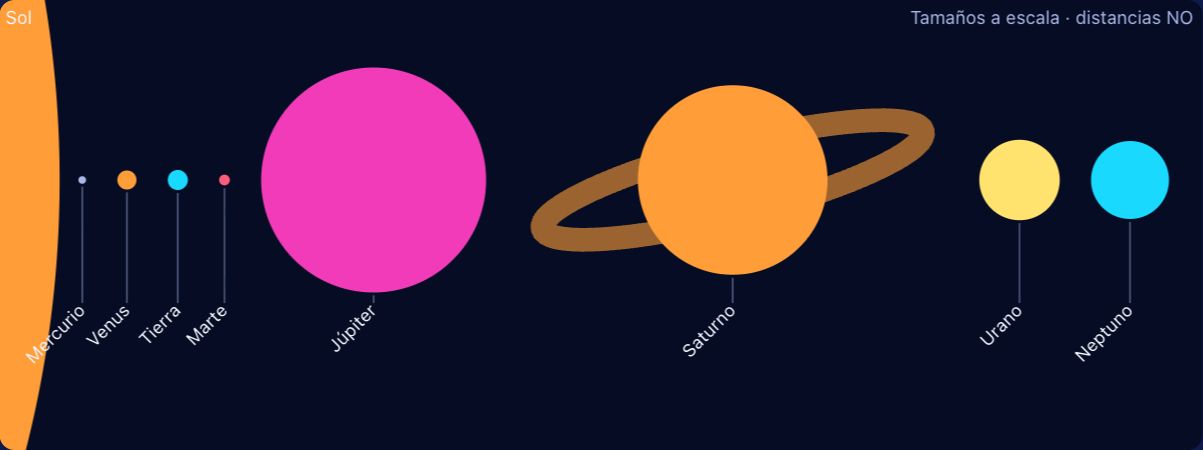
What about the sizes? With the same rule of three, the Earth (12 756 km) measures in the model 12 756 ÷ 1 391 400 × 1.6 cm ≈ 0.015 mm: smaller than a grain of salt, almost invisible. Jupiter (142 984 km) measures about 0.16 mm: a pencil dot. That is why the model needs a whole sports court: the Solar System is almost all empty space.
Project phases
Week 1 — The rule of three
- We review the lesson The Solar System to scale with the ball model: there Neptune ended up 706 m away, too far. Question: how do we shrink the model so it fits on the court?
- We choose the marble as the Sun and calculate the factor: 1.6 ÷ 1.4 ≈ 1.15 cm per million km.
- Each team (one per planet) calculates its distance with the rule of three and converts it to meters. Before calculating, estimate: “228 is about 200, and 200 × 1 is 200 cm, so it will be about 2 m and a bit more”.
- We compare the results with the table and with the simulator The Solar System to scale (which uses the exact value for the Sun, 1 391 400 km; the differences are small).
Week 2 — The signs and the planets
- Each team makes its planet’s sign: name, drawing, real distance, distance in the model and size in the model.
- We find the “planet” for each sign: for Mercury, Venus, the Earth and Mars, a grain of salt stuck on with tape (in reality they should be even smaller); for Jupiter and Saturn, a split sesame seed; for Uranus and Neptune, a split peppercorn. What matters is that all of them are far, far smaller than the marble.
- We calibrate our paces: each child walks 10 m measured with the tape and counts their paces. If it takes 16 paces, each pace is 10 ÷ 16 ≈ 0.6 m. We write down everyone’s pace.
- We prepare the rope with a knot every meter (an alternative to the tape measure).
Week 3 — We set up the model
- We choose a straight line on the court (a sideline) and put the Sun at one end.
- With the tape or the rope we measure each distance from the Sun and mark it with chalk. Each team places its sign. A “checking” team measures again and verifies.
- If the court is shorter than 52 m, Neptune goes out the gate: we mark it in the hallway or on the street (with permission and supervision) or use the variant with a smaller factor (below).
- We do the tour: we walk from the Sun to each planet counting paces and comparing with the calculated distance. How many of your paces is it to Jupiter?
Week 4 — Guided tour and wrap-up
- We invite another class. Each team, at its planet, explains its sign in one minute and answers questions.
- Light in the model: light travels 300 000 km in one second; in the model, 0.3 million km × 1.15 cm ≈ 0.35 cm per second: light would take 8 minutes to walk from the Sun to the Earth (1.7 m) and more than 4 hours to reach Neptune! We check it by moving a coin forward 3.5 mm every second.
- Wrap-up: each child writes three sentences: what surprised me, what I calculated and what I learned about empty space.
Mathematics in the project
- Rule of three: 1.4 million km → 1.6 cm; so 1 million km → 1.6 ÷ 1.4 ≈ 1.15 cm; and 778 million km → 778 × 1.15 ≈ 895 cm.
- Decimals: multiplying by 1.15 is multiplying by 1 and adding a bit more (15 hundredths). Quick estimate: “a bit more than the number”.
- Conversion: 895 cm = 8.95 m ≈ 9 m (dividing by 100 moves the decimal point two places).
- Calibrated paces: a unit of our own that we convert to meters with a multiplication.
Assessment rubric
| Criterion | Developing | Achieved | Advanced |
|---|---|---|---|
| Calculates with the rule of three | Needs to be given the factor and the calculation | Calculates their planet’s distance and converts it to meters | Estimates before calculating and explains why the result is reasonable |
| Measures in the playground | Measures with help | Measures their distance with tape or rope with an error under 20 cm | Checks another team’s measurement and converts their paces to meters |
| Explains the model | Names their planet | Explains the real distance and the model distance during the tour | Explains why the planets are almost invisible and space is “empty” |
| Teamwork and sign | Incomplete sign | Complete and correct sign | Sign with the size in the model and the light-travel fact |
Variants and extensions
- Small court: use a 1 cm Sun (factor 1 ÷ 1.4 ≈ 0.71 cm per million km): Neptune ends up 32 m away.
- Neighborhood model: with the ball Sun from the lesson (22 cm), Neptune ends up 706 m away: mark with the family how many blocks away each planet is.
- Mass and weight (unit 2): add to each sign “here you would weigh ___ kg” using the factors from the lesson How much would you weigh on Mars?.
Inclusion
- The knotted rope allows measuring by touch; the signs can carry the name in braille or in relief.
- If there are stairs or uneven ground, move the model to a long hallway or the perimeter of the court.
- Rotating roles: calculator, measurer, checker, tour guide; everyone presents at least once.
- For those who have not yet mastered multiplying decimals, use the table “1.15 × 100 = 115 cm” and add blocks of 100 million km.
Safety
- Outdoor work: hat, water and sunscreen; measurements are done at times of weaker sun if possible.
- Never look at the Sun (the real one) to “compare it” with the marble.
- If Neptune ends up outside the school, go out only with permission, accompanied by an adult and away from the road.
- Marbles and small seeds do not go in the mouth (especially with younger siblings visiting).