The idea in one line
There is an eclipse only when the new or full Moon occurs near a node: the point where the lunar orbit, tilted by , crosses the plane of the Earth’s orbit (the ecliptic). Away from the node, the Moon passes above or below the Earth’s shadow (or its shadow misses the Earth). The Moon’s ecliptic latitude measures that separation: if at the moment of full or new Moon , there is an eclipse of some kind.
Project phases
Week 1 — The shadow model
- With the lamp, the larger ball and the small ball we reproduce a solar eclipse (small ball between lamp and larger ball) and a lunar one (larger ball between lamp and small ball). We measure: how big is the larger ball’s shadow at the small ball’s distance?
- The question: if the Moon goes around once a month, why aren’t there two eclipses every month? We tilt the orbit hoop by 5° and see that the small ball almost always passes above or below the shadow.
- With the lesson Phases of the Moon and eclipses we calculate the angular sizes: the Sun and the Moon measure ≈ 0.5° and the Earth’s shadow at the Moon’s distance ≈ 1.4°. That is why the criterion makes sense.
- We draw to scale, on graph paper, the Sun, Earth and Moon with their distances (1 au and 384 400 km): we discover that the “textbook” drawing is never to scale.
Week 2 — The calendar of moons
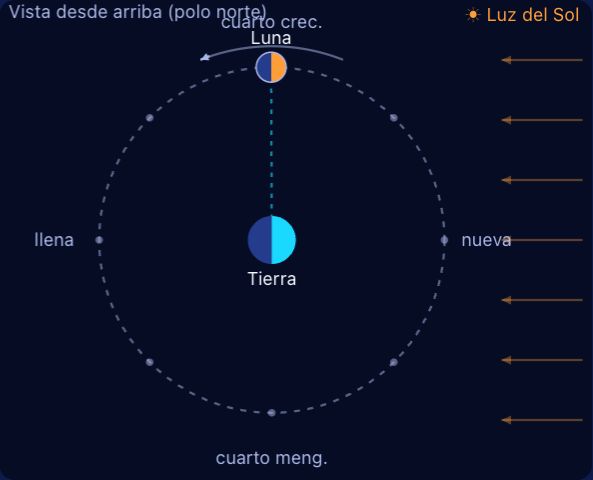
- Linear equation: starting from a known full Moon , the -th following one occurs at days. We calculate the full and new moons of the next 24 months (about 25 of each) and check them in the simulator Phases of the Moon in real-date mode.
- For each full and new moon we write down the ecliptic latitude given by the simulator. We mark those that satisfy : they are the eclipse candidates.
- We observe the pattern: the candidates come in seasons about 6 months apart (173 days: that is how long the Sun takes to go from one node to the other).
- We classify each candidate: lunar (full Moon) or solar (new Moon); and, according to , total or partial (the closer to 0, the more central).
Week 3 — Comparing with the catalog
- We open the NASA tables (eclipse.gsfc.nasa.gov, decade tables) and look for our candidates. Did we get them all? Are there eclipses we did not predict (for example, penumbral ones with a somewhat larger )?
- Time conversion: the catalog gives the time in TD (Dynamical Time), almost equal to UTC (it differs by ≈ 69 s). Colombian time is UTC − 5. Example: the maximum of the lunar eclipse of June 26, 2029 is at 03:23 TD → 03:22 UTC → 22:22 on June 25, Colombian time.
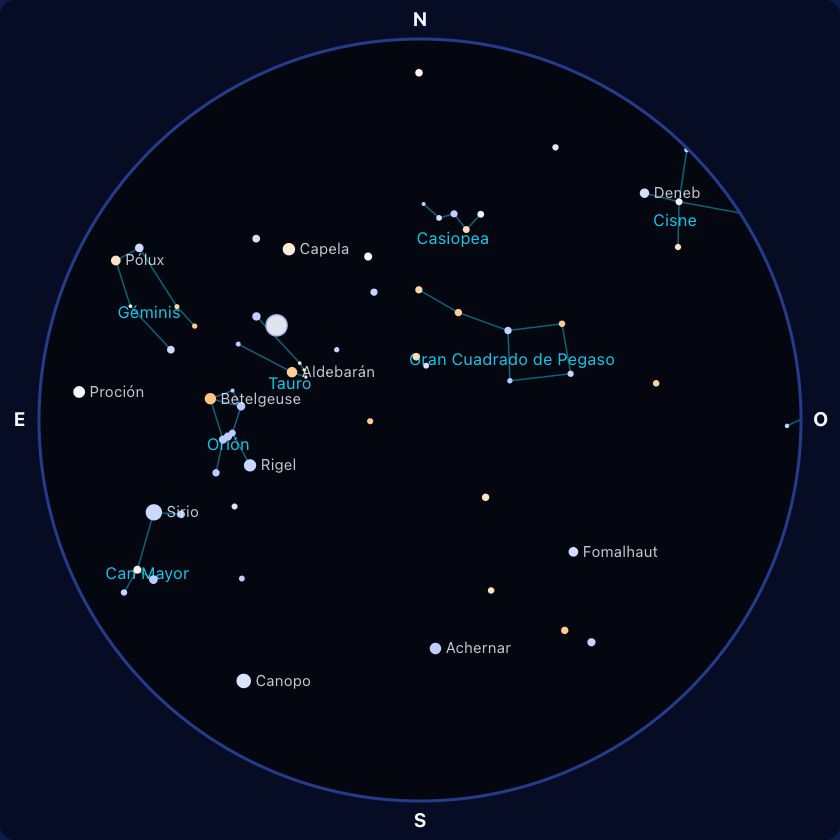
- Visibility: a lunar eclipse is visible from the whole night side of the Earth. With the Interactive planisphere we check whether the Moon is above the horizon in our city at that time. A solar eclipse is visible only from the strip swept by the shadow; the catalog includes the map.
- We assemble the class calendar 2026–2029 with the columns: date, type, local time of maximum, altitude of the Moon or the Sun in our city, visible?
| Date | Type | Colombian time | Visibility |
|---|---|---|---|
| Jan 11–12, 2028 | Partial lunar (magnitude 0.07) | 23:13 on the 11th | A small “bite” at the edge |
| Jan 26, 2028 | Annular solar | around 9:00 | Annular in Leticia (8:53–9:02); partial in the rest of the country (magnitude 0.73 in Bogotá) |
| Jun 25–26, 2029 | Total lunar (magnitude 1.84) | 22:22 on the 25th | Full totality from all of Colombia |
| Dec 20, 2029 | Total lunar (magnitude 1.12) | 17:42 | The Moon rises already eclipsed at dusk |
Week 4 — Observation plan and our own prediction
- We choose the next visible eclipse and write the plan: date, start, maximum and end times in local time, a place with a clear horizon, list of materials, person responsible for safety, what to record (time of each contact, photos, drawings of the Moon every 10 minutes).
- For a lunar eclipse: we will time the first contact with the umbra and compare with the catalog. For a solar one: only pinhole projection or ISO 12312-2 certified glasses.
- Saros challenge: to a known eclipse we add 6 585.32 days (18 years, 11 days and 8 hours) and predict the next one in its series. Example: total solar eclipse of April 8, 2024 → April 20, 2042. We check in the catalog.
- We hand in the report: method, calendar of moons, candidates, comparison with NASA, hits and misses, and observation plan.
Week 5 — Verification
- If the chosen eclipse happens during the school year, we observe it according to the plan and compare the measured times with the predicted ones (differences of minutes are normal: the contact time depends on the accuracy of the clock and on the atmosphere).
- If it has not happened yet, we verify a past eclipse: the partial lunar eclipse of August 27–28, 2026 (23:13 on the 27th, visible from the whole country). We look for photos or reports of that night (observatories, press) and check the time and magnitude.
- Wrap-up: each student explains in a paragraph, using the latitude , why in a specific month there was no eclipse.
Mathematics in the project
- Linear equation: . If is a full Moon, is the next new Moon.
- Angular sizes: an object of diameter at distance subtends . Moon: . Sun: .
- Coordinates: the ecliptic latitude is the “north–south” position relative to the plane of the Earth’s orbit; the nodes are the points with . Between two eclipse seasons ≈ 173 days go by.
- Time conversion: Colombian time = UTC − 5 h; if the result is negative, subtract one day.
Assessment rubric
| Criterion | Developing | Achieved | Advanced |
|---|---|---|---|
| Geometry of eclipses | Tells solar and lunar eclipses apart | Explains with the 5.1° tilt why there is no eclipse every month | Justifies the criterion with the angular sizes |
| Calendar and prediction | Calculates some full moons | Builds the 24-month calendar and selects the candidates with | Explains eclipse seasons (173 days) and the Saros cycle |
| Comparison with the catalog and times | Finds the eclipse in the table | Converts TD/UTC to local time and determines visibility from their city | Analyzes the prediction’s misses (penumbral eclipses, limits of the criterion) |
| Observation plan and safety | Incomplete plan | Complete plan with times, materials and solar safety rules | Carries out the observation or the verification and compares measured and predicted times |
Variants and extensions
- Rømer with the eclipses of Jupiter (unit 1): the eclipses of Io are also predicted with a linear equation; their delay when the Earth moves away from Jupiter made it possible to measure the speed of light (lesson The speed of light and the light-year).
- Solar eclipse with a class-wide camera obscura: a large box with a 1 mm hole projects the partially eclipsed Sun for the whole class.
- History: research the total eclipse of February 26, 1998 (visible from La Guajira and the Colombian Caribbean) and the accounts from that time.
Inclusion
- A lunar eclipse can be heard: one student describes out loud the eclipsed fraction every 5 minutes for classmates with low vision; it can also be “touched” with a model of two overlapping cardboard disks.
- Times and conversions are worked on in pairs; the calendar is built in a shared spreadsheet for those who prefer the digital format.
- Nighttime observation is optional and done with the family; verification with public photos is the equivalent alternative.
Safety
- Solar eclipse: never look directly at the Sun, not even partially eclipsed, not with sunglasses, smoked glass, X-ray film, CDs or homemade filters. Only projection (pinhole, camera obscura) or ISO 12312-2 certified eclipse glasses checked by the teacher (no scratches or holes). Never binoculars, telescopes or the phone camera pointed at the Sun without a certified solar filter over the lens.
- Lunar eclipse: it is completely safe to look with the naked eye or with binoculars.
- Nighttime observation with an adult, in a safe place and with warm clothes; let families know the schedule.