 16 years old · Grades 10 and 11 · Secondary Education
Grade 11
“How does a computer predict the motion of the planets?”
Units of the year
- Unit 1
Calculus and motion
- Velocity and acceleration as derivatives
- Differential equations
- 📘 Velocity, acceleration and derivatives · 165 min
- Unit 2
Simulating orbits
- Euler's method
- Euler–Cromer and energy conservation
- 📘 Simulating an orbit with the Euler method · 165 min
- Unit 3
Starlight
- Blackbody: Wien and Stefan–Boltzmann
- Exponential and logarithmic functions
- 📘 The H–R diagram · 165 min
- 📘 The blackbody and the color of the stars · 165 min
Math you will use
Limits and derivativesExponential and logarithmic functionsNumerical methodsModeling
Complementary lessons
-
The lives of stars
How much fuel a star has and how fast it burns it: the mass–luminosity relation L ∝ M^3.5, the lifetime t ∝ M^−2.5 with t☉ ≈ 10¹⁰ years, and the three final fates (white dwarf, neutron star, black hole) with the Chandrasekhar limit of 1.4 M☉.
⏱ 165 min
Simulators
-
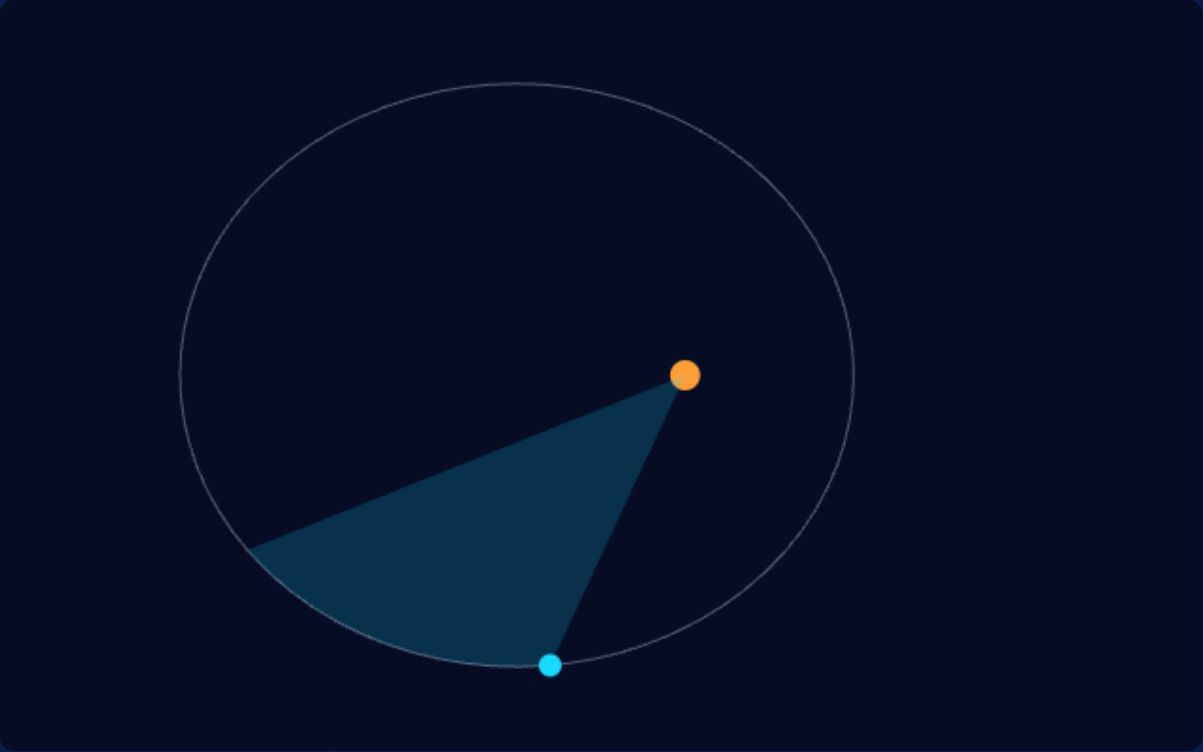
Keplerian orbit
A planet in an elliptical orbit: adjust a and e, watch the law of areas and the vis-viva equation.
-
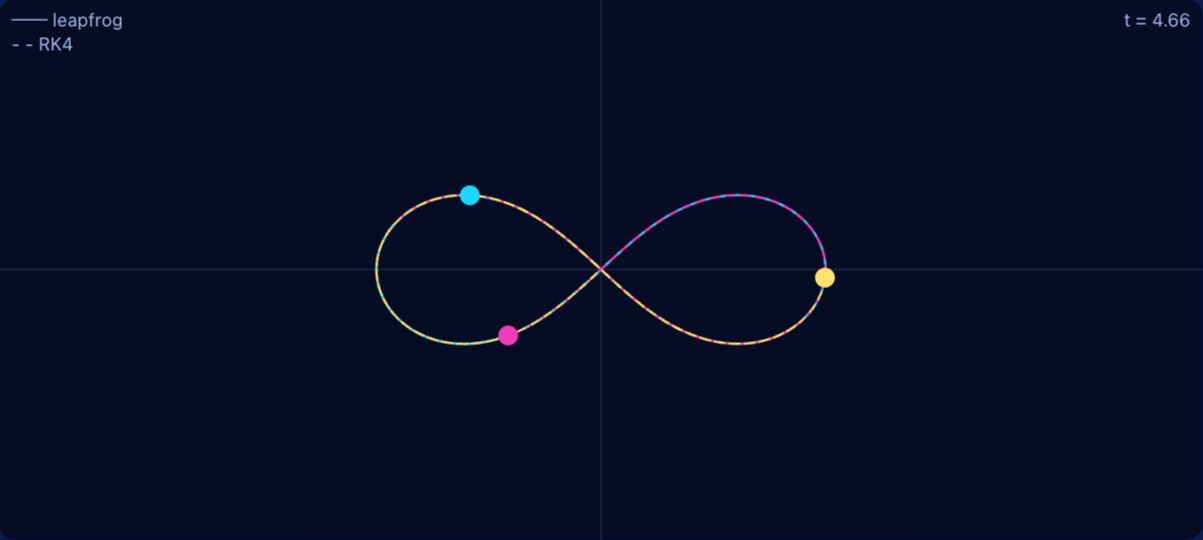
N bodies: integrators and chaos
RK4 versus symplectic leapfrog on an eccentric two-body orbit, the figure-eight and the Pythagorean problem; energy error on a log scale and divergence of neighboring trajectories (Lyapunov).
-
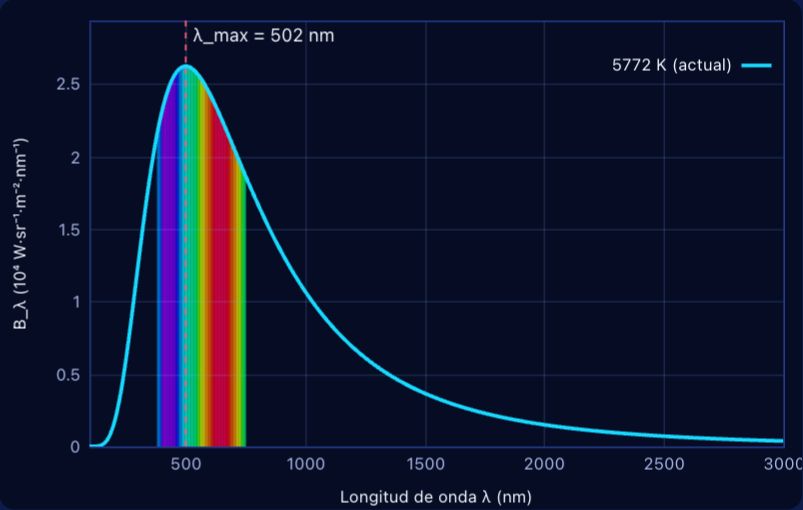
Blackbody spectrum
Planck curves, Wien’s law, sRGB color of stars, B−V index and luminosity L = 4πR²σT⁴.
-
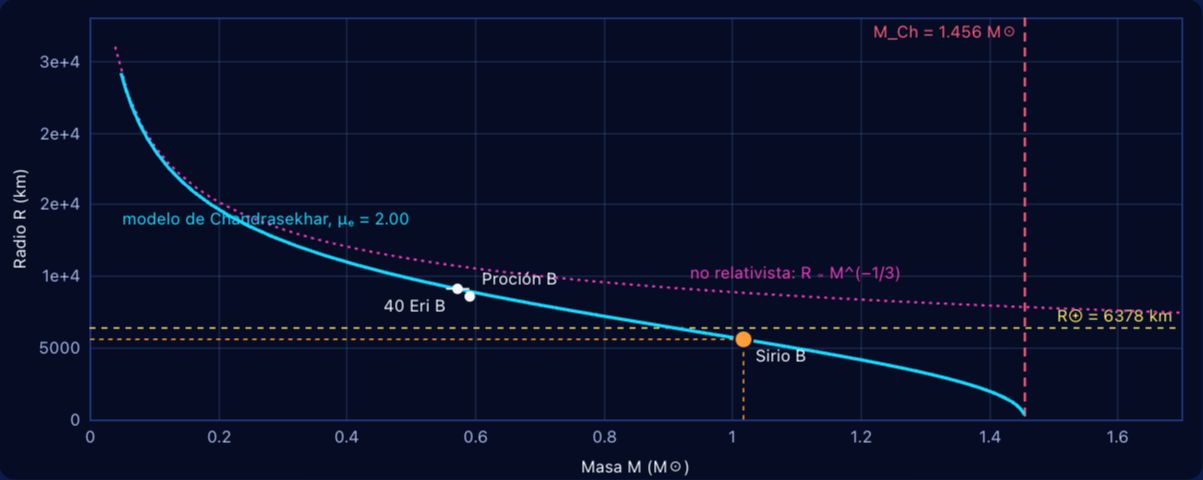
White dwarfs: mass, radius and the Chandrasekhar limit
Mass–radius curve of the Chandrasekhar model (degenerate electron gas with the exact equation of state) versus the non-relativistic branch R ∝ M^(−1/3) and the limit M_Ch = 5.83 μₑ⁻² M☉; choose the central density and the composition (C/O or Fe), look at the density profile and compare with Sirius B, Procyon B and 40 Eri B.
Program Earth's orbit in a spreadsheet with Euler's method.
Full project sheet: 5 weeks, materials, phases and rubric →
Get a simulated orbit to close with less than 1 % error.