Her life
Jocelyn Bell was born on July 15, 1943, in Lurgan, Northern Ireland. Her father was an architect who designed the Armagh Planetarium, and there were astronomy books at home that she read with interest. At her school at the time the boys studied science and the girls, domestic science; her parents protested and got her admitted to the science classes too. She graduated in physics from the University of Glasgow in 1965 and went to the University of Cambridge to do her doctorate with Antony Hewish, who was searching for very compact radio objects.
Today she is known by her husband’s surname, Burnell, but when she made her discovery she signed as S. J. Bell. She has since worked at the universities of Southampton, London and Oxford, and has presided over the Royal Astronomical Society, the Institute of Physics and the Royal Society of Edinburgh. She was made a Dame of the British Empire in 2007.
The first pulsar

Part of her doctoral work was to help build, with her own hands and those of her colleagues, an enormous radio telescope: an array of some two thousand wire dipoles held up by wooden posts in a field near Cambridge, covering an area of about 18 000 square meters (four and a half acres). It was meant to study objects that “twinkle” in radio, just as stars twinkle to the naked eye because of the atmosphere. The telescope scanned the sky and traced the signal on paper rolls of about thirty meters a day, which Bell checked by hand.
In August 1967 she noticed on the paper a strange trace, which she called a bit of “scruff”, that always appeared at the same sidereal time, that is, always from the same direction in the sky, and was not man-made noise. With a faster recording she found, on November 28 of that year, that the signal consisted of pulses separated by 1.3373 seconds with extraordinary precision. That regularity was so surprising that, for a moment, the group joked about it being an intelligent signal and named the source “LGM”, for “little green men”. Shortly afterward, Bell found three other similar sources in other parts of the sky, which ruled out that possibility: there could not be four civilizations sending similar messages.
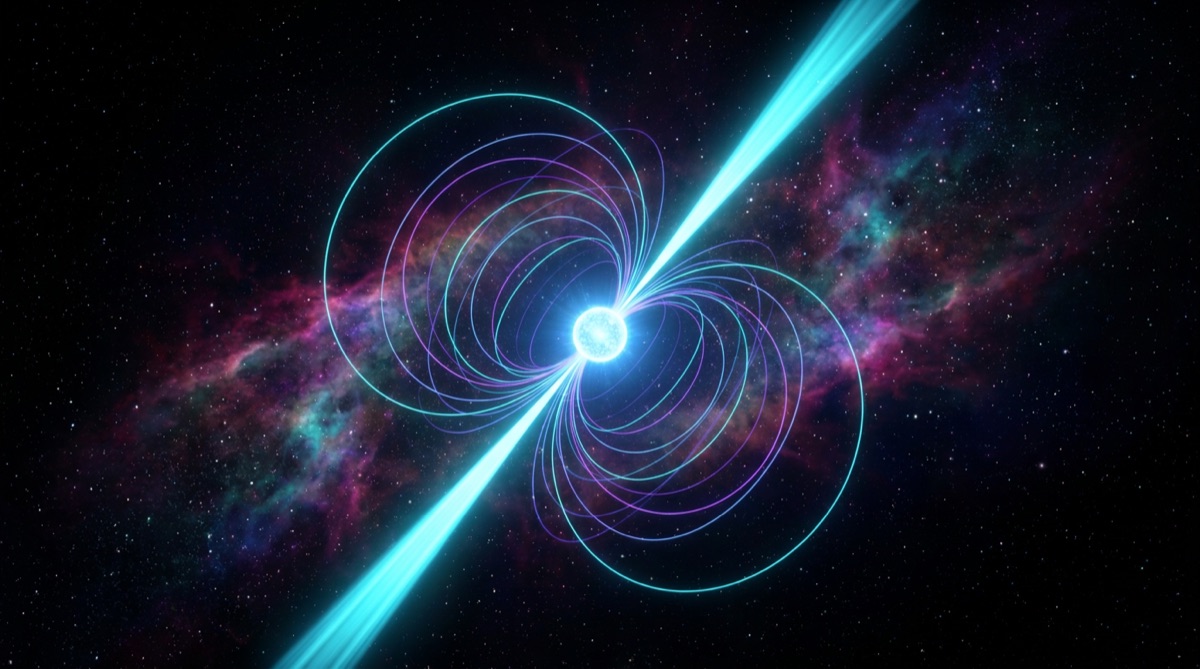
The paper announcing the discovery was published in the journal Nature in February 1968. That same year the astrophysicist Thomas Gold proposed the explanation accepted today: a pulsar is a neutron star, the ultradense core left behind by a supernova explosion, which spins very fast and emits a beam of radio waves, like a lighthouse. Each time the beam sweeps past the Earth, the telescope records a pulse. The first source, CP 1919 (now PSR B1919+21), lies in the constellation Vulpecula, the Fox. The Periodogram simulator shows how a periodicity hidden in a noisy signal is detected, the underlying problem of this discovery.
Her legacy
In 1974 the Nobel Prize in Physics was awarded to Antony Hewish, together with Martin Ryle, for his role in the discovery of pulsars; Bell was not included. That decision sparked a debate in the scientific community, and she has always spoken of the matter with great restraint, without bitterness. In 2018 she received the Special Breakthrough Prize in Fundamental Physics, worth three million dollars, and decided to donate it in full to the Institute of Physics in the United Kingdom to create scholarships for students from groups underrepresented in physics: women, people from ethnic minorities and refugees.
More than three thousand pulsars are known today. Some spin hundreds of times per second and work as cosmic clocks with an accuracy comparable to that of atomic clocks; others help in the search for gravitational waves. To learn how a neutron star is born, see the lesson The lives of stars and the Chandrasekhar limit.