His life
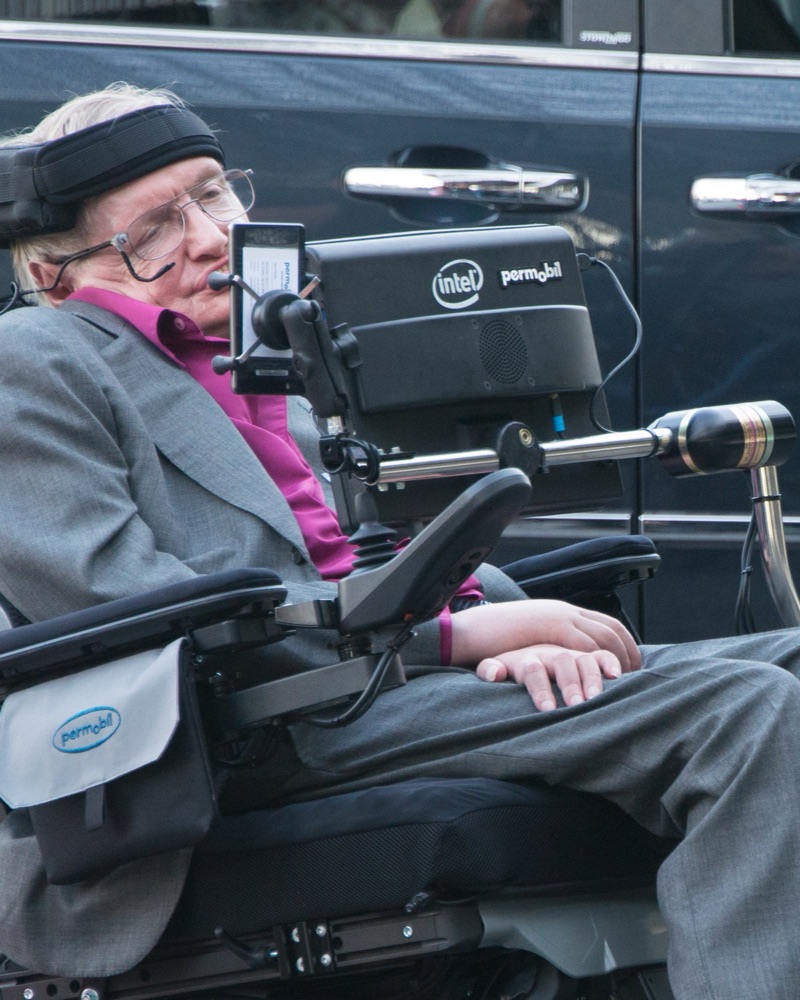
Stephen Hawking was born in Oxford on January 8, 1942, the son of a medical researcher. He studied physics at the University of Oxford and in 1962 went to Cambridge to do a doctorate in cosmology with Dennis Sciama. At 21 he was diagnosed with amyotrophic lateral sclerosis (ALS), a disease that gradually damages the neurons that move the muscles, and was given a few years to live. He lived more than fifty. In time he lost the use of his hands and his voice and communicated through a voice synthesizer controlled first with a switch, later with the movement of one cheek.
In 1979 he was appointed Lucasian Professor of Mathematics at Cambridge, the chair once held by Isaac Newton, and he held it until 2009. In 2007 he flew in an aircraft that performs parabolic arcs to experience weightlessness: he said he wanted to encourage others to look toward space.
Singularities: the beginning of time
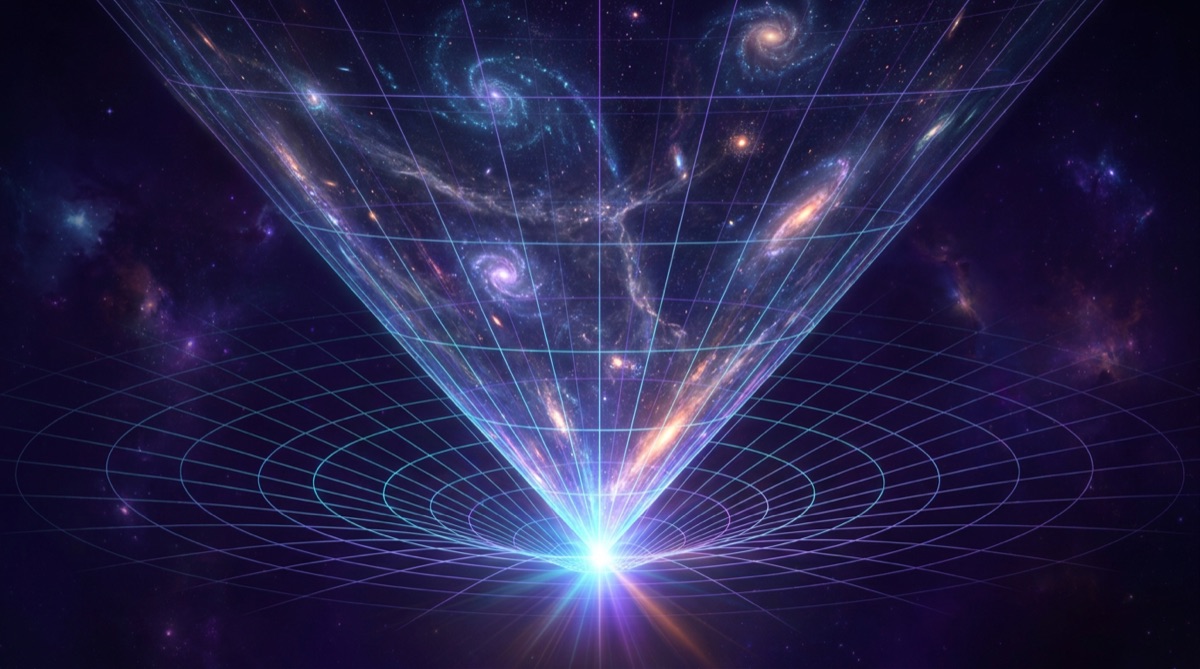
If general relativity is correct, what happens when a star collapses or when we go back in time toward the Big Bang? In the mid-1960s, Roger Penrose showed that a sufficiently large collapse cannot avoid forming a singularity, a point where the equations cease to hold. Hawking applied the same reasoning to the expansion of the universe, and in 1970 the two published a theorem: under reasonable conditions, the universe must have begun in a singularity. That does not mean we know what the origin was like, but that general relativity, on its own, reaches its limit at that point. The equations of the model are studied in the lesson Friedmann equations.
Black holes are not so black
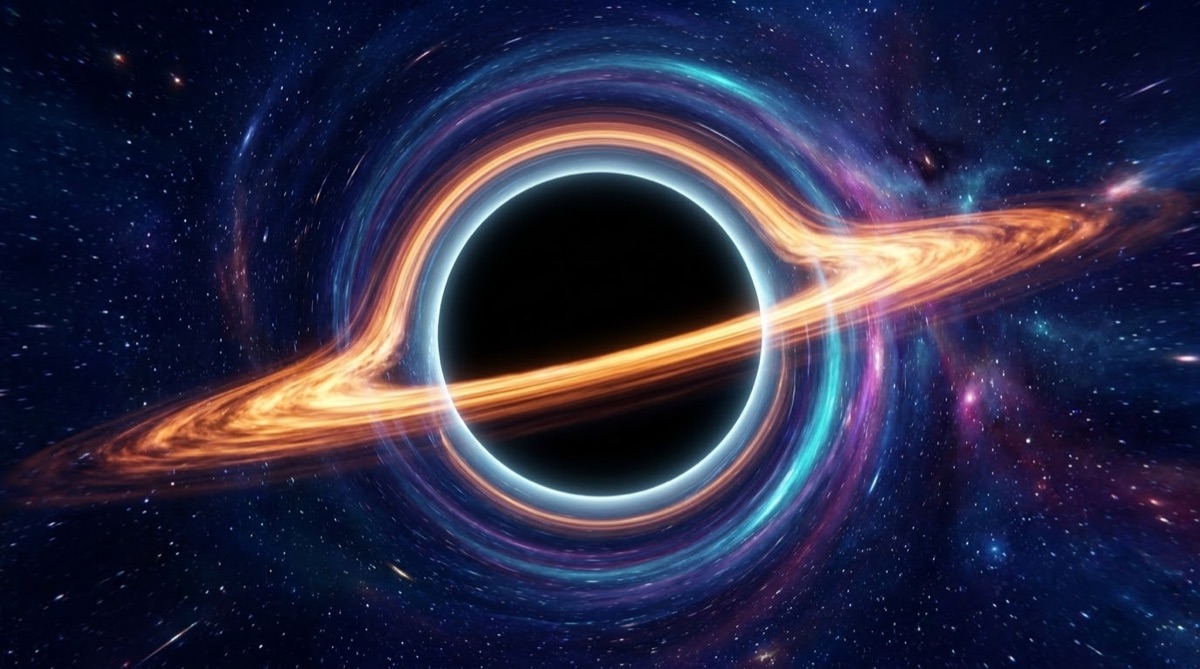
A black hole is surrounded by an event horizon, a surface of no return. In 1971 Hawking proved that the sum of the areas of the horizons never decreases, something like the entropy of thermodynamics. Jacob Bekenstein proposed that the analogy was literal, and Hawking, who doubted at first, discovered in 1974 that if quantum mechanics is included, a black hole emits thermal radiation. Its temperature is inversely proportional to its mass: the smaller the hole, the hotter. For one with the mass of the Sun, that temperature is about 6×10⁻⁸ kelvin (six hundred-millionths), much lower than that of the cosmic microwave background (about 2.7 K), so in practice stellar black holes absorb more energy than they emit and do not evaporate. No one has yet detected Hawking radiation, but the idea united relativity, quantum mechanics and thermodynamics, and it remains a starting point for quantum gravity. You can explore the geometry of the horizon with the simulator Schwarzschild geodesics.
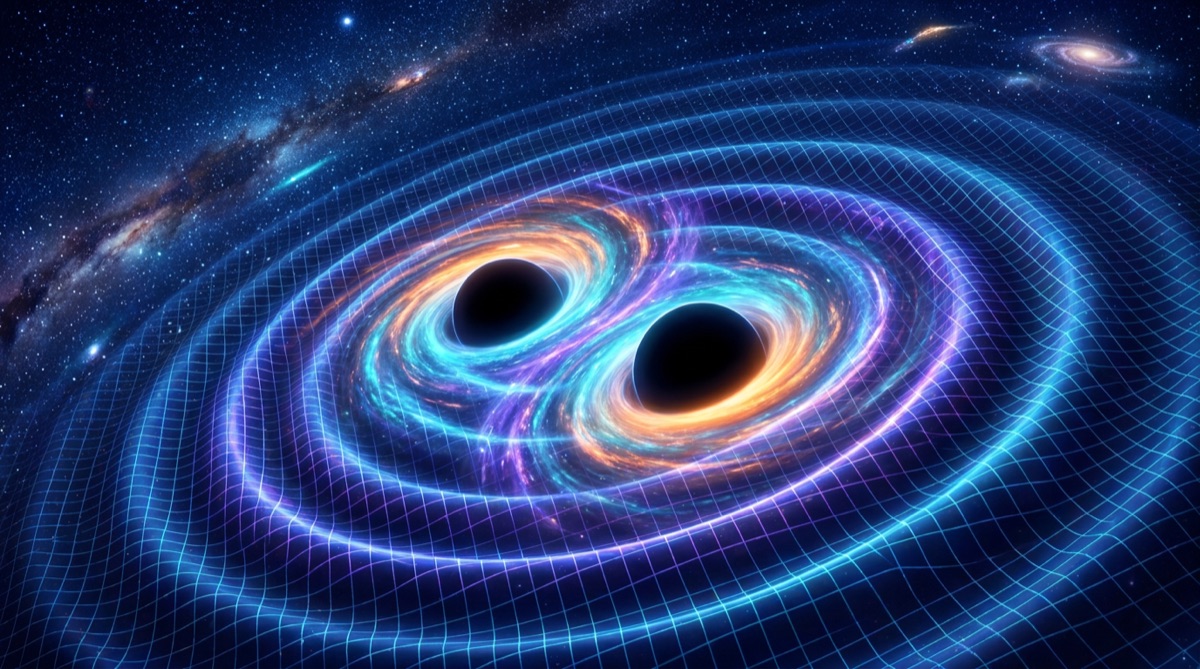
That radiation also raises the “information paradox”: what happens to whatever falls into a black hole if it evaporates? It is still an open problem. Black hole mergers, detected as gravitational waves since 2015, now make it possible to test part of his horizon area theory.
His legacy
A Brief History of Time (1988) sold millions of copies and was translated into dozens of languages. Hawking wrote more popular science books, some with his daughter Lucy, and appeared in television series and films. He received the Presidential Medal of Freedom of the United States in 2009. He died in Cambridge on March 14, 2018, and his ashes rest in Westminster Abbey, beside the graves of Newton and Darwin.
The 2020 Nobel Prize in Physics recognized Penrose for showing that the formation of black holes is a robust prediction of general relativity, and Reinhard Genzel and Andrea Ghez for finding one at the center of our galaxy. The physics Hawking helped build is no longer just theory.