Her life
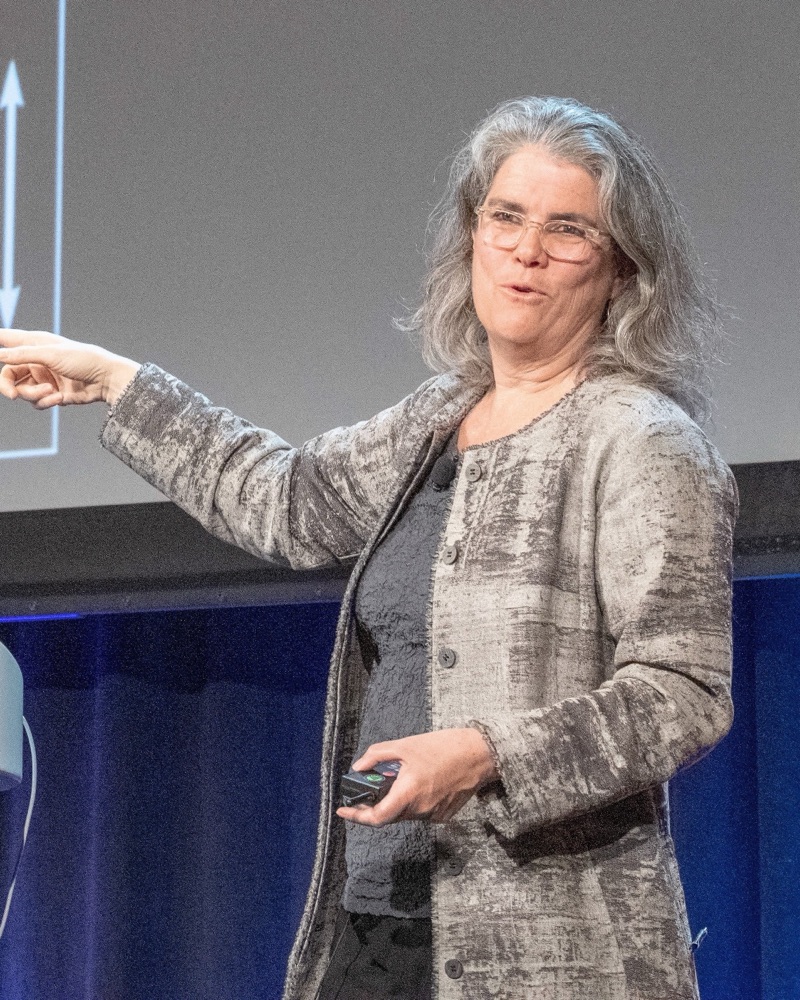
Andrea Ghez was born on June 16, 1965, in New York. As a child she wanted to be the first woman to walk on the Moon; she watched Apollo 11 on television, and from then on astronomy seemed to her a possible path. She earned a bachelor’s degree in physics at the Massachusetts Institute of Technology (MIT) in 1987 and a doctorate at the California Institute of Technology (Caltech) in 1992. Since 1994 she has been a professor at the University of California, Los Angeles (UCLA), where she leads a group devoted to the Galactic Center.
The stars that revolve at the center of the galaxy
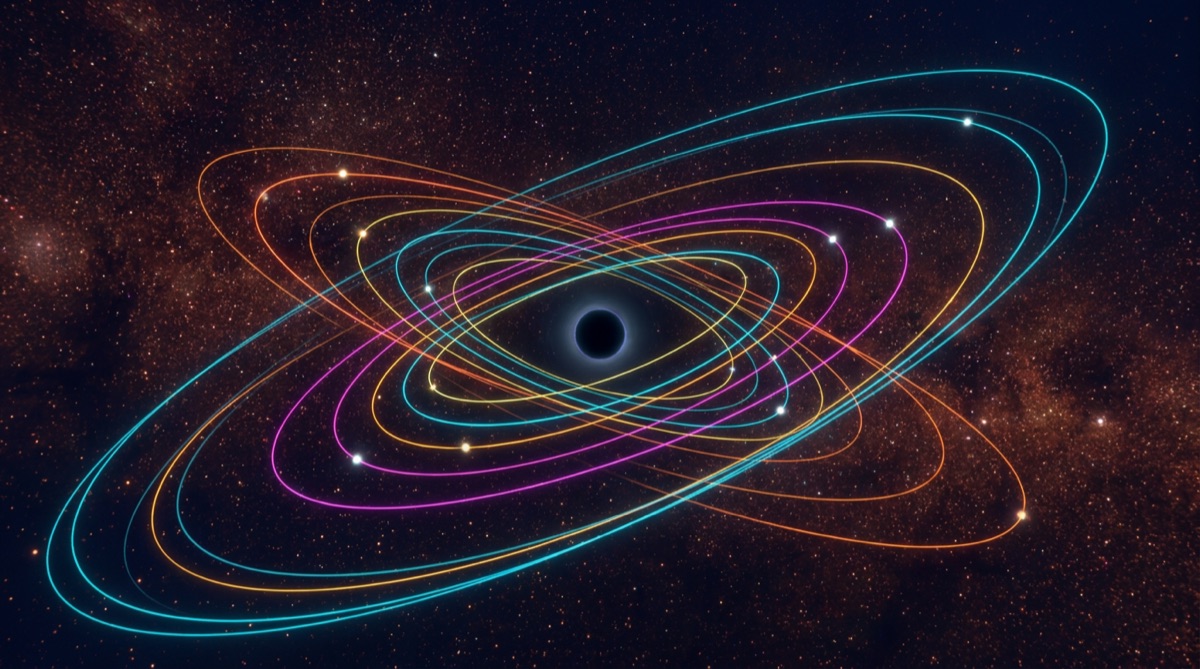
The center of the Milky Way lies some 26 000 light-years away, in the direction of the constellation Sagittarius, but dust makes it impossible to see in visible light. In the infrared it can be seen, and there sits a very compact radio source called Sagittarius A* (“Sagittarius A star”). The question was what it was: a huge cluster of dark stars or a black hole.
To answer it, one had to follow the motion of the nearest stars, a difficult problem, because on Earth the atmosphere makes images shimmer and blends neighboring stars into a single blur. Ghez used the ten-meter Keck telescopes on Mauna Kea (Hawaii), with ever better techniques: first very short-exposure images (speckle) and, from 2004, adaptive optics, which deforms a mirror hundreds of times per second to compensate for the turbulence. In parallel, Reinhard Genzel’s team in Europe was making measurements with other telescopes. Year after year her images showed that the stars near Sagittarius A* move at speeds of thousands of kilometers per second, and follow elliptical orbits.
The most studied star, S0-2 (S2 for the European team), completes an orbit every 16 years, with a semi-major axis of about a thousand astronomical units, and passes some 120 au from the center. Kepler’s third law says that the square of the period is proportional to the cube of the semi-major axis: with the period in years and the semi-major axis in astronomical units, the central mass, expressed in solar masses, is the cube of the semi-major axis divided by the square of the period. With 1000 au and 16 years, gives about 4 million solar masses. That object, so massive and so compact that it fits within the space of our planetary system, can only be a black hole. You can repeat that calculation with the Kepler Orbit simulator and the lesson Weighing the Sun and the planets.
A laboratory for relativity
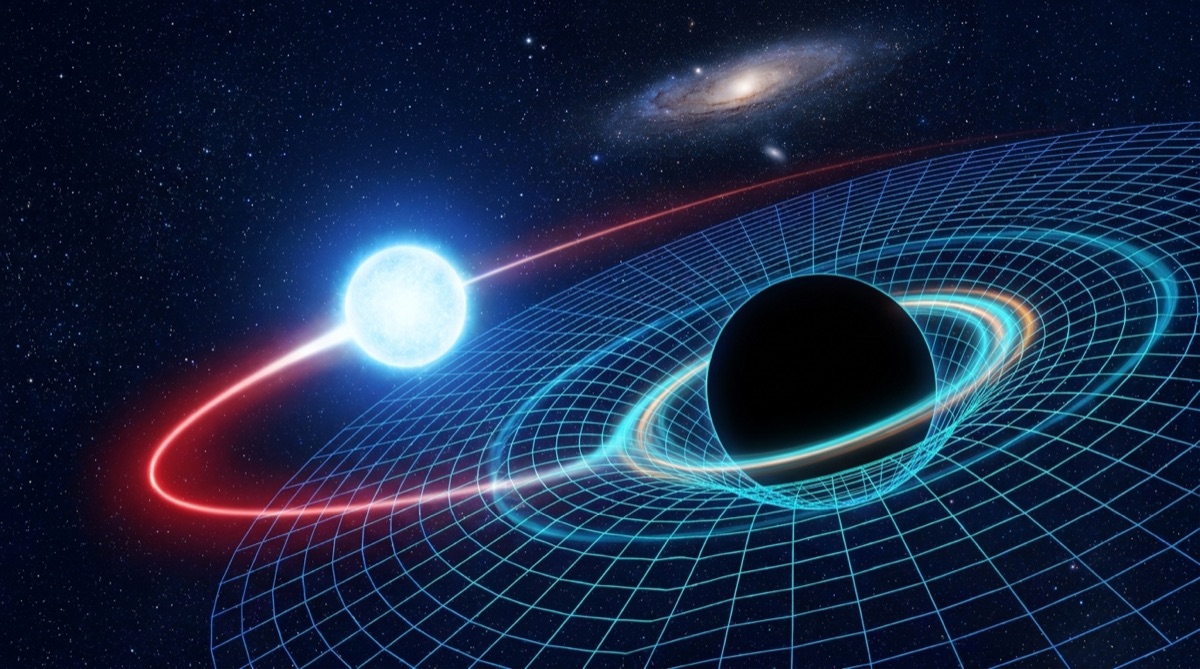
When S0-2 passed close to the black hole in 2018, Ghez’s team measured that its light was redshifted slightly more than Newton’s gravity predicts, just as Einstein’s general relativity requires (the gravitational redshift): that was the result they published in 2019. That center is a natural test bench for theories of gravity, such as those studied in the lesson Schwarzschild geodesics.
Her legacy
In 2020 the Swedish Academy awarded half of the Nobel Prize in Physics to Reinhard Genzel and Andrea Ghez “for the discovery of a supermassive compact object at the centre of our galaxy”; the other half went to Roger Penrose. Ghez is the fourth woman to have won the Nobel Prize in Physics, after Marie Curie, Maria Goeppert Mayer and Donna Strickland. Besides her research, Ghez devotes time to outreach and to encouraging girls to study science, and she has worked with her group on developing new imaging techniques for next-generation telescopes.