His life

Ibn al-Haytham was born around 965 in Basra, now in Iraq, and was educated in that great center of learning. Medieval biographers relate that, already a scholar of renown, he traveled to Egypt, drawn by the Fatimid caliph al-Hakim with the promise of regulating the floods of the Nile. On reaching the south and seeing the river, he understood that the project was unfeasible with the means of the time. According to those same stories, to escape the caliph’s wrath he feigned madness and lived in seclusion until al-Hakim’s death in 1021. It is an anecdote that was written down centuries later, and historians treat it with caution; what is certain is that, between 1011 and 1021, by then in Cairo, he completed his most important work.
He earned his living copying texts, taught and wrote more than a hundred works, of which a few dozen survive, on optics, mathematics, astronomy and philosophy. He died around 1040.
To see is to receive light
Since antiquity there had been two ideas about vision. Euclid and Ptolemy held that the eyes sent out rays toward objects. Aristotle preferred that objects send “forms” to the eye. Neither had solid proof.
In the Kitab al-Manazir, the “Book of Optics”, in seven volumes, Ibn al-Haytham settled the question with reasoning and experiments: light sets out from every point of an illuminated object in all directions, and it is the light reaching the eye that lets us see. Something as simple as the fact that the intense light of the Sun dazzles and leaves afterimages shows, he said, that something enters the eye rather than leaving it.
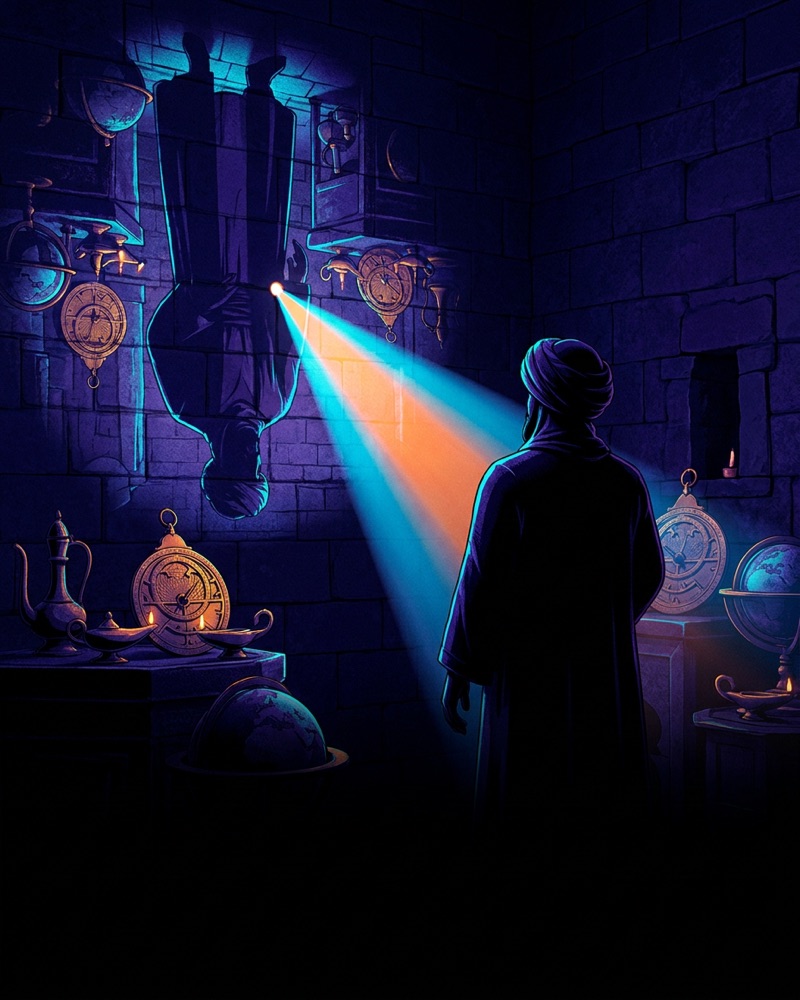
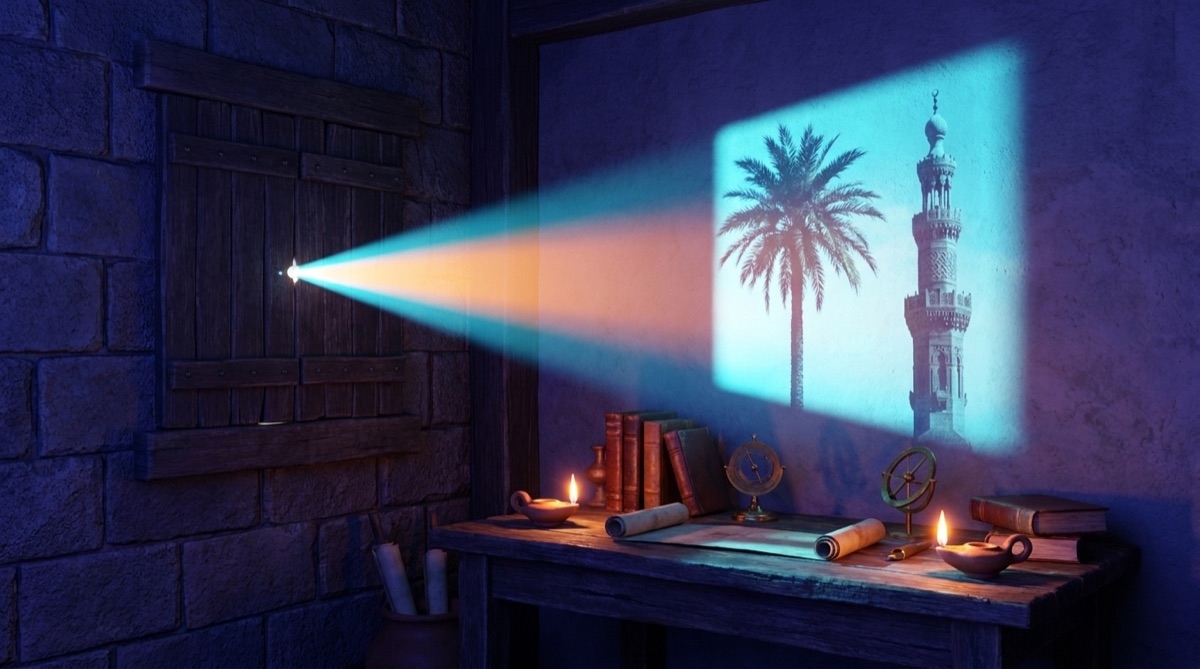
To study it he built a dark room with a small hole through which light entered, the camera obscura, and showed that the image of a lamp appears inverted on the wall, and that when one of the lamps is covered only its image disappears. He measured how light is reflected and how it is refracted when passing from one medium to another, and explained the shape of the eye and the role of its parts. Most influential of all was his method: pose a hypothesis, design an experiment to test it and accept the result, even if it contradicted the ancients. That is why many historians consider him a pioneer of the scientific method.
A sky that makes physical sense

Ibn al-Haytham applied the same standard to astronomy. In Al-shukuk ala Batlamyus, “Doubts Concerning Ptolemy”, he pointed out that the models of the Almagest worked for computing positions but could not exist as real bodies. The clearest case was the equant, the point from which a planet’s motion appears uniform: the sphere carrying it would have to rotate non-uniformly about its own axis, something impossible for a solid body. A model of the heavens, he held, must explain the observations and at the same time be consistent with physics.
His proposal in On the Configuration of the World was to imagine each planet carried by a set of nested spheres and shells, moving with uniform motions and without gaps. He did not solve the problem, but he posed the question that would guide the astronomers of Maragha, among them al-Tusi, and from there Copernicus. Studies of atmospheric refraction and twilight are also attributed to him, as well as the analysis of why the Moon and the Sun look larger near the horizon, an illusion he explained as a phenomenon of perception.
His legacy

The Kitab al-Manazir was translated into Latin around 1200 as De aspectibus and became the foundation of European optics. Roger Bacon, Witelo and later Kepler studied it; Kepler cites it in his 1604 book on astronomical optics, where he explains the image on the retina and the camera obscura. In 1572 the treatise was printed in Basel as Opticae thesaurus Alhazeni.
The UN declared 2015 the International Year of Light partly to commemorate the millennium of his great book. A lunar crater bears his name in its Latin form, Alhazen, and with it we remember that asking “how do I know it is so?” is the first step of science.