Astronomy and Space Exploration ES

History of Astronomy / 11 of 14

Europe c. 1230 – 1781 under review

Europe: from the Middle Ages to the Scientific Revolution

Between the Toledan tables and the discovery of Uranus, Europe went from copying Ptolemy to replacing him: a Sun at the center, elliptical orbits, the telescope and a law of gravitation that explained comets and tides.

Timeline

25 events, 8 of them milestones (★) that also appear on the overall timeline.

  1. c. 1230
    Illustration: Sacrobosco writes “De sphaera” (Paris)

    Theory and models

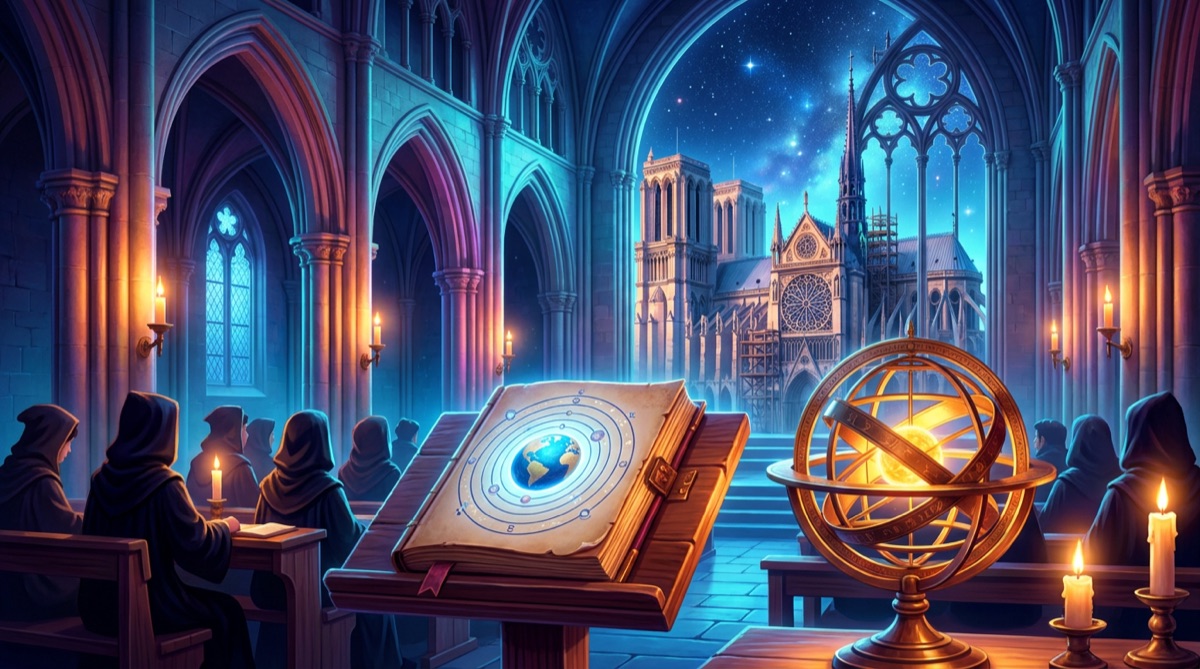
    Sacrobosco writes “De sphaera”

    John of Sacrobosco, a teacher in Paris, summarized in a small book the astronomy of Ptolemy as it arrived through the Arabs: the spherical Earth, the celestial spheres, the circles of the sky and the eclipses. It was the astronomy textbook of every European university for four centuries.

    👤 John of Sacrobosco · 📍 Paris

    Celestial sphereEcliptic

    Sources (2)
    • Thorndike, L. (1949). The Sphere of Sacrobosco and Its Commentators. University of Chicago Press.
    • Hoskin, M. (ed.) (1999). The Cambridge Concise History of Astronomy. Cambridge University Press, ch. 3.
  2. c. 1252
    Illustration: The Alfonsine Tables (Toledo)

    Mathematics

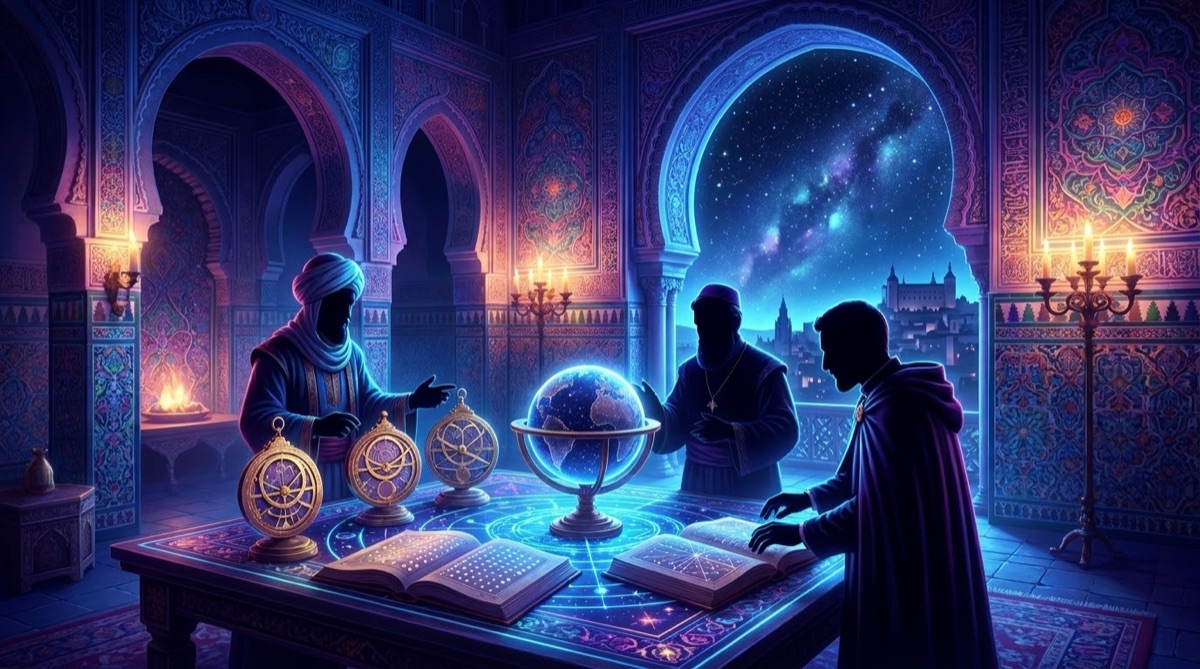
    The Alfonsine Tables

    In Toledo, the astronomers of Alfonso X the Wise, led by the Jewish scholar Isaac ibn Sid, computed new tables for predicting planetary positions with epoch 1252, the year of the king's coronation. Probably compiled between 1263 and 1272 and spread from Paris, they were the reference tables in Europe until Copernicus, who used the printed edition of 1492.

    👤 Alfonso X of Castile, Isaac ibn Sid, Judah ben Moses · 📍 Toledo

    Sources (2)
    • Chabás, J. & Goldstein, B. R. (2003). The Alfonsine Tables of Toledo. Kluwer (Archimedes, vol. 8).
    • Hoskin, M. (ed.) (1999). The Cambridge Concise History of Astronomy. Cambridge University Press, ch. 3.
  3. 1377
    Illustration: Oresme debates whether the Earth rotates (Paris)

    Theory and models

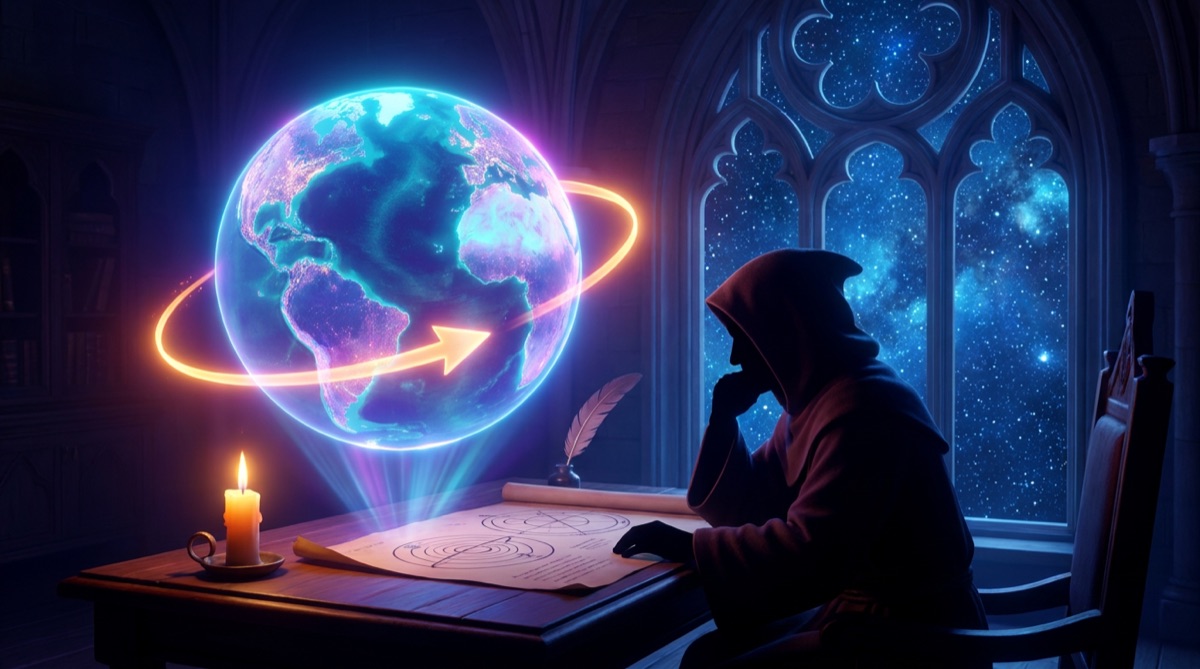
    Oresme debates whether the Earth rotates

    In his “Book of the Heavens and the World” (1377), Nicole Oresme carefully examined the idea that the Earth turns on itself once a day and showed that no observation or argument refutes it: what we see would be the same. He concluded, however, that the Earth is at rest. His analysis anticipates by two centuries the reasoning of Copernicus and Galileo.

    👤 Nicole Oresme · 📍 Paris

    Sources (2)
    • Oresme, N. Le Livre du ciel et du monde, book II, ch. 25 (ed. and trans. A. D. Menut & A. J. Denomy, University of Wisconsin Press, 1968).
    • Grant, E. (1994). Planets, Stars, and Orbs: The Medieval Cosmos, 1200–1687. Cambridge University Press, ch. 20.
  4. 1474
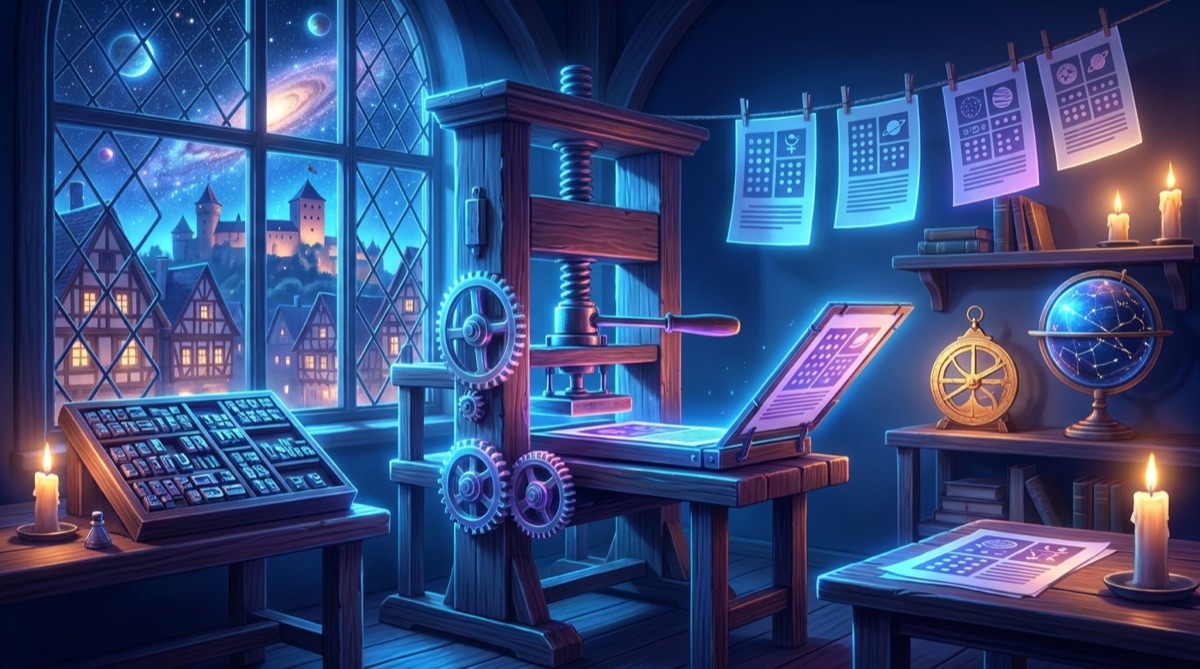
    Illustration: Regiomontanus prints ephemerides in Nuremberg (Nuremberg)

    Mathematics

    Regiomontanus prints ephemerides in Nuremberg

    Johannes Müller, Regiomontanus, founded in Nuremberg the first scientific printing press and published ephemerides with day-by-day planetary positions for 1475–1506; Columbus carried a copy to America. His “Epitome of the Almagest”, finished in 1462 and printed in 1496, was the book from which Copernicus learned Ptolemy.

    👤 Regiomontanus (Johannes Müller), Georg von Peuerbach · 📍 Nuremberg

    Sources (2)
    • Zinner, E. (1990). Regiomontanus: His Life and Work. Trans. E. Brown. North-Holland.
    • Swerdlow, N. M. & Neugebauer, O. (1984). Mathematical Astronomy in Copernicus's De Revolutionibus. Springer, part 1.
  5. 1543
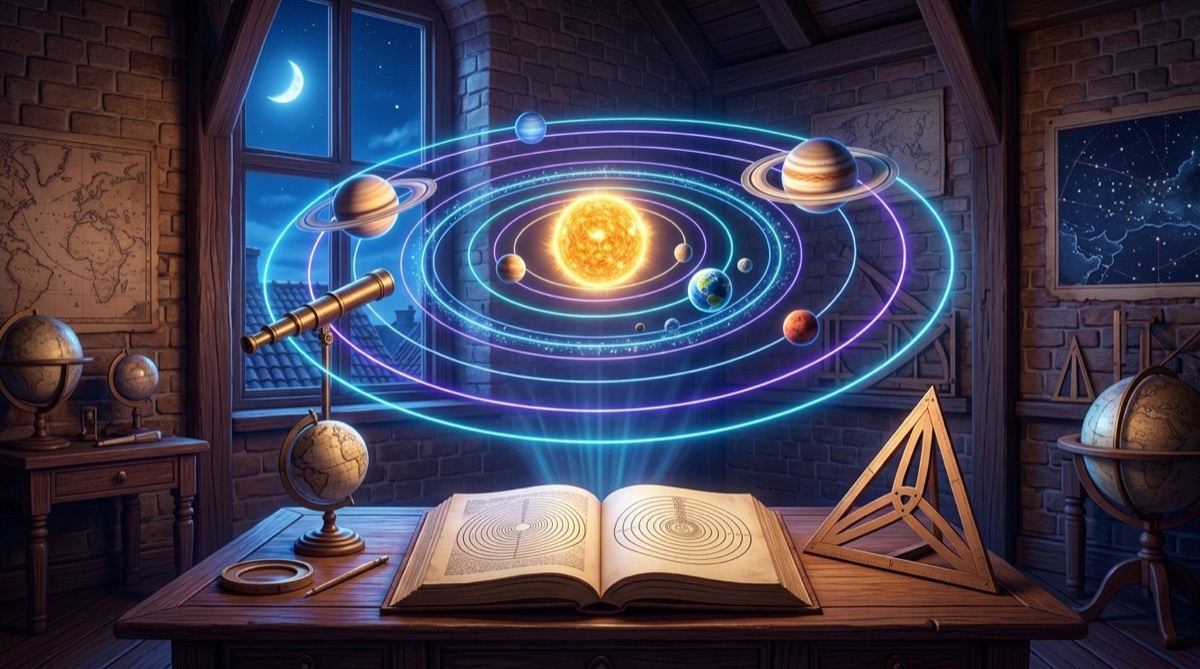
    Illustration: Copernicus: “De revolutionibus” (Frombork (Poland) and Nuremberg)

    Theory and models ★ milestone

    Copernicus: “De revolutionibus”

    Nicolaus Copernicus put the Sun at the center and set the Earth in motion: turning on itself every day and around the Sun every year. In this way he explained the loops of the planets naturally and fixed for the first time the order and the relative distances of the orbits. The book was printed in Nuremberg in 1543, the year of his death.

    👤 Nicolaus Copernicus, Georg Joachim Rheticus · 📍 Frombork (Poland) and Nuremberg

    🧪 The Solar System to scale OrbitAstronomical unit

    Sources (2)
    • Copernicus, N. (1543). De revolutionibus orbium coelestium. Trans. E. Rosen, On the Revolutions, Johns Hopkins University Press, 1992.
    • Gingerich, O. (2004). The Book Nobody Read: Chasing the Revolutions of Nicolaus Copernicus. Walker & Co.
  6. 1572
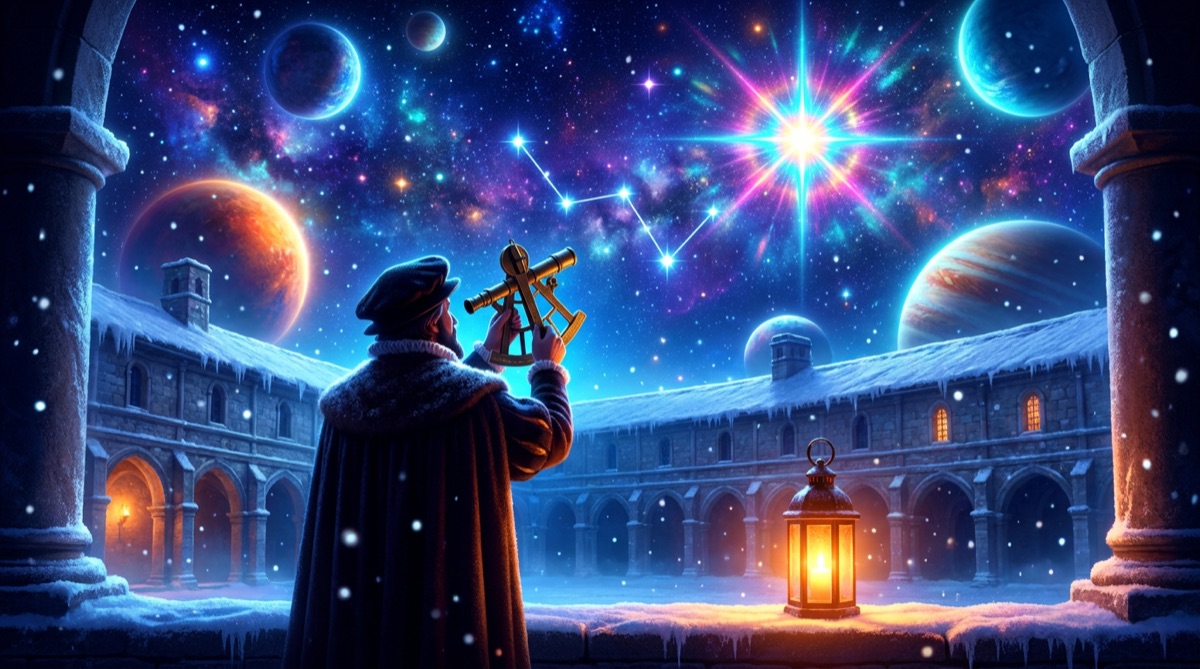
    Illustration: Tycho Brahe and the “new star” of 1572 (Herrevad (Scania, then Denmark))

    Observation ★ milestone

    Tycho Brahe and the “new star” of 1572

    On November 11, 1572, a star as bright as Venus appeared in Cassiopeia. Tycho Brahe measured that it did not change position relative to the neighboring stars: it was not an atmospheric phenomenon but something new in the sky of the fixed stars, which according to Aristotle was unchangeable. Today we know it was a supernova.

    👤 Tycho Brahe · 📍 Herrevad (Scania, then Denmark)

    📘 Tycho and Kepler, or how eight minutes of arc changed the universe SupernovaParallax

    Sources (2)
    • Brahe, T. (1573). De nova et nullius aevi memoria prius visa stella. Copenhagen.
    • Thoren, V. E. (1990). The Lord of Uraniborg: A Biography of Tycho Brahe. Cambridge University Press, ch. 2.
  7. 1576 – 1597
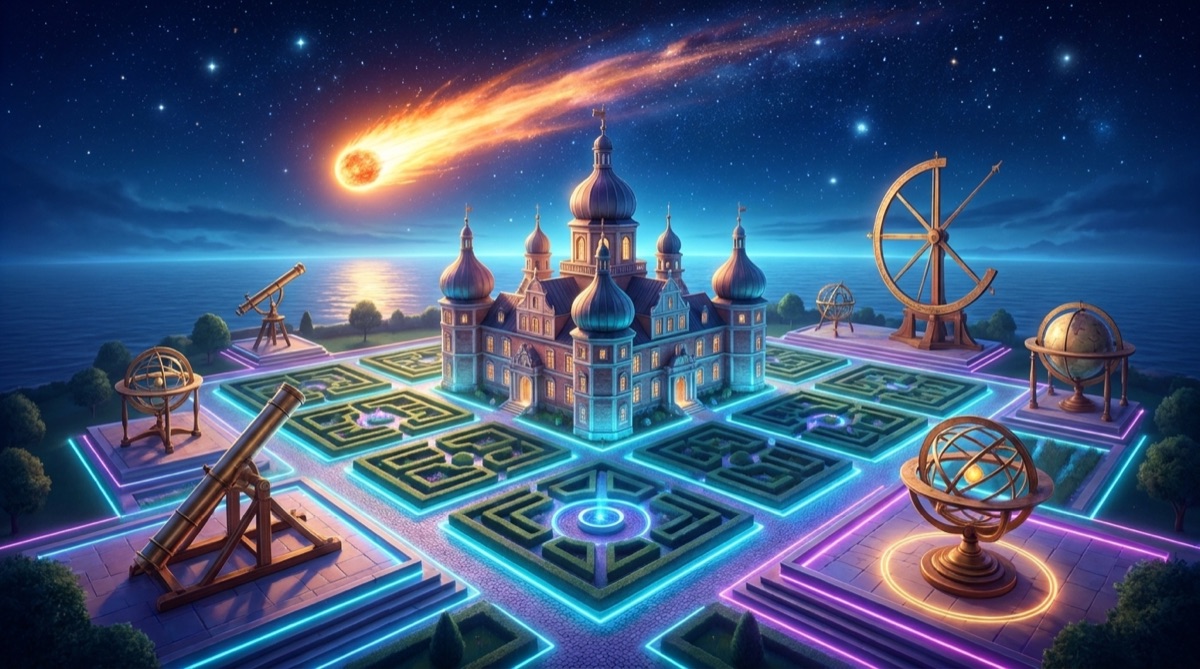
    Illustration: Uraniborg: Tycho's observatory and the comet of 1577 (Island of Hven (now Sweden))

    Observatories and institutions

    Uraniborg: Tycho's observatory and the comet of 1577

    With the support of the king of Denmark, Tycho built on the island of Hven the observatory of Uraniborg, with enormous instruments that measured positions with an error of one arcminute, the best before the telescope. From there he showed that the comet of 1577 was farther away than the Moon, which shattered the supposed solid spheres of the heavens. Twenty years of data from Hven would be Kepler's raw material.

    👤 Tycho Brahe, Frederick II of Denmark · 📍 Island of Hven (now Sweden)

    ArcsecondParallax

    Sources (2)
    • Thoren, V. E. (1990). The Lord of Uraniborg: A Biography of Tycho Brahe. Cambridge University Press.
    • Christianson, J. R. (2000). On Tycho's Island: Tycho Brahe and His Assistants, 1570–1601. Cambridge University Press.
  8. 1582
    Illustration: The Gregorian calendar (Rome)

    Calendar

    The Gregorian calendar

    Because the Julian year was 11 minutes too long, the equinox had moved forward ten days since the Council of Nicaea. The reform of Pope Gregory XIII, based on the calculations of the astronomer Luigi Lilio and the Jesuit Christopher Clavius, dropped ten days (October 4, 1582 was followed by the 15th) and adjusted the centurial leap years. It is the calendar that almost the whole world uses today.

    👤 Gregory XIII, Luigi Lilio, Christopher Clavius · 📍 Rome

    Equinox

    Sources (2)
    • Gregory XIII (1582). Bull Inter gravissimas (February 24, 1582).
    • Coyne, G. V., Hoskin, M. A. & Pedersen, O. (eds.) (1983). Gregorian Reform of the Calendar: Proceedings of the Vatican Conference. Pontificia Academia Scientiarum and Specola Vaticana.
  9. 1600
    Illustration: Giordano Bruno is executed in Rome (Rome (Campo de' Fiori))

    Theory and models

    Giordano Bruno is executed in Rome

    The philosopher Giordano Bruno, who imagined an infinite universe with countless suns and inhabited worlds, was burned in Rome on February 17, 1600. His condemnation by the Inquisition was due above all to his theological doctrines; Bruno was not an astronomer and made no observations, so presenting him as a “martyr of science” oversimplifies the story.

    👤 Giordano Bruno · 📍 Rome (Campo de' Fiori)

    Sources (2)
    • Rowland, I. D. (2008). Giordano Bruno: Philosopher/Heretic. Farrar, Straus and Giroux.
    • Knox, D. (2019). Giordano Bruno. Stanford Encyclopedia of Philosophy. https://plato.stanford.edu/entries/bruno/
  10. 1608
    Illustration: The telescope: Lipperhey's application (Middelburg and The Hague)

    Instrument ★ milestone

    The telescope: Lipperhey's application

    In October 1608, the spectacle maker Hans Lipperhey, of Middelburg, applied to the States General of the Netherlands for a patent on a tube with two lenses that brought distant objects closer. It was refused because others claimed the same invention, but the news spread across Europe and within a year the telescope was pointed at the sky.

    👤 Hans Lipperhey · 📍 Middelburg and The Hague

    Sources (1)
    • Van Helden, A. (1977). The Invention of the Telescope. Transactions of the American Philosophical Society 67(4). https://doi.org/10.2307/1006276
  11. 1609
    Illustration: Kepler: “Astronomia nova” and elliptical orbits (Prague)

    Theory and models ★ milestone

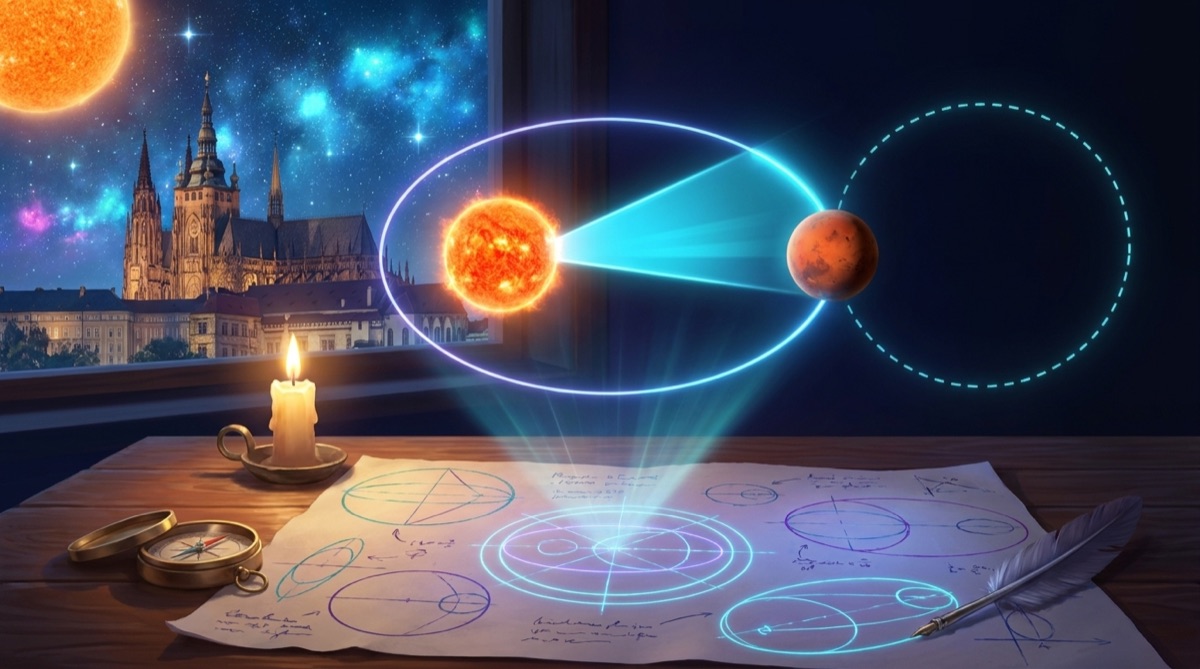
    Kepler: “Astronomia nova” and elliptical orbits

    After years of struggling with Tycho's data on Mars, Kepler found that a circular orbit left an error of 8 arcminutes, small but larger than Tycho's precision. He refused to ignore it and discovered that the orbit is an ellipse with the Sun at one focus and that the planet sweeps out equal areas in equal times: his first two laws.

    👤 Johannes Kepler · 📍 Prague

    📘 Kepler's three laws 🧪 Keplerian orbit Kepler's lawsEllipseEccentricity

    Sources (2)
    • Kepler, J. (1609). Astronomia nova. Trans. W. H. Donahue, New Astronomy, Cambridge University Press, 1992, ch. 19 and 58–60.
    • Voelkel, J. R. (2001). The Composition of Kepler's Astronomia Nova. Princeton University Press.
  12. 1610
    Illustration: Galileo: “Sidereus nuncius” (Padua and Venice)

    Discovery ★ milestone

    Galileo: “Sidereus nuncius”

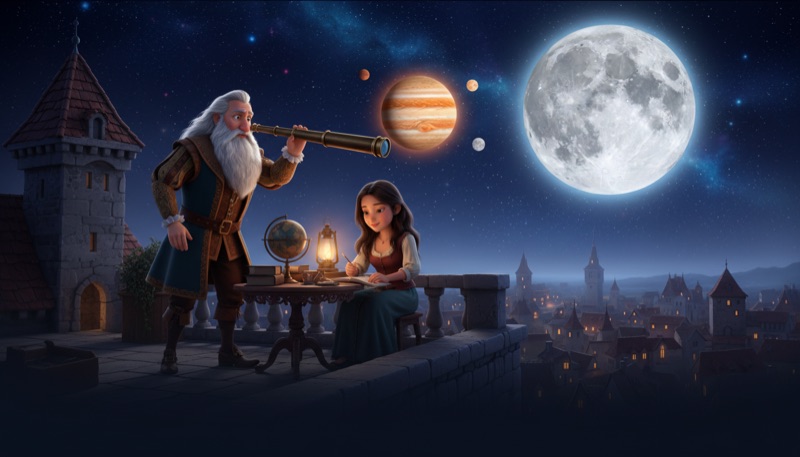
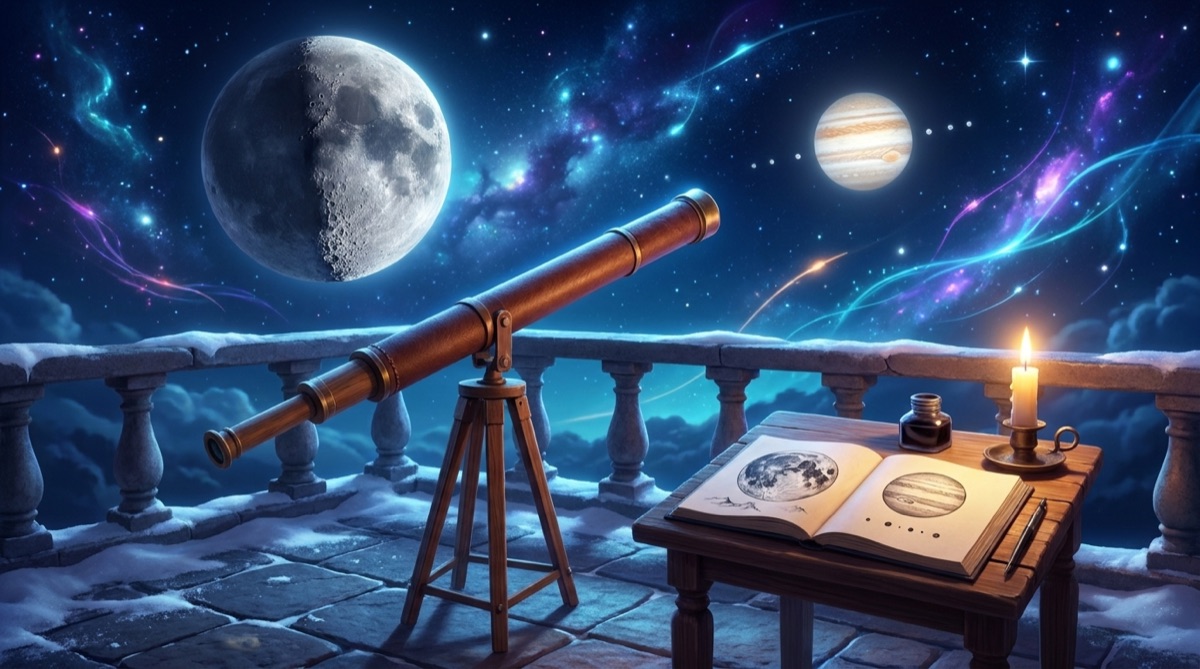
    In March 1610 Galileo published what he had seen with his telescope since the previous autumn: mountains on the Moon, many more stars than are visible to the naked eye, the Milky Way resolved into stars, and four moons circling Jupiter. Those moons proved that not everything revolves around the Earth.

    👤 Galileo Galilei · 📍 Padua and Venice

    Galaxy

    Sources (1)
    • Galilei, G. (1610). Sidereus nuncius. Trans. A. Van Helden, University of Chicago Press, 1989.
  13. 1610 – 1613
    Illustration: Phases of Venus and sunspots (Florence)

    Discovery

    Phases of Venus and sunspots

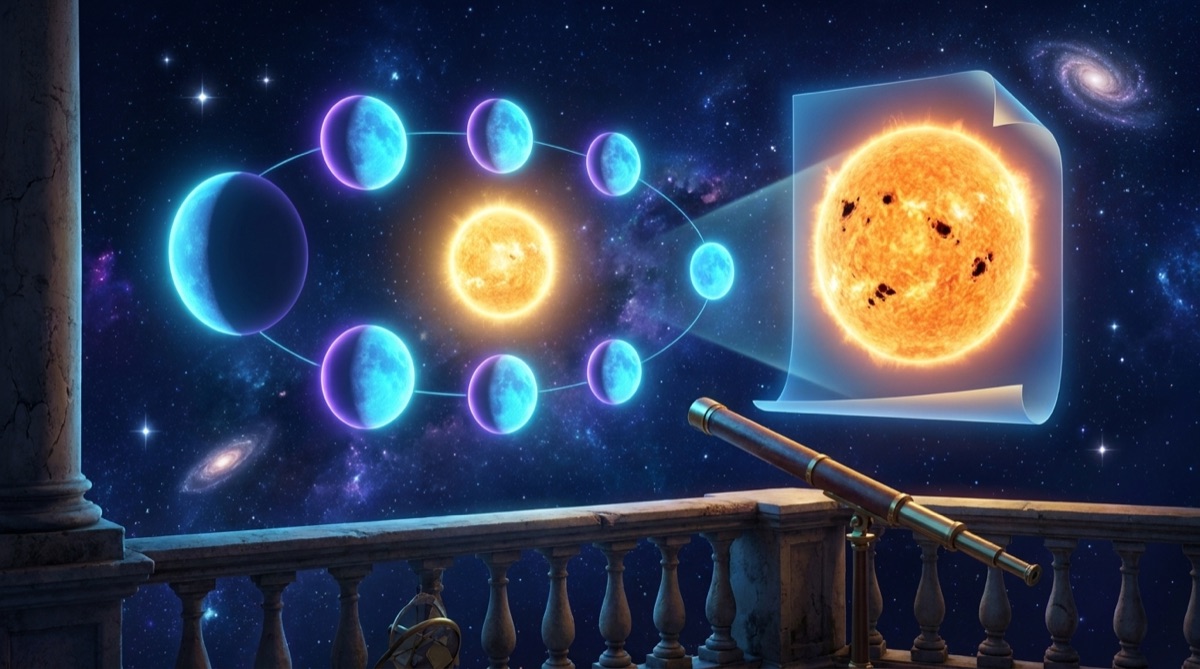
    In late 1610 Galileo verified that Venus shows a full set of phases, like the Moon, which is impossible in Ptolemy's model and requires Venus to revolve around the Sun. Between 1611 and 1613, Fabricius, Harriot, Scheiner and Galileo himself observed spots on the Sun; Galileo showed in 1613 that they lie on the solar surface and that the Sun rotates.

    👤 Galileo Galilei, Johannes Fabricius, Thomas Harriot, Christoph Scheiner · 📍 Florence

    Phases of the Moon

    Sources (2)
    • Palmieri, P. (2001). Galileo and the discovery of the phases of Venus. Journal for the History of Astronomy 32, 109–129. https://doi.org/10.1177/002182860103200202
    • Galilei, G. & Scheiner, C. On Sunspots. Trans. E. Reeves & A. Van Helden, University of Chicago Press, 2010.
  14. 1619
    Illustration: Kepler's third law (Linz)

    Theory and models

    Kepler's third law

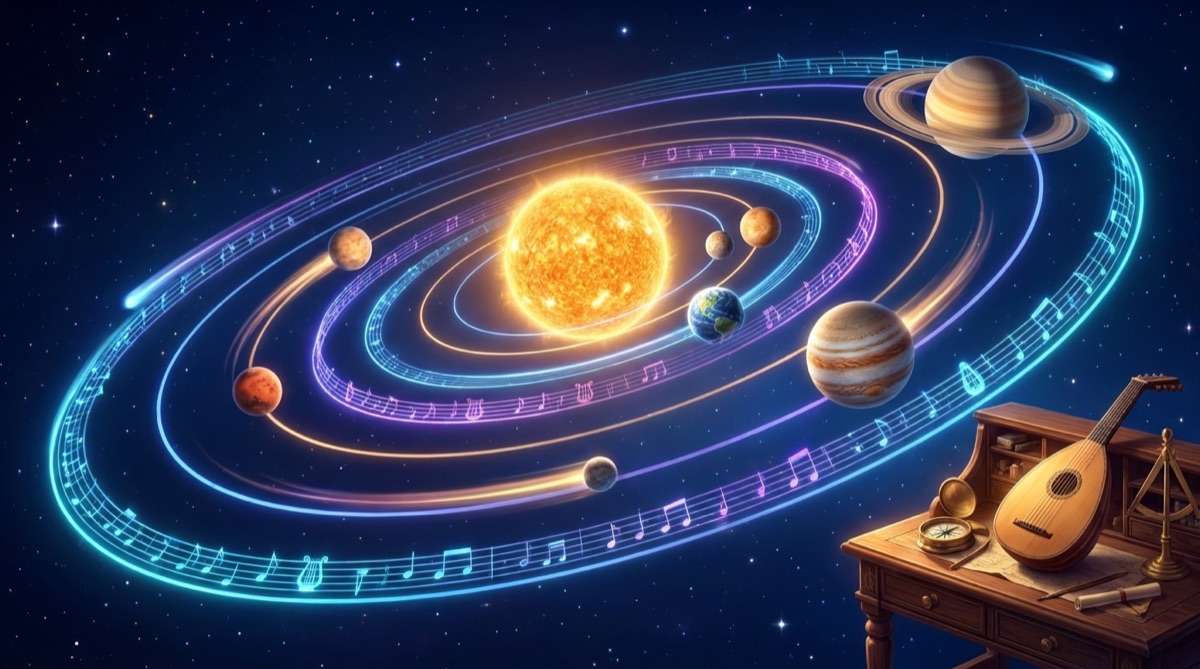
    In “Harmonices mundi” Kepler published the relation he had sought since his youth: the square of a planet's period is proportional to the cube of its mean distance from the Sun. With his three laws, the “Rudolphine Tables” of 1627 predicted planetary positions with a precision ten times better than earlier ones.

    👤 Johannes Kepler · 📍 Linz

    📘 Kepler's three laws 🧪 Keplerian orbit Orbital periodSemi-major axis

    Sources (1)
    • Kepler, J. (1619). Harmonices mundi, book V, ch. 3. Trans. E. J. Aiton, A. M. Duncan & J. V. Field, The Harmony of the World, American Philosophical Society, 1997.
  15. 1631
    Illustration: Gassendi observes the transit of Mercury (Paris)

    Observation

    Gassendi observes the transit of Mercury

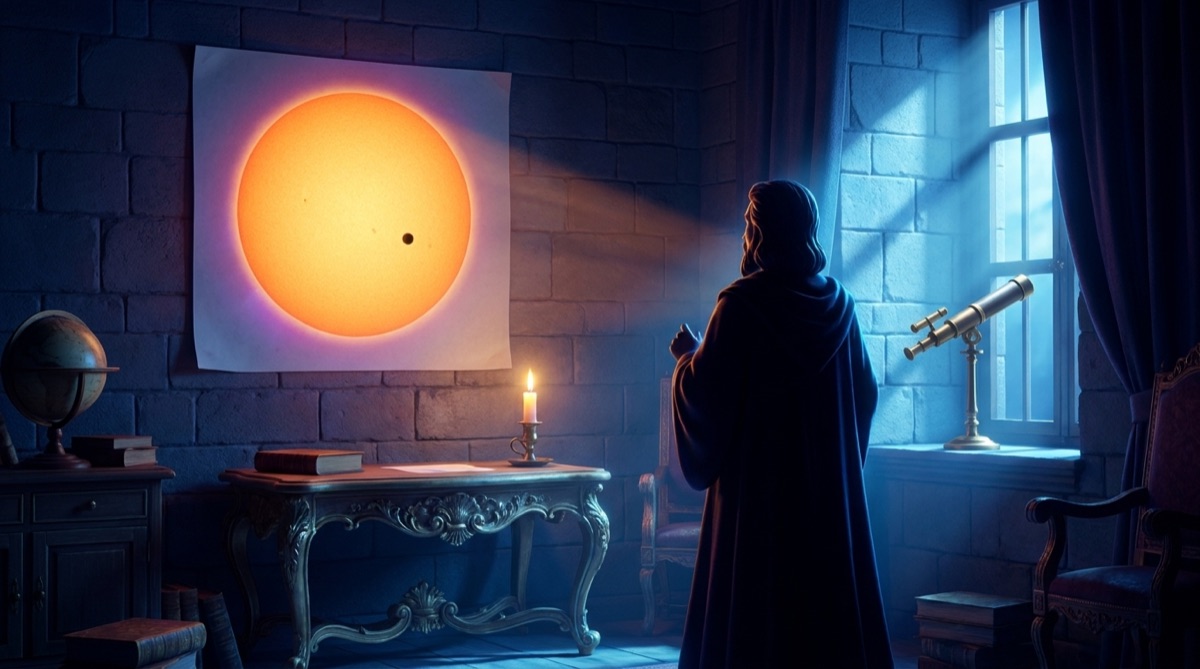
    On November 7, 1631, in Paris, Pierre Gassendi saw Mercury cross the disc of the Sun, just as Kepler had predicted with the Rudolphine Tables. It was the first observation of a planetary transit and showed that Mercury was much smaller than had been believed.

    👤 Pierre Gassendi, Johannes Kepler · 📍 Paris

    🧪 Light curve of a transit Transit

    Sources (2)
    • Gassendi, P. (1632). Mercurius in Sole visus et Venus invisa. Paris.
    • Van Helden, A. (1976). The importance of the transit of Mercury of 1631. Journal for the History of Astronomy 7, 1–10.
  16. 1633
    Illustration: The trial of Galileo (Rome)

    Observatories and institutions

    The trial of Galileo

    In June 1633 the Roman Inquisition condemned Galileo for “vehement suspicion of heresy” after he published the “Dialogue Concerning the Two Chief World Systems” (1632), which defended Copernicanism. He abjured and spent the rest of his life under house arrest, where he wrote his work on motion, the “Discorsi” (1638).

    👤 Galileo Galilei, Urban VIII · 📍 Rome

    Sources (1)
    • Finocchiaro, M. A. (1989). The Galileo Affair: A Documentary History. University of California Press.
  17. 1655 – 1659
    Illustration: Huygens: Titan and the ring of Saturn (The Hague)

    Discovery

    Huygens: Titan and the ring of Saturn

    Christiaan Huygens discovered Titan, Saturn's largest moon, on March 25, 1655, with a telescope he had built with his brother. In “Systema Saturnium” (1659) he explained the strange “handles” of Saturn that Galileo had been unable to interpret: a thin, flat ring that surrounds the planet without touching it.

    👤 Christiaan Huygens · 📍 The Hague

    Sources (2)
    • Huygens, C. (1659). Systema Saturnium. The Hague.
    • Van Helden, A. (1974). Saturn and his anses. Journal for the History of Astronomy 5, 105–121.
  18. 1675
    Illustration: Cassini discovers the division in the rings (Paris Observatory)

    Observation

    Cassini discovers the division in the rings

    From the new Paris Observatory (founded in 1667), Giovanni Domenico Cassini saw that Saturn's ring is split by a dark band, the “Cassini Division”. He also discovered four moons of Saturn (Iapetus, Rhea, Tethys and Dione) and published tables of Jupiter's moons that would serve to measure longitudes on land.

    👤 Giovanni Domenico Cassini · 📍 Paris Observatory

    Sources (2)
    • Débarbat, S. & Wilson, C. (1989). The Galilean satellites of Jupiter from Galileo to Cassini, Römer and Bradley. In R. Taton & C. Wilson (eds.), Planetary Astronomy from the Renaissance to the Rise of Astrophysics, Part A. Cambridge University Press, pp. 144–157.
    • NASA Science. Cassini Division. https://science.nasa.gov/saturn/facts/
  19. 1676
    Illustration: Rømer: light takes time to arrive (Paris Observatory)

    Discovery ★ milestone

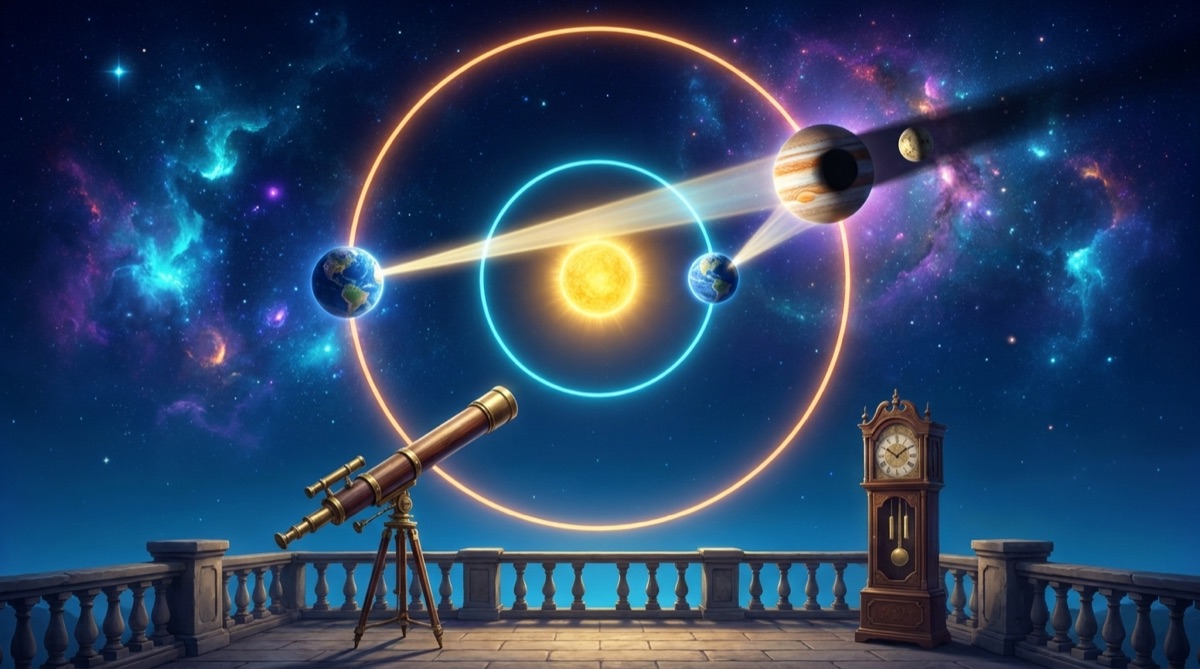
    Rømer: light takes time to arrive

    Ole Rømer noticed that the eclipses of Io, a moon of Jupiter, ran late when the Earth was moving away from Jupiter and early when it was approaching. He concluded that light has a finite speed and estimated that it takes about 22 minutes to cross the Earth's orbit (today: about 16.6 minutes). It was the first proof that light is not instantaneous.

    👤 Ole Rømer · 📍 Paris Observatory

    📘 The speed of light and the light-year Speed of lightAstronomical unit

    Sources (2)
    • Rømer, O. (1676). Démonstration touchant le mouvement de la lumière. Journal des sçavans, December 7, 1676, pp. 233–236.
    • Bobis, L. & Lequeux, J. (2008). Cassini, Rømer and the velocity of light. Journal of Astronomical History and Heritage 11(2), 97–105.
  20. 1687
    Illustration: Newton: the “Principia” (Cambridge and London)

    Theory and models ★ milestone

    Newton: the “Principia”

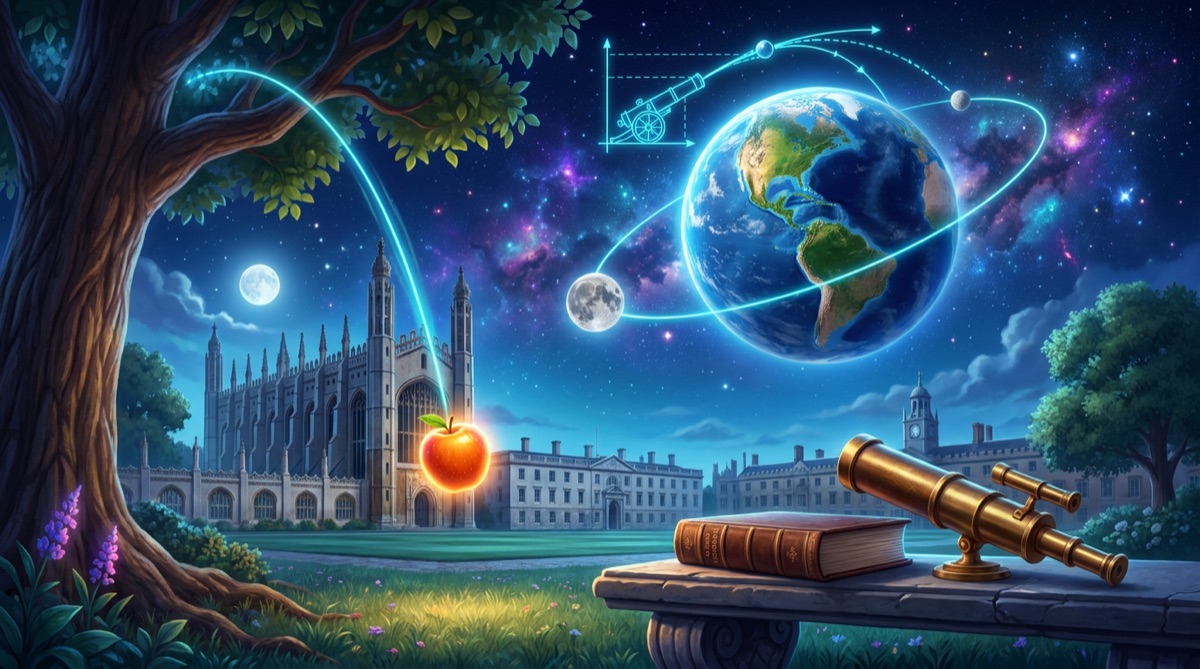
    Isaac Newton proved that a single force, gravitation, which attracts bodies with a strength proportional to their masses and inversely proportional to the square of the distance, explains at once the fall of an apple, Kepler's laws, the tides, precession and the orbits of comets. The heavens and the Earth were brought under the same laws.

    👤 Isaac Newton, Edmond Halley · 📍 Cambridge and London

    📘 Universal gravitation and satellites 🧪 Newton’s cannonball Law of universal gravitationGravityOrbital velocity

    Sources (2)
    • Newton, I. (1687). Philosophiae naturalis principia mathematica. Trans. I. B. Cohen & A. Whitman, University of California Press, 1999.
    • Westfall, R. S. (1980). Never at Rest: A Biography of Isaac Newton. Cambridge University Press, ch. 10.
  21. 1729
    Illustration: Bradley discovers the aberration of light (Wanstead and Kew (England))

    Discovery

    Bradley discovers the aberration of light

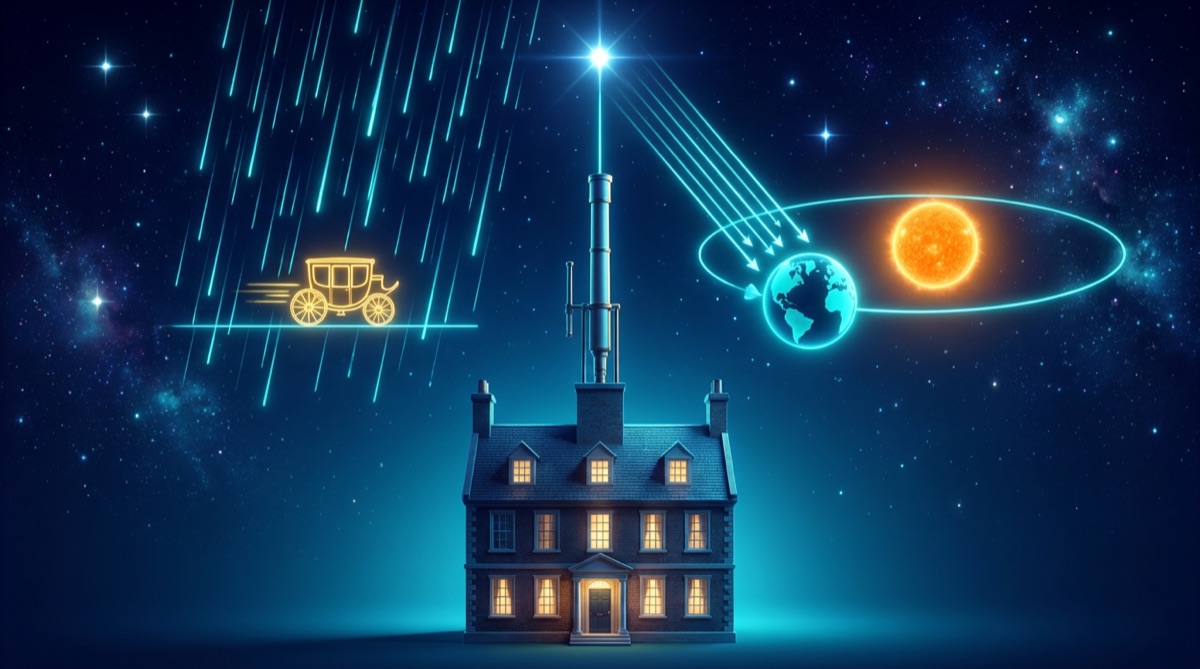
    While searching for stellar parallax, James Bradley found another annual displacement, of about 20 arcseconds, that did not depend on distance: aberration, caused by the Earth's velocity combined with that of light. It was the first direct proof that the Earth moves, and it gave a value of the speed of light with an error of only 1 %.

    👤 James Bradley · 📍 Wanstead and Kew (England)

    📘 Precession, nutation, aberration and refraction ParallaxSpeed of light

    Sources (1)
    • Bradley, J. (1729). A letter from the Reverend Mr. James Bradley… giving an account of a new discovered motion of the fix'd stars. Philosophical Transactions 35, 637–661. https://doi.org/10.1098/rstl.1727.0064
  22. 1758 – 1759
    Illustration: Halley's comet returns as predicted (Prohlis (near Dresden) and Paris)

    Observation

    Halley's comet returns as predicted

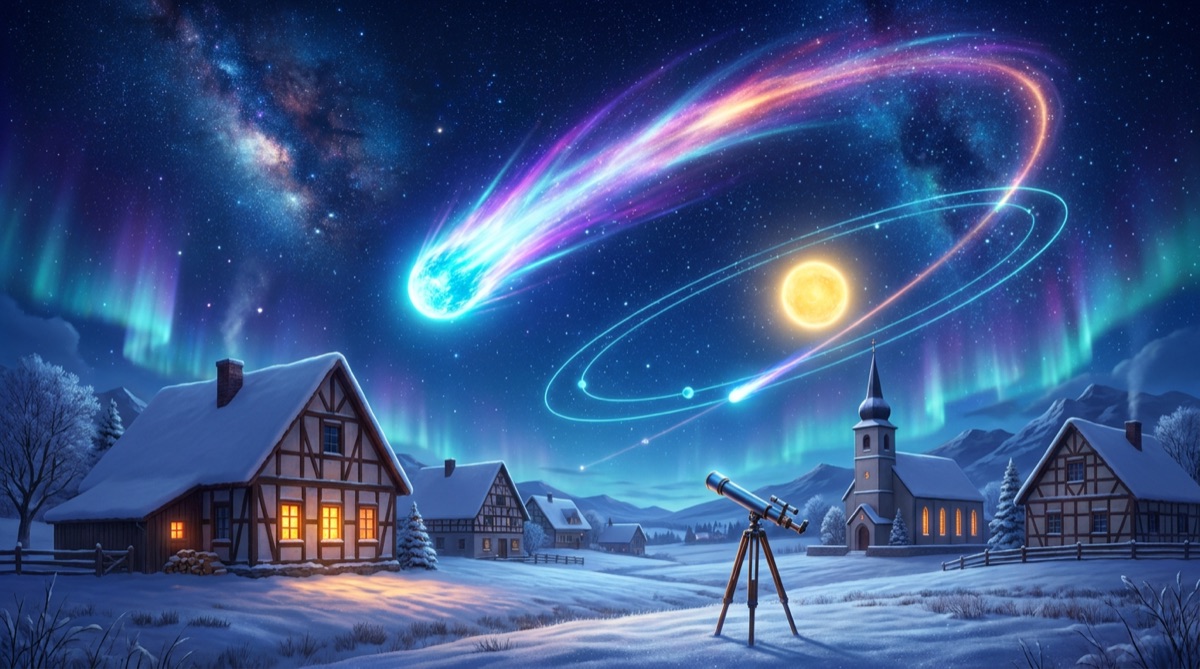
    In 1705 Edmond Halley had noticed that the comets of 1531, 1607 and 1682 followed almost identical orbits and predicted its return for 1758. Clairaut, Lalande and Nicole-Reine Lepaute computed the perturbations by Jupiter and Saturn; the farmer and amateur astronomer Johann Palitzsch saw it on December 25, 1758, and it passed perihelion on March 13, 1759. It was the great public triumph of Newton's gravitation.

    👤 Edmond Halley, Alexis Clairaut, Nicole-Reine Lepaute, Jérôme Lalande, Johann Georg Palitzsch · 📍 Prohlis (near Dresden) and Paris

    🧪 N bodies: integrators and chaos OrbitPerturbationPerihelion

    Sources (2)
    • Halley, E. (1705). Astronomiae cometicae synopsis. Philosophical Transactions 24, 1882–1899. https://doi.org/10.1098/rstl.1704.0064
    • Yeomans, D. K. (1991). Comets: A Chronological History of Observation, Science, Myth, and Folklore. Wiley, ch. 5.
  23. 1761 – 1769
    Illustration: The transits of Venus and the size of the Solar System (Expeditions all over the world)

    Observation

    The transits of Venus and the size of the Solar System

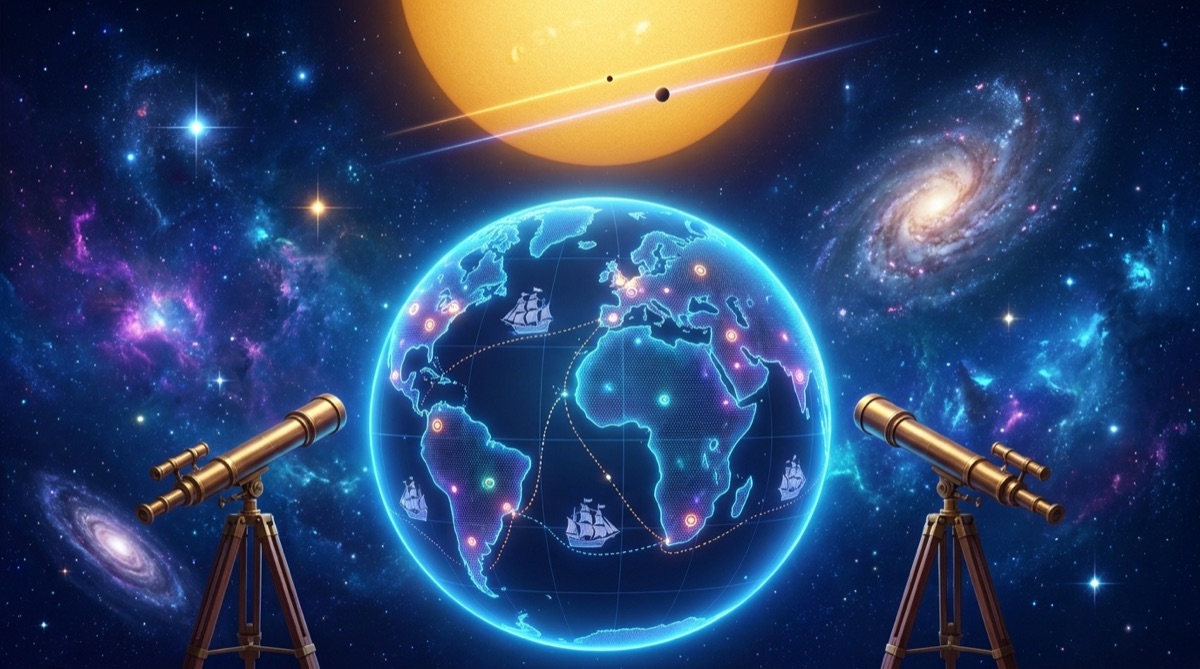
    Following an idea of Halley's, hundreds of observers from many countries traveled to remote places to time the transits of Venus of June 6, 1761 and June 3, 1769 (James Cook did so from Tahiti). By comparing the times measured from different latitudes, the Earth–Sun distance was obtained with an error of only 2 %: at last the Solar System had a scale.

    👤 Edmond Halley, James Cook, Jérôme Lalande, Maximilian Hell · 📍 Expeditions all over the world

    📘 Astronomical unit, light-year and parsec Astronomical unitTransitParallax

    Sources (2)
    • Woolf, H. (1959). The Transits of Venus: A Study of Eighteenth-Century Science. Princeton University Press.
    • NASA Eclipse Web Site. Transits of Venus: Six Millennium Catalog. https://eclipse.gsfc.nasa.gov/transit/catalog/VenusCatalog.html
  24. 1774 – 1781
    Illustration: The Messier catalog (Paris (Hôtel de Cluny))

    Observation

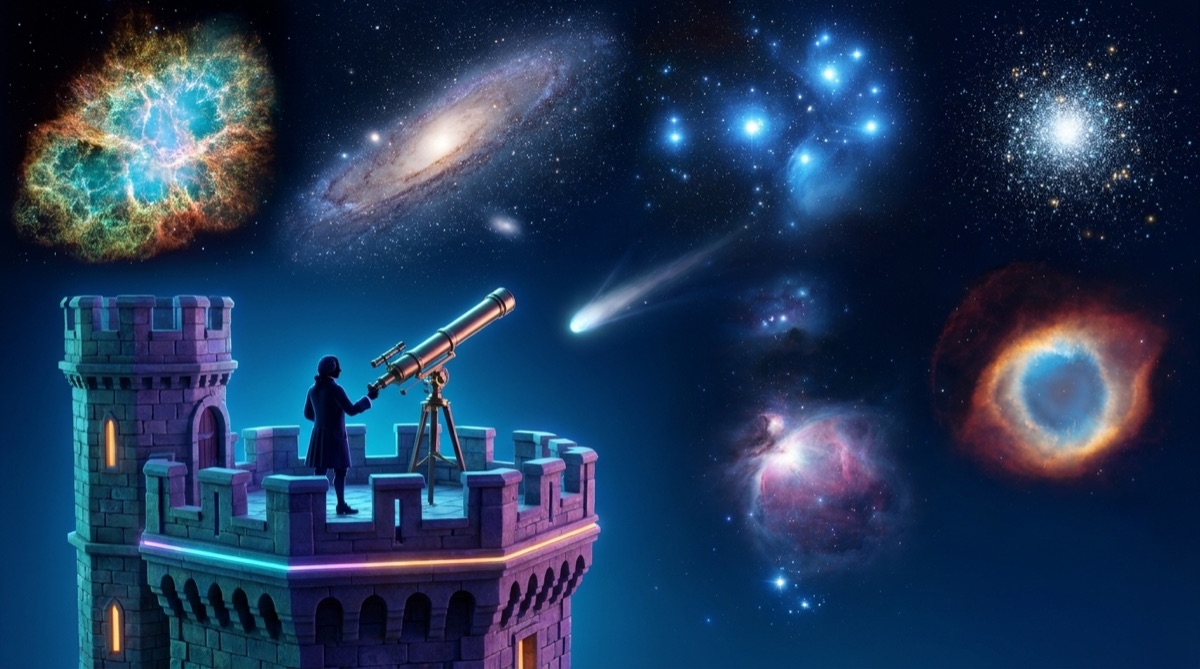
    The Messier catalog

    Charles Messier, a comet hunter in Paris, made a list of the fuzzy patches that could be mistaken for one: 45 objects in 1774 and 103 in the 1781 edition. Without intending to, he cataloged the brightest nebulae, clusters and galaxies in the sky; M31, M42 and M45 are still the names amateurs use.

    👤 Charles Messier, Pierre Méchain · 📍 Paris (Hôtel de Cluny)

    Galaxy

    Sources (2)
    • Messier, C. (1781). Catalogue des nébuleuses et des amas d'étoiles. Connaissance des Temps pour 1784, pp. 227–267.
    • Observatoire de Paris, Bibliothèque numérique. Charles Messier (1730–1817). https://bibnum.obspm.fr/exhibits/show/messier_english
  25. 1781
    Illustration: William Herschel discovers Uranus (Bath (England))

    Discovery ★ milestone

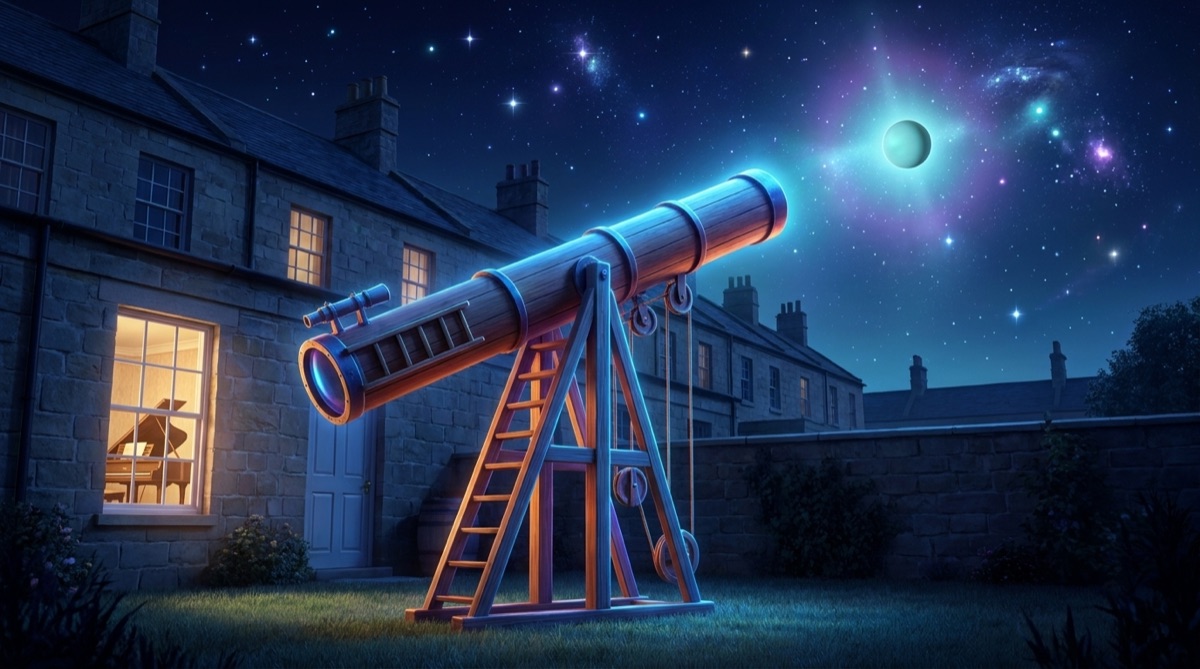
    William Herschel discovers Uranus

    On March 13, 1781, from the garden of his house in Bath, the musician and amateur astronomer William Herschel saw with a telescope of his own making an object that was not a point: he thought it was a comet, but its orbit turned out to be nearly circular and very distant. It was the first planet discovered in history, and at a stroke it doubled the size of the known Solar System.

    👤 William Herschel, Caroline Herschel · 📍 Bath (England)

    🧪 The Solar System to scale Gas giantOrbit

    Sources (2)
    • Herschel, W. (1781). Account of a Comet. Philosophical Transactions 71, 492–501. https://doi.org/10.1098/rstl.1781.0056
    • Hoskin, M. (2011). Discoverers of the Universe: William and Caroline Herschel. Princeton University Press.

Context

During the early Middle Ages, western Europe preserved very little astronomy: fragments of Pliny, the calendar for fixing the date of Easter, and little more. Greek knowledge survived in Byzantium and, above all, in the Islamic world, which translated it, corrected it and extended it. From the 12th century on, in Toledo and Sicily, Europeans translated the Almagest and the astronomical tables from Arabic, and in the new universities (Bologna, Paris, Oxford) astronomy entered the curriculum with Sacrobosco’s little book.

Why did they watch the sky? For the liturgical calendar, for medicine and astrology (which went together at the time), for navigation, which from 1400 on becomes oceanic and needs latitudes, and, more and more, because of an intellectual problem: the tables were not accurate, the calendar had drifted, and Ptolemy’s model looked like a patchwork of circles. Between 1543 and 1687, that unease produced a complete transformation of the picture of the universe.

Major contributions

The Sun at the center

Copernicus (1543) did not have better observations than Ptolemy; he had a better idea. If the Earth revolves around the Sun, the loops of the planets are an effect of perspective, and the order of the planets and the size of their orbits are fixed by geometry. His system still used circles and epicycles, and it did not predict any better; it took a century to prevail, and it did so because Kepler and Galileo gave it what it lacked. You can compare the distances Copernicus calculated with the real ones in the simulator The Solar System to scale.

Measuring better: Tycho and Kepler

Tycho Brahe showed with the supernova of 1572 and the comet of 1577 that the sky changes, and accumulated at Uraniborg twenty years of positions with a precision of one arcminute. Kepler inherited those data and refused to tolerate an error of 8 minutes: out of that stubbornness came elliptical orbits (1609) and the law of periods (1619). We tell the story in Tycho and Kepler; the laws are worked through in Kepler’s laws and in the simulator Keplerian orbit.

Seeing farther: the telescope

From 1609 on, the telescope multiplied what could be observed: the moons of Jupiter, the phases of Venus, sunspots, the ring of Saturn, Titan, the Cassini Division, the Messier catalog and, in 1781, Uranus. Each discovery provided a new argument against Aristotle’s closed and perfect cosmos.

One law for the heavens and the Earth

Newton (1687) united everything that came before in a single law of gravitation. The key equation is simple:

F=G M mr2F = G\,\frac{M\,m}{r^{2}}

In words: two bodies of masses MM and mm attract each other with a force FF that grows with the masses and becomes four times smaller every time the distance rr doubles (GG is a universal constant). With it Newton derived Kepler’s three laws and explained the tides and precession, and Halley predicted the return of a comet that arrived, on schedule, in 1758. It is explained in Gravitation and satellites and you can play with it in Newton’s cannonball.

Light and the scale of the Solar System

Rømer (1676) showed that light takes time to arrive; Bradley (1729) discovered aberration, the first direct proof of the Earth’s motion; and the transits of Venus of 1761 and 1769 finally gave the distance to the Sun, the astronomical unit, with an error of 2 %. See The speed of light and the light-year.

How do we know?

Unlike antiquity, this period is documented with first-hand sources: the printed books of Copernicus, Tycho, Kepler, Galileo and Newton survive in hundreds of copies, and their letters, notebooks and manuscripts have been edited almost completely (Kepler’s collected works fill more than twenty volumes). The records of Galileo’s trial are in the Vatican Archives and have been published in full. The scientific journals, the Journal des sçavans (1665) and the Philosophical Transactions (1665), make it possible to date exactly Rømer’s announcement or Bradley’s letter.

That does not mean everything is settled. Historians debate how much Copernicus owes to the Islamic astronomers of Maragha (the “Tusi couples” appear in his work without our knowing how they reached him), whether Galileo observed the phases of Venus before or after a pupil suggested it to him, and what role politics and vanity played in his condemnation. And it is wise to distrust the epic tales: the Church did not burn Bruno for Copernicanism, Galileo did not mutter “and yet it moves”, and Newton’s apple is an anecdote he himself told in old age.

Legacy

From this period we inherit the idea that a theory is judged by the numbers it predicts: Kepler gave up the circle over 8 arcminutes, and Halley staked his reputation on a date. We inherit the Gregorian calendar, the telescope and the national observatories (Paris 1667, Greenwich 1675), the measured astronomical unit and the laws of Kepler and Newton, which still guide probes to Mars today. We also inherit names: the Galilean moons, the Cassini Division, Halley’s comet, the Messier objects. And we inherit a lesson about science and power: the Galileo affair reminds us that no authority can decide what the universe is like.

✦ Check your understanding

  1. 1. What did Tycho Brahe prove with the new star of 1572?
  2. 2. Why did Kepler abandon circular orbits?
  3. 3. What did Galileo observe that was impossible in Ptolemy's model?
  4. 4. What did Rømer conclude from the eclipses of Io?
Answer all the questions to check.

References

  • Hoskin, M. (ed.) (1999). The Cambridge Concise History of Astronomy. Cambridge University Press, ch. 3–6.
  • Kuhn, T. S. (1957). The Copernican Revolution. Harvard University Press.
  • Thoren, V. E. (1990). The Lord of Uraniborg: A Biography of Tycho Brahe. Cambridge University Press.
  • Kepler, J. (1609). Astronomia nova. Trans. W. H. Donahue, New Astronomy, Cambridge University Press, 1992.
  • Galilei, G. (1610). Sidereus nuncius. Trans. A. Van Helden, Sidereus Nuncius or The Sidereal Messenger, University of Chicago Press, 1989.
  • Newton, I. (1687). Philosophiae naturalis principia mathematica. Trans. I. B. Cohen & A. Whitman, The Principia, University of California Press, 1999.
  • Taton, R. & Wilson, C. (eds.) (1989–1995). Planetary Astronomy from the Renaissance to the Rise of Astrophysics (The General History of Astronomy, vol. 2, parts A and B). Cambridge University Press.
  • Van Helden, A. (1977). The Invention of the Telescope. Transactions of the American Philosophical Society 67(4). https://doi.org/10.2307/1006276