His life

Al-Battani was born around 858 in Harran, a city in northern Mesopotamia (today in Turkey) famous for its Sabian community, a religion of ancient origin that venerated the heavenly bodies and from which several great mathematicians of Islam emerged. His nickname al-Sabi’ suggests that his family came from that group, although he himself was a Muslim. His father, Jabir ibn Sinan, was a well-known maker of astronomical instruments, and that trade explains the precision the son would go on to achieve.
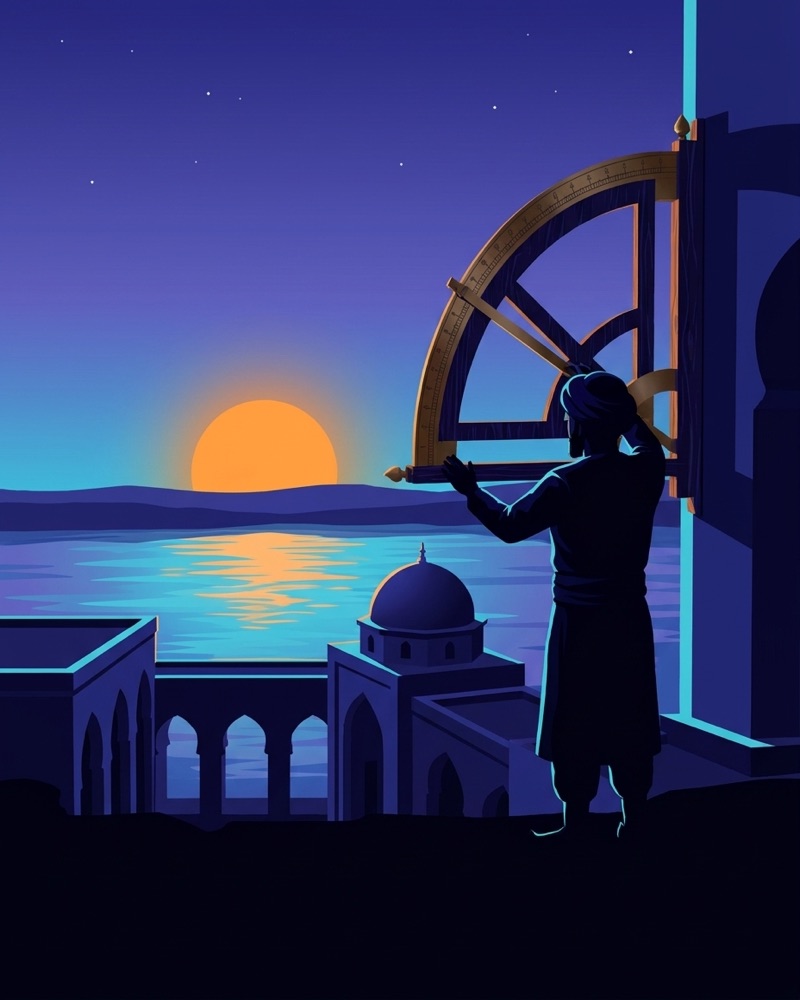
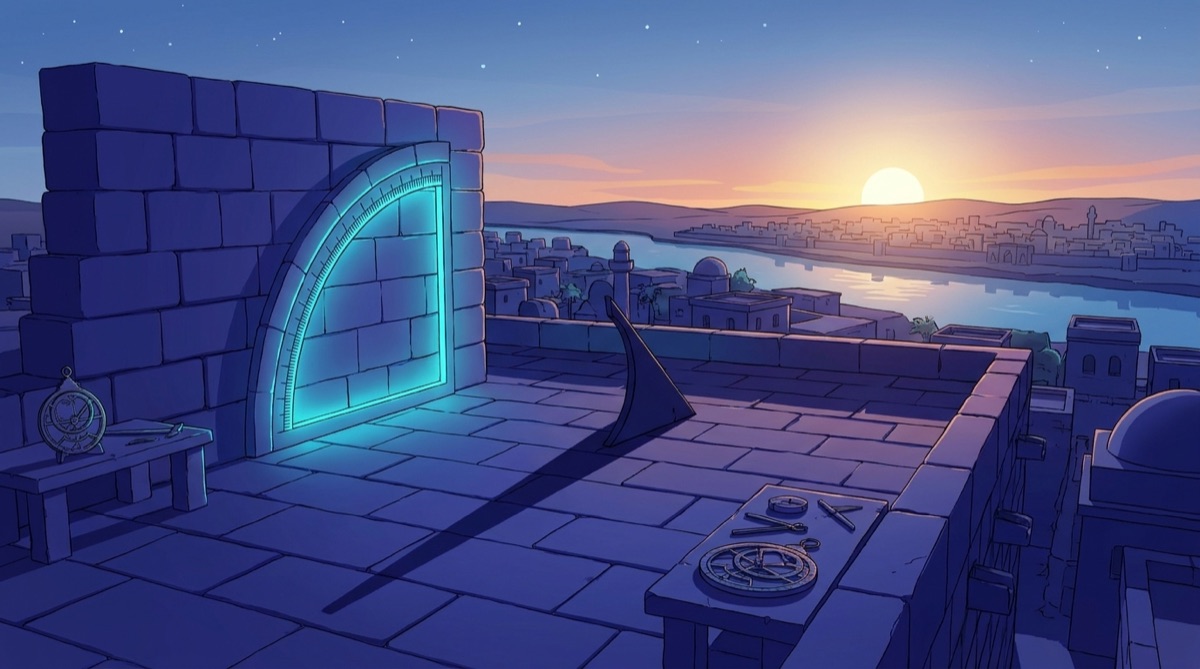
He spent most of his life in Raqqa, on the banks of the Euphrates, in present-day Syria. According to the bibliographer Ibn al-Nadim, he observed there without interruption between 877 and 918, more than forty years, with instruments he built himself: a large mural quadrant, armillary spheres, a sundial and an astrolabe. In 901 he observed from Antioch an eclipse of the Sun and one of the Moon whose measurements astronomers would use for centuries. He died in 929, at Qasr al-Jiss, near Samarra, on his way back from Baghdad, where he had gone to protest an unjust tax on the people of Raqqa.
Forty years measuring the Sun
Al-Battani’s work is a zij, a treatise with tables for computing the positions of celestial bodies, in the style of Ptolemy’s Handy Tables but built on new observations. The Zij al-Sabi’, in 57 chapters, is the first complete zij of the Ptolemaic tradition to survive and the most influential in Islamic astronomy.
Its great subject is the Sun. By carefully measuring the equinoxes and solstices over decades, al-Battani obtained a tropical year of 365 days, 5 hours, 46 minutes and 24 seconds. The true value is 365 days, 5 hours, 48 minutes and 45 seconds: an error of two minutes and twenty seconds, much better than Ptolemy’s, which was off by almost seven minutes. That precision is what made the reform of the calendar possible centuries later.
By comparing his measurements with Ptolemy’s he discovered something nobody expected: the Sun’s apogee, the point of the ecliptic where the Sun is farthest away and moves most slowly, was not where the Almagest said, but 16° 47′ farther along. Ptolemy had taken it to be fixed with respect to the stars; al-Battani showed that it moves. Today we explain it by the motion of the perihelion of Earth’s orbit added to precession. He also obtained a solar eccentricity smaller than Ptolemy’s, closer to the current value, and from it he deduced that the distance to the Sun varies over the year enough for a solar eclipse to be annular, with the Moon too small to cover it completely, something Ptolemy had denied.
His other two classic figures are precession, 54.5 arcseconds per year (1° every 66 years; the current value is 50.3″), and the obliquity of the ecliptic, 23° 35′, which is exactly the tilt Earth’s axis had in the year 900. His catalog of 489 stars corrected Ptolemy’s longitudes for the precession accumulated over seven centuries.
Triangles with sines
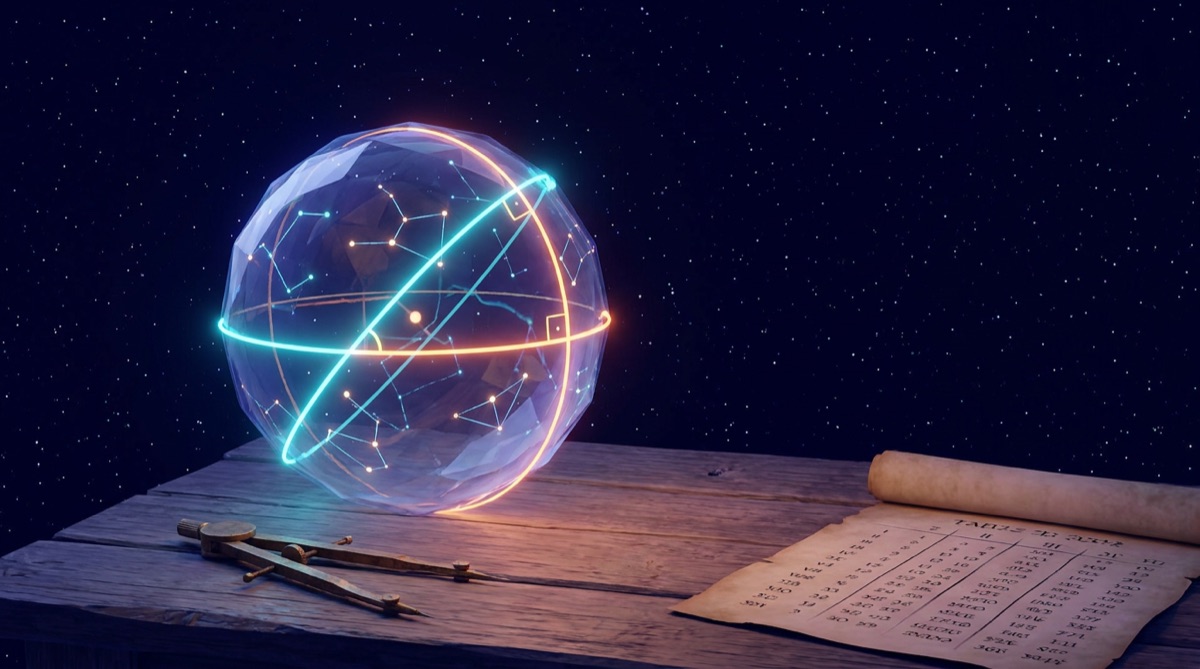
Al-Battani did not just observe better: he calculated differently. Where Ptolemy used chords of arcs, he used the sine, which had come from India through the translations made in Baghdad, and combined it with the tangents and cotangents that his contemporaries had just introduced. He compiled a “table of shadows”, the cotangent degree by degree (the length of the shadow of a gnomon as a function of the altitude of the Sun), and wrote relations such as
for the right spherical triangle, which make it possible to go from the position of a celestial body to its altitude above the horizon at any place. His rule for finding the direction of Mecca from the differences in latitude and longitude is an example of that applied trigonometry. It was an important step toward spherical trigonometry as a discipline in its own right, which al-Tusi would complete three centuries later.
His legacy

The Zij al-Sabi’ was translated into Latin by Plato of Tivoli between 1134 and 1138 under the title De motu stellarum, and into Castilian at the court of Alfonso X in the 13th century. Printed in Nuremberg in 1537, it reached Copernicus, who cites it 23 times in De revolutionibus and uses its observations of the Sun to determine precession and the variation of the eccentricity. Tycho Brahe, Kepler, Galileo and Halley used his eclipses of 901 to test their own theories, and Clavius relied on his tropical year when preparing the Gregorian reform of 1582. Few medieval astronomers were so widely read for so long.
In the West he was called Albategnius, and under that name Riccioli christened a large crater on the Moon in 1651.