His life

Nasir al-Din al-Tusi was born in 1201 in Tus, in the Iranian region of Khorasan. His father, a jurist, educated him, and his uncle gave him his first lessons in logic, mathematics and philosophy. He studied in Nishapur with the best teachers of his time, in an age of violence: the Mongols of Genghis Khan were laying waste to Central Asia and Persia.
For some thirty years he lived and wrote under the protection of the Ismaili rulers in fortresses in northern Iran, among them Alamut. There he wrote his great treatise on ethics, the Akhlaq-i Nasiri. When in 1256 Hulagu, grandson of Genghis Khan, took those fortresses, al-Tusi went on to serve him as scientific adviser. That decision, debated then and since, gave him the means for his main project: an observatory.
Hulagu authorized its construction at Maragha, in northwestern Iran, around 1259. Al-Tusi directed it until his death, in Baghdad, in 1274, and gathered there a library and a team of astronomers from several countries, including a Chinese colleague.
The Maragha observatory

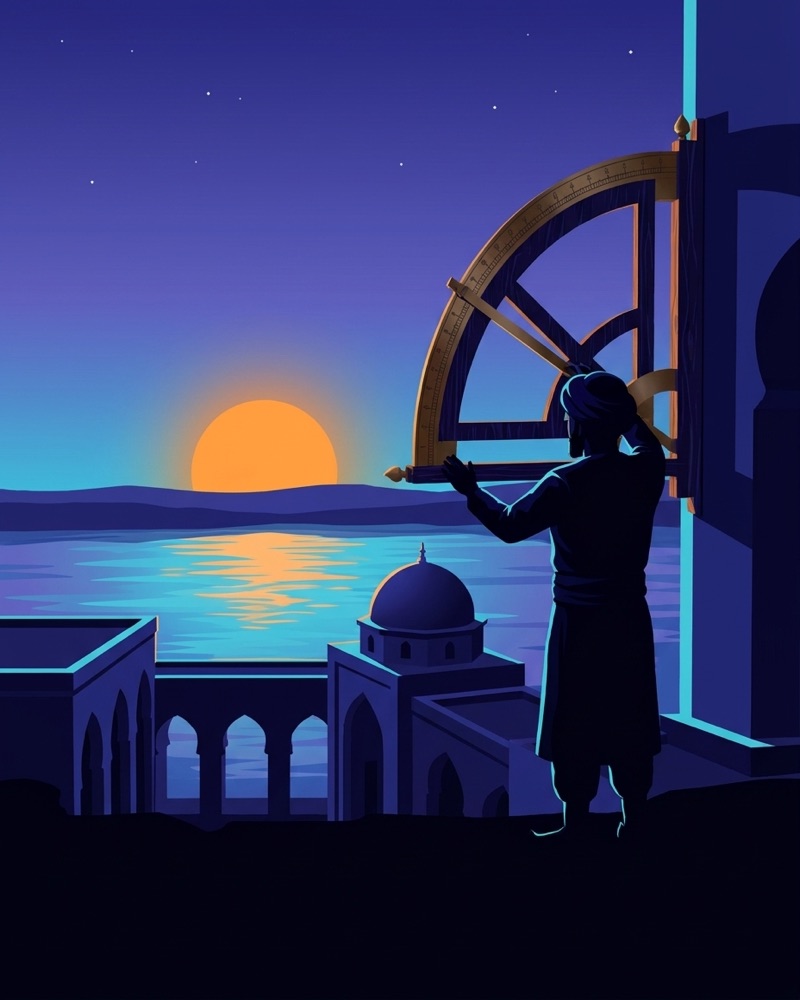
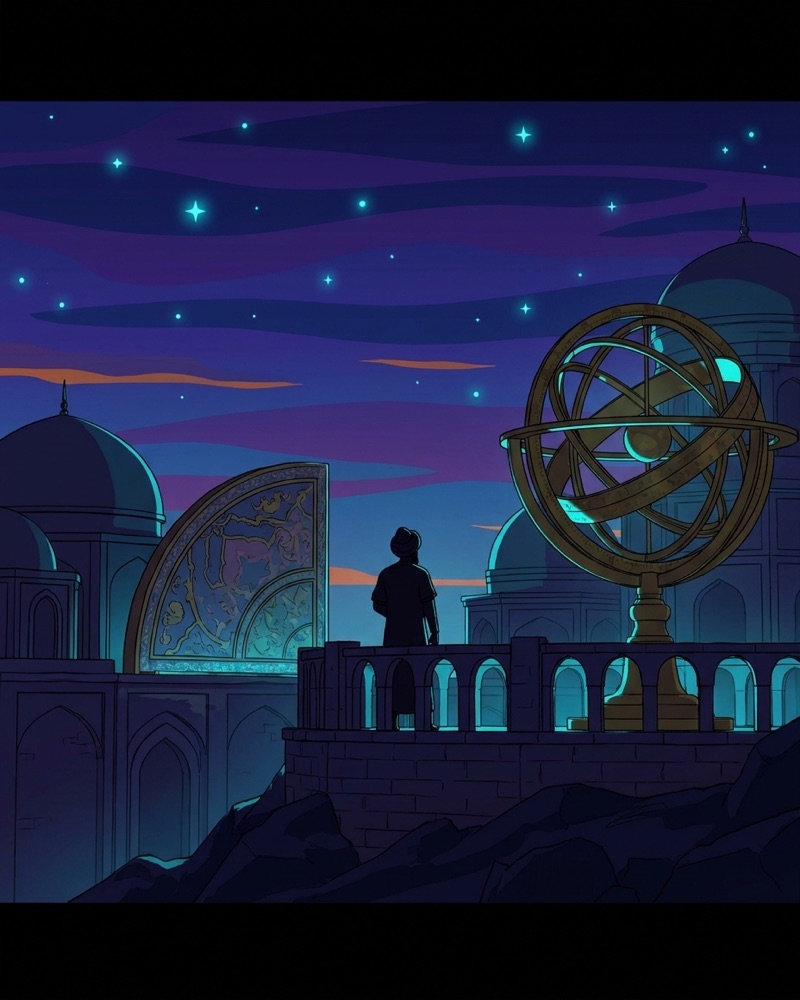
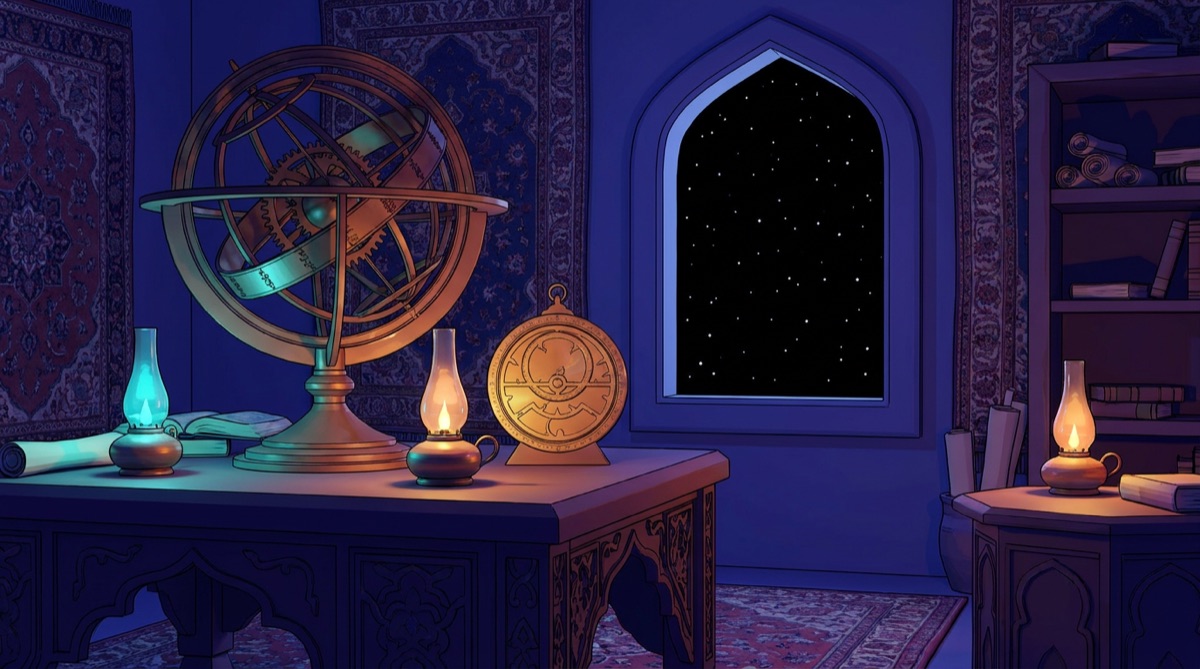
Maragha was one of the great institutions of medieval science. It was equipped with a mural quadrant, armillary spheres and other large instruments, and it brought together astronomers who worked for years in common, something rather unusual. The fruit was the Zij-i Ilkhani, the “Ilkhanid Tables”, completed around 1272, with planetary positions based on new observations, which was used in Persia, in Central Asia and also, through translations, in Byzantium and China.
It is no accident that Maragha was also the place where an attempt was made to reform Ptolemy’s astronomy. Its astronomers, such as Mu’ayyad al-Din al-Urdi and later Qutb al-Din al-Shirazi, and later still Ibn al-Shatir in Damascus, criticized the models of the Almagest with arguments of the same kind as Ibn al-Haytham’s: the equant broke the principle that the heavenly bodies move with uniform circular motion.
The Tusi couple and a spherical triangle

In his Tadhkira fi ilm al-hay’a, “Memoir on Astronomy”, al-Tusi stated a geometric theorem: if a circle rolls inside another of twice its size without slipping, a point on its rim traces a straight line, a diameter of the larger circle. Two uniform circular motions thus produce a back-and-forth motion along a straight line. It was just the piece needed to replace the equant: it produced the variation in speed that the observations demanded, without breaking the rule of circles. He applied it to the latitude of the planets and to other irregularities.
More than two centuries later, Copernicus used that same device, with almost identical geometric constructions, in De revolutionibus. How it reached his hands is still a subject of research; the work of historians such as George Saliba and F. Jamil Ragep has shown the coincidence clearly, although there is no documentary proof of the transmission.
His other influential work was the Kitab al-shakl al-qatta’, the “Treatise on the Complete Quadrilateral”, where for the first time spherical trigonometry is set out as a separate mathematical discipline, without depending on astronomy. It includes the law of sines for spherical triangles: the sines of the sides are proportional to the sines of the opposite angles, a basic result for computing positions on the celestial sphere.
His legacy
The successors of Maragha kept alive a critical tradition that reached Europe; Regiomontanus reworked spherical trigonometry in Latin in the 15th century. The Zij-i Ilkhani served as a reference for centuries, and the Maragha observatory inspired later ones, such as that of Ulugh Beg in Samarkand. Besides being an astronomer, al-Tusi wrote on logic, ethics, philosophy and medicine, and his commentaries on Euclid and Ptolemy were read for centuries.
The Moon remembers his name in the crater Nasireddin. The story of al-Tusi is also a reminder that science has no borders: it was in a newly conquered empire that a Persian scholar gathered astronomers from several cultures to improve Ptolemy’s sky.