His life

Abd al-Rahman al-Sufi was born in 903 in Rayy, a city near present-day Tehran, and died in 986 in Shiraz. His name, al-Sufi, suggests a link with Sufism, but almost everything we know about his life comes from his own books and from a few lines by later biographers. He lived under the Buyid dynasty and was court astronomer to the emir Adud al-Dawla, who ruled Persia and Iraq from Shiraz and was a patron of scholars. He worked and conversed with him, and in his work he mentions him with respect.
He wrote on the astrolabe (a treatise with hundreds of uses of the instrument is attributed to him) and on the celestial globe, but his fame rests on a single work, completed around 964: the Kitab suwar al-kawakib al-thabita, the “Book of the Images of the Fixed Stars”.
Ptolemy’s sky, checked by eye
Seven centuries earlier, Ptolemy had gathered in the Almagest a catalog of about a thousand stars with their positions and brightnesses. The astronomers of Baghdad translated and copied it, but hardly anyone had compared it with the real sky. Al-Sufi did. Night after night he went out to look at each constellation and compared what he saw with what the catalog said.
The result was not a simple translation. He corrected positions, adding the shift that precession had produced since Ptolemy’s time, and revised the brightnesses, star by star, with the same scale of six magnitudes the Greek astronomer had used (the brightest, of first magnitude; the faintest visible to the naked eye, of sixth). When a star did not look to him as Ptolemy had described it, he said so clearly, and when it matched, he said so too. That honesty is what makes the book valuable: it is an observing report, not a tribute.
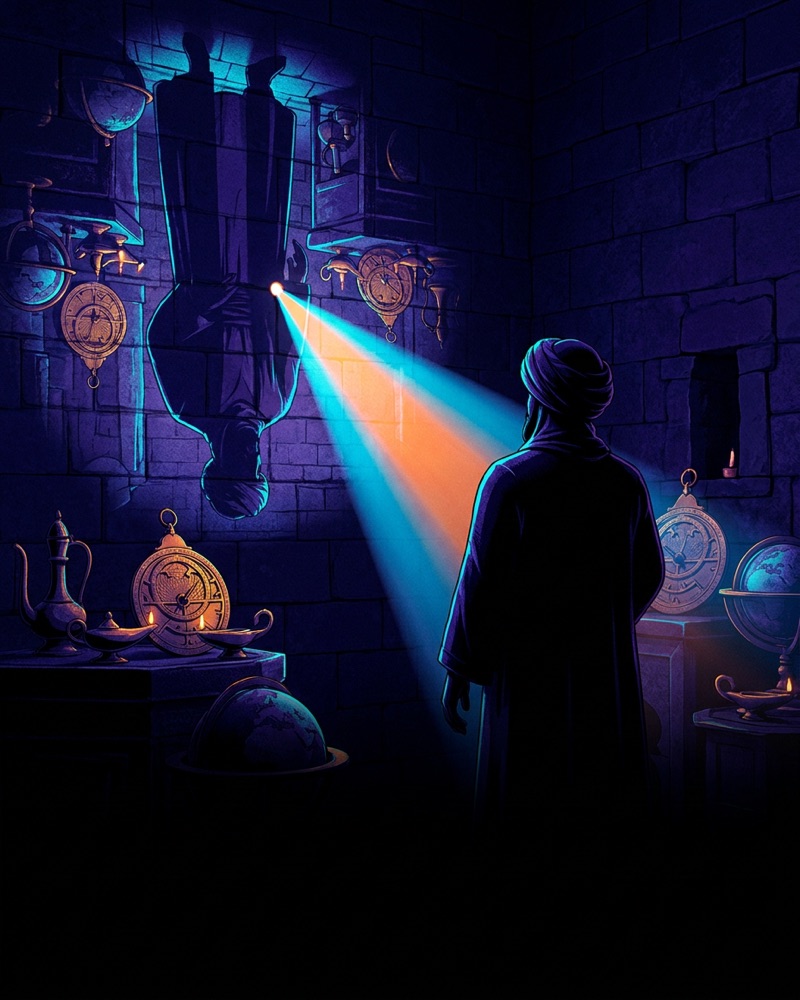
Each of the 48 Ptolemaic constellations appears with two drawings: one as it is seen in the sky and another as it appears on a celestial globe, where the figure is reversed as in a mirror. It is a very practical solution for someone who had to identify the stars on a metal sphere and then look for them overhead. He also added the figures that the Arab Bedouins saw in the sky, which did not match the Greek ones, and wrote down which was which.
The little cloud of Andromeda
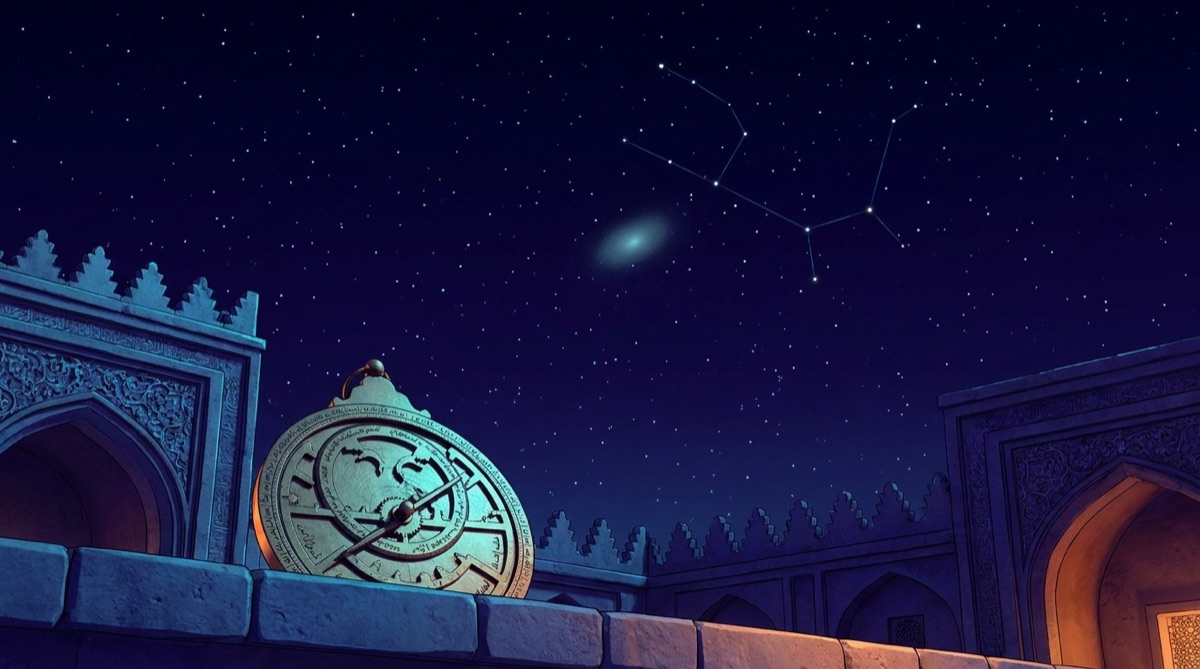
While reviewing the constellation of Andromeda, al-Sufi noted an object that was not a star: a “little cloud” beside the mouth of the fish the myth speaks of. It is the earliest surviving description of the Andromeda Galaxy, the most distant object visible to the naked eye from a dark place, some 2.5 million light-years away. Nobody in his time could know what it was, but he made it clear that there was something different there.
He is also credited with mentioning another diffuse patch in the south, the one we now call the Large Magellanic Cloud, which he described from the accounts of sailors from southern Arabia, since he could not see it from Persia. In both cases he was a good observer and a careful chronicler of what others saw.
His legacy

Al-Sufi’s book was copied for centuries and translated into Castilian, among other languages, at the court of Alfonso X. Thanks to it, many Arabic star names reached Europe and remain in use: Aldebaran, Rigel, Betelgeuse and Deneb. Ulugh Beg, who would measure the sky anew in Samarkand five centuries later, cited his catalog as the best he had at hand. European astronomers knew him as Azophi.
His name is today on a crater on the Moon, Azophi, and on an asteroid. Beyond the honors, al-Sufi left a lesson that still holds: before repeating a catalog, you have to go out and look at the sky.