His life

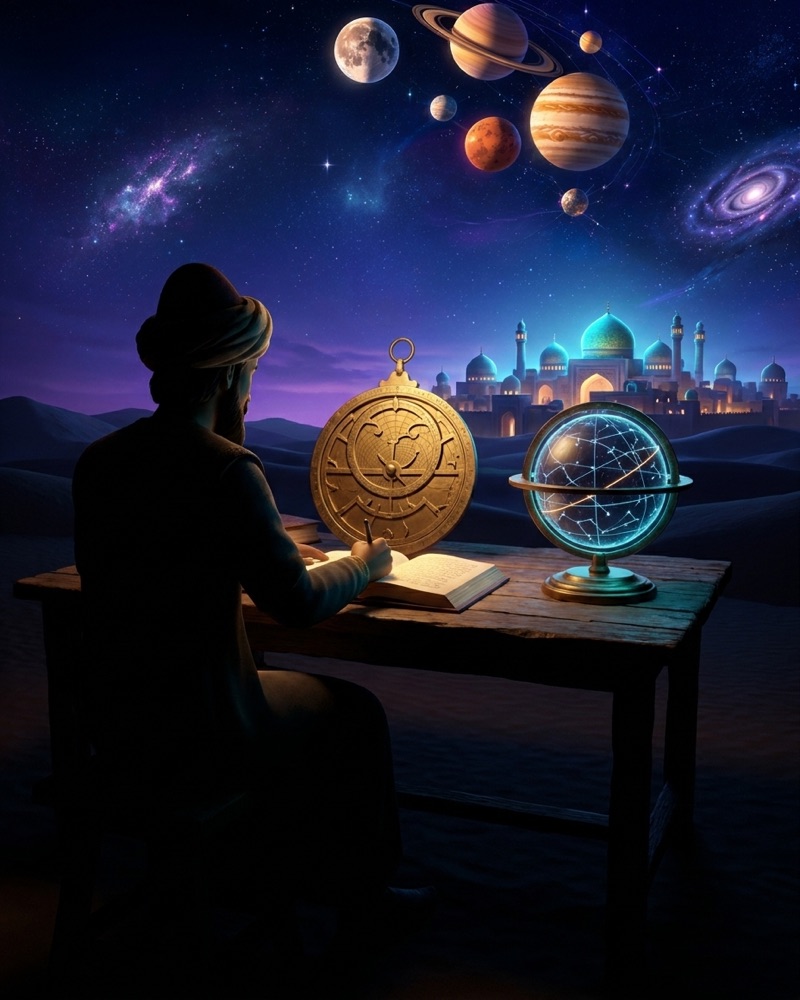
Muhammad Taraghay was born in 1394, in Sultaniya, during a military campaign of his grandfather, Tamerlane (Timur). His father, Shahrukh, inherited the empire, and the young man was appointed governor of Samarkand in 1409, at barely fifteen. Ulugh Beg, “Great Prince”, was his title. He ruled the city for four decades and from 1447 was sovereign of the whole Timurid Empire.
He was an unconventional ruler: he preferred books to war. Around 1417 he founded in Samarkand a madrasa, a school of higher learning, where he invited scholars from all over the Islamic world to teach mathematics and astronomy, and he is said to have taken part in classes himself. Among his collaborators were Ghiyath al-Kashi, a great calculator, Qadi Zada al-Rumi and Ali Qushji, who would later carry this tradition to Istanbul.
Samarkand was then one of the richest cities on the Silk Road, and he wanted it to be one of the richest in learning as well: he gathered a great library and kept alive the tradition of the astronomers of Baghdad and Maragha, whose tables and methods he studied in detail.
His reign was brief and ended badly. After a dispute with his son Abd al-Latif, he was defeated and, in 1449, murdered while on his way to make the pilgrimage to Mecca. His death halted the work at Samarkand.
The Samarkand observatory

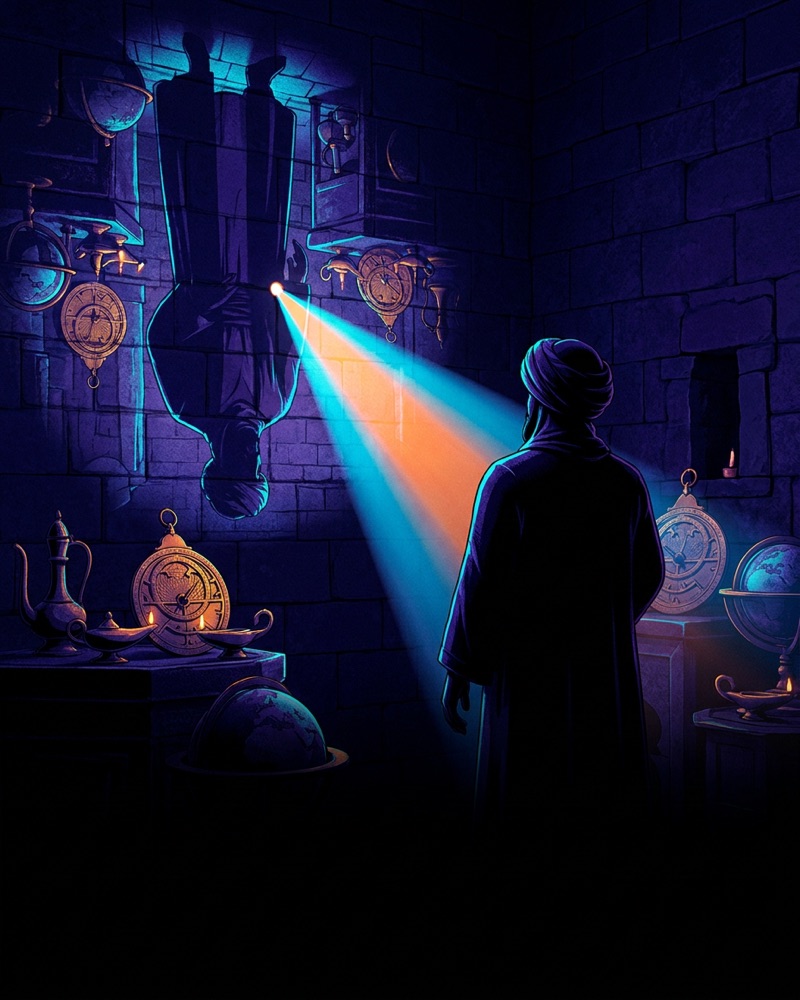
Around 1420 construction began on a great observatory on a hill near the city. Its main instrument was the Fakhri sextant, an arc of 60° about 40 meters in radius, whose lower part descended into a trench cut into the rock. A beam of sunlight, a sight or the shadow of an aperture at the top indicated on the marble scale the altitude of a celestial body as it crossed the meridian. The larger an instrument, the finer its scale, and at that size fractions of an arcminute could be read. It is today one of the largest scientific structures of its time. Because of the length of its arc, each degree of the scale measured almost 70 centimeters, and it could be divided into very small pieces: a reading error of half a millimeter amounted to a tiny fraction of an arcminute.
With it and with other instruments, Ulugh Beg and his team measured the position of the Sun for years and obtained a sidereal year of 365 days, 6 hours, 10 minutes and 8 seconds, about one minute above the true value. They also calculated the tilt of the Earth’s axis, close to 23° 30′, and the precession, which they fixed at one degree every 70 years, that is, about 51 arcseconds per year, very close to today’s 50.3″.
The catalog of 1437

The Zij-i Sultani, completed in 1437, includes trigonometric tables and tables of planetary motions and, above all, a catalog of 1018 stars. Most medieval catalogs limited themselves to updating Ptolemy’s for precession. In Samarkand the positions were measured again directly, for 994 of those stars, and the rest were taken from other sources. It is considered, together with Tycho Brahe’s a hundred and fifty years later, one of the best catalogs before the telescope.
The work is written in Persian, with a preface in Arabic, and it also includes sine tables of remarkable precision, of interest to any calculator. In 1650 the Englishman John Greaves published a Latin edition, and Thomas Hyde another, complete one, in 1665; that is how it reached European astronomers.
His legacy
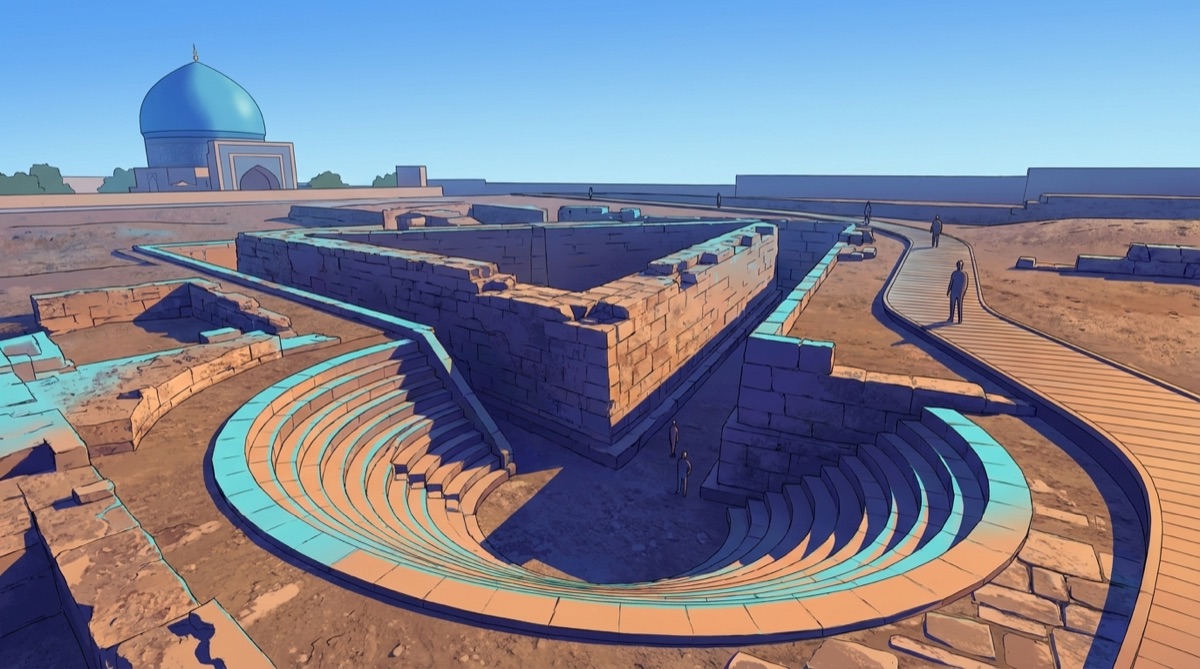
After the death of Ulugh Beg, the observatory was abandoned and damaged, and its location was lost. In 1908 the Russian archaeologist Vasily Vyatkin rediscovered it and excavated the base of the sextant, which is still visible. Today the site is a museum in Uzbekistan, and the name of Ulugh Beg is on a crater of the Moon.
His example shows that science can flourish from a political decision: a prince who invested in instruments, in libraries and in teachers. And who, like Hipparchus and Tycho, understood that the best catalogs are not copied: they are measured.