















Astronomy and Space Exploration ES

History of Astronomy / 9 of 14

From al-Andalus to Samarkand c. 770 – 1580 under review

Islamic world

Between the 8th and 16th centuries, from Baghdad to Córdoba and from Cairo to Samarkand, astronomers writing in Arabic and Persian translated, measured, corrected Ptolemy and left us the astrolabe, the names of the stars and words like zenith, azimuth and algorithm.

Timeline

20 events, 8 of them milestones (★) that also appear on the overall timeline.

  1. c. 773
    Illustration: The Sindhind arrives in Baghdad (Baghdad, Iraq)

    Theory and models

    The Sindhind arrives in Baghdad

    An Indian embassy brought to the court of the caliph al-Mansur an astronomical treatise derived from Brahmagupta. Al-Fazari translated it into Arabic as the Sindhind: with it the Indian numerals, the sine tables and the methods for calculating eclipses entered the Islamic world.

    👤 Al-Fazari, Al-Mansur · 📍 Baghdad, Iraq

    Sources (2)
    • Pingree, D. (1970). The fragments of the works of al-Fazari. Journal of Near Eastern Studies 29(2), 103–123. https://doi.org/10.1086/372158
    • Hoskin, M. (ed.) (1999). The Cambridge Concise History of Astronomy, ch. 3.
  2. 8th–9th centuries
    Illustration: The astrolabe is perfected in Baghdad (Baghdad and Harran)

    Instrument

    The astrolabe is perfected in Baghdad

    The astrolabe, a flat rotating map of the sky over a plate with the local horizon, was a Greek invention, but it was in Baghdad that it was produced in quantity, described in treatises and given scales for the hour of prayer and the direction of Mecca. The oldest surviving ones are from the 10th century.

    👤 Al-Fazari, Ali ibn Isa al-Asturlabi · 📍 Baghdad and Harran

    📘 Celestial coordinates 🧪 Interactive planisphere ZenithAzimuthAltitude above the horizonHorizon

    Sources (2)
    • King, D. A. (2005). In Synchrony with the Heavens, vol. 2, part XIII (the oldest astrolabes).
    • History of Science Museum, Oxford, astrolabe collection (hsm.ox.ac.uk).
  3. 813 – 833
    Illustration: Al-Ma'mun, the House of Wisdom and the Almagest in Arabic (Baghdad and Damascus)

    Observatories and institutions ★ milestone

    Al-Ma'mun, the House of Wisdom and the Almagest in Arabic

    The caliph al-Ma'mun sponsored systematic translations from Greek, Persian and Sanskrit, among them Ptolemy's Almagest, and ordered observations in Baghdad (828) and Damascus to check its tables. It is the start of Islamic astronomy as a research program.

    👤 Al-Ma'mun, Al-Hajjaj ibn Yusuf, Yahya ibn Abi Mansur · 📍 Baghdad and Damascus

    Sources (2)
    • Saliba, G. (2007). Islamic Science and the Making of the European Renaissance, chs. 1–2.
    • Sayili, A. (1960). The Observatory in Islam, ch. 2 (al-Ma'mun's observations).
  4. c. 820
    Illustration: Al-Khwarizmi and his tables (Baghdad, Iraq)

    Mathematics ★ milestone

    Al-Khwarizmi and his tables

    Muhammad ibn Musa al-Khwarizmi compiled in Baghdad a zij, a manual with tables for calculating the positions of celestial bodies, based on Indian methods. His books on arithmetic and algebra gave the world the words “algorithm” (from his name) and “algebra” (from al-jabr).

    👤 Al-Khwarizmi · 📍 Baghdad, Iraq

    Sources (2)
    • Neugebauer, O. (1962). The Astronomical Tables of al-Khwarizmi. Royal Danish Academy of Sciences and Letters.
    • MacTutor History of Mathematics, biography of al-Khwarizmi (University of St Andrews).
  5. c. 827
    Illustration: A degree of meridian is measured on the plain of Sinjar (Plain of Sinjar, Iraq)

    Observation

    A degree of meridian is measured on the plain of Sinjar

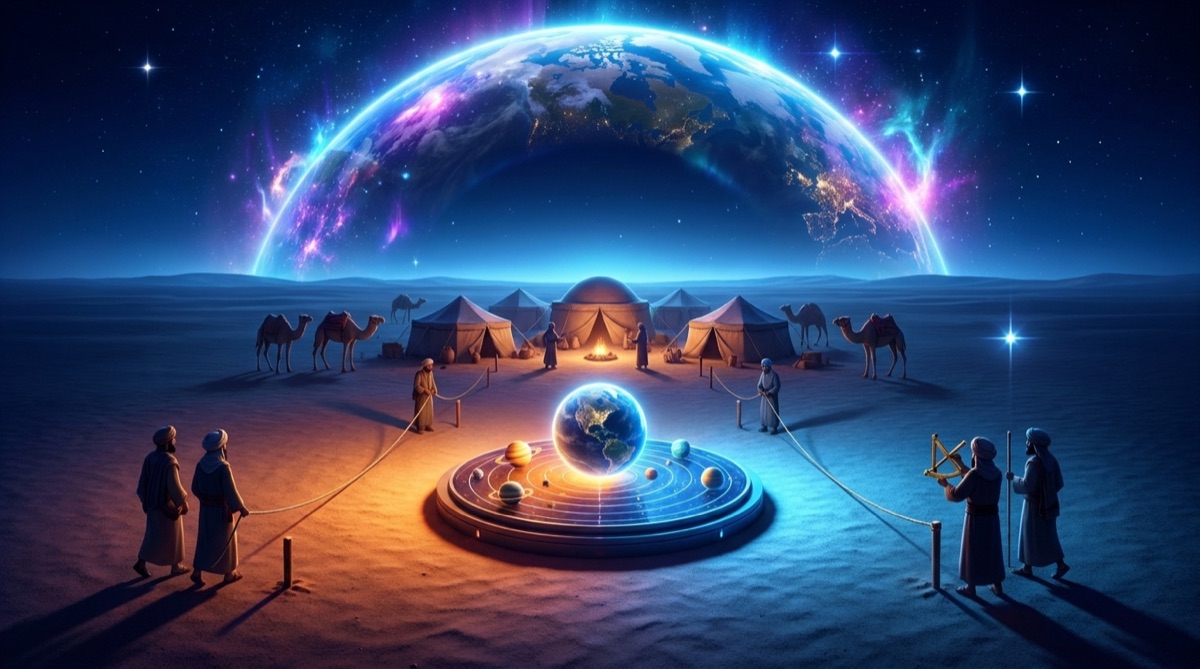
    By order of al-Ma'mun, two teams walked north and south from the same point until the altitude of the pole changed by one degree, and measured the distance covered. They obtained about 56 2/3 Arabic miles per degree: a repetition, with rope and astrolabe, of Eratosthenes' method.

    👤 Al-Ma'mun, Ali ibn Isa al-Asturlabi, Khalid al-Marwarrudhi · 📍 Plain of Sinjar, Iraq

    📘 Eratosthenes measures the Earth 🧪 Eratosthenes measures the Earth LatitudeCelestial pole

    Sources (2)
    • Al-Biruni, Kitab Tahdid nihayat al-amakin (Trans. J. Ali, The Determination of the Coordinates of Cities, American University of Beirut, 1967).
    • King, D. A. (2008). Astronomy in the Islamic world. In Selin (ed.), Encyclopaedia of the History of Science, Technology, and Medicine in Non-Western Cultures. Springer.
  6. c. 880–918
    Illustration: Al-Battani measures the year and precession (Raqqa, Syria)

    Observation ★ milestone

    Al-Battani measures the year and precession

    Over some forty years of observation in Raqqa, al-Battani obtained a tropical year of 365 days, 5 hours, 46 minutes and 24 seconds (about two minutes less than the real value), a precession of 1° every 66 years and better values for the obliquity of the ecliptic and the solar orbit. Copernicus cites him dozens of times.

    👤 Al-Battani · 📍 Raqqa, Syria

    📘 Hipparchus and the sky that moves slowly PrecessionObliquity of the eclipticEquinox

    Sources (2)
    • Hockey, T. et al. (eds.) (2007). Biographical Encyclopedia of Astronomers, entry “Battani”. Springer.
    • Nallino, C. A. (ed.) (1899–1907). Al-Battani sive Albatenii Opus Astronomicum (3 vols.). Milan.
  7. 964
    Illustration: Al-Sufi and the Book of Fixed Stars (Isfahan and Shiraz, Persia)

    Observation ★ milestone

    Al-Sufi and the Book of Fixed Stars

    Abd al-Rahman al-Sufi revised Ptolemy's catalog star by star, corrected brightnesses and added the traditional Arabic names. He described a “little cloud” in Andromeda, the first written mention of that galaxy. He is often also credited with the first description of the Large Magellanic Cloud (al-Bakr, “the white ox”, visible from southern Arabia), but specialists debate whether the passage really refers to it.

    👤 Abd al-Rahman al-Sufi · 📍 Isfahan and Shiraz, Persia

    📘 The Milky Way and other galaxies GalaxyApparent magnitudeConstellation

    Sources (2)
    • Hafez, I. (2010). Abd al-Rahman al-Sufi and his Book of the Fixed Stars: a journey of re-discovery. Doctoral thesis, James Cook University.
    • Kunitzsch, P. & Smart, T. (2006). A Dictionary of Modern Star Names. Sky Publishing (introduction).
  8. 1006
    Illustration: Ali ibn Ridwan describes the supernova of 1006 (Cairo, Egypt)

    Observation

    Ali ibn Ridwan describes the supernova of 1006

    From Cairo, the physician and astrologer Ali ibn Ridwan described a new star in Lupus “two and a half or three times larger than Venus” and with light like that of a quarter Moon. His account, together with the Chinese and Japanese ones, allowed modern astronomers to classify the explosion.

    👤 Ali ibn Ridwan · 📍 Cairo, Egypt

    📘 The lives of stars Supernova

    Sources (2)
    • Goldstein, B. R. (1965). Evidence for a supernova of A.D. 1006. Astronomical Journal 70, 105–114. https://doi.org/10.1086/109679
    • Stephenson, F. R. & Green, D. A. (2002). Historical Supernovae and their Remnants. Oxford University Press, ch. 6.
  9. c. 1007
    Illustration: Ibn Yunus and the Hakimi Zij (Cairo, Egypt)

    Observation

    Ibn Yunus and the Hakimi Zij

    In Cairo, Ibn Yunus gathered in a great manual his observations of eclipses and conjunctions and those of his predecessors, with very accurate trigonometric tables. His eclipses are used today to measure the slowing of the Earth's rotation.

    👤 Ibn Yunus · 📍 Cairo, Egypt

    Solar eclipseLunar eclipse

    Sources (2)
    • King, D. A. (1976). Ibn Yunus. In Dictionary of Scientific Biography, vol. 14, 574–580. Scribner's.
    • Stephenson, F. R. (1997). Historical Eclipses and Earth's Rotation. Cambridge University Press, ch. 12 (medieval Arab eclipses).
  10. c. 1025
    Illustration: Al-Biruni measures the radius of the Earth from a mountain (Nandana (Punjab))

    Discovery

    Al-Biruni measures the radius of the Earth from a mountain

    At the fortress of Nandana (present-day Pakistan), al-Biruni measured the height of a hill and the angle by which the horizon “dips” seen from the top; with trigonometry he deduced the radius of the Earth with an error of a few percent. Around 1030 he also wrote the best medieval description of Indian science.

    👤 Al-Biruni · 📍 Nandana (Punjab)

    📘 How Eratosthenes measured the Earth with a stick and a shadow Horizon

    Sources (2)
    • Hockey, T. et al. (eds.) (2007). Biographical Encyclopedia of Astronomers, entry “Biruni”. Springer.
    • MacTutor History of Mathematics, biography of al-Biruni (University of St Andrews).
  11. c. 1028
    Illustration: Ibn al-Haytham: Doubts about Ptolemy (Cairo, Egypt)

    Theory and models

    Ibn al-Haytham: Doubts about Ptolemy

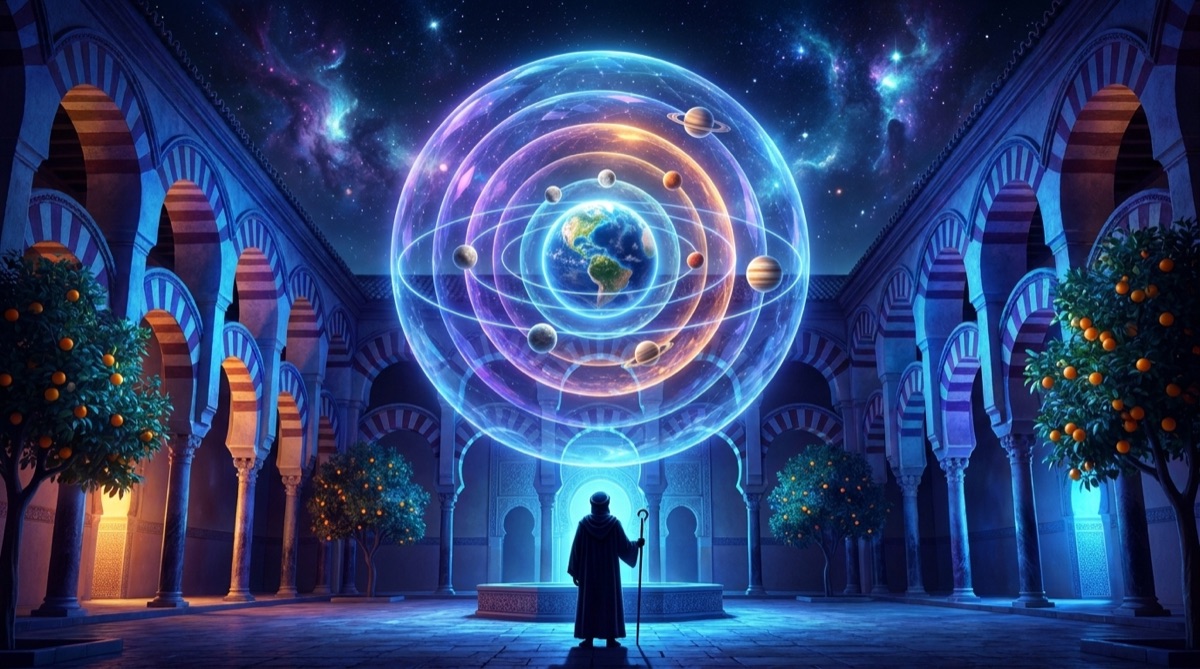
    The great scholar of optics pointed out that Ptolemy's equant (a point from which the motion appears uniform without being so) contradicts the physics of rotating spheres. His critique opened two centuries of attempts to build models without an equant.

    👤 Ibn al-Haytham · 📍 Cairo, Egypt

    Orbit

    Sources (2)
    • Sabra, A. I. (1978). An eleventh-century refutation of Ptolemy's planetary theory. Studia Copernicana 16, 117–131.
    • Saliba, G. (2007). Islamic Science and the Making of the European Renaissance, ch. 3.
  12. c. 1080
    Illustration: Al-Zarqali and the Toledan Tables (Toledo, al-Andalus)

    Instrument ★ milestone

    Al-Zarqali and the Toledan Tables

    In Toledo, a group led by the qadi Said al-Andalusi and the instrument maker Ibrahim ibn Yahya al-Zarqali (Arzachel) compiled astronomical tables based on al-Khwarizmi and al-Battani. Al-Zarqali also designed the saphaea, a universal astrolabe that works at any latitude, and measured the slow motion of the solar apogee.

    👤 Al-Zarqali (Arzachel), Said al-Andalusi · 📍 Toledo, al-Andalus

    📘 Celestial coordinates 🧪 Interactive planisphere LatitudePerihelion

    Sources (2)
    • Pedersen, F. S. (2002). The Toledan Tables: A Review of the Manuscripts and the Textual Versions (4 vols.). Royal Danish Academy of Sciences and Letters.
    • Samsó, J. (2011). Las ciencias de los antiguos en al-Andalus (2nd ed.), ch. 6.
  13. c. 1175
    Illustration: Toledo translates into Latin (Toledo, Castile)

    Observatories and institutions

    Toledo translates into Latin

    After the Christian conquest of Toledo (1085), translators such as Gerard of Cremona rendered into Latin the Almagest, the tables of al-Khwarizmi and al-Battani, and the astrolabe treatises. By that route Arabic astronomy, and Greek astronomy with it, entered the European universities.

    👤 Gerard of Cremona, John of Seville · 📍 Toledo, Castile

    Sources (2)
    • Hoskin, M. (ed.) (1999). The Cambridge Concise History of Astronomy, chs. 3–4.
    • Burnett, C. (2001). The coherence of the Arabic-Latin translation program in Toledo in the twelfth century. Science in Context 14, 249–288. https://doi.org/10.1017/S0269889701000096
  14. c. 1200
    Illustration: Al-Bitruji and the Andalusian revolt against Ptolemy (Seville, al-Andalus)

    Theory and models

    Al-Bitruji and the Andalusian revolt against Ptolemy

    Following the philosophers of Córdoba (Ibn Tufayl, Averroes), al-Bitruji (Alpetragius) tried to explain the planets using only spheres centered on the Earth, without epicycles or eccentrics. The model did not predict well, but it showed that Ptolemy's cosmology could be debated.

    👤 Al-Bitruji, Averroes · 📍 Seville, al-Andalus

    Sources (2)
    • Goldstein, B. R. (1971). Al-Bitruji: On the Principles of Astronomy (2 vols.). Yale University Press.
    • Samsó, J. (2011). Las ciencias de los antiguos en al-Andalus (2nd ed.), ch. 9.
  15. 1259
    Illustration: The Maragha observatory (Maragha, Iranian Azerbaijan)

    Observatories and institutions ★ milestone

    The Maragha observatory

    With the support of the Mongol Hulagu, Nasir al-Din al-Tusi founded in Maragha an observatory with a library, large instruments designed by al-Urdi and an international team. Its tables (Zij-i Ilkhani, around 1272) and its school of planetary models were influential for three centuries.

    👤 Nasir al-Din al-Tusi, Muayyad al-Din al-Urdi, Hulagu · 📍 Maragha, Iranian Azerbaijan

    Sources (2)
    • Sayili, A. (1960). The Observatory in Islam, ch. 6 (Maragha).
    • Saliba, G. (2007). Islamic Science and the Making of the European Renaissance, ch. 4.
  16. c. 1261
    Illustration: The Tusi couple (Maragha)

    Theory and models

    The Tusi couple

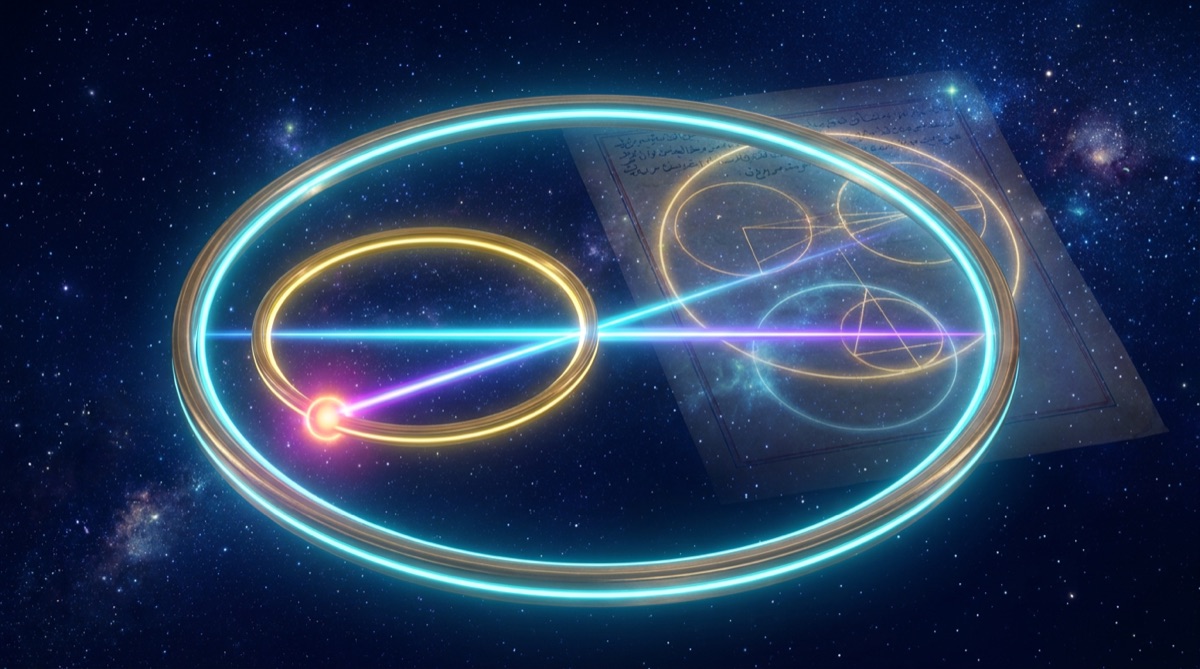
    In his Tadhkira, al-Tusi showed that two rotating circles, one inside another of twice the radius, produce a back-and-forth motion in a straight line. With that mechanism he replaced Ptolemy's equant with uniform motions; Copernicus would use exactly the same device in 1543.

    👤 Nasir al-Din al-Tusi · 📍 Maragha

    Orbit

    Sources (2)
    • Ragep, F. J. (1993). Nasir al-Din al-Tusi's Memoir on Astronomy (al-Tadhkira fi 'ilm al-hay'a). Springer, vol. 1, II.11.
    • Saliba, G. (2007). Islamic Science and the Making of the European Renaissance, ch. 4.
  17. c. 1350
    Illustration: Ibn al-Shatir, the timekeeper of Damascus (Damascus, Syria)

    Theory and models ★ milestone

    Ibn al-Shatir, the timekeeper of Damascus

    In charge of the hours of prayer at the Umayyad mosque, Ibn al-Shatir built models of the Moon and the planets without an equant that are, mathematically, the same ones Copernicus would publish two centuries later, though centered on the Earth. How those ideas reached Europe is still not known with certainty.

    👤 Ibn al-Shatir · 📍 Damascus, Syria

    📘 Tycho and Kepler, or how eight minutes of arc changed the universe 🧪 Keplerian orbit OrbitKepler's laws

    Sources (2)
    • Roberts, V. (1957). The solar and lunar theory of Ibn ash-Shatir: a pre-Copernican Copernican model. Isis 48(4), 428–432. https://doi.org/10.1086/348609
    • Kennedy, E. S. & Roberts, V. (1959). The planetary theory of Ibn al-Shatir. Isis 50(3), 227–235. https://doi.org/10.1086/348774
  18. c. 1420 – 1437
    Illustration: Ulugh Beg and the Samarkand observatory (Samarkand, Uzbekistan)

    Observatories and institutions ★ milestone

    Ulugh Beg and the Samarkand observatory

    The Timurid prince Ulugh Beg built in the 1420s an observatory with a meridian arc of about 40 meters in radius. With al-Kashi and Qadi Zada he measured the sidereal year with an error of less than a minute and cataloged 1 018 stars (1437), the first new catalog since Ptolemy and the most accurate until Tycho Brahe.

    👤 Ulugh Beg, Al-Kashi, Qadi Zada al-Rumi, Ali Qushji · 📍 Samarkand, Uzbekistan

    📘 Tycho and Kepler, or how eight minutes of arc changed the universe Sidereal timeConstellation

    Sources (3)
    • Knobel, E. B. (1917). Ulugh Beg's Catalogue of Stars. Carnegie Institution of Washington.
    • Hockey, T. et al. (eds.) (2007). Biographical Encyclopedia of Astronomers, entry “Ulugh Beg”. Springer.
    • UNESCO, World Heritage List: Samarkand – Crossroad of Cultures (ref. 603, 2001).
  19. 1577 – 1580
    Illustration: Taqi al-Din in Istanbul (Istanbul, Ottoman Empire)

    Observatories and institutions

    Taqi al-Din in Istanbul

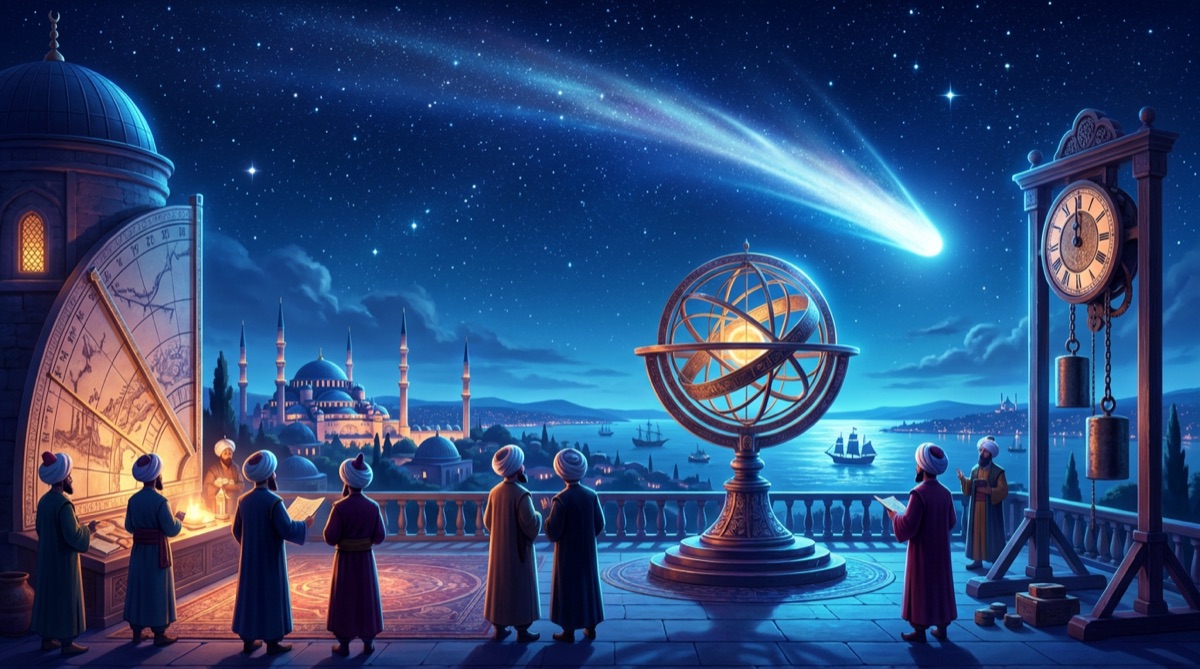
    Sultan Murad III funded an observatory in Istanbul directed by Taqi al-Din, who observed the great comet of 1577 and used a mechanical clock to time his observations, almost at the same time as Tycho Brahe in Denmark. It was demolished in 1580 under political and religious pressure.

    👤 Taqi al-Din, Murad III · 📍 Istanbul, Ottoman Empire

    📘 Tycho and Kepler, or how eight minutes of arc changed the universe

    Sources (2)
    • Sayili, A. (1960). The Observatory in Islam, ch. 8 (the Istanbul observatory).
    • Hockey, T. et al. (eds.) (2007). Biographical Encyclopedia of Astronomers, entry “Taqi al-Din”. Springer.
  20. 2016
    Illustration: The IAU fixes the Arabic names of the stars (International Astronomical Union)

    Observation

    The IAU fixes the Arabic names of the stars

    The Working Group on Star Names of the International Astronomical Union approved the first official names in 2016. Dozens of them come from Arabic: Aldebaran (“the follower” of the Pleiades), Betelgeuse (“the hand of the giant”), Rigel (“the foot”), Altair (“the flying eagle”), Deneb (“the tail”), Vega (“the swooping eagle”).

    📍 International Astronomical Union

    📘 Stars and constellations Constellation

    Sources (2)
    • IAU Working Group on Star Names, Bulletins no. 1 and 2 (2016) and IAU-CSN catalog (iau.org/public/themes/naming_stars).
    • Kunitzsch, P. & Smart, T. (2006). A Dictionary of Modern Star Names. Sky Publishing.

Context

When in the 8th century the caliphate stretched from Spain to India, its rulers inherited three astronomical traditions: the Greek (Ptolemy), the Persian and the Indian. Baghdad brought them together. The caliph al-Ma’mun paid for translations of the Almagest and the Sindhind, and ordered new observations to check whether the old tables were still valid. They were not entirely: seven centuries had passed since Ptolemy and the errors were piling up.

There were also religious and practical reasons to watch the sky precisely. The five daily prayers are set by the altitude of the Sun; the month of Ramadan begins with the visible new Moon; the qibla, the direction of Mecca, is a problem of spherical trigonometry that every city had to solve. Hence the office of muwaqqit, the mosque’s timekeeper, which was Ibn al-Shatir’s job in Damascus. And on top of all this came court astrology, which demanded reliable tables.

This astronomy was written in Arabic, but it was done by Persians, Arabs, Turks, Jews and Eastern Christians, from al-Andalus to Central Asia, over eight centuries.

Major contributions

Measuring better

Al-Ma’mun’s program started a custom: observing for decades to improve the constants. Al-Battani measured for forty years in Raqqa and obtained a tropical year with an error of about two minutes and a precession of 1° every 66 years (the real value is 1° every 72). Ibn Yunus recorded eclipses in Cairo; Ulugh Beg, in Samarkand, measured 1 018 stars with an arc of 40 meters in radius. The article Hipparchus and the slowly moving sky tells where the problem of precession came from, and Tycho and Kepler, who took up the baton from Ulugh Beg and Taqi al-Din.

The size of the Earth, again

In 827 two teams measured a degree of meridian on the plain of Sinjar; around 1025 al-Biruni did it alone, from a hill, with a simple idea: from a height the horizon appears slightly “below” the horizontal, a “dip” angle that depends on the radius of the Earth. By measuring that angle and the height of the hill, trigonometry gives the radius. In words: the larger the Earth, the less the horizon dips when seen from a mountain. It is the same problem that Eratosthenes solved with shadows, and that you can repeat in Eratosthenes measures the Earth.

Instruments: the astrolabe

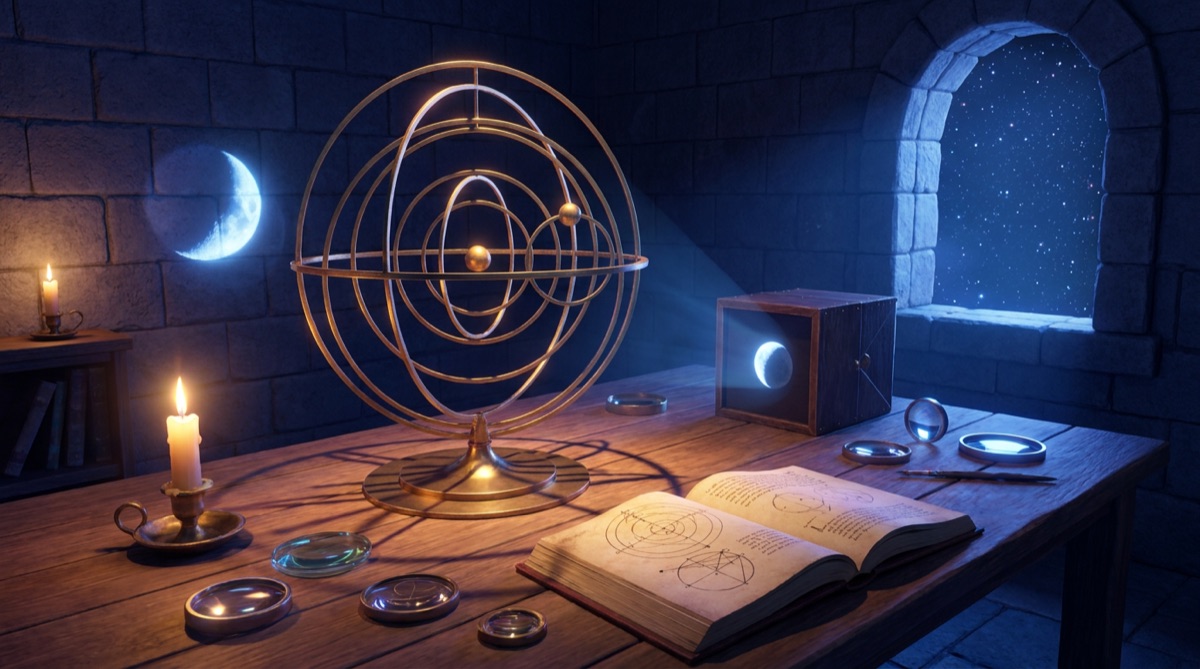
The astrolabe is a flattened celestial sphere: an openwork net with the stars rotates over a plate engraved with the horizon, the zenith and the altitude curves of a place. With it you can read the time by night and by day, find the latitude, and calculate sunrise and sunset. Al-Zarqali invented in Toledo the saphaea, valid for any latitude. The words we use to describe it are Arabic: zenith (samt al-ras, “direction of the head”), nadir (nazir, “opposite”), azimuth (al-sumut, “the directions”). The lesson Celestial coordinates and the local sky simulator teach precisely those horizon coordinates.

Correcting Ptolemy

Ibn al-Haytham objected that Ptolemy’s equant (a point from which a planet appears to move at uniform speed, even though it does not do so with respect to the center of its circle) could not correspond to real rotating spheres. In Maragha, al-Tusi invented a two-circle mechanism that turns uniform rotations into a straight-line oscillation; Ibn al-Shatir, in Damascus, used those parts to build equant-free models for the Moon and the planets. Two centuries later, Copernicus used the Tusi couple and lunar models identical to Ibn al-Shatir’s. He went on to set the Earth in motion, something none of them did, but the toolbox was that of Maragha and Damascus.

The catalog with names

Al-Sufi, in 964, revised Ptolemy’s 1 025 stars, corrected their brightnesses and noted next to each one the name the Bedouins gave it. He drew each constellation as seen from outside and from inside the globe, and mentioned a “little cloud” in Andromeda: the galaxy M31, 650 years before the telescope.

How do we know?

We have thousands of manuscripts (zijes, instrument treatises, commentaries on the Almagest), many still unedited; hundreds of signed and dated astrolabes; the ruins of the Maragha observatory and of Ulugh Beg’s sextant, excavated in 1908; and the Latin translations that show what reached Europe.

The doubts are of another kind. That the models of Ibn al-Shatir and Copernicus are mathematically the same is a fact; how the ideas traveled from Damascus to Poland is a hypothesis with clues (Greek manuscripts in Italy, contacts in Padua) but no documentary proof. That al-Sufi described the Large Magellanic Cloud is a frequent attribution that specialists debate: his text speaks of something visible from southern Arabia, and it is not clear that it is the Cloud. And some famous values, such as Ulugh Beg’s sidereal year, could come in part from earlier constants rather than from new measurements. On this page such claims carry “is credited with” or “around”.

Legacy

We inherited words: zenith, nadir, azimuth, almanac, algorithm, algebra, cipher. We inherited star names: of the more than 400 the IAU has made official, a good part are Arabic, sometimes distorted by Latin copyists (Betelgeuse comes from yad al-jawza, “the hand of the giant”). We inherited tables (the Toledan ones and, through them, the Alfonsine tables of 1272, which Europe used until Copernicus), the astrolabe and the quadrant, spherical trigonometry with sines and tangents, and the idea that an observatory is an institution with large instruments, staff and a program spanning decades. And we inherited something less visible: the habit of reading the ancients with respect and, at the same time, with doubts.

✦ Check your understanding

  1. 1. Which three astronomical traditions came together in Baghdad in the 8th and 9th centuries?
  2. 2. Where do the words zenith, nadir and azimuth come from?
  3. 3. What do the planetary models of Ibn al-Shatir (14th century) and those of Copernicus (1543) have in common?
  4. 4. What did Ulugh Beg do in Samarkand in the years 1420–1437?
Answer all the questions to check.

References

  • Saliba, G. (2007). Islamic Science and the Making of the European Renaissance. MIT Press.
  • Hoskin, M. (ed.) (1999). The Cambridge Concise History of Astronomy. Cambridge University Press, ch. 3 (“Astronomy in Islam”).
  • Hockey, T. et al. (eds.) (2007). The Biographical Encyclopedia of Astronomers. Springer (entries Battani, Biruni, Ibn al-Shatir, Sufi, Tusi, Ulugh Beg, Taqi al-Din, Zarqali).
  • King, D. A. (2004–2005). In Synchrony with the Heavens: Studies in Astronomical Timekeeping and Instrumentation in Medieval Islamic Civilization (2 vols.). Brill.
  • Sayili, A. (1960). The Observatory in Islam and its Place in the General History of the Observatory. Turkish Historical Society.
  • Samsó, J. (2011). Las ciencias de los antiguos en al-Andalus [The sciences of the ancients in al-Andalus] (2nd ed.). Fundación Ibn Tufayl.
  • Kunitzsch, P. & Smart, T. (2006). A Dictionary of Modern Star Names: A Short Guide to 254 Star Names and Their Derivations (2nd ed.). Sky Publishing.
  • Ragep, F. J. (1993). Nasir al-Din al-Tusi's Memoir on Astronomy (al-Tadhkira fi 'ilm al-hay'a) (2 vols.). Springer.
  • Selin, H. (ed.) (2008). Encyclopaedia of the History of Science, Technology, and Medicine in Non-Western Cultures (2nd ed.). Springer (entry “Astronomy in the Islamic world”).