His life

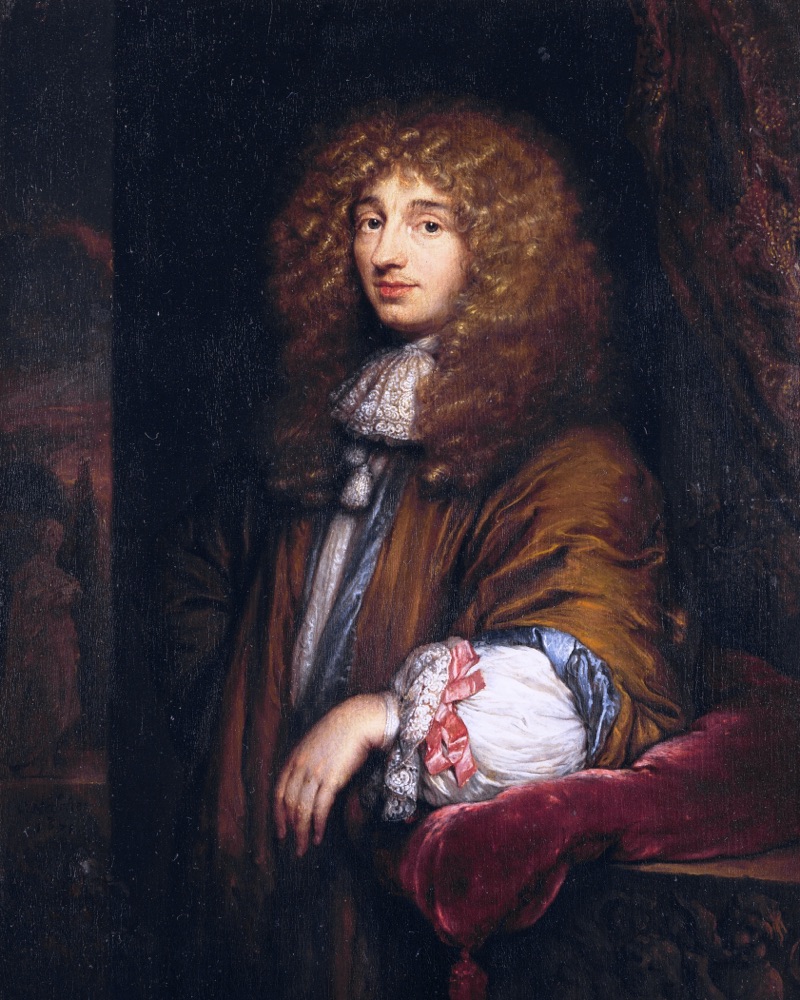
Christiaan Huygens was born in The Hague on April 14, 1629, into one of the most cultured families in the Netherlands. His father, Constantijn Huygens, was a diplomat, poet and secretary to the princes of Orange, and knew almost every scholar of his time; René Descartes visited the house. Christiaan studied law and mathematics at the universities of Leiden and Breda, but soon devoted himself to what really interested him: mathematics, mechanics and optics.
He lived on the family income, without a professorship. In 1663 he was admitted to the Royal Society of London, and in 1666 he settled in Paris as a founding member of the Royal Academy of Sciences, with a pension from King Louis XIV. There he spent fifteen very productive years. Illness made him return to The Hague in 1681; he did not go back to France. On a visit to London, in 1689, he met Isaac Newton. He admired his mathematics, but never accepted that two bodies could attract each other at a distance without any mechanical cause to explain it. Huygens died in The Hague on July 8, 1695, unmarried.
Titan and Saturn’s ring
With his brother Constantijn he learned to grind and polish lenses, and obtained better telescopes than those of the time. On March 25, 1655, he pointed one at Saturn and saw, near the planet, a tiny star that changed place from one night to the next: it was Titan, Saturn’s largest moon, which takes about sixteen days to complete an orbit. It is the second-largest satellite in the Solar System, behind only Ganymede, and the only moon with a thick atmosphere.
The most famous problem of the time was Saturn itself. Galileo had seen it with two “handles” that changed shape, and he could not interpret them. Other astronomers proposed very different explanations. Huygens solved it with patience: with a better telescope and with geometric reasoning, he concluded that Saturn is surrounded by a thin, flat ring that does not touch it and is tilted with respect to the ecliptic. As Saturn’s position in its orbit changes, so does the angle from which we see it, and that is why the ring seems to open, close and even disappear when seen edge-on. He published it in 1659 in the Systema Saturnium. Today we know that the ring is not solid but a swarm of ice particles, yet Huygens’ geometric explanation remains the correct one.
The pendulum clock

To measure the sky, one had to measure time well. In 1656 Huygens had the idea of regulating a clock with a pendulum, which swings with an almost constant period, and in 1657 he patented the first pendulum clock. The best earlier clocks drifted by about fifteen minutes a day; his, by less than a minute. In his great work Horologium oscillatorium (1673) he studied the pendulum with mathematical rigor: for small oscillations, the period depends on the length of the cord and on the local gravity, but not on the amplitude, a property Galileo had already intuited. In that book he also derived how to calculate the centrifugal force of a rotating body, a result that Newton also obtained independently and that proved key to understanding orbits.
Pendulum clocks made it possible to time eclipses, transits and the passage of stars across the meridian with much greater accuracy. Later, in 1675, Huygens also patented the spiral balance spring, which made precise pocket watches possible. His attempt to build a marine clock that would solve the problem of longitude at sea did not succeed, because the pendulum goes haywire with the rolling of the ship, but it opened the way that others completed.
His legacy

Huygens thought that light was a wave that advances like waves on water, and used that idea to explain reflection and refraction in his Traité de la lumière (1690). The theory was eclipsed for a century by Newton’s particle theory and returned with force in the 19th century. In his posthumous book Cosmotheoros (1698) he asked, before almost anyone else, whether other planets could harbor living beings. He also wrote the first published treatise on probability, in 1657.
His name lives on in space: the Huygens probe, of the European Space Agency, descended in 2005 onto Titan, the world he discovered, and sent back the first images of its surface. With the Newton’s Cannonball simulator you can see what happens to a projectile launched faster and faster, the problem of orbits that Huygens and Newton, from different approaches, helped to solve.