His life
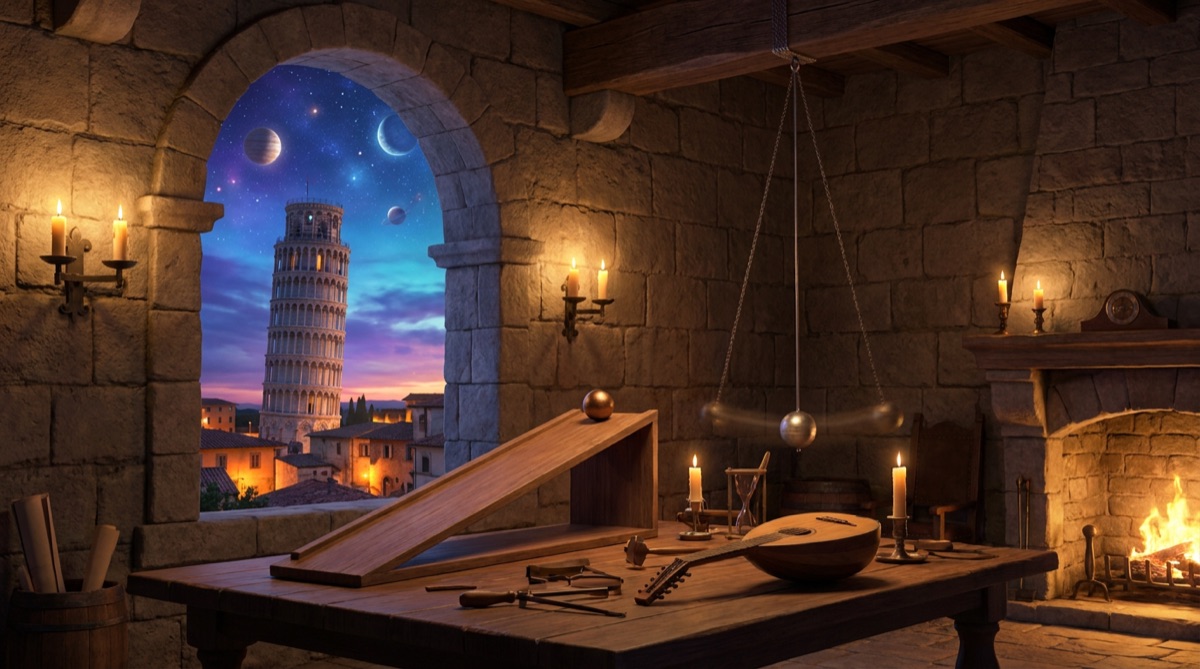
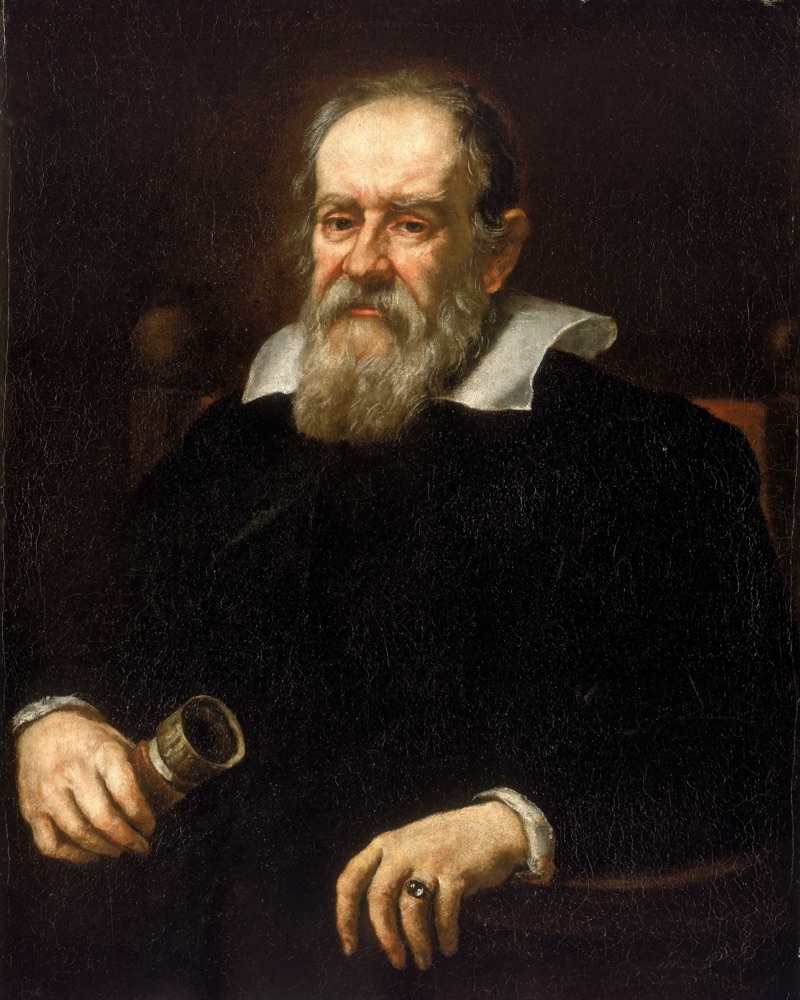
Galileo Galilei was born in Pisa on February 15, 1564, the son of Vincenzo Galilei, a musician and music theorist who experimented with strings to test the rules of harmony. From him he inherited a taste for measuring and a distrust of the authority of books. He entered the University of Pisa to study medicine, abandoned it for mathematics and, without finishing his degree, obtained the chair of mathematics at Pisa in 1589 and at Padua in 1592, in the Republic of Venice, where he spent the eighteen years that he himself called the best of his life.
In Padua he studied motion: the pendulum, whose period does not depend on the amplitude (for small swings), inclined planes, with which he measured that the distance covered by a falling body grows with the square of the time, and projectiles, which follow parabolas. He also built instruments to sell, among them a geometric and military compass. He had three children with Marina Gamba without marrying her; his eldest daughter, Sister Maria Celeste, was his closest correspondent.
In 1610 he moved to Florence as mathematician and philosopher to Grand Duke Cosimo II de’ Medici, a prestigious post that freed him from teaching and brought him closer to the courts and to Rome. There the rest of his life was decided.
The telescope pointed at the sky
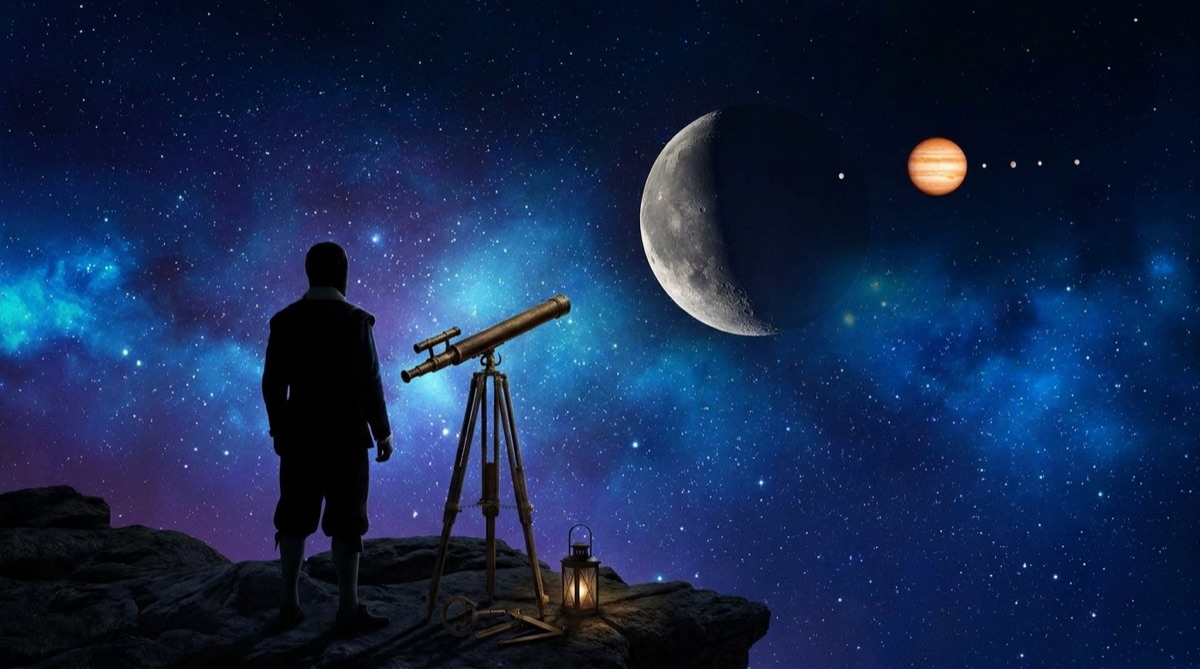
In 1609 Galileo learned that a tube with two lenses that brought objects closer was being sold in the Netherlands. Without having seen one, he worked out how to build it and within a few months went from three to twenty and thirty magnifications, far more than any other maker. In the autumn of 1609 he did what no one had done systematically: he pointed it at the sky.
The Moon was not Aristotle’s polished sphere: it had mountains and craters, and Galileo measured the height of the mountains from the length of their shadows. The Milky Way dissolved into countless stars. And on January 7, 1610, he saw next to Jupiter three “little stars” in a straight line; night after night they changed position, and soon there were four. They were moons circling Jupiter: there was at least one center of motion that was not the Earth, and the favorite argument against Copernicus collapsed. He published it all in March 1610 in the Sidereus Nuncius (“Sidereal Messenger”), a little book that turned a professor from Padua into the most famous scientist in Europe. The moons, which he called the “Medicean Stars” in honor of his future patrons, are today called Io, Europa, Ganymede and Callisto, the Galilean satellites.
In late 1610 he confirmed that Venus shows a full set of phases, like the Moon, from a small full disk to a large crescent: that is only possible if Venus goes around the Sun, as the lesson Phases and eclipses explains. Between 1611 and 1613 he studied sunspots and showed that they lie on the surface of the Sun, which rotates in about twenty-seven days. He also saw the strange “handles” of Saturn, though he could not interpret them; Huygens would do so half a century later.
The trial

Galileo defended the Copernican system, and he did so publicly and combatively. In 1616 the Church declared heliocentrism contrary to Scripture, placed De revolutionibus on the Index, and Cardinal Bellarmine warned Galileo not to hold it. In 1623 an admirer of his, Urban VIII, was elected pope, and Galileo thought the moment had come: in 1632 he published the Dialogue Concerning the Two Chief World Systems, in which three characters discuss the systems of Ptolemy and Copernicus and the defender of the former, Simplicio, is made to look ridiculous.
The book was banned and Galileo, at sixty-nine, was summoned to Rome. On June 22, 1633, the Inquisition condemned him for “vehement suspicion of heresy” and made him abjure on his knees. The phrase “Eppur si muove” (“and yet it moves”) attributed to him appears in no document of the time; the first known mention is from 1757. He spent the rest of his life under house arrest at his villa in Arcetri, near Florence, where, by then blind, he dictated his most important work in physics: the Discorsi (Leiden, 1638), which founds the science of motion. He died on January 8, 1642.
His legacy
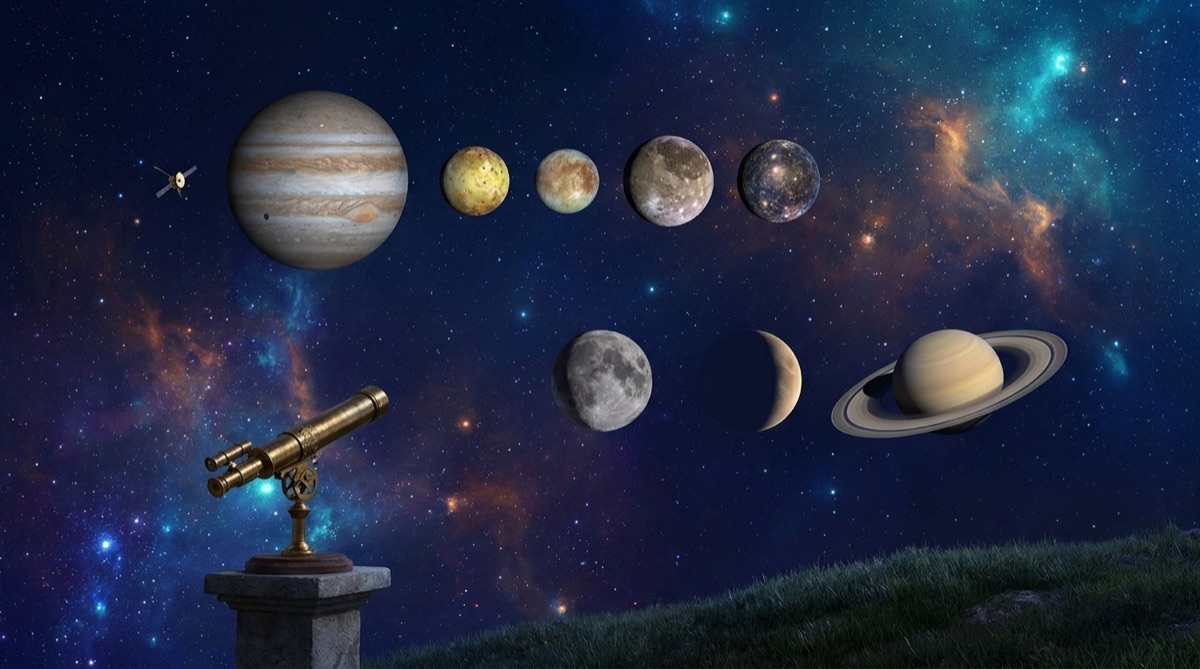
Galileo did not invent the telescope, nor was he the only one to point it at the sky (Thomas Harriot drew the Moon months earlier), but he was the one who understood what he saw and turned it into an argument. With him astronomy ceased to be only the measuring of positions and became also the seeing of what celestial bodies are like: mountains, moons, phases, spots. And his physics of motion, inertia and uniformly accelerated fall, is what Newton used as the foundation of mechanics. The Newton’s cannonball simulator joins the two: a Galilean projectile that, launched fast enough, becomes a satellite.
In 1992, after thirteen years of work by a commission, Pope John Paul II publicly acknowledged the errors of the trial. The Galileo probe orbited Jupiter between 1995 and 2003 and studied up close the four moons he discovered one January night in 1610.