His life

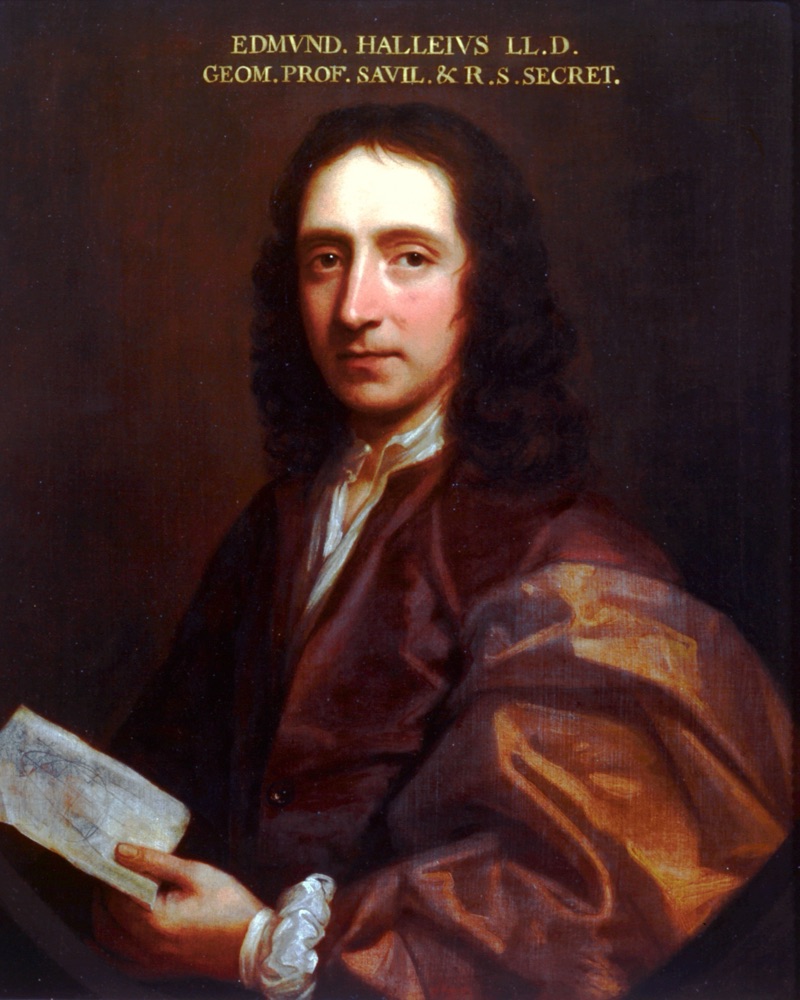
Edmond Halley was born in 1656 in Haggerston, then on the outskirts of London, the son of a prosperous soap maker who could afford him the best education. He studied at the University of Oxford but left without a degree in 1676 with a bold idea: to sail to the island of Saint Helena, in the South Atlantic, and do what no one had yet done with a telescope, a catalog of the stars of the southern hemisphere. He was twenty years old. In little more than a year he measured the positions of 341 stars, which he published in 1678, and from there he observed a transit of Mercury across the Sun. On his return, King Charles II granted him his Oxford degree and he was made a Fellow of the Royal Society.
In 1704 he was appointed professor of geometry at Oxford, and in 1720 he succeeded John Flamsteed as Astronomer Royal at Greenwich, a post he held until his death in 1742. Besides an astronomer he was a navigator: he led a naval expedition to the Atlantic (1698–1700) to chart the deviation of the compass, and he drew up a mortality table, based on records from the city of Breslau, that was one of the first scientific studies of life expectancy.
The comet that bears his name
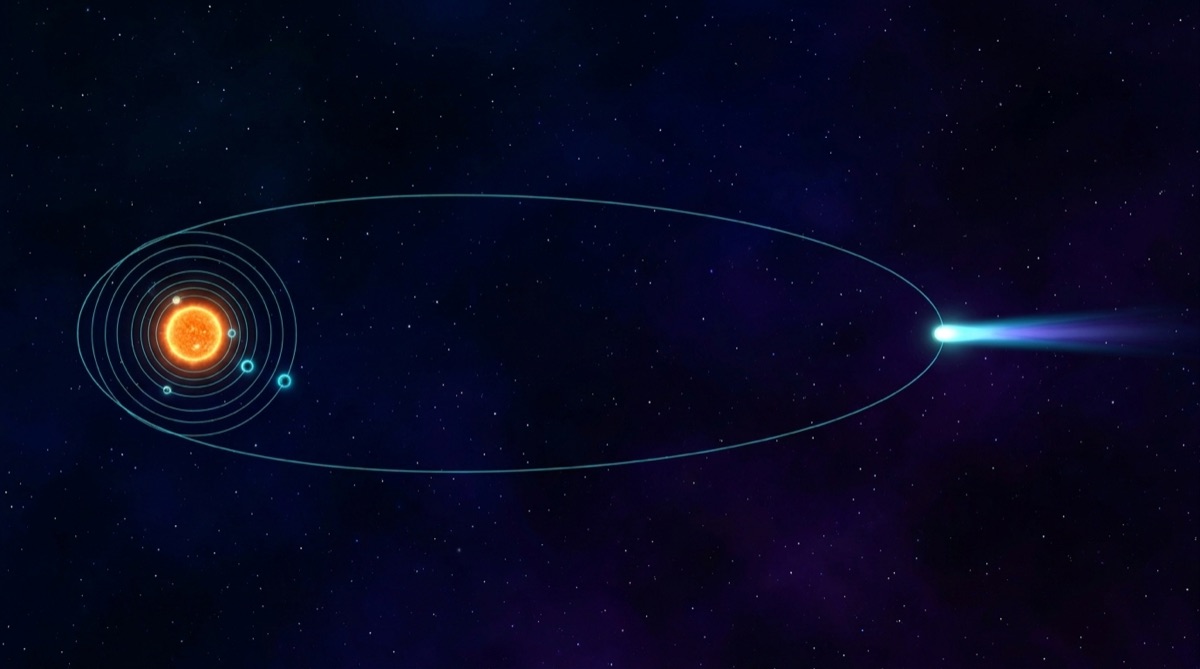
Comets were thought to be unique, unpredictable apparitions until Halley decided to check whether they had orbits. In August 1684 he had gone to Cambridge to consult Isaac Newton about the force that keeps the planets in their orbits, and from that visit the Principia (1687) were born. Halley, who edited the book and paid for the printing, used Newton’s method to compute the paths of twenty-four comets observed between 1337 and 1698. Three of them, those of 1531, 1607 and 1682, had nearly identical orbits and arrived some 75 or 76 years apart. Halley, who had observed the comet of 1682 himself, concluded in his Astronomiae cometicae synopsis (1705) that it was a single body and that it would return toward the end of 1758. He admitted that the pull of Jupiter and Saturn might delay it a little.
Halley died in 1742 without seeing the proof. The comet was sighted again on the night of December 25, 1758, by the German farmer and amateur astronomer Johann Georg Palitzsch, and it passed perihelion in March 1759, within the margin computed by the French mathematicians Clairaut, Lalande and Nicole-Reine Lepaute, who had included the perturbations of the giant planets. It was the great public triumph of Newtonian gravitation, and the body has been called Halley’s Comet ever since. Its period is about 76 years, and the last time it passed near the Sun was in February 1986, when the European probe Giotto flew to within about 600 km of its nucleus. It will return in 2061.
Before Halley, the comet had already been recorded by Chinese astronomers, and the surviving records go back to the year 240 BCE. Once its orbit had been reconstructed, it could be identified in chronicles of much older apparitions.
The scale of the Solar System

In 1677, from Saint Helena, Halley watched Mercury cross the face of the Sun and realized something important: by timing a transit from widely separated places on Earth one can compute the parallax of the Sun and, with it, the distance between the Earth and the Sun. Halley knew that a transit of Venus, because of its larger apparent size, would give more precise results. Since the next one would occur in 1761, when he would no longer be alive, he wrote down the method in 1716 and asked the astronomers of the future to apply it. Hundreds of observers from many countries did so during the transits of 1761 and 1769 (among them James Cook, in Tahiti). The results gave the Earth–Sun distance to within a few percent.
His legacy
Halley was the one who persuaded Newton to write his masterpiece and who paid to have it printed; without him, modern physics would have started later. He was also the first to show with a prediction that gravitation works for comets, and the first to notice, in 1718, that Sirius, Arcturus and Aldebaran had moved from the positions recorded by the Greeks: the “fixed” stars do not stand still. With the Keplerian orbit simulator you can give an orbit the eccentricity of a comet and check that it moves very fast near the Sun and very slowly far from it.