His life
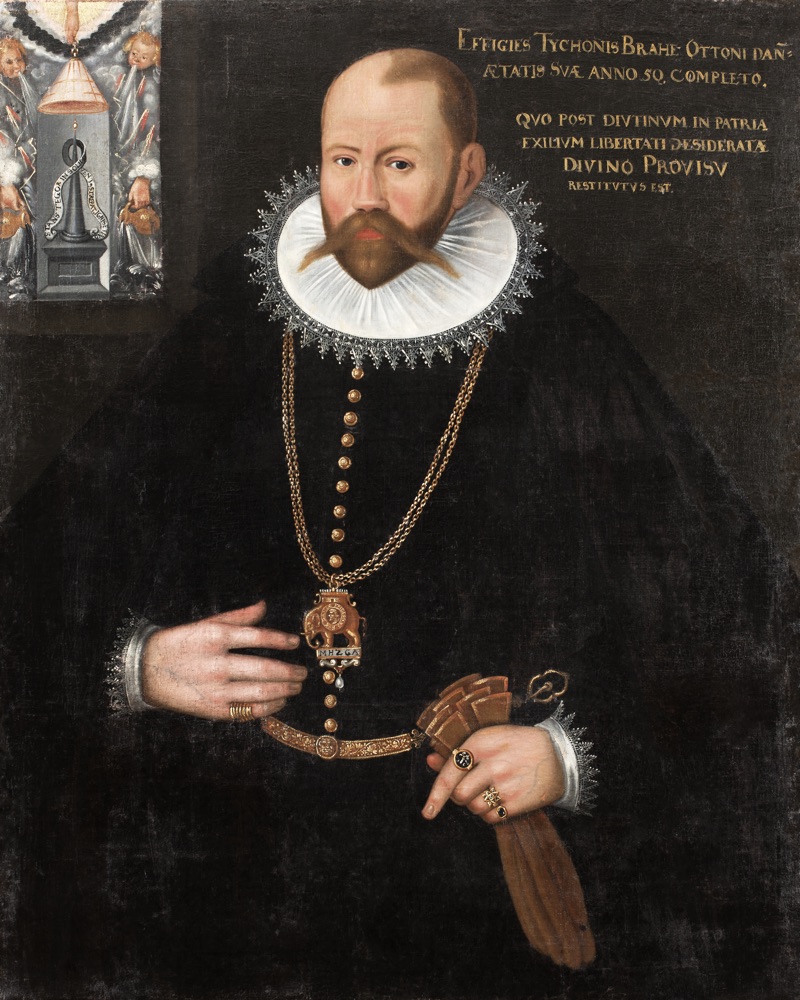
Tycho Brahe was born on December 14, 1546, at Knutstorp Castle, in Scania, a region that was then Danish and is now Swedish. He was the firstborn of one of the most powerful families in Denmark, and he was raised by a childless uncle, Jørgen Brahe, who intended him for a career in law and politics. A partial solar eclipse, on August 21, 1560, diverted him: he was fascinated that astronomers had predicted it, and at the universities of Copenhagen, Leipzig, Wittenberg and Rostock he spent on books and instruments the money that was meant for his law studies.
In Rostock, in December 1566, a duel with another student cost him part of his nose; for the rest of his life he wore a metal prosthesis. Analyses of his tomb, opened in 2010, indicate that it was brass, not gold or silver as the legend said. The same investigation ruled out that he died of mercury poisoning: the most likely cause was a urinary infection.
He was a courtly figure: he kept a tame elk, a dwarf jester named Jepp and a commoner wife, Kirsten Jørgensdatter, for which the nobility never quite forgave him. But he was, above all, the most meticulous observer of his century.
The new star of 1572
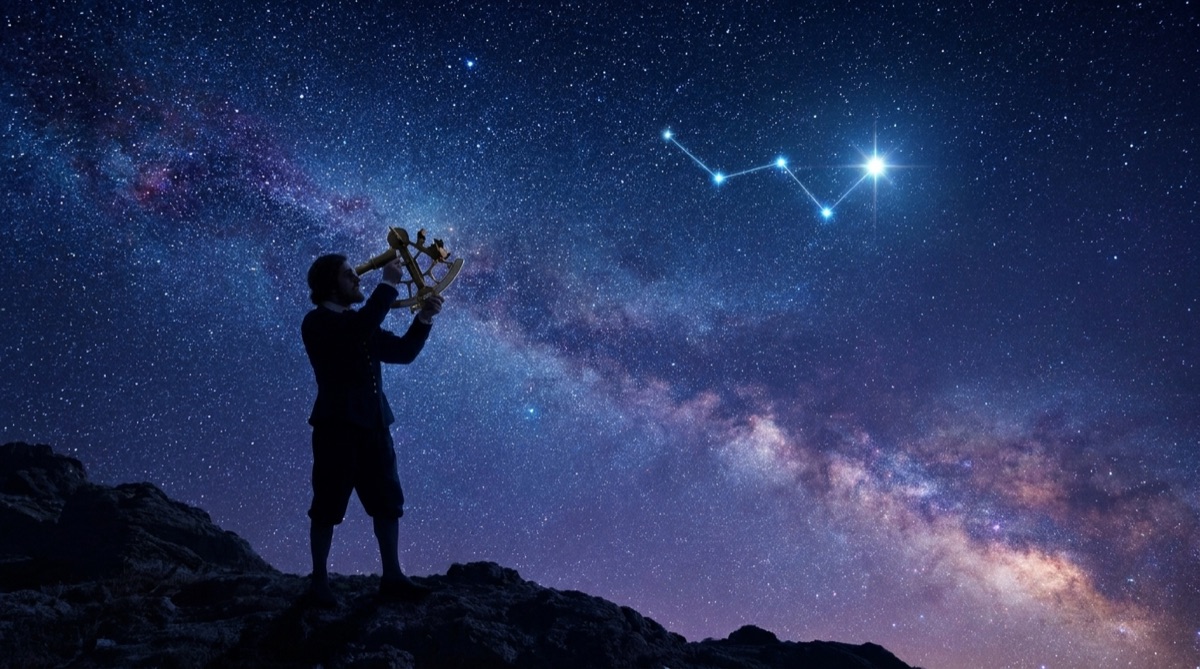
On November 11, 1572, coming out of his alchemy laboratory at Herrevad, Tycho saw in the constellation of Cassiopeia a star that had not been there the night before and that shone brighter than Venus. According to Aristotle, the sky beyond the Moon was perfect and immutable: any novelty had to be an atmospheric phenomenon, a “meteor”.
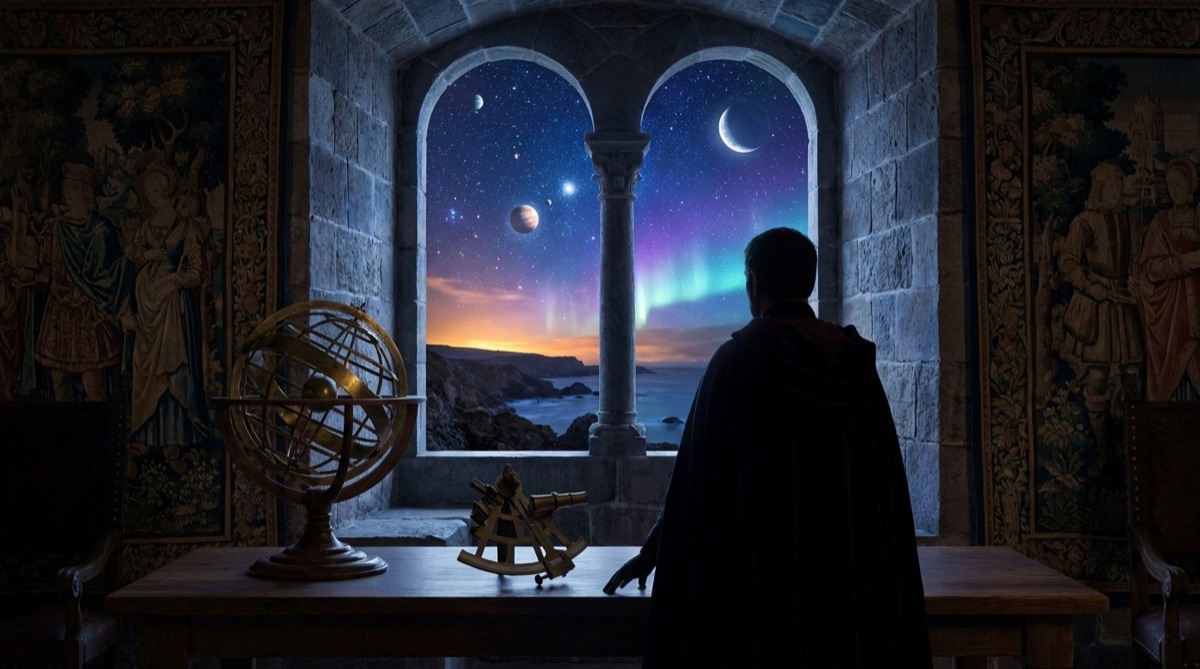
Tycho did what almost no one had done: he measured. With a large sextant he had built himself he confirmed, night after night, that the star did not shift relative to its neighbors. If it were close, within the sphere of the Moon, its apparent position would change over the course of the night because of parallax, the same effect that makes an outstretched finger jump against the background when we look at it with one eye and then the other. He detected none, so the star was very far away, among the fixed stars. He published it in 1573 in De nova stella, and that is where the word “nova” comes from. Today we know it was a supernova; its remains are still expanding in Cassiopeia.
With the great comet of 1577 he repeated the argument: it showed no appreciable parallax either, so it was beyond the Moon and crossed the orbits of the planets. The solid crystalline spheres that, according to the cosmology of the time, carried the planets could not exist.
Uraniborg: measuring without a telescope
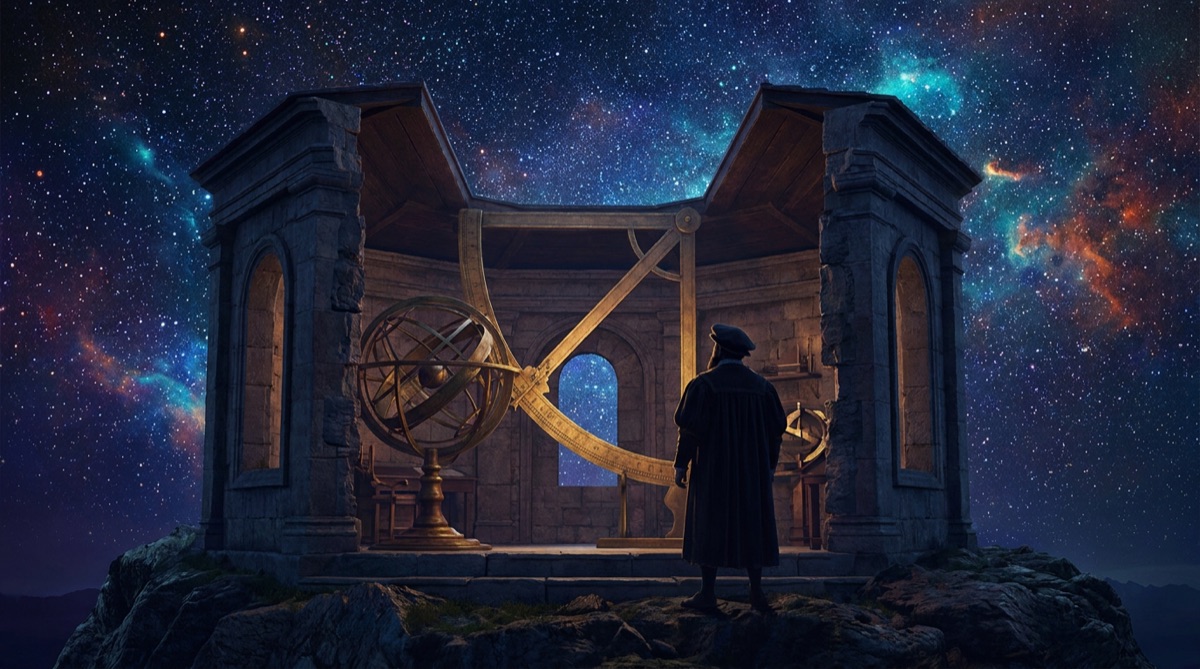
King Frederick II of Denmark granted him in 1576 the island of Hven, in the strait between Denmark and Sweden, and money to build there Uraniborg, “the castle of Urania”: at once palace, observatory, alchemy laboratory, printing press and instrument workshop. In 1584 he added Stjerneborg, a half-buried observatory so that the wind would not shake the instruments. A great mural quadrant two meters in radius, armillaries and steel sextants, with scales subdivided by an ingenious system of transversal points, allowed him to measure angles with an error of about one arcminute, a thirtieth of the diameter of the full Moon. It was the limit of what the human eye can do, and no one had reached it.
For twenty years, he and his team of assistants systematically recorded the positions of the planets, not only at special moments as their predecessors had done, but all along their orbits. They also cataloged about a thousand stars and measured atmospheric refraction. Tycho did not accept the Copernican system, because he could not detect the annual parallax of the stars that the Earth’s motion should produce; in 1588 he proposed an intermediate system, with the planets revolving around the Sun and the Sun around a motionless Earth.
After the death of Frederick II his relations with the court soured, and in 1597 he left Hven. Two years later the emperor Rudolf II received him in Prague as imperial mathematician. There, in February 1600, a young German mathematician, Johannes Kepler, came to work with him. Tycho died on October 24, 1601, barely twenty months later.
His legacy
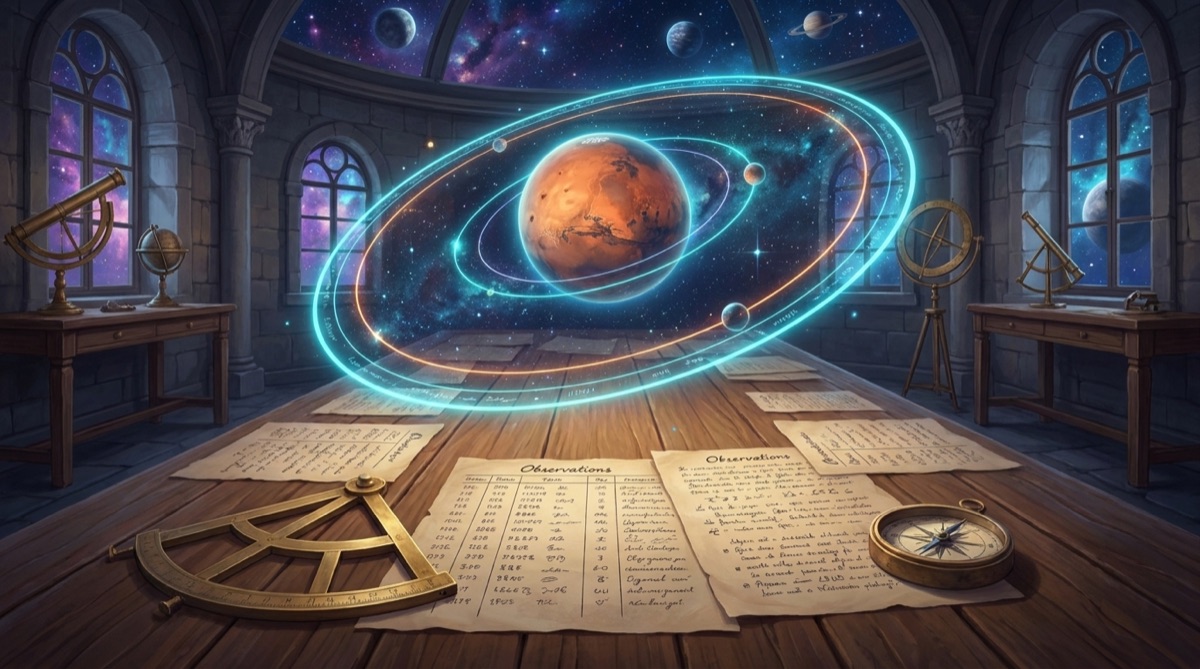
What Tycho left was, above all, data: the longest and most precise series of observations that had ever existed. Kepler inherited them, with the task of completing the Rudolphine Tables, and in them he found a discrepancy of eight arcminutes between the circular orbit of Mars and what had been measured. Since he knew Tycho was not that far wrong, he looked for another curve and found the ellipse. Without the precision of Hven, Kepler’s first law would not have been possible; we tell the story in Tycho and Kepler.
He also left a method: measure a lot, measure always and know the error of every instrument. That idea, which today seems obvious, is the basis of all later astronomy. A crater on the Moon with bright rays bears his name, and the parallax simulator lets you repeat, with numbers, the reasoning he used in 1572 to show that a new star really was among the stars.