His life
Johannes Kepler was born on December 27, 1571, in Weil der Stadt, a small free city of the Holy Roman Empire in the southwest of present-day Germany. He was a premature, sickly child; smallpox left him with weak eyesight and damaged hands, which made him a poor observer and an extraordinary calculator. His mother, Katharina, showed him the sky: he remembered seeing with her the great comet of 1577 and a lunar eclipse in 1580.
A scholarship from the Duke of Württemberg took him to the University of Tübingen to study theology and become a Lutheran pastor. There his astronomy professor, Michael Maestlin, taught him the Copernican system in private, and Kepler embraced it with an almost religious conviction: the Sun at the center was, for him, the image of God in the world. In 1594 he accepted, without much enthusiasm, a post as mathematics teacher in Graz. Two years later he published the Mysterium cosmographicum, in which he explained the distances of the six known planets by fitting the five regular solids between their spheres. The idea was false, but it posed a new question: why are there exactly those planets, at those distances?
Expelled from Graz for being a Protestant, in 1600 he joined Tycho Brahe in Prague, who assigned him the orbit of Mars. On Tycho’s death, in 1601, he succeeded him as imperial mathematician to Rudolf II. Then came Linz (1612), the defense of his mother in a witchcraft trial that lasted six years and ended with her acquittal (1621), the Thirty Years’ War and a life of moves and unpaid salaries. He died in Regensburg on November 15, 1630, while traveling to collect what he was owed.
The elliptical orbits
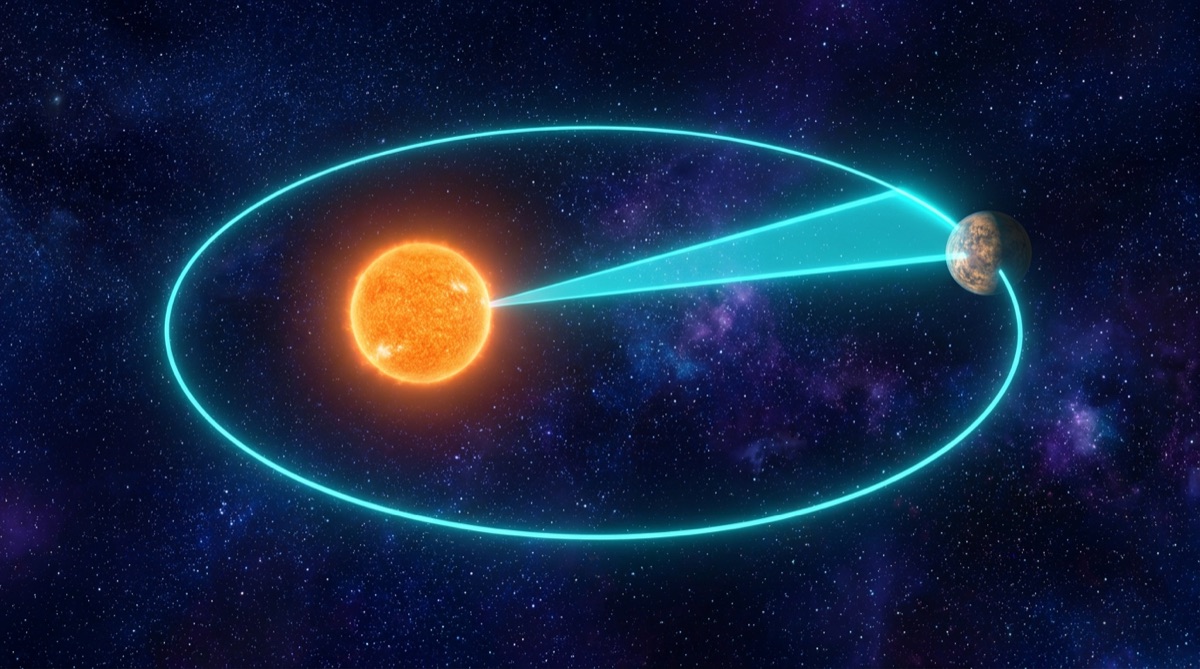
Mars was the hardest planet: its orbit departs from a circle more than that of any other visible to the naked eye. Kepler thought he would solve it in eight days; it took him five years. He built a model with circles and a point of uniform speed that reproduced Tycho’s positions with a maximum error of 8 minutes of arc. Any earlier astronomer would have accepted it: Ptolemy was content with errors of 10 minutes. But Kepler knew that Tycho measured to a precision of 1 or 2 minutes. Eight minutes was a real error, and he decided the model was wrong.
What followed was one of the longest chains of reasoning in the history of science, told step by step in the Astronomia nova (1609), dead ends included. First he discovered that Mars moves faster when it is near the Sun and more slowly when it is far away, so that the line joining it to the Sun sweeps out equal areas in equal times (what we now call the second law). Then, after trying an oval that did not work, he found that the orbit is an ellipse with the Sun at one of its foci (the first law). It was the first time in two thousand years that anyone had abandoned the circle as the figure of the heavens.
Kepler also wanted a physical cause: he imagined that the Sun, as it rotated, dragged the planets along with a force that weakened with distance, an intuition that Newton would turn into gravitation. You can manipulate these orbits in the Keplerian orbit simulator and work through them in the lesson Kepler’s laws.
The harmony of the periods
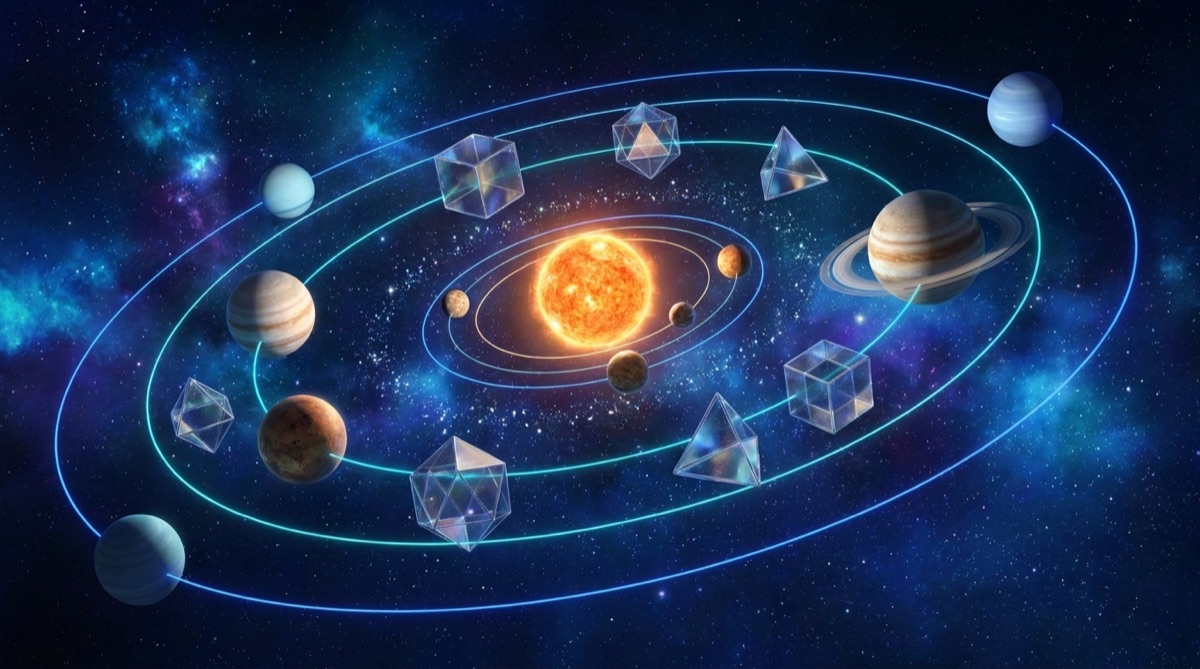
The question of the Mysterium remained open: what relates the distances of the planets? On May 15, 1618, as he himself notes, he found the answer in the data: the square of each planet’s period is proportional to the cube of its mean distance from the Sun. If is the period (in years) and the semi-major axis of the orbit (in units of the Earth–Sun distance), then . Jupiter, at 5.2 units, takes years. He published it in 1619 in Harmonices mundi, a book that mixes geometry, music and astrology and in which the third law takes up barely a few pages.
With the three laws he computed the Rudolphine Tables (1627), which predicted planetary positions with an accuracy ten times better than earlier ones. Thanks to them, Pierre Gassendi observed in 1631 the first transit of Mercury across the disk of the Sun, just as Kepler had announced.
Kepler was also the founder of modern optics. In Astronomiae pars optica (1604) he explained that the eye forms an inverted image on the retina and that the intensity of light decreases with the square of the distance; in Dioptrice (1611) he gave the theory of Galileo’s telescope and proposed the design with two convex lenses that we call the “Keplerian telescope”. And in Somnium, published after his death, he imagined a journey to the Moon and how the sky would look from there.
His legacy
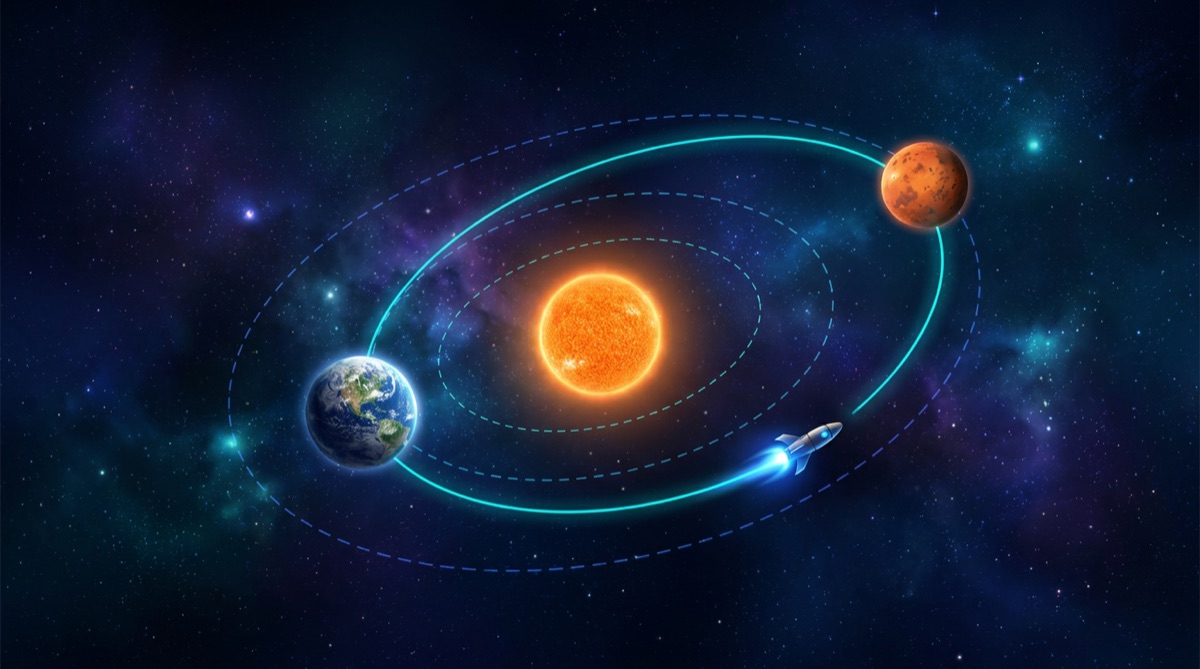
Kepler’s laws were exact descriptions without a proven cause. Newton showed in 1687 that all three follow from a single force, gravitation, which attracts with the inverse square of the distance: the second law is the conservation of angular momentum, and the first and third are consequences of the form of the force. Since then they have applied to everything that orbits: moons, artificial satellites, double stars and exoplanets, whose mass is computed today with the third law.
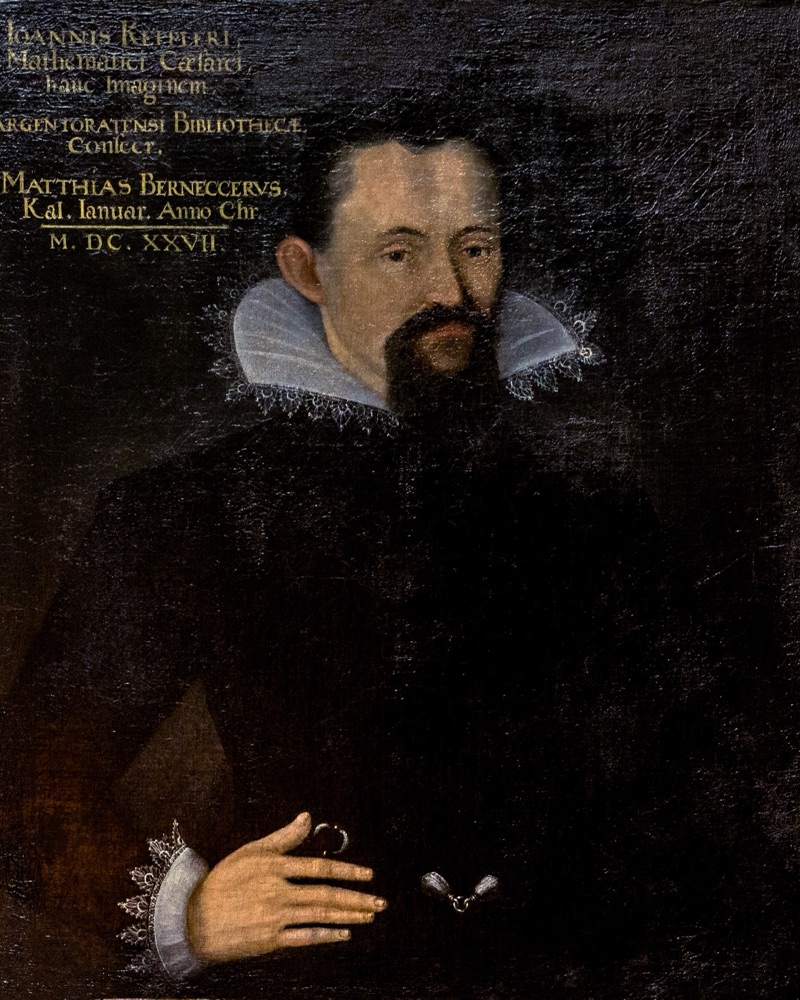
His way of working was as important as his results: taking a small error seriously, publishing the failed attempts and demanding that the model match the data to the limit of the instrument’s precision. The equation relating time to position on the ellipse, Kepler’s equation, is still solved every day in mission control centers. And, by an ironic twist, the portrait that for decades represented him in books and on the internet turned out not to be his: the only one painted during his lifetime is the one from 1627 that illustrates this fiche.