

Context
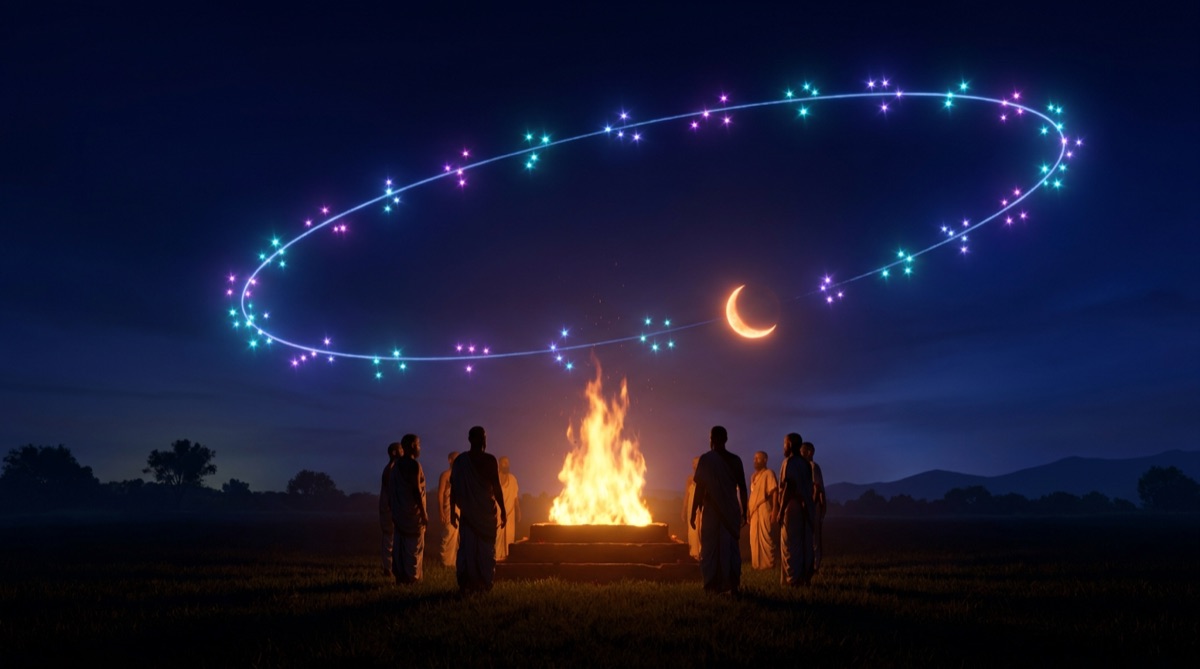
In ancient India the sky served, first of all, to know when: when to perform a sacrifice, when the month begins, when the solstice falls. The Vedic texts (around 1000 BCE) already name the 27 or 28 nakshatras, the stations the Moon passes through on its monthly journey around the sky, and the Vedanga Jyotisha is a manual so that the priest does not get the date wrong. Later, from the 2nd–5th centuries on, epicycles, the zodiac and horoscope astrology arrived from Greece and Mesopotamia, and Indian scholars rewrote them in Sanskrit and combined them with their own arithmetic.
From that blend a tradition was born that lasted more than a thousand years, with centers in Pataliputra, Ujjain, Gujarat and, at the end, on the coast of Kerala. Its protagonists wrote in verse so that students could memorize, and their best results were astronomical and mathematical at the same time.
Major contributions
Aryabhata: the Earth rotates
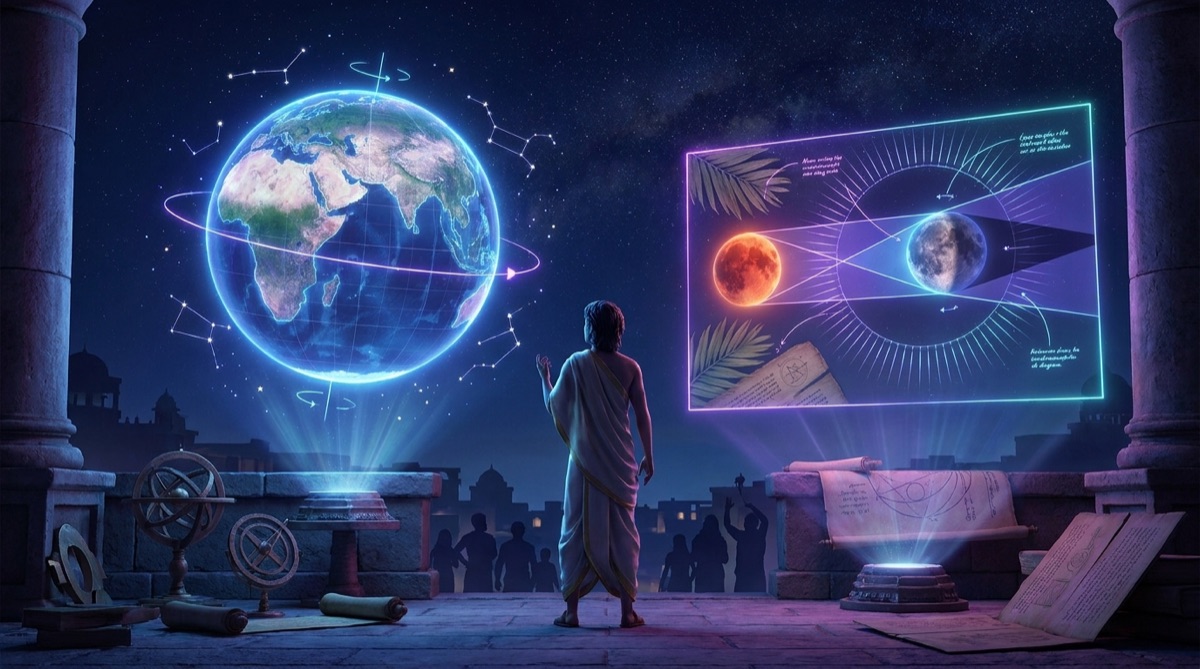
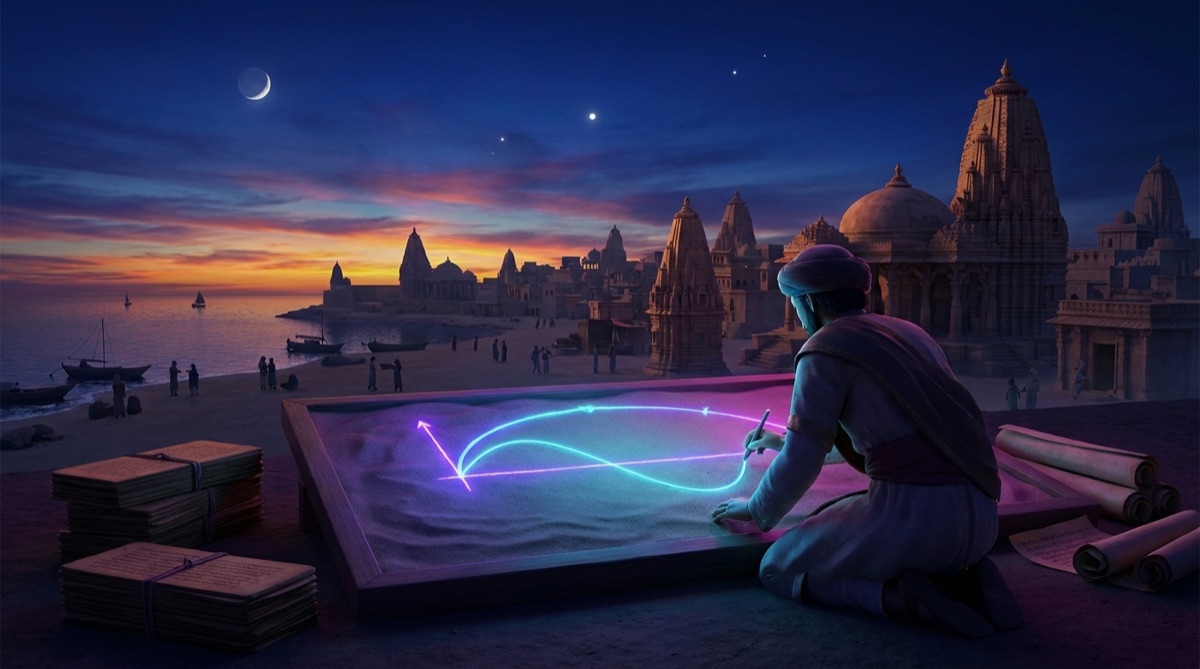
In 499, Aryabhata wrote that the Earth rotates on its axis and that the stars only seem to move westward, “like someone in a boat who sees the shore move backward”. He explained eclipses as shadows (the Earth’s on the Moon, the Moon’s on the Earth), without dragons devouring the Sun, and gave for π the value 62 832 / 20 000 = 3.1416. His successors did not always accept the rotation, but his treatise was the basis of everything that came after. The lesson Day and night explains precisely that idea.
Numbers for calculating the sky
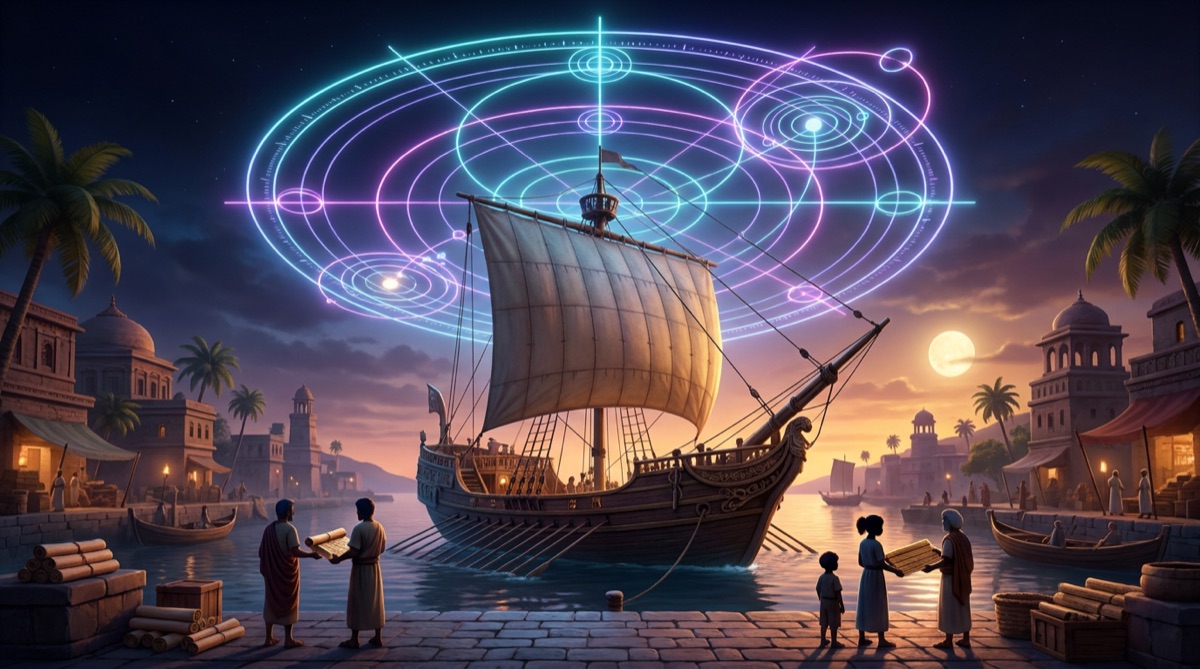
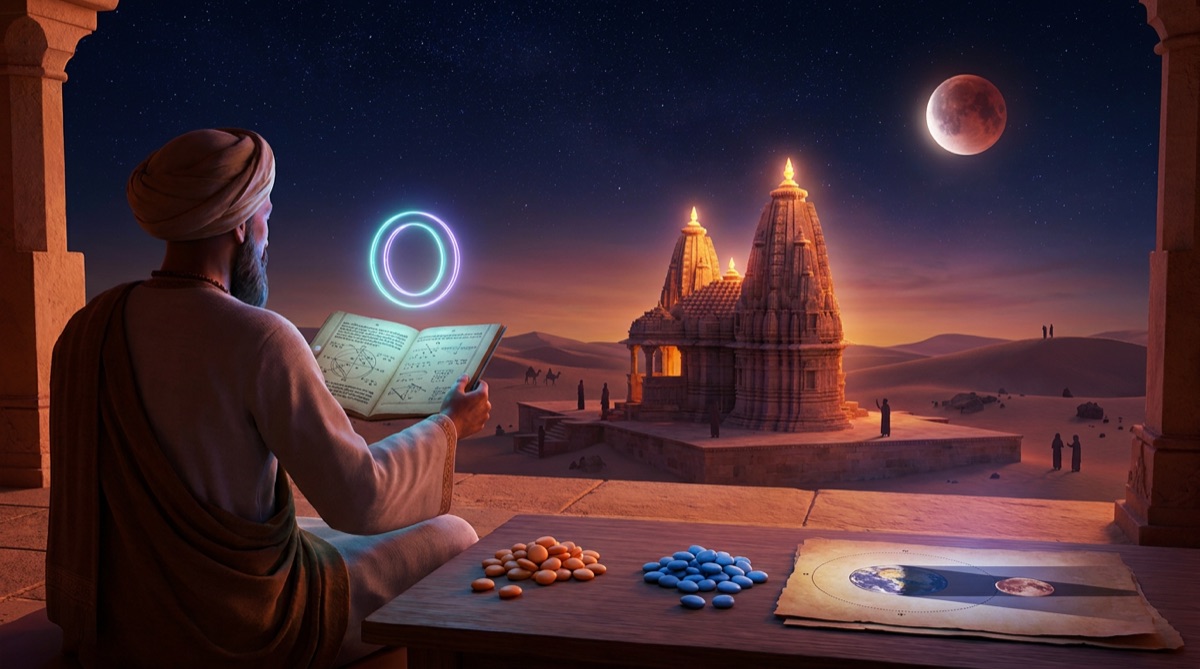
To predict eclipses you need sine tables and fast arithmetic. Indian astronomers developed the decimal numeration with zero that the whole world uses today, and Brahmagupta (628) wrote the first rules for operating with zero and negatives. Those numbers traveled to Baghdad with the siddhantas around 773 and from there, centuries later, to Europe. Every time you write a large quantity in scientific notation you are using an Indian tool.
Kerala: calculus before calculus
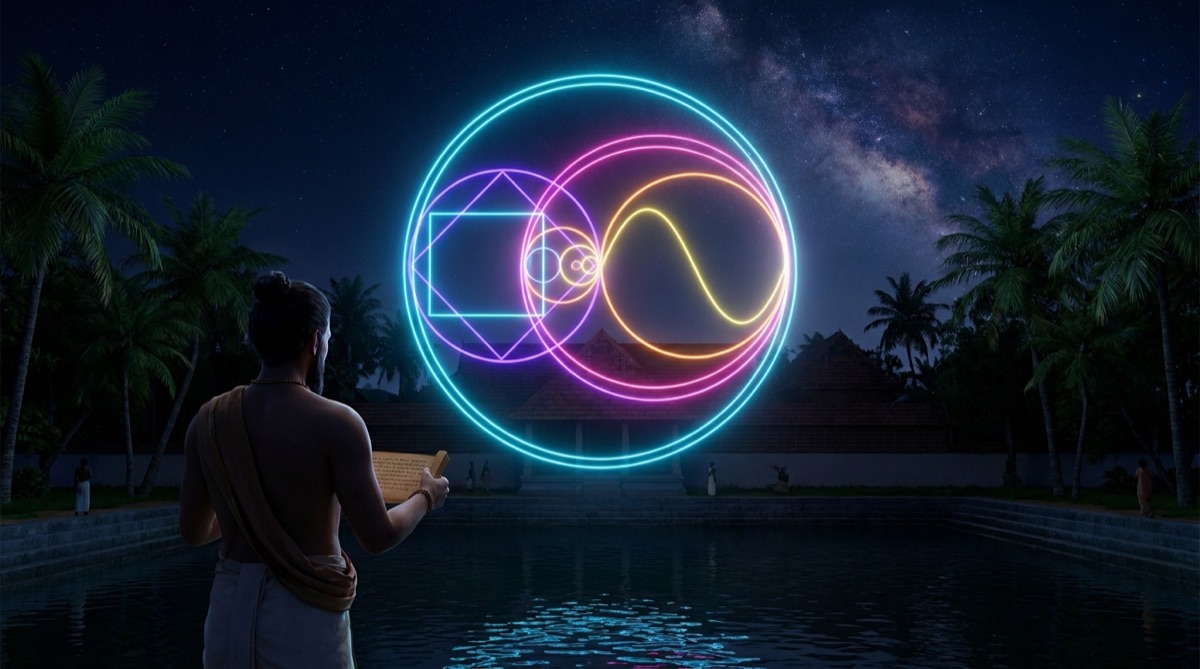
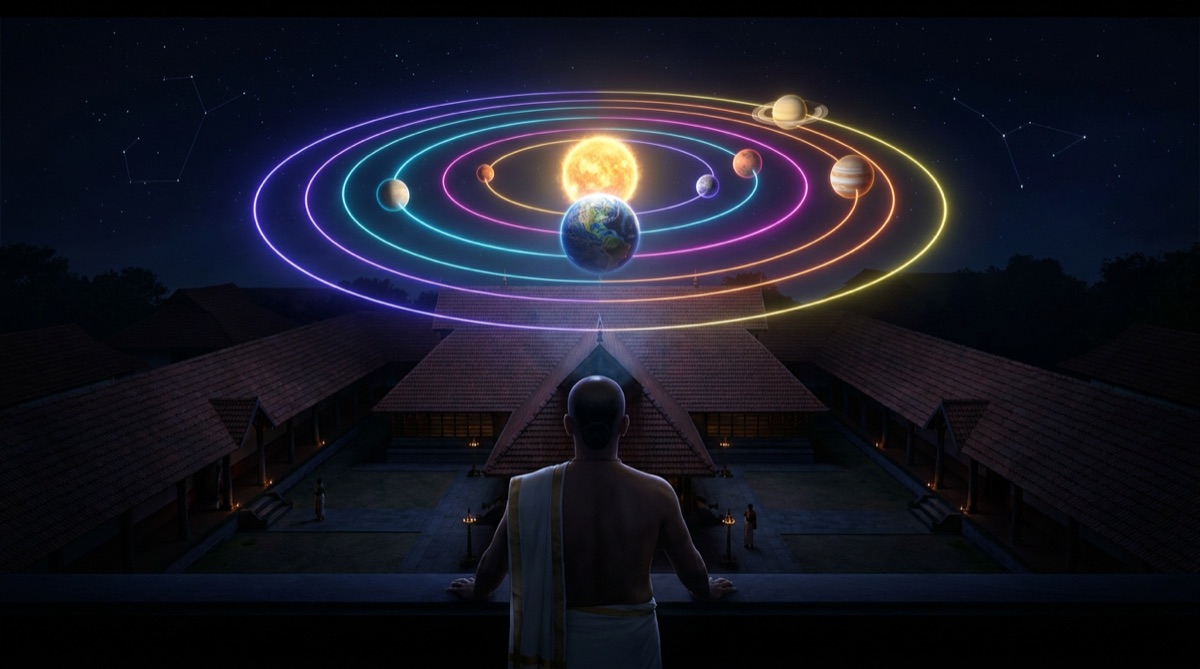
Between the 14th and 16th centuries, in a school of villages in Kerala, Madhava discovered that the sine, the cosine and the arctangent can be obtained by adding infinitely many terms. The most famous series, today called the Madhava–Leibniz series, says in words: a quarter of π is one, minus a third, plus a fifth, minus a seventh… and so on without end. With sums of this kind and ingenious corrections Madhava calculated π to eleven correct decimal places. Nilakantha, around 1500, also proposed a system in which the planets revolve around the Sun and the Sun around the Earth, similar to the one Tycho Brahe would defend decades later; the article Tycho and Kepler tells that other story. These ideas are the forerunner of what you will see in Derivatives and motion.
Giant instruments
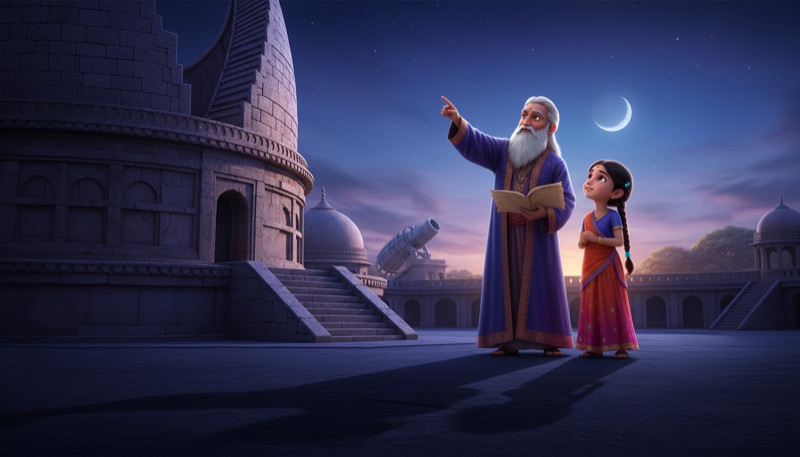
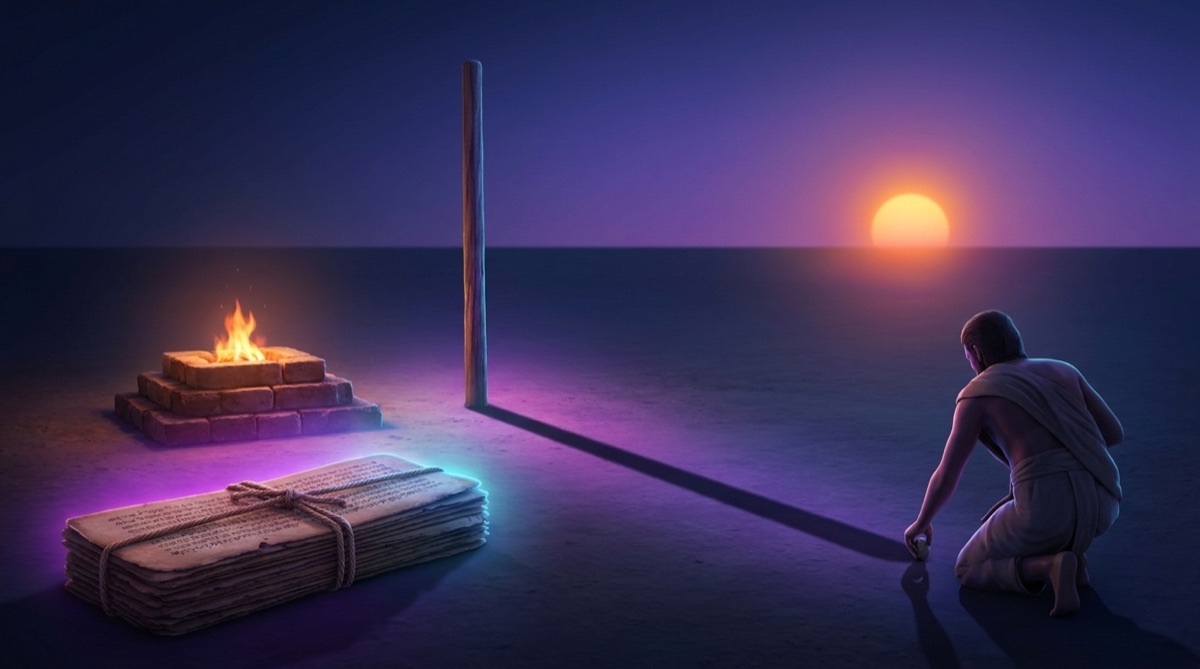
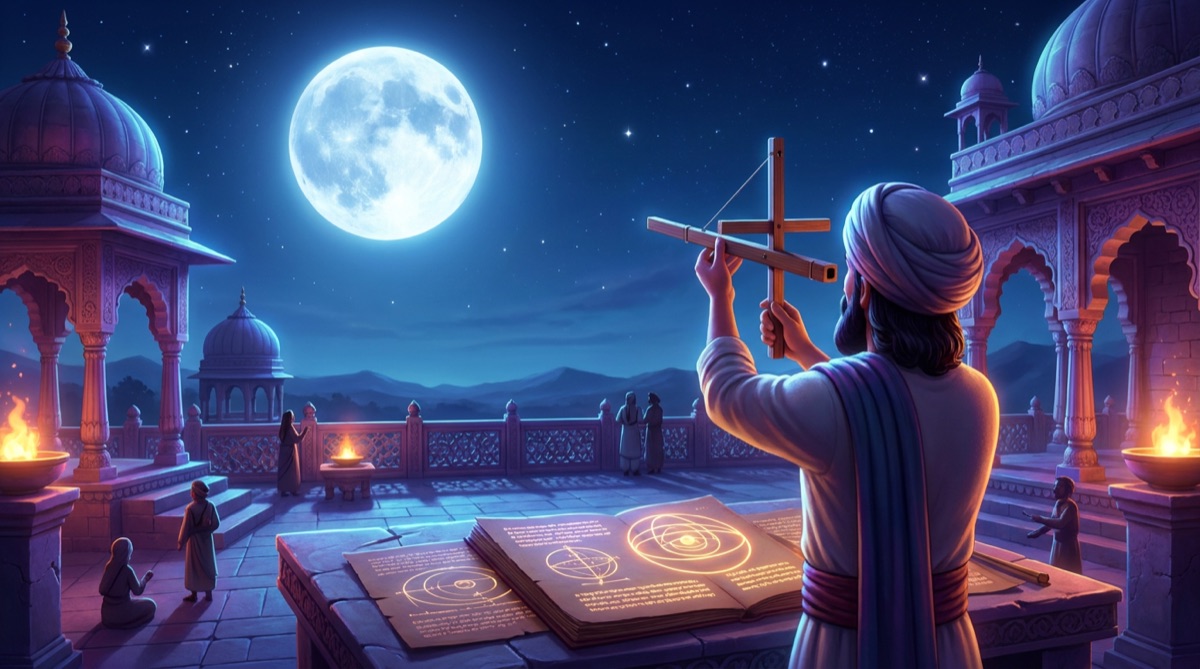
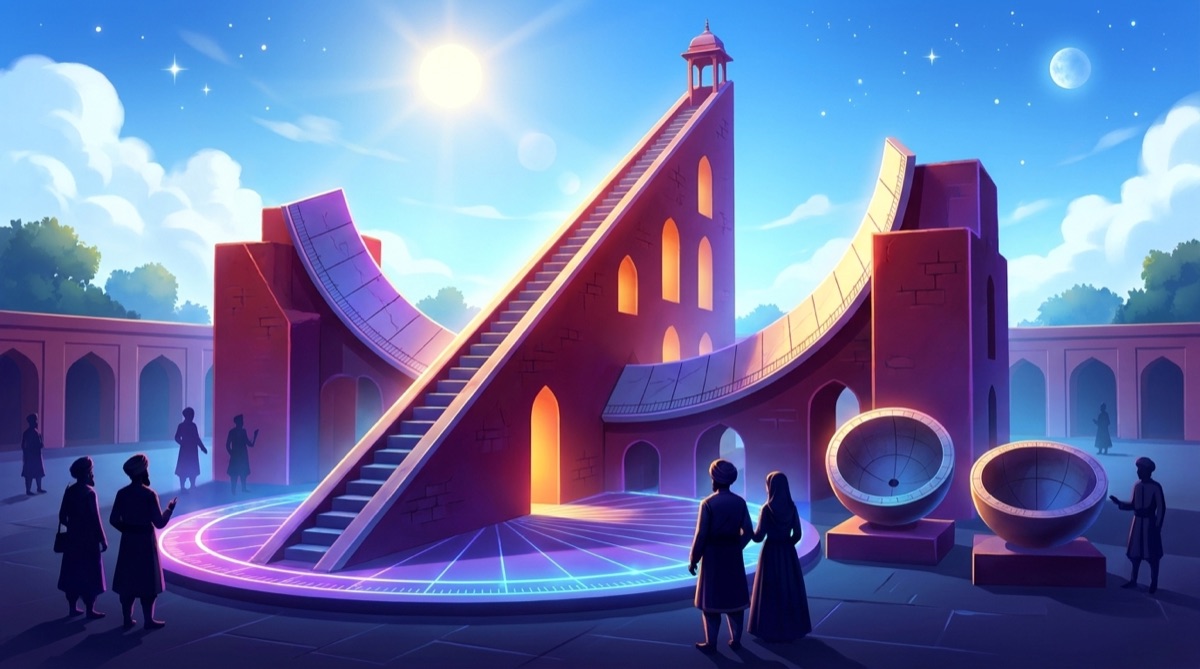
In the 18th century the raja Jai Singh II built five masonry observatories, the Jantar Mantars. His sundial in Jaipur is 27 meters tall: the larger an instrument, the smaller the reading error, the same principle that led the Chinese to erect 12-meter gnomons. You can check it with a stick in Shadows and the sundial. Jai Singh used his measurements to correct the tables of Ulugh Beg, but he did not adopt the telescope, which had already existed in Europe for a century.
How do we know?
The sources are above all texts: treatises in Sanskrit verse copied and commented on for centuries, plus the Yuktibhasa in Malayalam. Almost no ancient instruments survive, except the 18th-century Jantar Mantars, and the external descriptions (al-Biruni around 1030) help to date the rest.
That dependence on texts has a price: dates are hard. Works were copied and revised, so a title like “Surya Siddhanta” designates different versions separated by centuries. The Vedanga Jyotisha describes a sky of around 1200 BCE, but its language points to a much later composition; the date of the Yavanajataka has been corrected in the last decade. That is why many years on this page carry “c.”. One should also be wary of claims that Indian science “discovered everything first”: Madhava did get ahead of Europe in series, and Aryabhata did defend rotation, but neither of them reached heliocentrism or the complete differential calculus.
Legacy
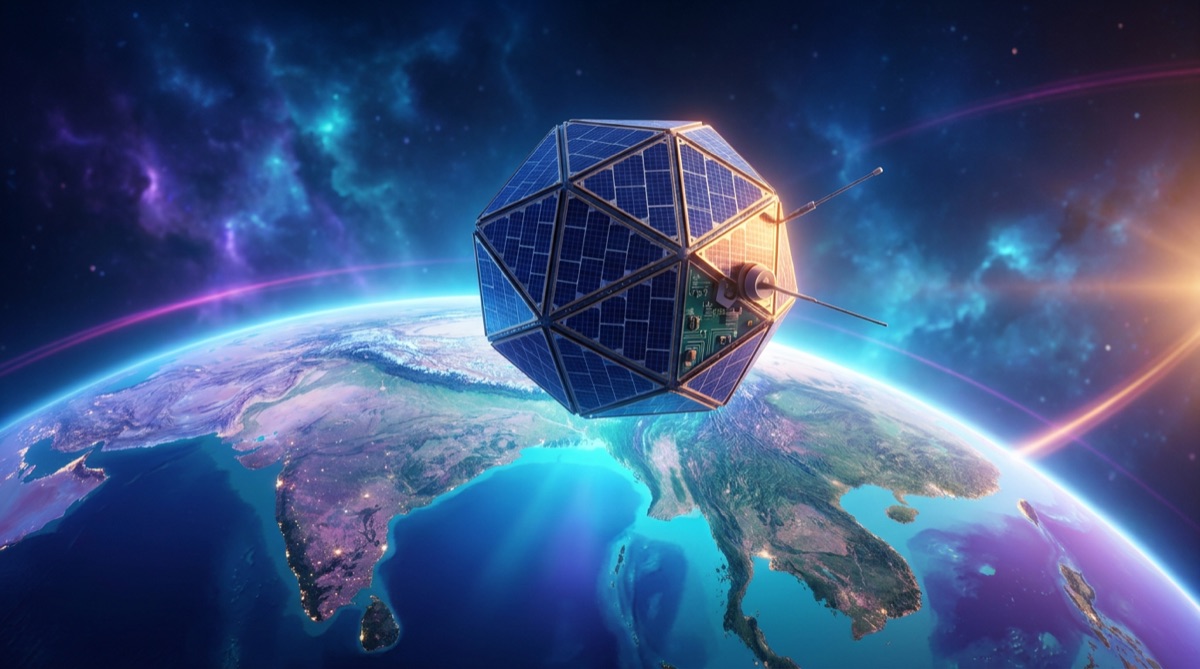
The most visible part of the Indian legacy we carry in our hands: the numerals and the zero with which we calculate. In astronomy we inherited the word sine (from the Sanskrit jya via Arabic), the sine tables, the idea of correcting tables with observed eclipses (Parameshvara) and the infinite series of Kerala. The nakshatra calendar still marks festivals throughout India, and the Jantar Mantars are today World Heritage Sites and open-air classrooms. The first Indian satellite, in 1975, was named Aryabhata; the agency that launched it, ISRO, today sends probes to the Moon and Mars.