His life

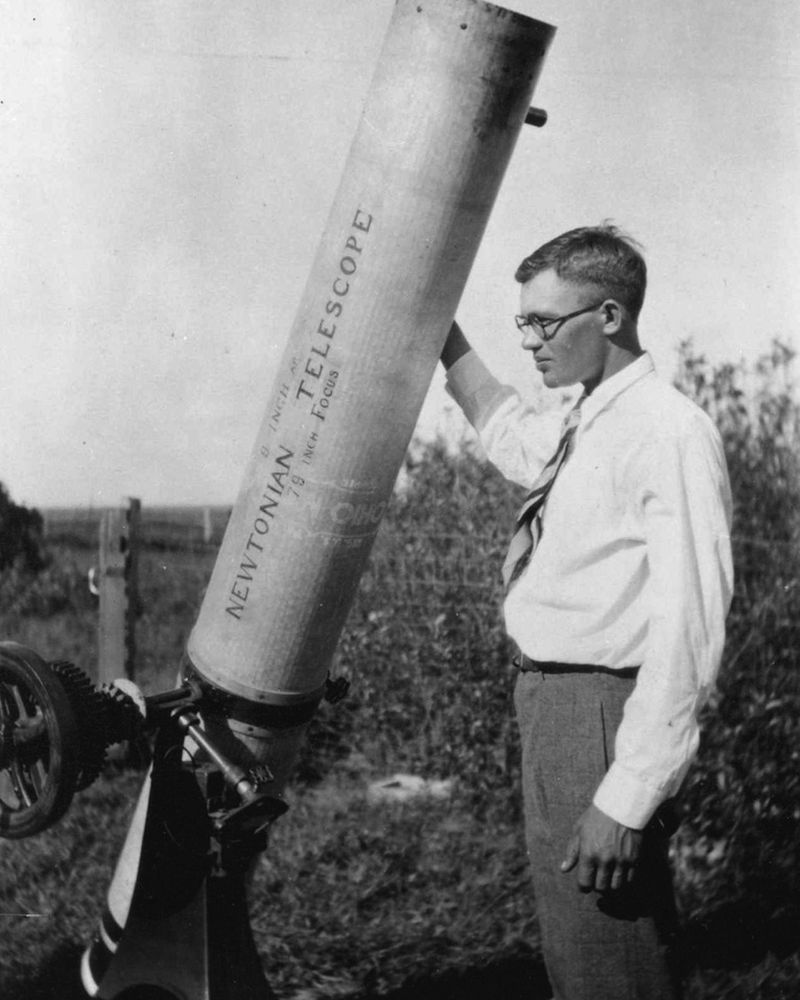
Clyde William Tombaugh was born on February 4, 1906, in Streator, Illinois, and grew up on a farm in Burdett, Kansas. The family could not pay for college: a hailstorm ruined the harvest and he had to give up his studies. From his teens he built his own telescopes, with mirrors he polished by hand and parts from farm machinery. With them he drew Jupiter and Mars.
He sent his drawings to the Lowell Observatory, in Flagstaff (Arizona), and in 1929 the director, Vesto Slipher, offered him a job. He was 23 and had no university degree. He later studied at the University of Kansas, where he graduated in 1936 and earned a master’s degree in 1939. He was a professor at New Mexico State University, and died in Las Cruces on January 17, 1997.
The blink comparator
The Lowell Observatory was searching for a “Planet X” beyond Neptune, whose existence Percival Lowell had predicted from supposed irregularities in the orbit of Uranus. Tombaugh was given the task of photographing the sky systematically with an astrograph and comparing the plates.
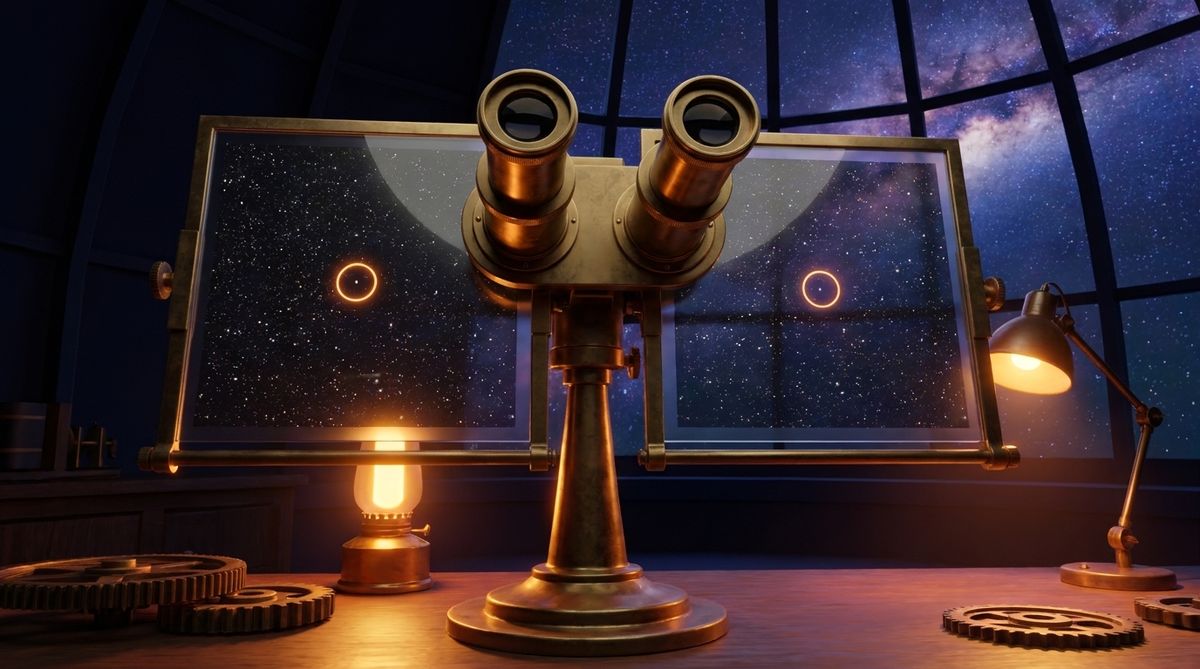
The method was simple, but exhausting. A fixed star occupies the same place in two photographs taken a few days apart; a planet, on the other hand, shifts. With a blink comparator the two plates are placed in the same viewer and the view switches rapidly from one to the other, so that whatever moves “jumps” and whatever is fixed stays still. Each pair of plates contained hundreds of thousands of stars. Tombaugh spent months looking at fields of sky, one after another.
On February 18, 1930, he was examining the plates taken on January 23 and 29 in the region of the constellation of Gemini, near the star delta Geminorum, and saw a tiny dot that jumped. It was an object at a distance of about 40 astronomical units. The announcement was made on March 13, 1930, the anniversary of the discovery of Uranus by William Herschel and of the birth of Percival Lowell. A name suggested by Venetia Burney, an eleven-year-old English girl, won the vote: Pluto.
Pluto, from planet to dwarf planet

Pluto turned out to be much smaller than expected. Its mass is less than a fifth of the Moon’s, too little to perturb Uranus: Lowell’s prediction, in fact, rested on measurement errors, and Tombaugh’s find was partly a lucky coincidence, the result of systematic work and not of the prediction. Its orbit is highly eccentric and inclined: at times it is closer to the Sun than Neptune, as can be seen in the Kepler Orbit simulator by raising the eccentricity.
From 1992 onward many objects were discovered beyond Neptune, the Kuiper belt, and Pluto turned out to be the largest of those then known. In 2005 Eris was found, of similar mass. In August 2006 the International Astronomical Union defined “planet” and classified Pluto as a dwarf planet. Tombaugh, who died in 1997, did not live to see it.
NASA’s New Horizons probe, launched in 2006, flew past Pluto on July 14, 2015, and revealed a world with mountains of water ice, plains of frozen nitrogen and a thin atmosphere. Aboard it travels a portion of Tombaugh’s ashes.
His legacy

Tombaugh kept observing the sky all his life. He discovered asteroids, star clusters and a comet, and examined much of the sky in search of other planets or moons without finding any. He was a tenacious science communicator and an example that astronomy does not depend on diplomas, but on patience and curiosity. His find also opened up the study of the Kuiper belt, the region of icy bodies where many short-period comets originate.