His life

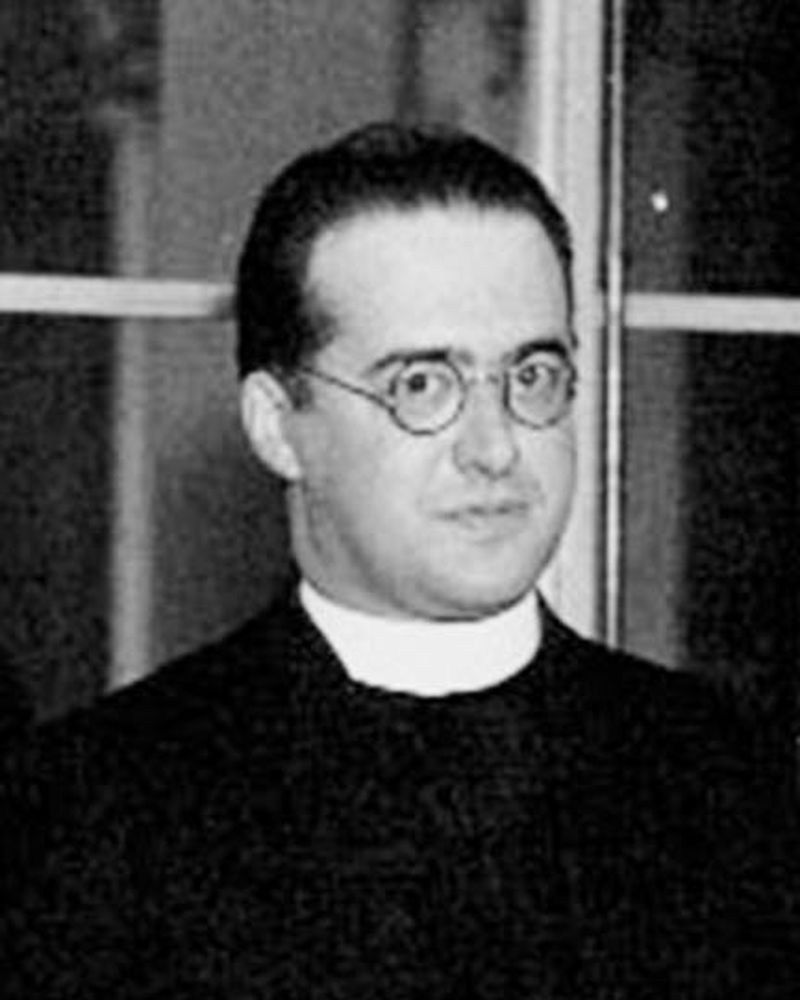
Georges Lemaître was born on July 17, 1894, in Charleroi, Belgium. He studied civil engineering at the Catholic University of Leuven. When the First World War broke out he enlisted as a volunteer and served in the Belgian artillery; after the war he went back to study mathematics and physics and, at the same time, prepared for the priesthood. He was ordained a priest in 1923.
That same year he traveled to Cambridge (England) to work with Arthur Eddington, and between 1924 and 1925 he studied in the United States, at the Harvard Observatory and at MIT, where he obtained his doctorate in 1925. There he became acquainted with the work of Vesto Slipher and Edwin Hubble on the velocities of galaxies. He returned to Leuven as a professor and taught there until his retirement. He died in Leuven on June 20, 1966, one year after the cosmic background radiation, which confirmed his idea, was detected.
An expanding universe

In 1922 the Russian Alexander Friedmann had found solutions of Einstein’s equations in which the size of the universe changes with time. Lemaître, unaware of that work, reached a similar result in 1927 with an approach closer to physics: a homogeneous universe whose “radius” increases with time, as explained in the lesson Friedmann equations. The relative size of the universe is described by the scale factor , which grows with time and can be explored in the Friedmann universe simulator.
But Lemaître went further: he showed that in such a universe the light of distant galaxies must be shifted toward the red, and that this shift must be proportional to the distance. With Slipher’s velocity data and the distances estimated by Hubble he computed the value of the proportionality: about 625 kilometers per second per megaparsec. He published it in 1927, in French, in a little-read Belgian journal, two years before Hubble’s 1929 paper. When his article was translated into English in 1931 for a British journal, the translation omitted the paragraphs containing that estimate. In 2018 the International Astronomical Union recommended calling this relation the “Hubble–Lemaître law” (see the lesson The universe is expanding).
The primeval atom

If the universe is expanding, then going back in time it must have been smaller, denser and hotter. Lemaître took the idea to its conclusion: in 1931 he proposed in the journal Nature that the entire content of the universe came from a single “primeval atom”, an initial state of concentrated energy that fragmented, like a gigantic radioactive decay. Today we know that the origin was not an atom but a state of enormous density and temperature (one must speak of the expansion of space, not of an explosion at a point), but the central idea, a hot, dense beginning, is that of the Big Bang.
The hypothesis was put to the test in 1965, when Arno Penzias and Robert Wilson detected the cosmic background radiation, the remnant of the light of that hot phase, studied in the lesson Cosmic background and nucleosynthesis. The name “Big Bang” was not Lemaître’s: the astronomer Fred Hoyle used it, somewhat ironically, in 1949 on BBC radio.
His legacy

Lemaître showed that one could be a priest and a scientist without confusing the two planes: he separated what physics can say about the origin of the universe from what belongs to religion, and he rejected the notion that his theory was a “proof” of creation. In 1960 Pope John XXIII appointed him president of the Pontifical Academy of Sciences, a post he held until his death. He was also an enthusiast of calculating machines: he worked with the Mexican Manuel Sandoval Vallarta on the trajectories of cosmic rays in the Earth’s magnetic field.
His name appears in the Hubble–Lemaître law and on a crater of the Moon. Today, whenever someone says that the universe began about 13.8 billion years ago in a very dense, hot state, they are repeating, without knowing it, an idea he formulated almost a century ago.