His life

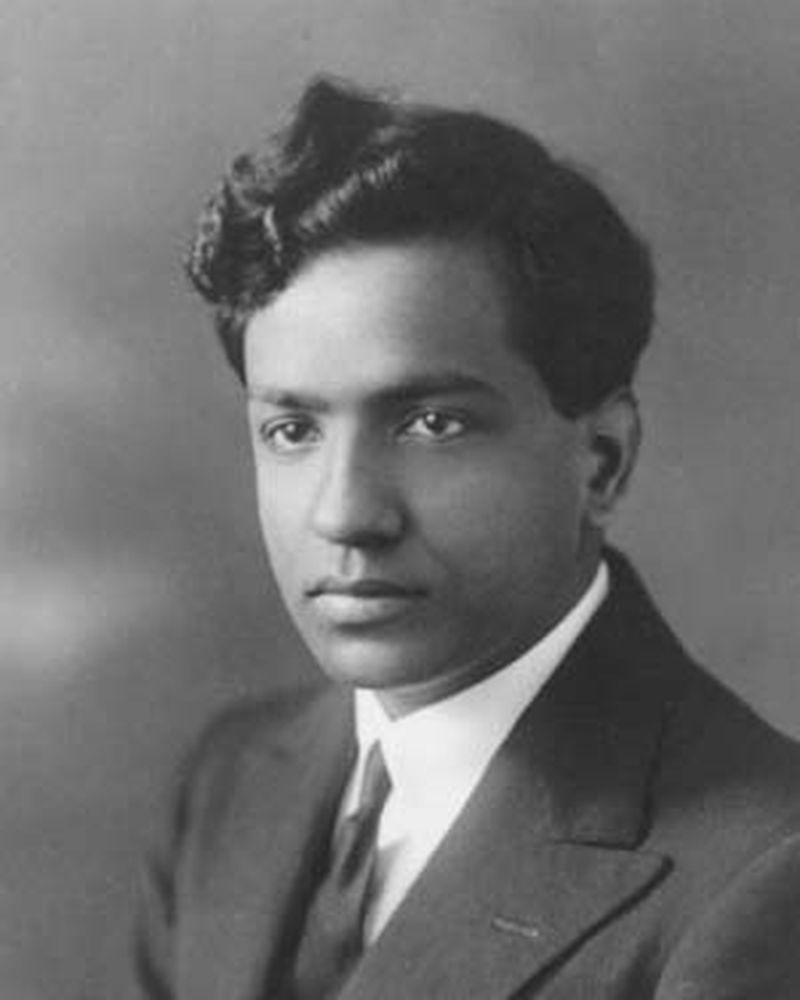
Subrahmanyan Chandrasekhar, “Chandra” to his colleagues, was born on October 19, 1910, in Lahore, then part of British India. He was a nephew of the physicist C. V. Raman, Nobel laureate in Physics in 1930. He studied physics at Presidency College, Madras, where he graduated in 1930, and while still a student he published his first scientific papers. He won a scholarship from the Indian government to study at the University of Cambridge, and in the summer of 1930 he traveled to England by ship.
At Cambridge he worked with the physicist Ralph Fowler and earned his doctorate in 1933. In 1937 he moved to the University of Chicago and its Yerkes Observatory, where he spent the rest of his life. He edited the Astrophysical Journal between 1952 and 1971, and became a United States citizen in 1953. He died in Chicago on August 21, 1995.
The limit of the white dwarfs
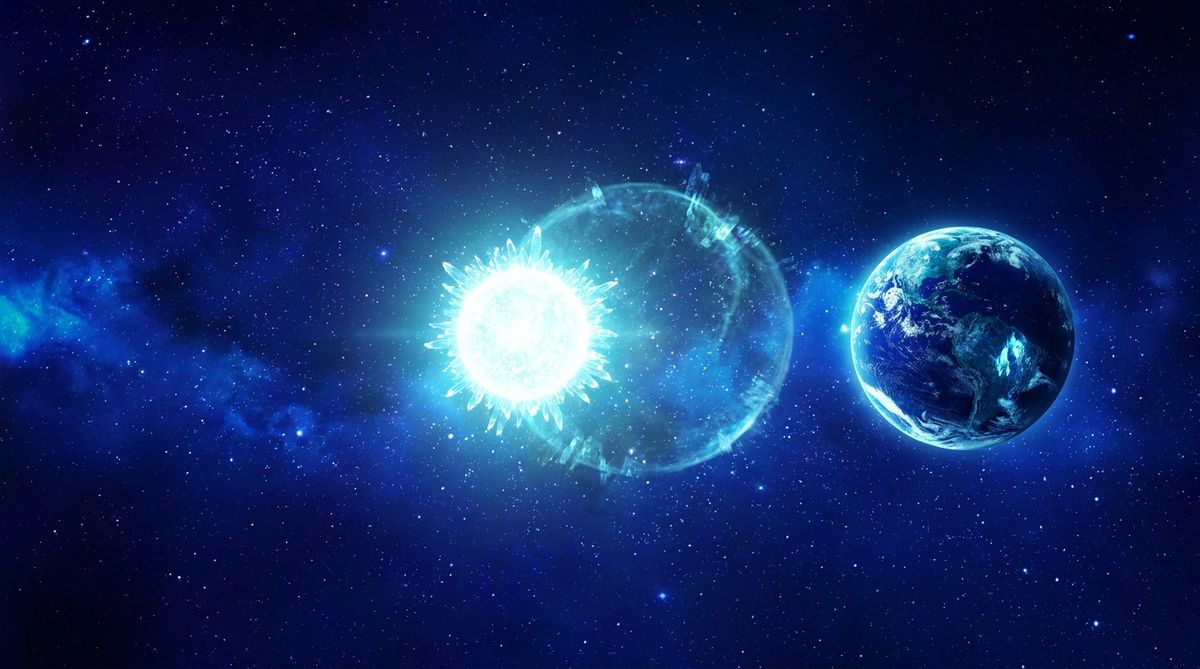
A white dwarf is the hot core left behind when a star like the Sun exhausts its fuel: the size of the Earth, but with a mass comparable to the Sun’s. What keeps it from collapsing under its own weight? Fowler had explained in 1926 that the answer is the degeneracy pressure of the electrons, a quantum effect that prevents them from being squeezed beyond a certain point, studied in the lesson on the Chandrasekhar limit.
Aboard the ship to England, at barely 19, Chandra combined that idea with special relativity. In a more massive star the electrons in the interior move at speeds close to that of light, and then the degeneracy pressure stops growing as fast as the matter is compressed. He concluded that there is a maximum mass above which the pressure of the electrons cannot support the star. For a typical carbon–oxygen composition that limit is approximately 1.4 times the mass of the Sun. You can check it in the simulator White dwarfs: as the mass increases, the radius shrinks until it reaches zero at that value.
From the dispute with Eddington to black holes
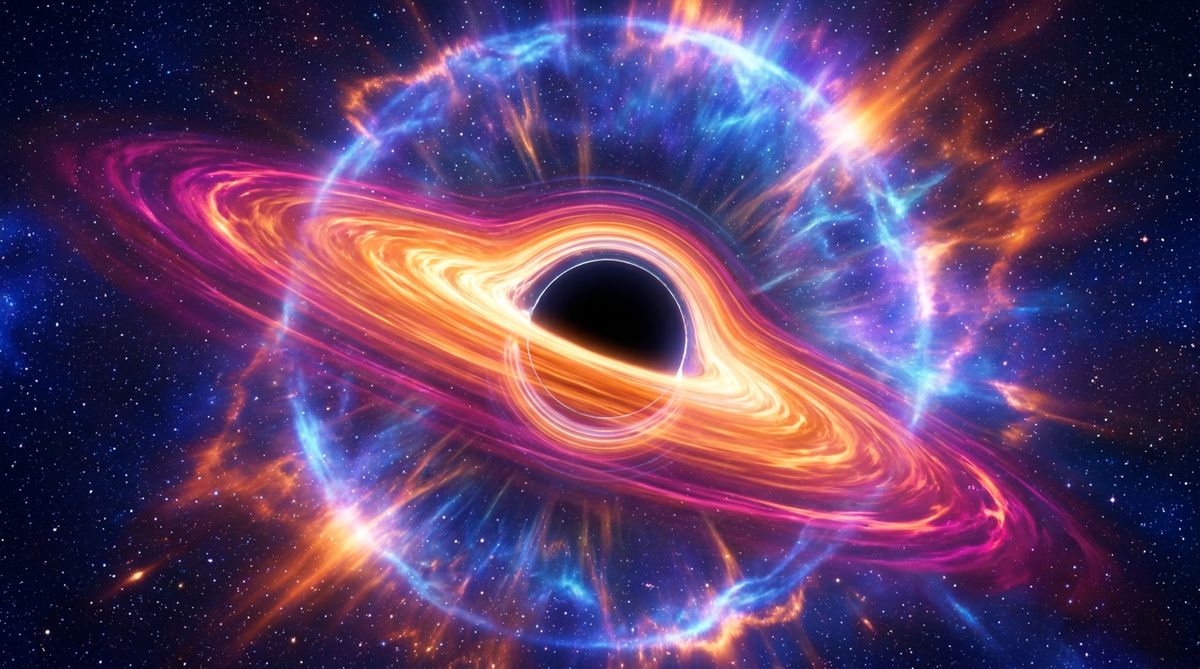
What happens to a star that exceeds the limit? Chandra concluded that it would keep collapsing. On January 11, 1935, at a meeting of the Royal Astronomical Society, he presented the result and Arthur Eddington, the highest British authority on stellar structure, rejected it publicly and with sarcasm, without a mathematical refutation: he found it unacceptable that a star could collapse indefinitely. Many prestigious physicists, although they disagreed with Eddington, did not support Chandra in public. Chandra published his work in a book and changed subject, but he was right.
Decades later, physics proved Chandrasekhar right. The most massive stars end in supernovae and leave behind neutron stars or black holes. Type Ia supernova explosions, which occur when a white dwarf approaches the limit, are used today as “standard candles” to measure cosmological distances, and they revealed the acceleration of the expansion of the universe.
Chandra later worked in very different areas, devoting about ten years to each: stellar dynamics, radiative transfer, hydrodynamic stability and, from the 1960s, general relativity and black holes. His 1983 book on the mathematical theory of black holes remains a reference.
His legacy
In 1983 he received the Nobel Prize in Physics, shared with William Fowler, “for his theoretical studies of the physical processes of importance to the structure and evolution of the stars”. Throughout his life he defended the search for beauty in science, the theme of his book Truth and Beauty (1987).
The Chandra X-ray space observatory, launched by NASA in 1999, bears his name. Anyone who approaches a white dwarf, a supernova or a black hole today is using, without knowing it, ideas from that ship voyage of 1930.