Her life
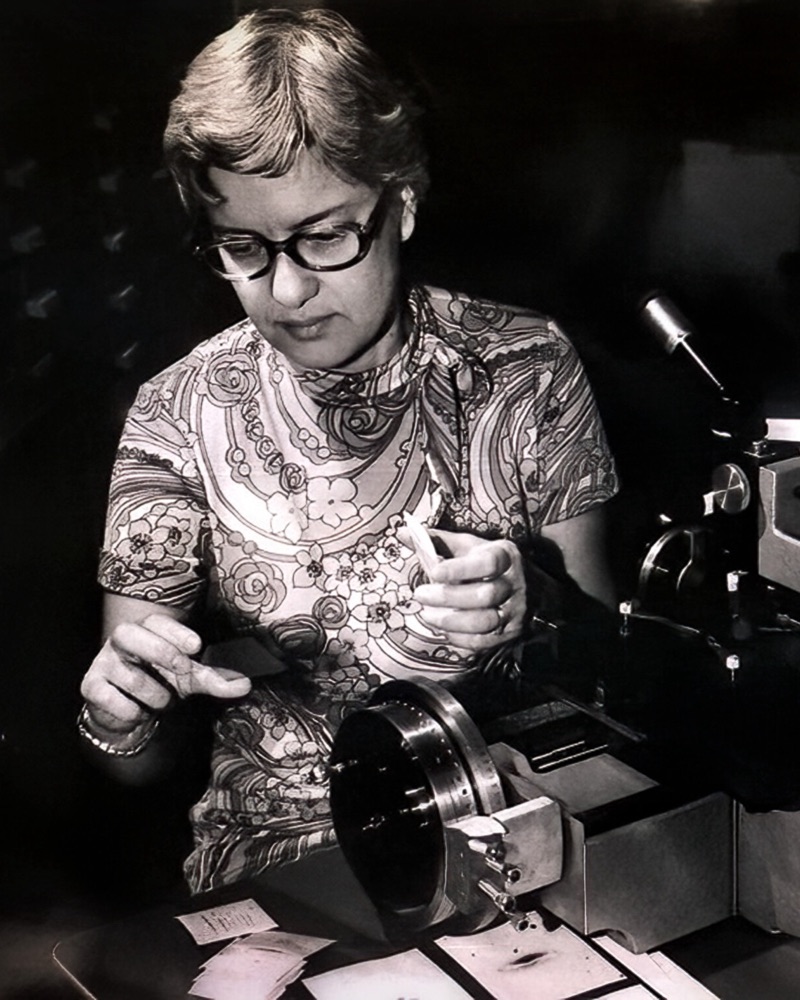
Vera Cooper was born on July 23, 1928, in Philadelphia. When she was a child, her family moved to Washington, D.C., and from her bedroom she watched the stars wheel across the sky; she set about building a cardboard telescope with the help of her father, an engineer. She studied astronomy at Vassar College and graduated in 1948. When she wanted to do graduate work at Princeton she found that women were not admitted to the astronomy program; she did it at Cornell University, where she earned her master’s degree in 1951, and in 1954 she earned her doctorate at Georgetown University with the physicist George Gamow.
She combined research with raising her four children, who would later become scientists too. In 1965 she started working at the Department of Terrestrial Magnetism of the Carnegie Institution, in Washington, and that same year she was the first woman officially allowed to observe at the Palomar Observatory, in California. Her vocation was to take data as carefully as possible, and that led her to her great discovery.
The galaxies that spin too fast
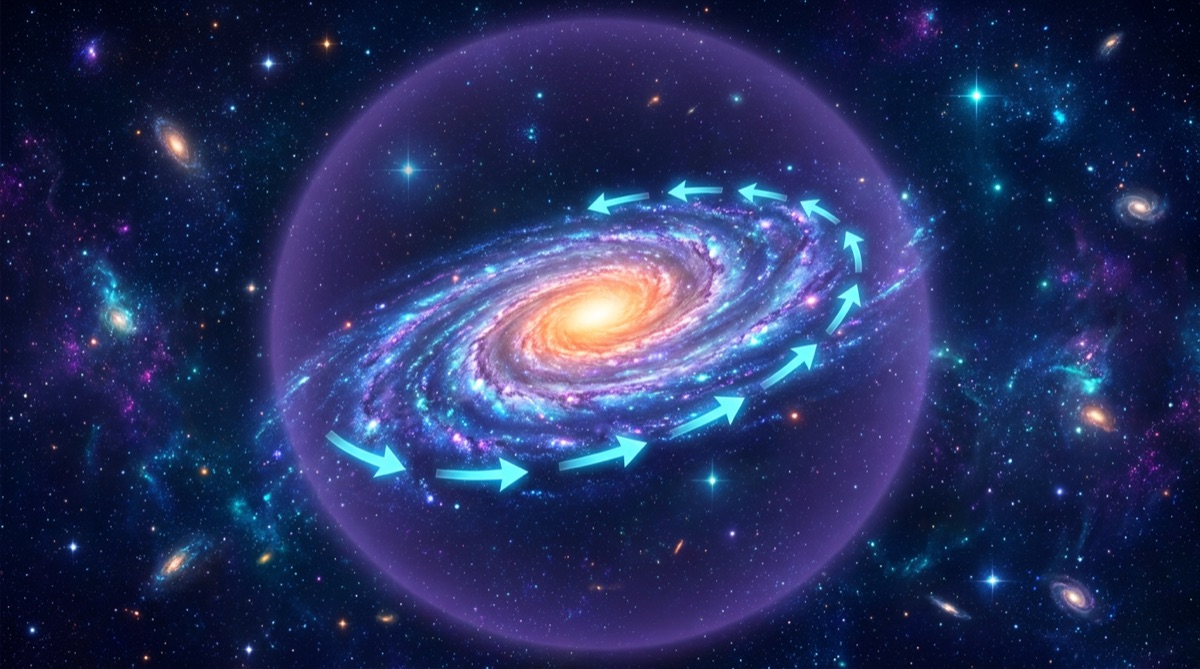
A spiral galaxy rotates like a disk: the stars orbit around the center. If almost all the mass were at the center, as in the Solar System, the speed of the stars would decrease with distance, as the speed of the distant planets does: that is described by Kepler’s third law, which you can explore in the Keplerian orbit simulator. In the early 1970s, Rubin and the astronomer Kent Ford, who had built a very sensitive spectrograph, measured how the gas moves in Andromeda, our neighboring galaxy. They used the Doppler effect: the light of what approaches is shifted toward the blue and that of what recedes, toward the red.
The result was not what was expected. The speed did not fall off away from the center, but stayed almost constant: a “flat rotation curve”. Rubin and her collaborators repeated the measurement with more and more galaxies, of different sizes and shapes, and the result was the same. The simplest explanation is that each galaxy is surrounded by an enormous halo of a matter that emits no light but does exert gravity: dark matter. That idea was not entirely new (Fritz Zwicky had already suspected in 1933 that mass was missing in the Coma cluster), but Rubin’s curves showed that the problem lay in every galaxy and convinced the community. You can experiment with the Galactic rotation simulator and read the derivation in the lesson Rotation curves and dark matter.
Her legacy
Rubin did not stop at dark matter. In 1976 she noticed with Ford that the galaxies in one region of the sky seemed to be moving together in an unexpected way, a result that opened the study of the large-scale motion of galaxies; in 1992 she discovered that in the galaxy NGC 4550 there are two disks of stars rotating in opposite directions. She was also a constant advocate for the participation of women in science, and devoted much time to mentoring young women astronomers.
Rubin received the National Medal of Science of the United States in 1993 and the Gold Medal of the Royal Astronomical Society of London in 1996, the second woman to receive it after Caroline Herschel. She died on December 25, 2016. Today we know that dark matter makes up more than 80 % of the matter in the universe, although no one has yet identified what it is made of. The sky-survey observatory in Chile, funded by the NSF and the United States Department of Energy, is named the Vera C. Rubin Observatory in her honor. To learn more you can read the article Vera Rubin and dark matter.