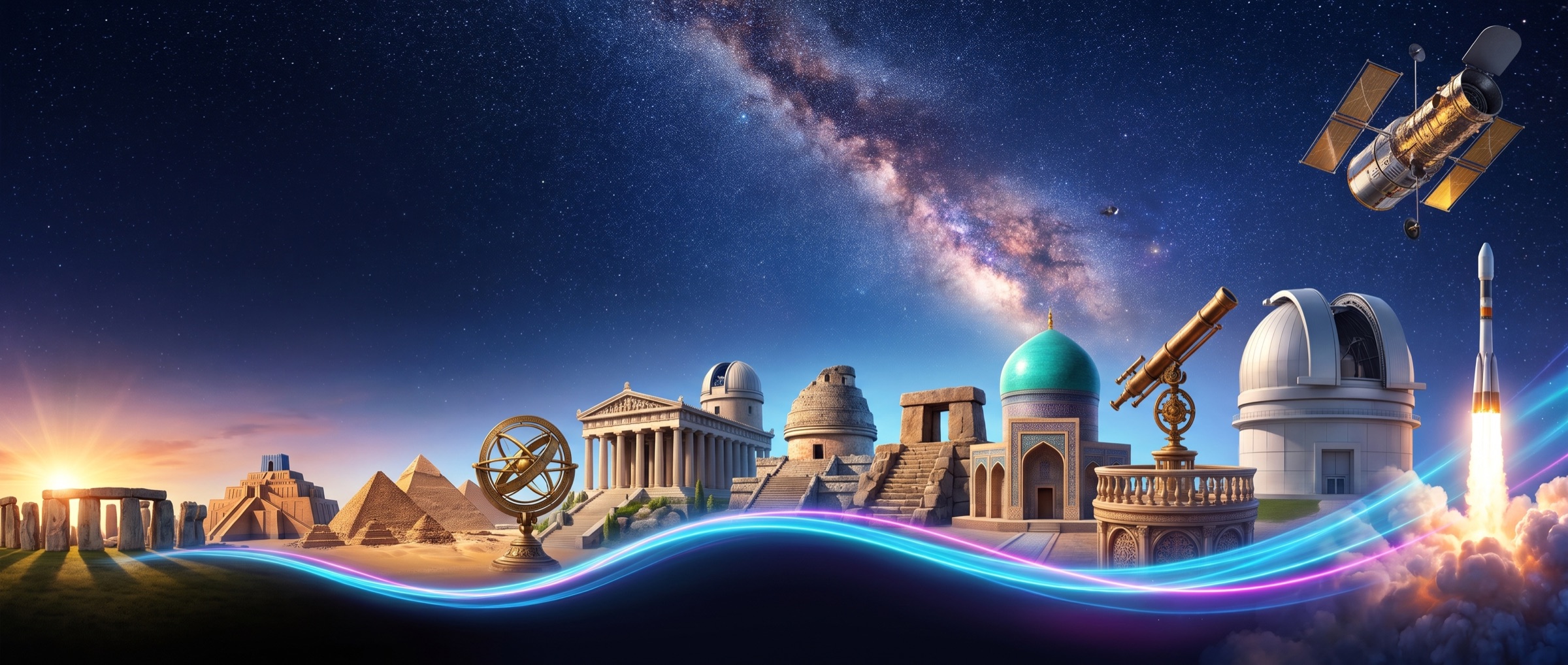
History of Astronomy
There were astronomers long before telescopes: shepherds who counted moons, scribes who recorded eclipses, navigators who read the stars. This chapter covers five thousand years of observation, calculation and ideas across fourteen civilizations, with the source of every fact in plain view.
Civilizations side by side
Which peoples were watching the sky at the same time. Hover over the dots to see each event; click a row to open its story.
Overall timeline
The milestones of every civilization in order. Filter by civilization or category, or show all events.
106 events
-
Prehistory
before writing (c. 3200 BCE) - c. 20 000 BCE
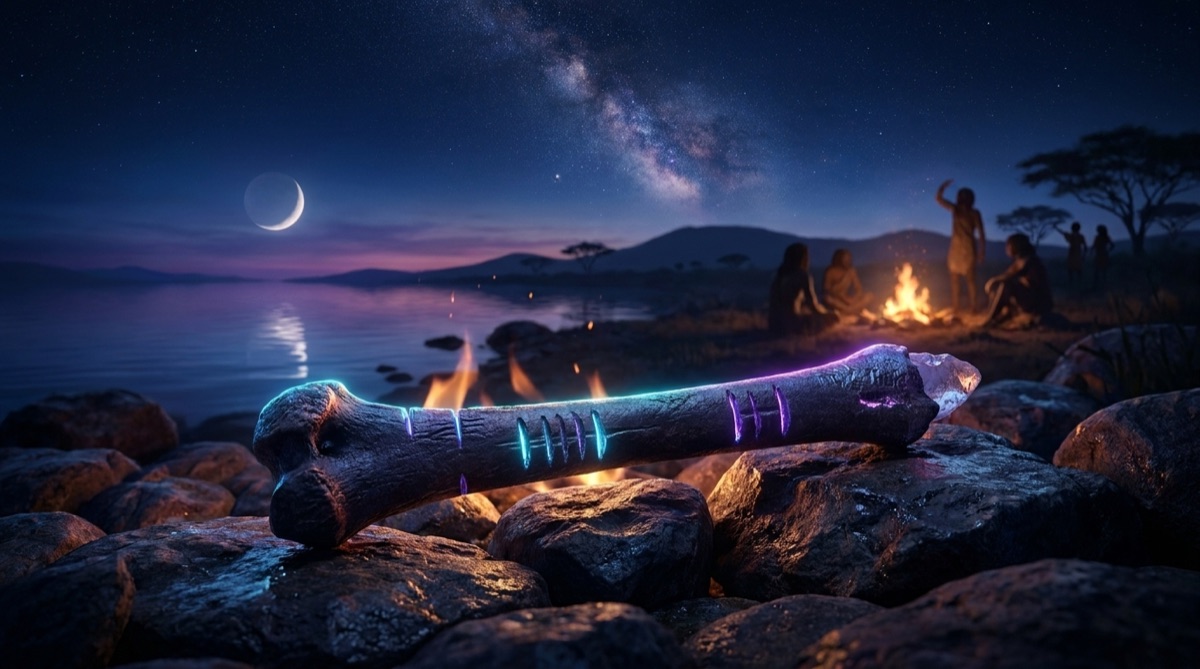
The Ishango bone
A baboon bone with grouped notches, found beside Lake Edward. Alexander Marshack proposed in 1972 that the notches record lunar months, but that reading is a disputed hypothesis: other researchers see only a tally object or a decoration.
📍 Ishango, Democratic Republic of the Congo
📘 The lunar calendar Synodic monthPhases of the Moon
Sources (3)
- Royal Belgian Institute of Natural Sciences, Brussels (piece on permanent display; excavation by J. de Heinzelin, 1950).
- Marshack, A. (1972). The Roots of Civilization. McGraw-Hill (lunar calendar hypothesis).
- Robinson, J. (1992). Not counting on Marshack: a reassessment of the work of Alexander Marshack on notation in the Upper Palaeolithic. Journal of Mediterranean Studies 2(1), 1–17 (critique).
- c. 17 000 BCE
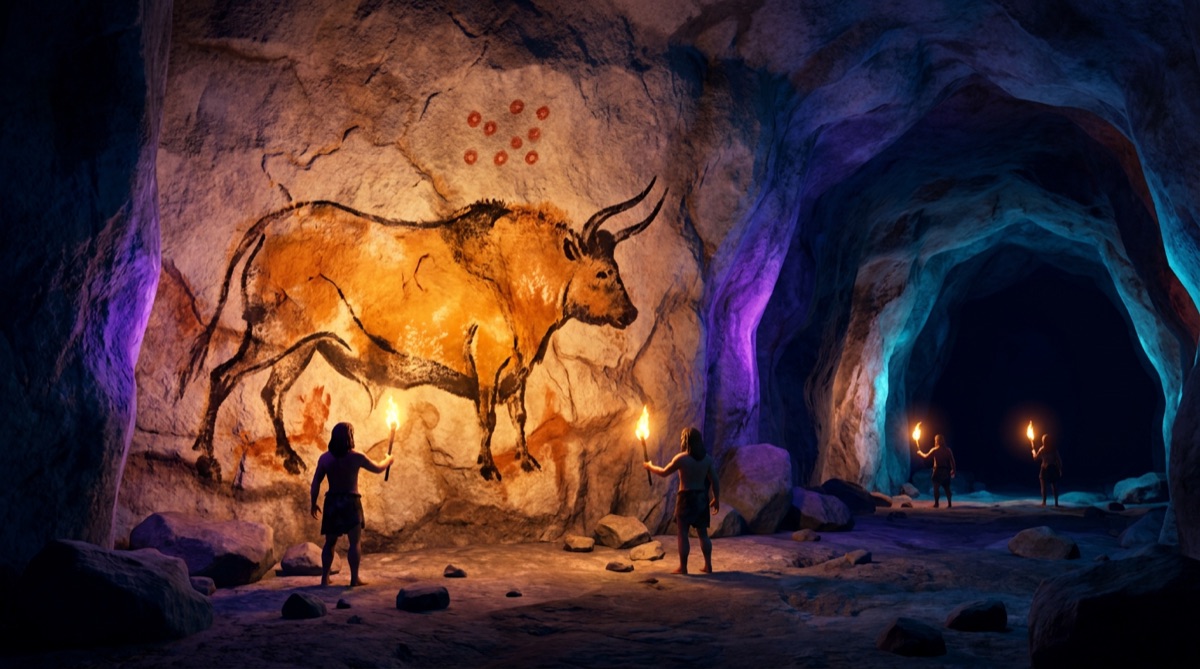
The Lascaux paintings: a map of the sky?
In 1999 Michael Rappenglück suggested that a group of dots above the bull in the Hall of the Bulls represents the Pleiades. It is an interpretation without consensus among archaeologists: there is no way to test it, and many consider it a coincidence.
📍 Lascaux, Dordogne, France
Sources (3)
- UNESCO, World Heritage List: Prehistoric Sites and Decorated Caves of the Vézère Valley (inscribed in 1979).
- Rappenglück, M. A. (1999). Eine Himmelskarte aus der Eiszeit? Peter Lang (Pleiades hypothesis).
- Ruggles, C. L. N. (ed.) (2015). Handbook of Archaeoastronomy and Ethnoastronomy, Springer, part on Paleolithic art (state of the debate).
- c. 9500 BCE
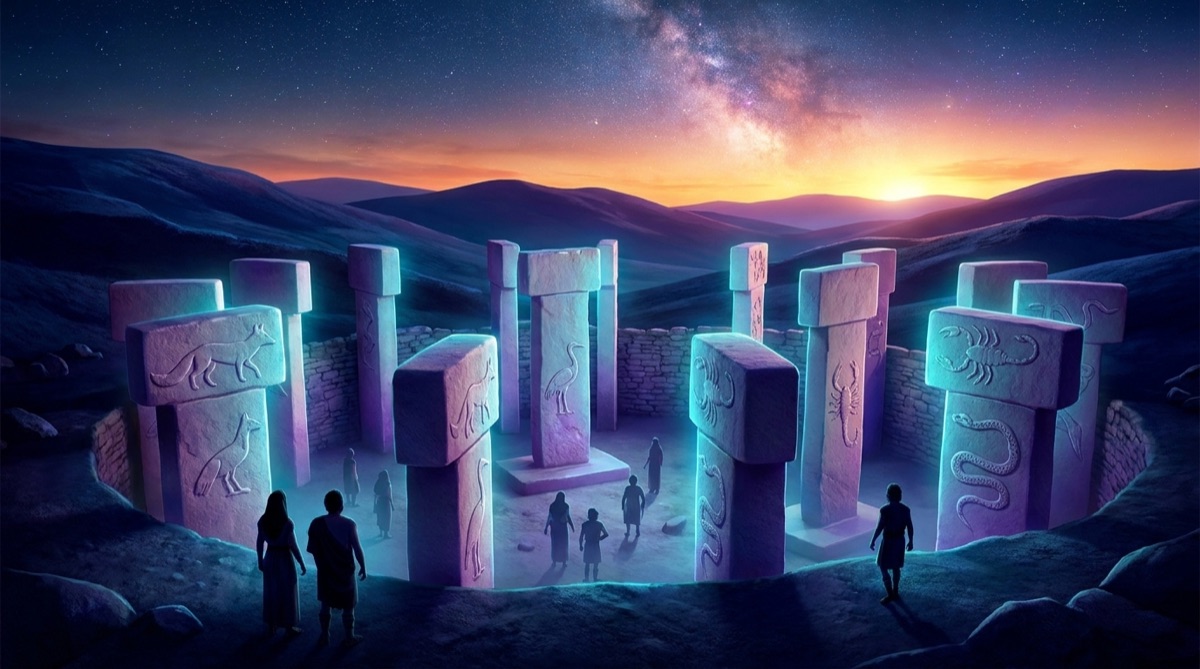
Göbekli Tepe and the disputed astronomical readings
The enclosures of T-shaped pillars at Göbekli Tepe are the oldest known monuments. In 2017 it was proposed that their reliefs record a comet and an astronomical date; the excavators themselves replied that the pillars were moved and reused, so the alignments cannot be reconstructed reliably.
📍 Göbekli Tepe, Şanlıurfa, Turkey
Sources (3)
- UNESCO, World Heritage List: Göbekli Tepe (inscribed in 2018).
- Sweatman, M. B. & Tsikritsis, D. (2017). Decoding Göbekli Tepe with archaeoastronomy. Mediterranean Archaeology and Archaeometry 17(1), 233–250 (hypothesis).
- Notroff, J. et al. (2017). More than a vulture: a response to Sweatman and Tsikritsis. Mediterranean Archaeology and Archaeometry 17(2), 57–63 (reply by the excavators).
- c. 4900 BCE
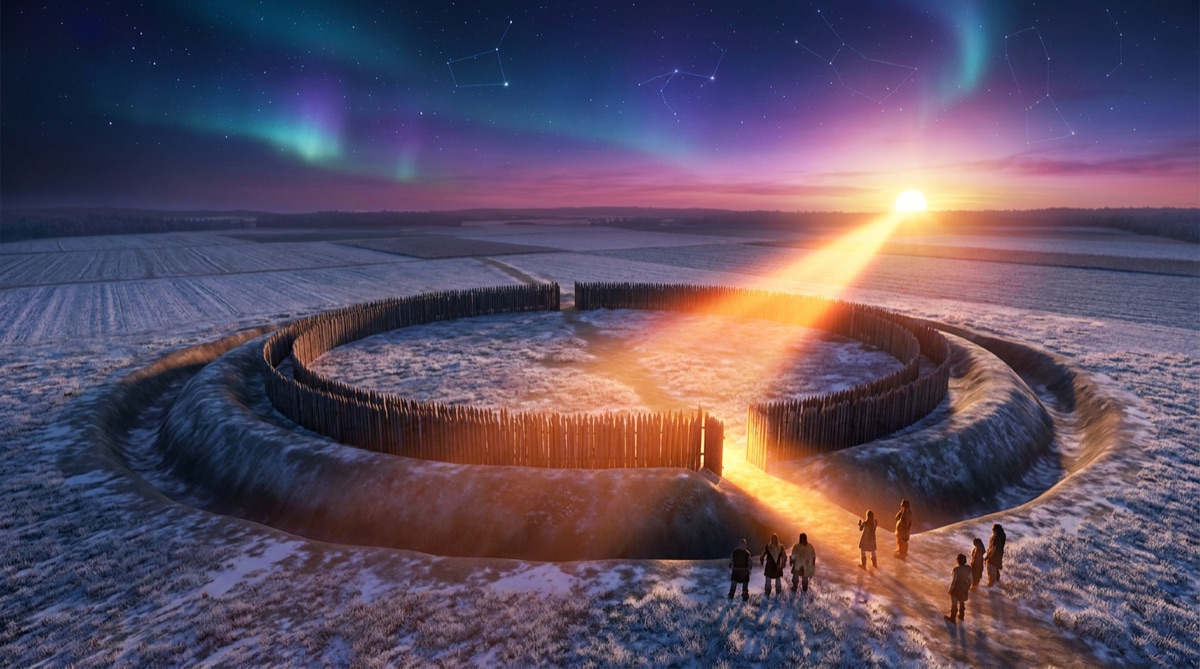
The Goseck circular enclosure
A circular ditch with wooden palisades and three gates; the two southern ones point to sunrise and sunset at the winter solstice. Discovered in 1991 in an aerial photograph, it was excavated between 2002 and 2004 and reconstructed in 2005.
📍 Goseck, Saxony-Anhalt, Germany
📘 Seasons and latitude 🧪 Day, night and the seasons Solstice
Sources (2)
- Landesamt für Denkmalpflege und Archäologie Sachsen-Anhalt (state office for archaeology): Sonnenobservatorium Goseck.
- Bertemes, F. & Schlosser, W. (2004). Der Kreisgraben von Goseck und seine astronomischen Bezüge. In Meller, H. (ed.), Der geschmiedete Himmel, Theiss, 48–51.
- c. 4500 BCE
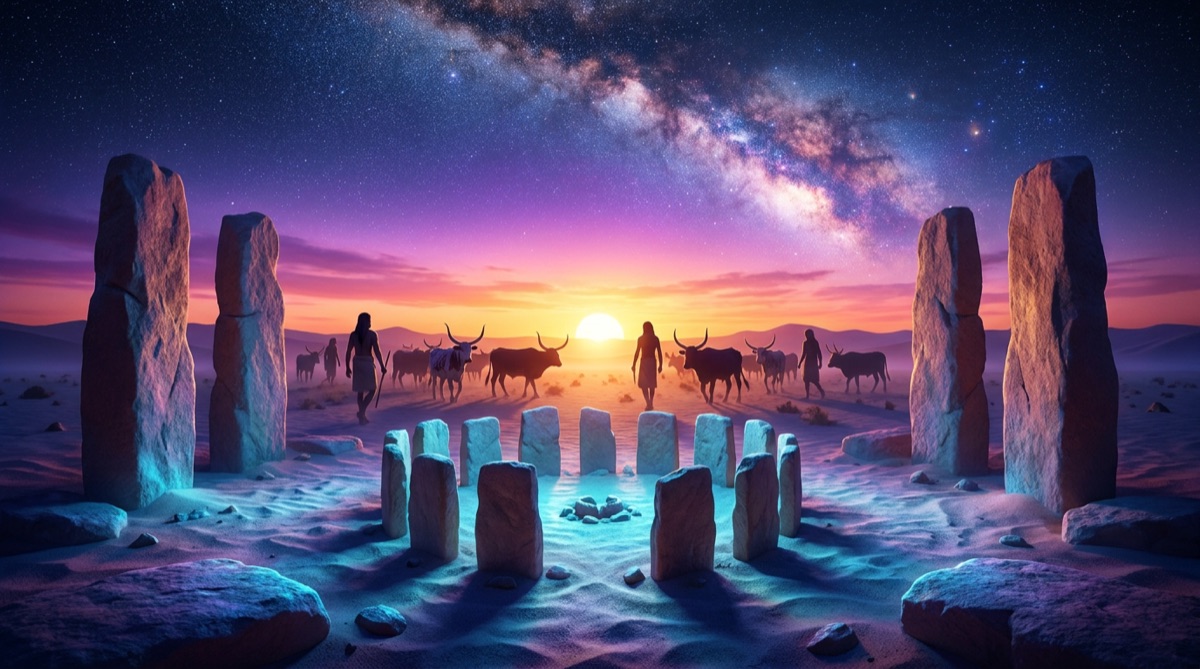
c. 4500–4000 BCE (date disputed)
The Nabta Playa calendar circle
In the Western Desert of Egypt, Neolithic herders set up a small circle of slabs with two pairs of stones that mark north and sunrise at the summer solstice, the herald of the rains. It is one of the oldest megalithic groupings with an astronomical orientation; its exact date and the stellar alignments proposed later are still under debate.
👤 J. McKim Malville, Fred Wendorf, Romuald Schild · 📍 Nabta Playa, Western Desert, Egypt
📘 Seasons and latitude SolsticeCardinal points
Sources (3)
- Malville, J. M., Wendorf, F., Mazar, A. A. & Schild, R. (1998). Megaliths and Neolithic astronomy in southern Egypt. Nature 392, 488–491. https://doi.org/10.1038/33131
- Brophy, T. G. & Rosen, P. A. (2005). Satellite imagery measures of the astronomically aligned megaliths at Nabta Playa. Mediterranean Archaeology and Archaeometry 5(1), 15–24 (review of dates and orientations).
- Malville, J. M. (2015). Astronomy at Nabta Playa, southern Egypt. In Ruggles (ed.), Handbook of Archaeoastronomy and Ethnoastronomy, Springer, 1079–1091.
- c. 3600 BCE – 3000 BCE
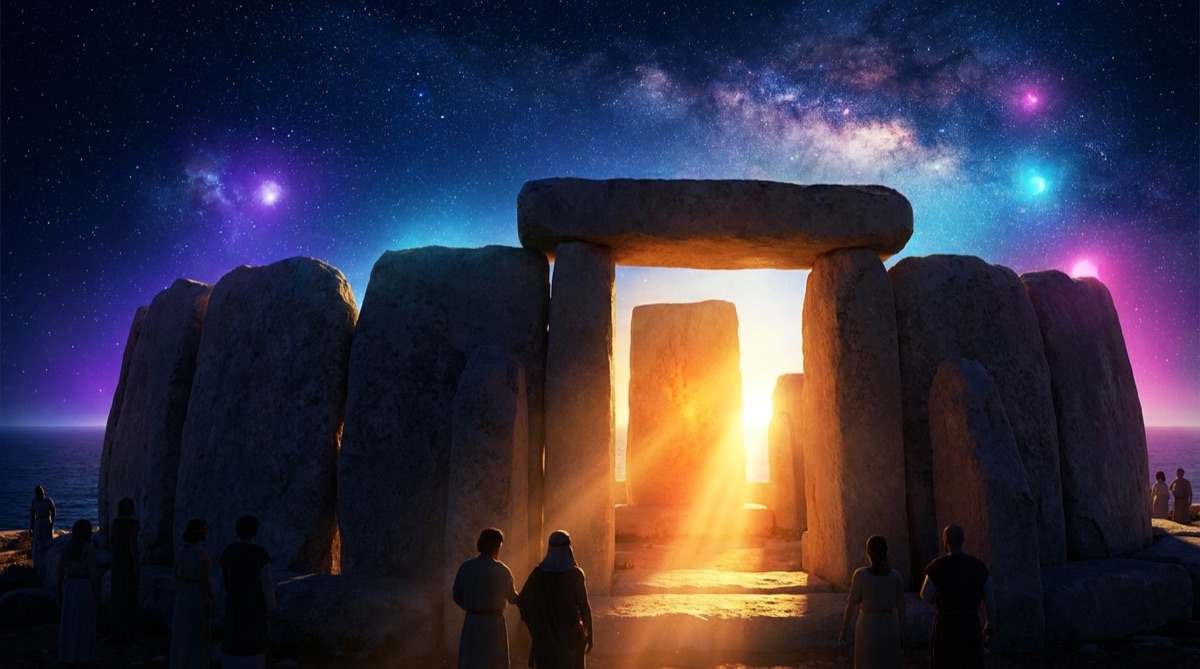
The Mnajdra temples, Malta
The south temple of Mnajdra has its axis oriented to sunrise at the equinoxes, and at the solstices the light enters through the doorway and illuminates specific slabs of the passage. The main alignments are well measured; whether the builders sought them deliberately is what is debated.
📍 Mnajdra, Malta
Sources (2)
- UNESCO, World Heritage List: Megalithic Temples of Malta (inscribed in 1980, extended in 1992).
- Ventura, F. & Agius, J. (2017). An investigation of the possible equinox alignment at Mnajdra, Malta. Journal of Skyscape Archaeology 3(1), 71–92.
-
Antiquity
from writing to the fall of Rome (476) - c. 3200 BCE
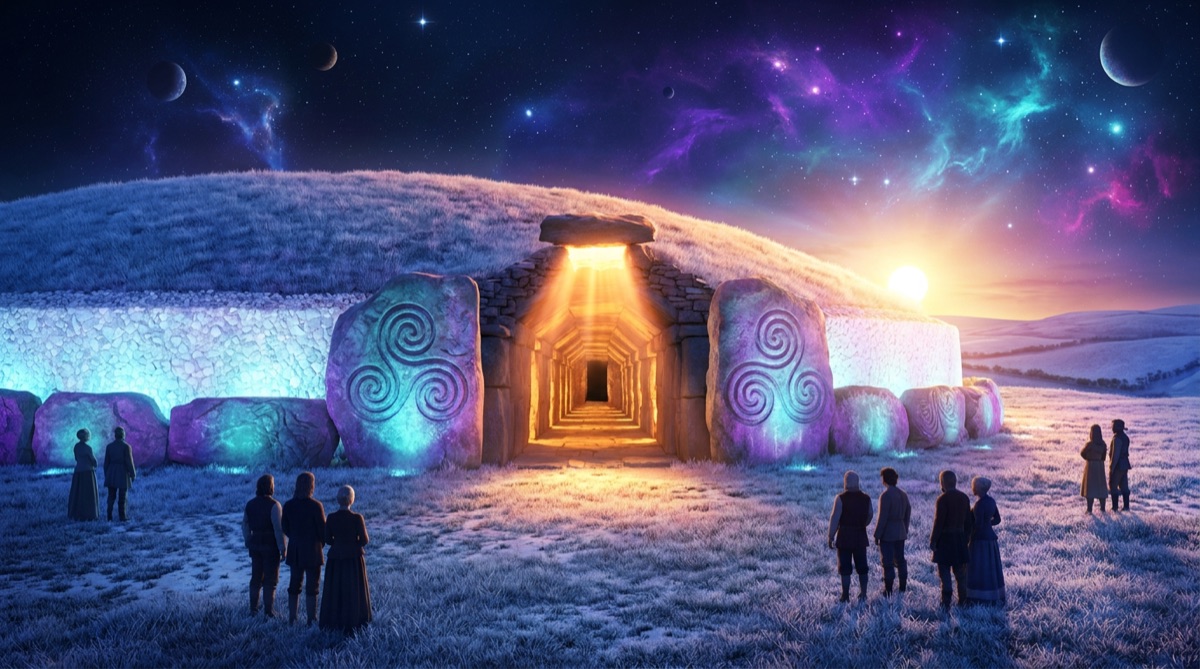
Newgrange: the light of the winter solstice
Above the entrance of the great mound of Newgrange there is an opening, the “roof-box”, through which the rising Sun of the winter solstice travels down the 19-meter passage and lights the chamber for a few minutes. It is one of the best-established prehistoric alignments.
📍 Brú na Bóinne, County Meath, Ireland
📘 Seasons and latitude 🧪 Day, night and the seasons SolsticeAltitude above the horizon
Sources (3)
- O'Kelly, M. J. (1982). Newgrange: Archaeology, Art and Legend. Thames & Hudson.
- UNESCO, World Heritage List: Archaeological Ensemble of the Bend of the Boyne (Brú na Bóinne), inscribed in 1993 (ref. 659).
- National Museum of Ireland: The winter solstice at Newgrange (collection article).
- c. 3000 BCE
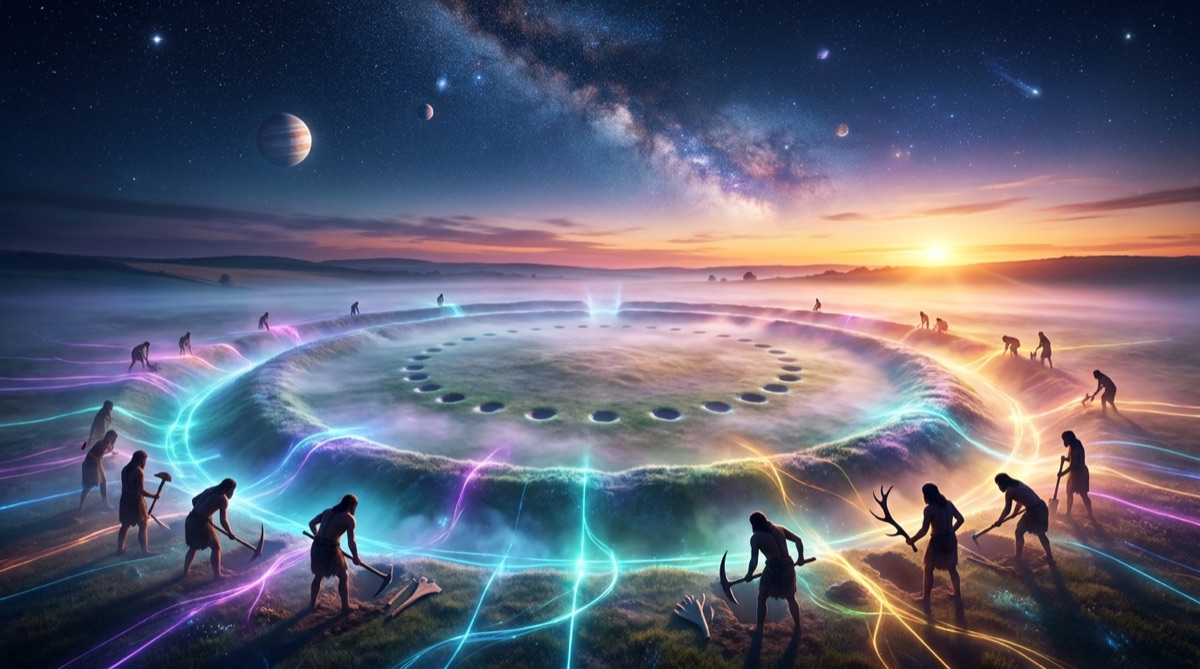
Stonehenge, first phase: the circular ditch
Around 3000 BCE the great circular ditch with its bank and the 56 Aubrey holes were dug. There were no large stones yet; the solstitial orientation of the monument would come with the later phases.
📍 Salisbury Plain, Wiltshire, England
Sources (2)
- Darvill, T., Marshall, P., Parker Pearson, M. & Wainwright, G. (2012). Stonehenge remodelled. Antiquity 86(334), 1021–1040. https://doi.org/10.1017/S0003598X00048225
- English Heritage: History of Stonehenge (official page of the monument).
- c. 3000 BCE
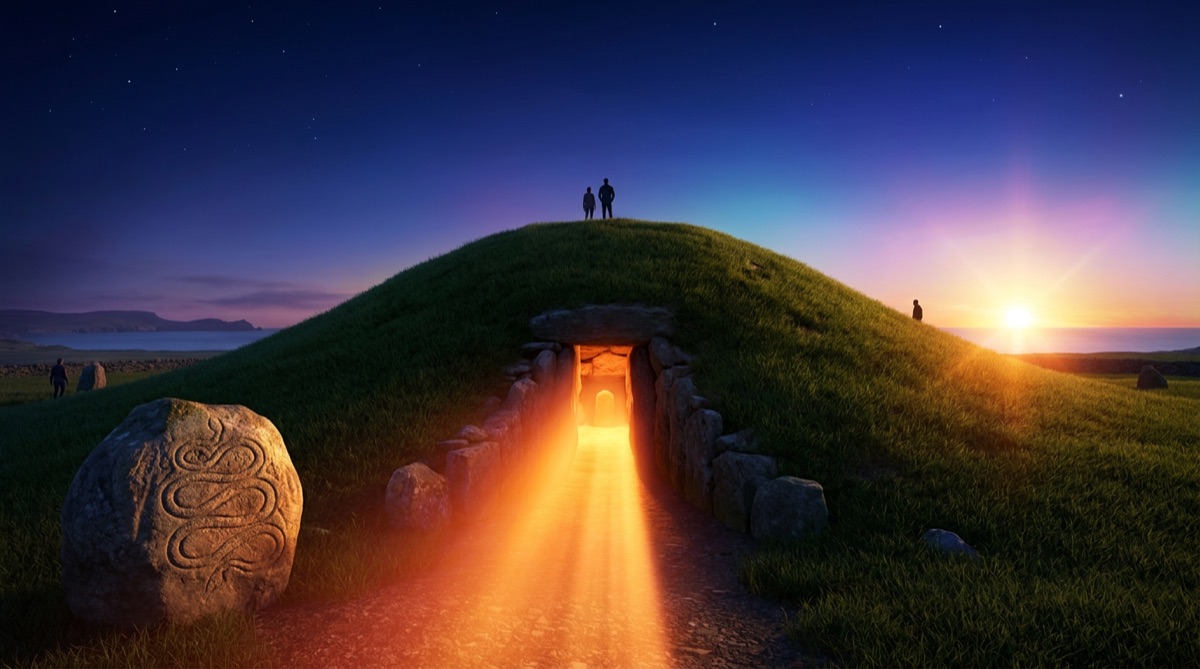
Bryn Celli Ddu, oriented to the summer solstice
On the island of Anglesey, a passage mound lets the rising Sun of the summer solstice reach the chamber. Its dating and orientation were measured again in recent excavations.
📍 Anglesey, Wales
Sources (2)
- Cadw (Welsh heritage service): Bryn Celli Ddu Burial Chamber.
- Burrow, S. (2010). Bryn Celli Ddu passage tomb, Anglesey: alignment, construction, date, and ritual. Proceedings of the Prehistoric Society 76, 249–270.
- 3rd millennium BCE
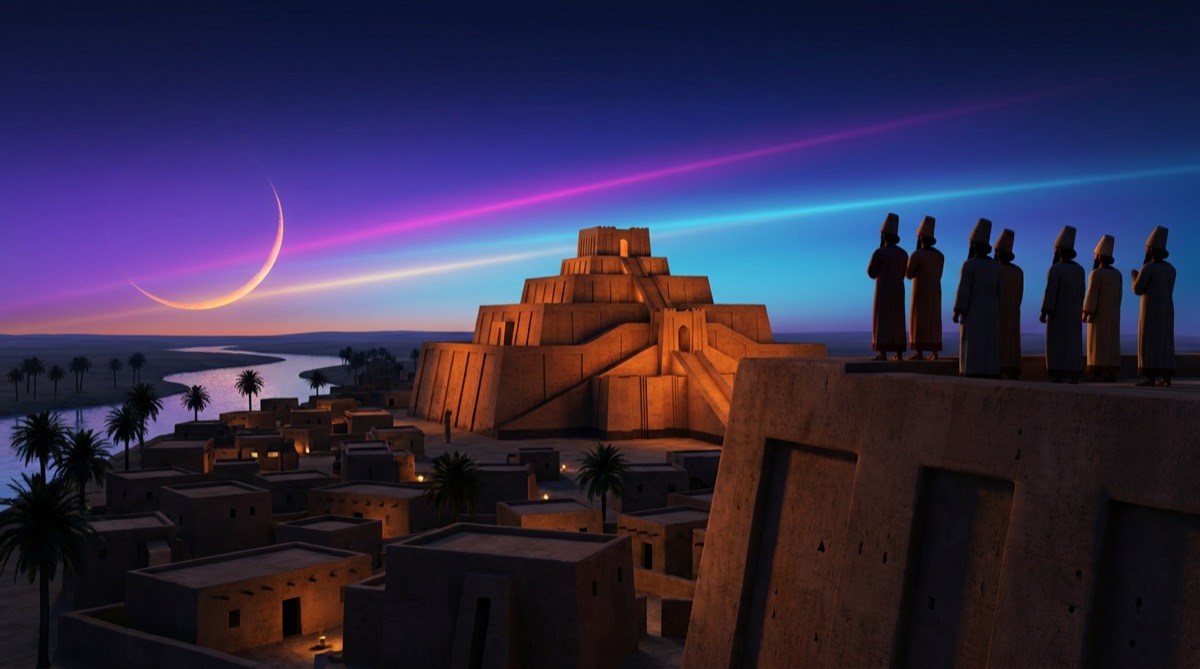
The Sumerian lunisolar calendar
The Sumerian cities counted months of 29 or 30 days from the first visible crescent Moon and added an extra month whenever the lunar year ran too far ahead of the harvests. Each city decided its own intercalation, often by order of the king.
📍 Sumer, southern Iraq
📘 The lunar calendar 🧪 Phases of the Moon Synodic monthPhases of the Moon
Sources (2)
- Cohen, M. E. (1993). The Cultic Calendars of the Ancient Near East. CDL Press.
- Britton, J. P. (2007). Calendars, intercalations and year-lengths in Mesopotamian astronomy. In Steele, J. M. (ed.), Calendars and Years: Astronomy and Time in the Ancient Near East, Oxbow Books, 115–132.
- 3rd millennium BCE
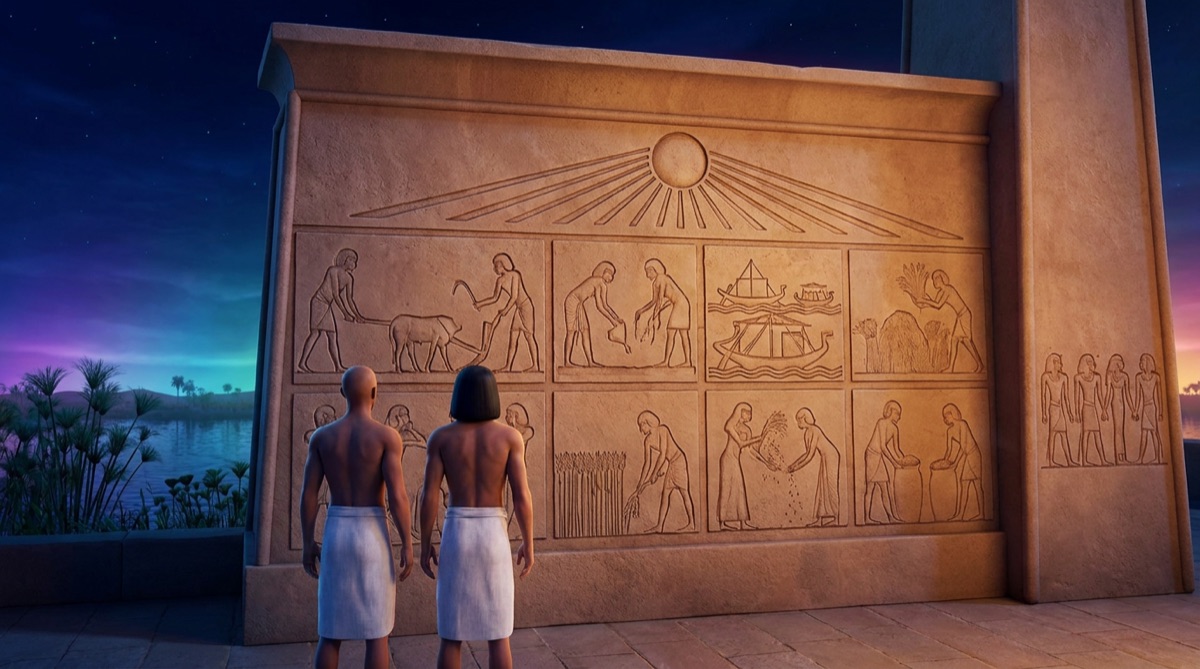
The 365-day civil calendar
Twelve months of 30 days plus five “added” days at the end: exactly 365, with no leap year. Since the solar year lasts almost a quarter of a day longer, the calendar gained a day every four years and came full circle in about 1460 years. Its simplicity made it a favorite of astronomers throughout antiquity; its exact origin predates the Old Kingdom and is still debated.
📍 Egypt
📘 The lunar calendar 🧪 Day, night and the seasons Seasons of the year
Sources (3)
- Parker, R. A. (1950). The Calendars of Ancient Egypt. University of Chicago Press.
- Depuydt, L. (1997). Civil Calendar and Lunar Calendar in Ancient Egypt. Peeters.
- Clagett, M. (1995). Ancient Egyptian Science, vol. II. American Philosophical Society, ch. 1.
- 3rd millennium BCE
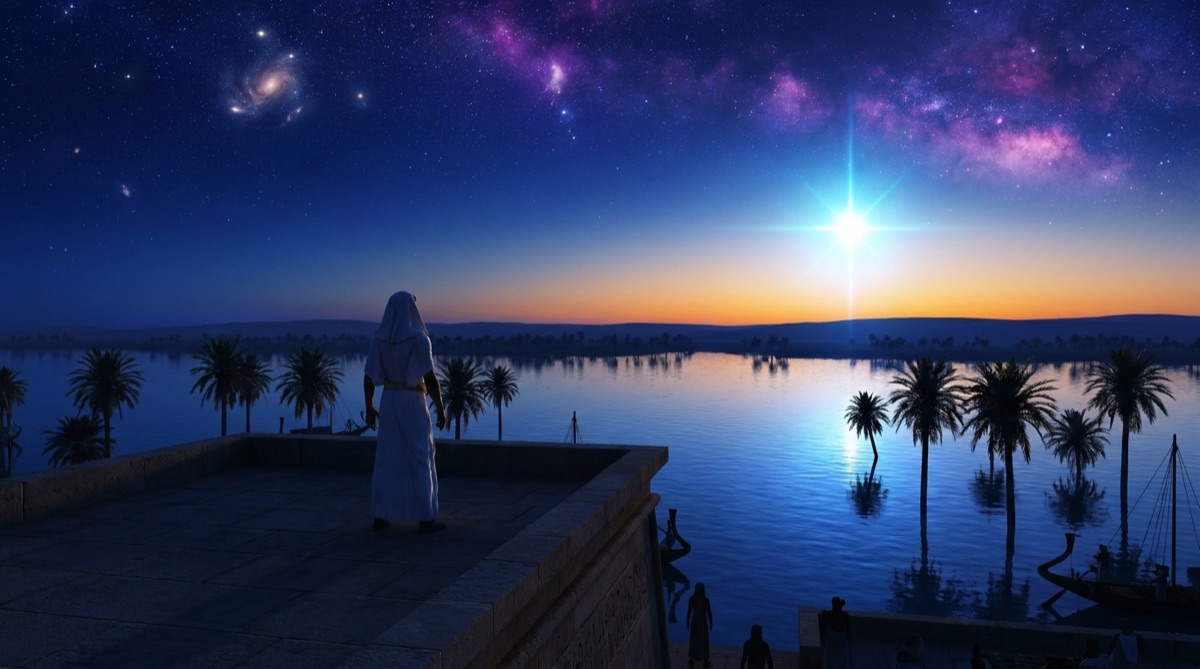
Sirius announces the flooding of the Nile
Every year, after some 70 days of invisibility, Sirius (Sopdet to the Egyptians) reappeared at dawn in July, just as the Nile flood was beginning. That “heliacal rising” marked the ideal New Year and, compared with the civil calendar, allows us today to date reigns.
📍 Nile Valley
📘 Watching the sky like scientists 🧪 Interactive planisphere Seasons of the yearHorizon
Sources (2)
- Parker, R. A. (1950). The Calendars of Ancient Egypt. University of Chicago Press.
- Krauss, R. (1985). Sothis- und Monddaten: Studien zur astronomischen und technischen Chronologie Altägyptens. Gerstenberg.
- c. 2800 BCE

Maeshowe, in Orkney
The chamber of Maeshowe receives the light of the setting Sun in the weeks around the winter solstice. It is part of the Neolithic complex of Orkney, with the village of Skara Brae and the circles of Stenness and Brodgar.
📍 Orkney, Scotland
Sources (2)
- UNESCO, World Heritage List: Heart of Neolithic Orkney (inscribed in 1999).
- Ruggles, C. L. N. (1999). Astronomy in Prehistoric Britain and Ireland. Yale University Press, chapter on passage monuments.
- c. 2600–2500 BCE
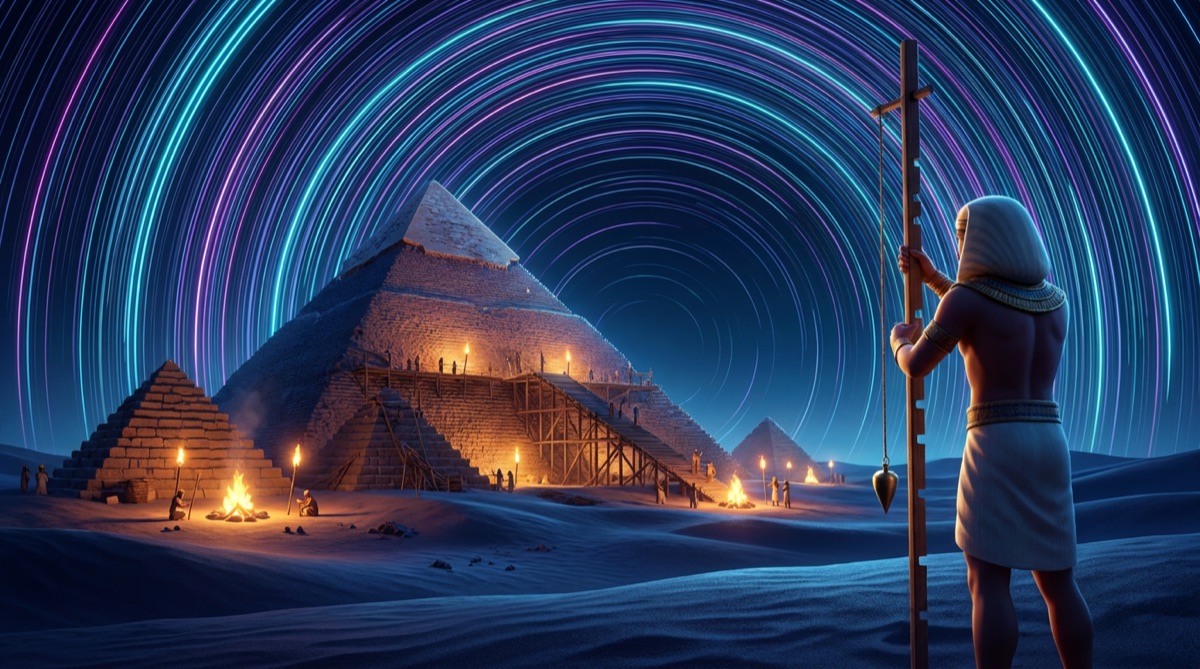
The pyramids of Giza face north
The sides of the Great Pyramid of Khufu deviate from true north by less than 4 arcminutes, a fifteenth of the diameter of the full Moon. There was no pole star at that time, so the method is debated: a pair of circumpolar stars aligned with a plumb line, or the shadow of a gnomon at the equinox.
👤 Khufu, Khafre · 📍 Giza, Egypt
📘 Polaris and the Southern Cross 🧪 Interactive planisphere Celestial polePrecessionCardinal points
Sources (4)
- Petrie, W. M. F. (1883). The Pyramids and Temples of Gizeh. Field & Tuer (first precise measurements of the orientation).
- Spence, K. (2000). Ancient Egyptian chronology and the astronomical orientation of pyramids. Nature 408, 320–324. https://doi.org/10.1038/35042510 (two-star hypothesis).
- Dash, G. (2017). Occam's Egyptian razor: the equinox and the alignment of the pyramids. Journal of Ancient Egyptian Architecture 2, 1–8 (equinox gnomon hypothesis).
- Belmonte, J. A. (2001). On the orientation of Old Kingdom Egyptian pyramids. Journal for the History of Astronomy 32, S1–S20.
- c. 2500 BCE
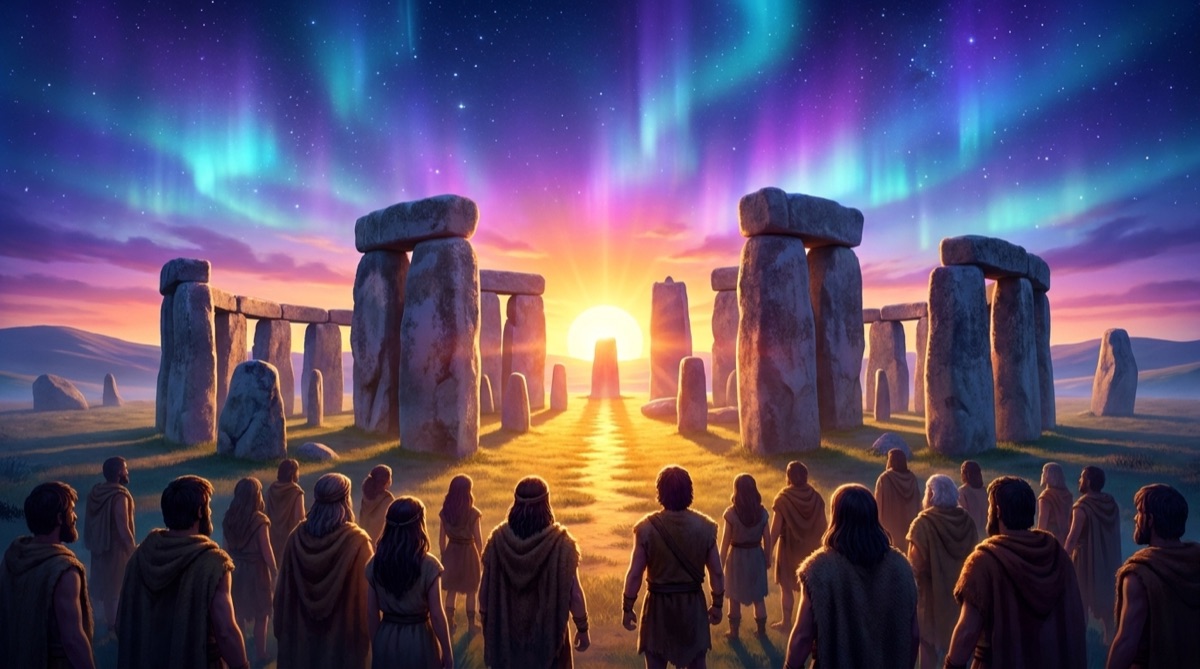
Stonehenge: the sarsen circle and the trilithons
The great sarsen stones and the trilithons were raised around 2500 BCE with the axis of the monument pointing to sunrise at the summer solstice and, in the opposite direction, to sunset at the winter solstice. The smaller bluestones came from the Preseli Hills in Wales, more than 200 km away.
📍 Stonehenge, Wiltshire, England
📘 Length of the day and altitude of the Sun 🧪 Day, night and the seasons SolsticeAzimuth
Sources (3)
- UNESCO, World Heritage List: Stonehenge, Avebury and Associated Sites (inscribed in 1986).
- Ruggles, C. L. N. (1997). Astronomy and Stonehenge. Proceedings of the British Academy 92, 203–229.
- Parker Pearson, M. (2012). Stonehenge: Exploring the Greatest Stone Age Mystery. Simon & Schuster.
- c. 2350 BCE
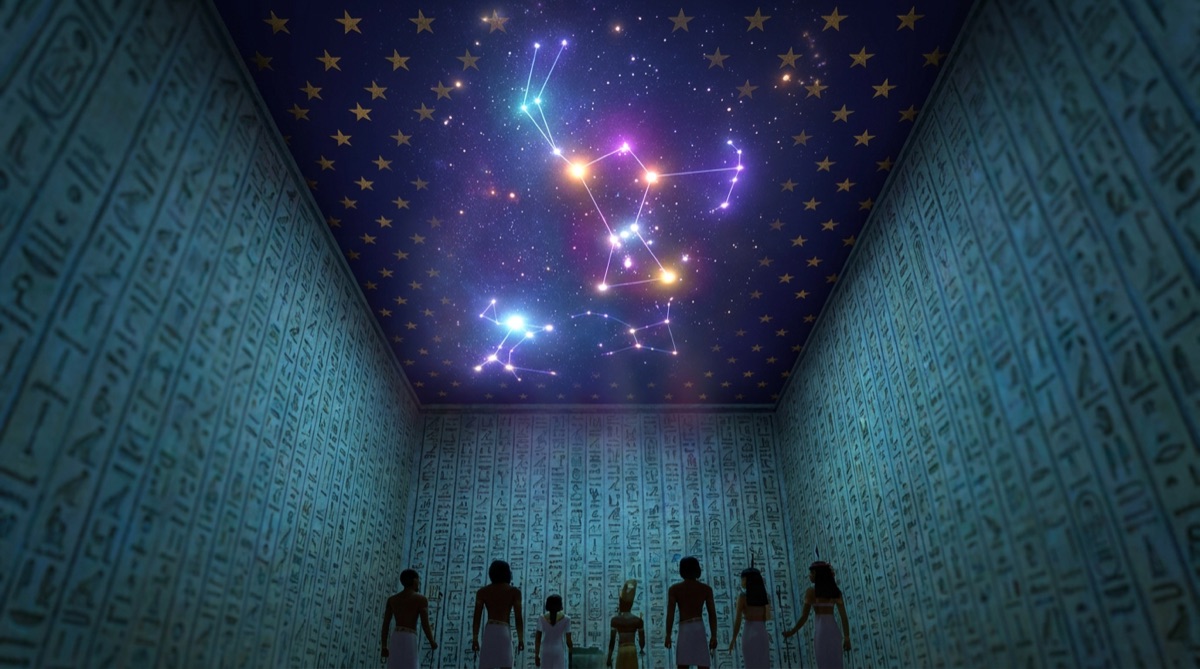
The Pyramid Texts and the “imperishable stars”
The spells carved in the pyramid of Unas describe the dead king ascending to the sky to join the stars that never set, the circumpolar ones, and Orion and Sirius. They are the oldest written testimony of how the Egyptians imagined the sky.
👤 Unas · 📍 Saqqara, Egypt
Sources (2)
- Allen, J. P. (2005). The Ancient Egyptian Pyramid Texts. Society of Biblical Literature.
- Krauss, R. (1997). Astronomische Konzepte und Jenseitsvorstellungen in den Pyramidentexten. Harrassowitz.
- c. 2100 BCE
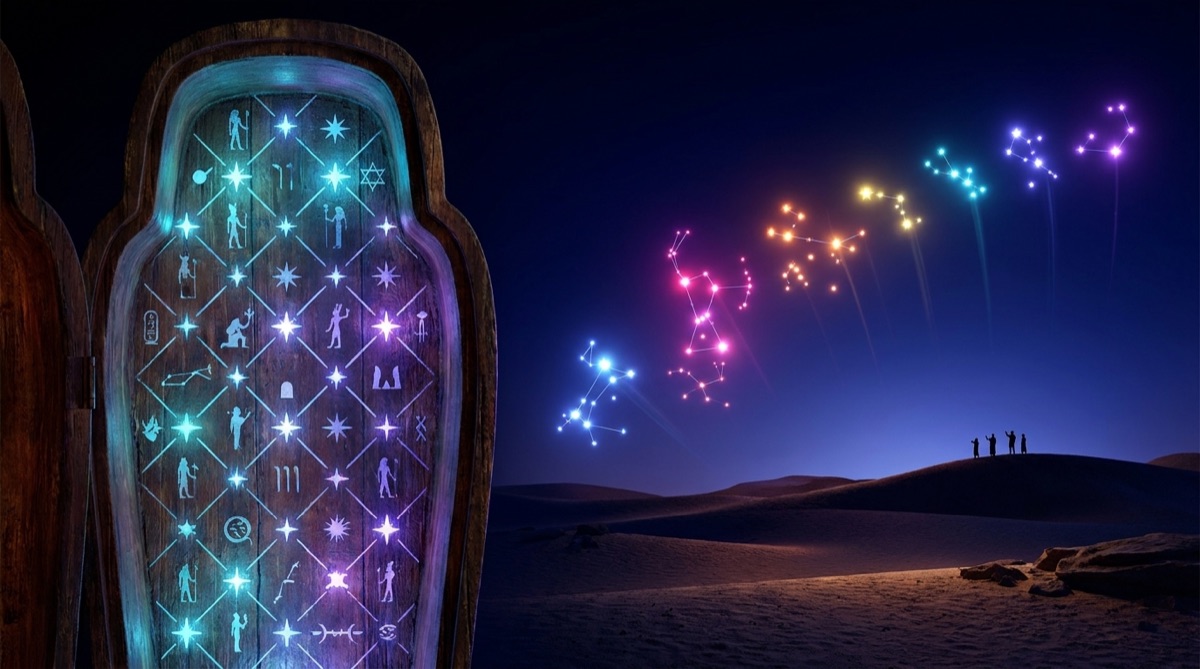
Decanal star clocks: the 12 hours of the night
On the inside of coffins from Asyut, diagonal tables were painted with 36 groups of stars, the decans, which rise one after another every 10 days. Twelve of them rise over the course of one night: hence the 12 night hours, which together with the 12 hours of the day give our 24 hours.
📍 Asyut, Egypt
📘 Solar time and sidereal time 🧪 Interactive planisphere Sidereal daySidereal timeConstellation
Sources (3)
- Neugebauer, O. & Parker, R. A. (1960). Egyptian Astronomical Texts I: The Early Decans. Brown University Press.
- Leitz, C. (1995). Altägyptische Sternuhren. Peeters.
- Symons, S., Ancient Egyptian Astronomy Database (McMaster), section Diagonal Star Tables.
- c. 2000 BCE
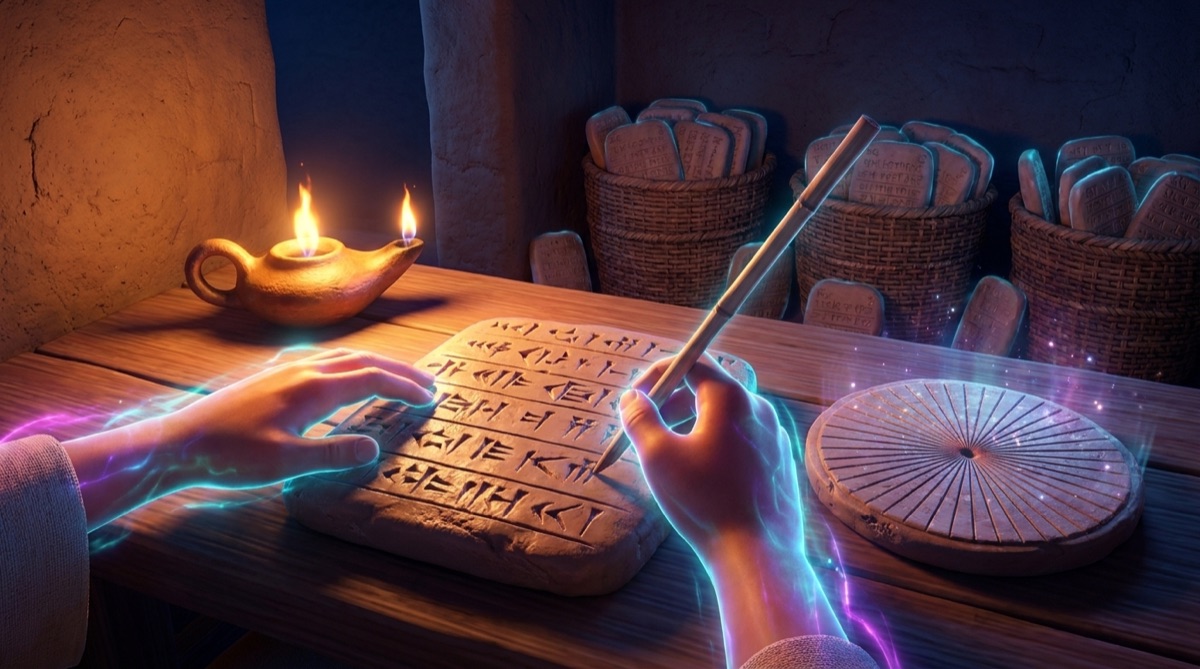
The sexagesimal place-value system
Babylonian scribes wrote numbers in base 60 with place value, just as we do in base 10. With that system they later divided the circle into 360 parts and each part into 60: that is where the degrees, minutes and seconds of arc and of time that we still use come from.
📍 Babylon and Larsa
📘 Celestial coordinates ArcsecondRight ascension
Sources (2)
- Robson, E. (2008). Mathematics in Ancient Iraq: A Social History. Princeton University Press.
- Tablet Plimpton 322 (c. 1800 BCE), Rare Book and Manuscript Library, Columbia University.
- c. 1870 BCE
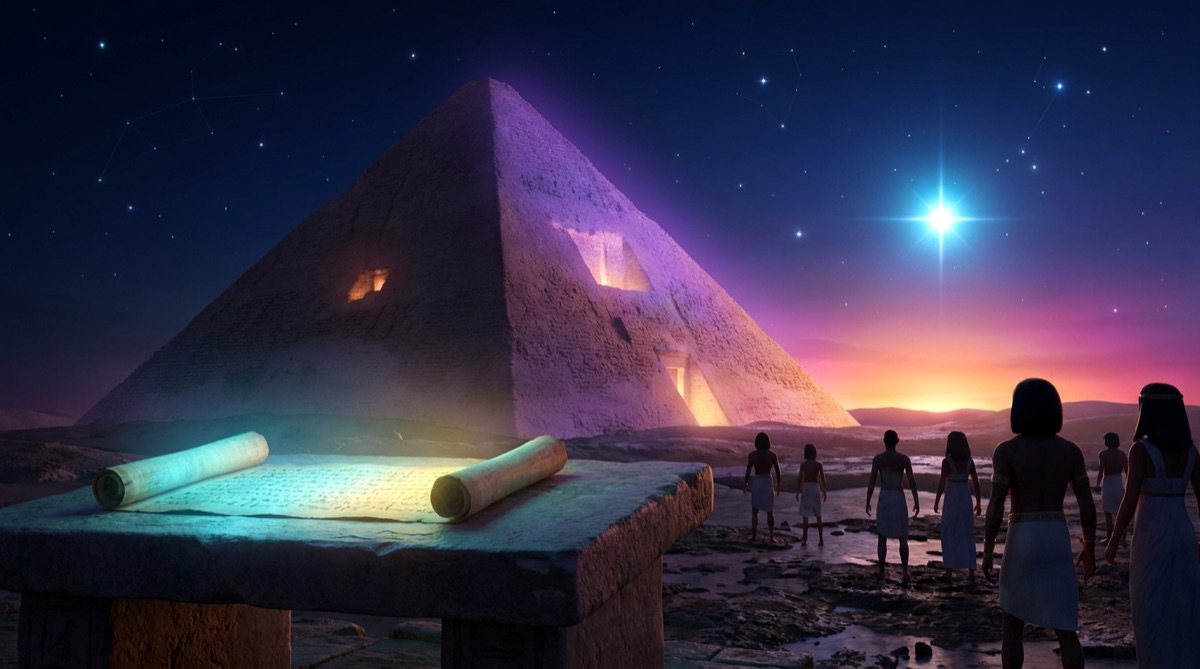
The Illahun papyrus dates Senusret III
A letter from the archive of the temple of Illahun announces the heliacal rising of Sirius on a civil-calendar date in year 7 of Senusret III. Since the calendar drifted one day every four years, the note allows the year to be calculated: around 1872 BCE if observed near Memphis, a few decades later if at Elephantine. The debate over the place remains open.
👤 Senusret III · 📍 Illahun (El-Lahun), Faiyum, Egypt
Sources (3)
- Parker, R. A. (1950). The Calendars of Ancient Egypt. University of Chicago Press.
- Krauss, R. (1985). Sothis- und Monddaten. Gerstenberg (proposal of Elephantine as the place of observation).
- Gautschy, R. (2011). Monddaten aus dem Archiv von Illahun: Chronologie des Mittleren Reiches. Zeitschrift für Ägyptische Sprache und Altertumskunde 138, 1–19.
- c. 1640–1620 BCE
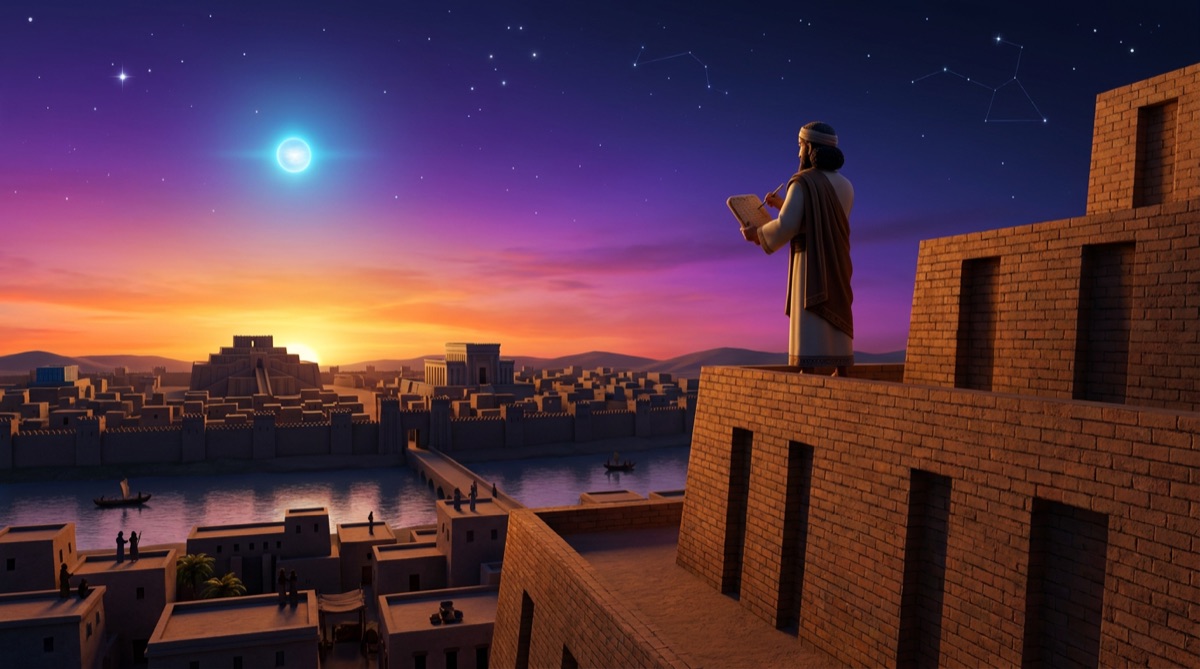
The Venus Tablet of Ammisaduqa
For 21 years, during the reign of King Ammisaduqa of Babylon, the dates on which Venus appeared and disappeared next to the Sun were written down, together with the corresponding omens. It is the oldest known systematic planetary record; it survives in copies from the 7th century BCE, and historians use it to pin down the chronology of the period, although the exact date of the reign is still debated.
👤 Ammisaduqa · 📍 Babylon
Sources (2)
- British Museum, tablet K.160 (copy from the library of Ashurbanipal, Nineveh).
- Reiner, E. & Pingree, D. (1975). Babylonian Planetary Omens, Part 1: The Venus Tablet of Ammisaduqa. Undena Publications.
- c. 1600 BCE
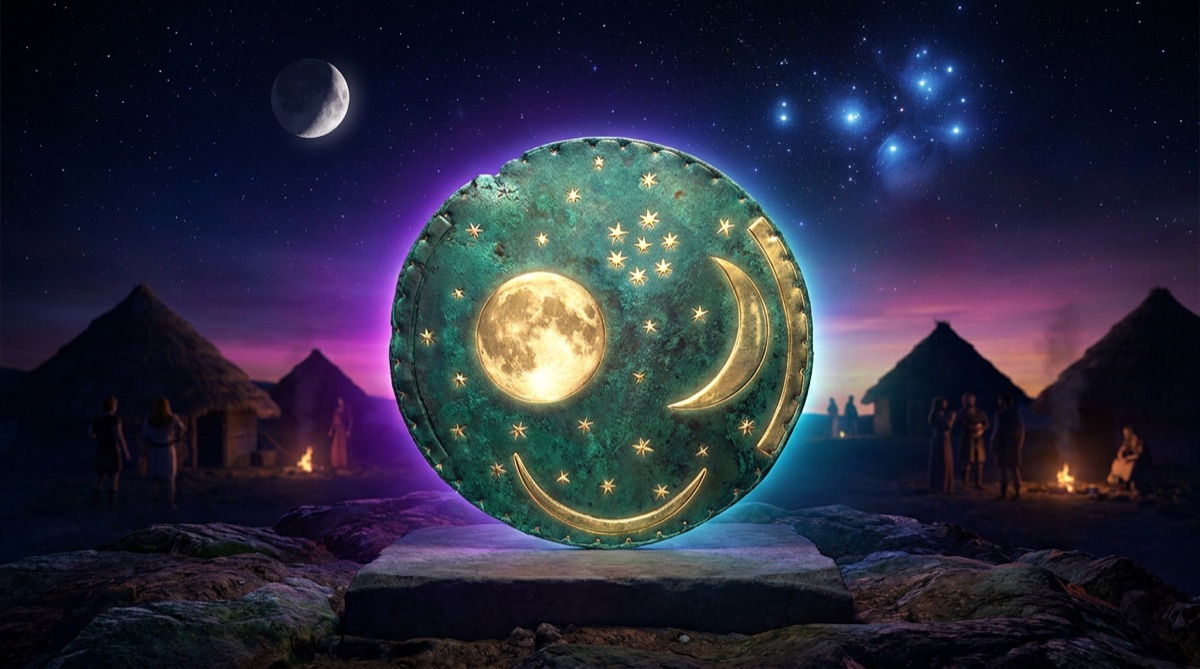
The Nebra sky disc
A 32 cm bronze disc with the Sun or the full Moon, a crescent Moon and 32 gold stars, among them a group of seven interpreted as the Pleiades. Two arcs added later span 82°, the range of sunrise points between the solstices at the latitude of the site. It is the oldest known concrete depiction of the sky.
📍 Mittelberg, near Nebra, Saxony-Anhalt, Germany
📘 Stars and constellations 🧪 Interactive planisphere SolsticeConstellationPhases of the Moon
Sources (3)
- Landesmuseum für Vorgeschichte Halle (Saale), where the disc is kept.
- UNESCO, Memory of the World Register: Nebra Sky Disc (inscribed in 2013).
- Pernicka, E. et al. (2020). Why the Nebra Sky Disc Dates to the Early Bronze Age. Archaeologia Austriaca 104, 89–122. https://doi.org/10.1553/archaeologia104s89
- c. 1550–1500 BCE
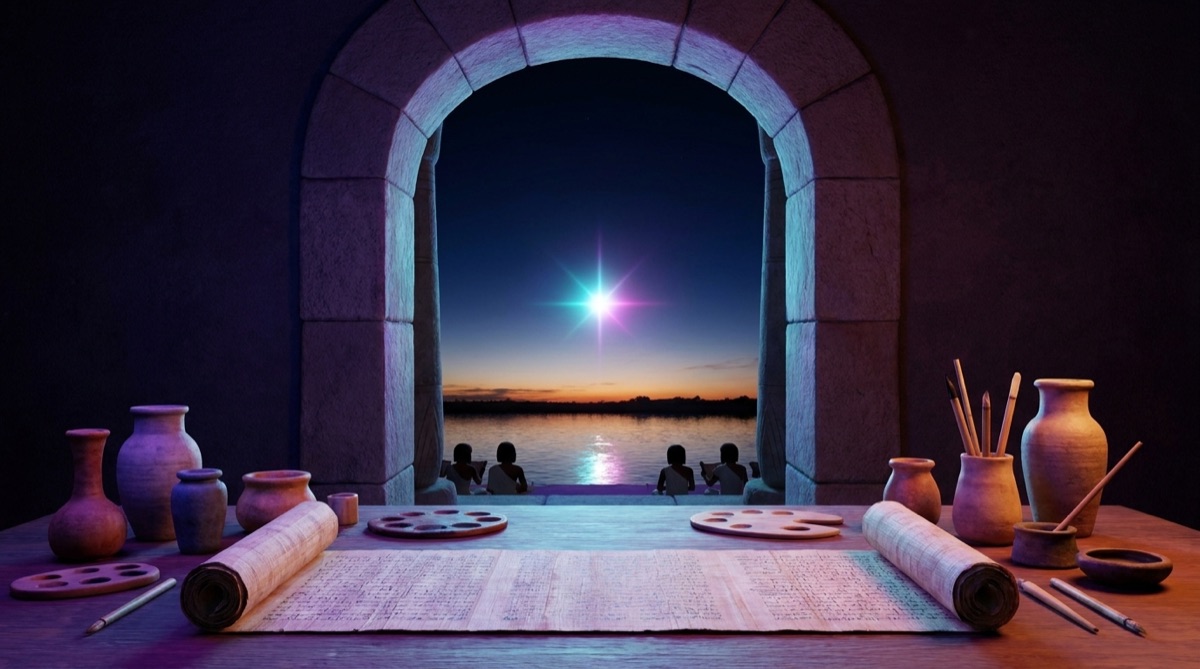
The calendar of the Ebers Papyrus
On the back of a medical treatise, a note records the rising of Sirius in year 9 of Amenhotep I. It is the second great astronomical anchor of Egyptian chronology; depending on the assumed place of observation, it falls between 1550 and 1500 BCE.
👤 Amenhotep I · 📍 Thebes, Egypt (papyrus in the Leipzig University Library)
Sources (2)
- Clagett, M. (1995). Ancient Egyptian Science, vol. II. American Philosophical Society.
- Depuydt, L. (1997). Civil Calendar and Lunar Calendar in Ancient Egypt. Peeters.
- c. 1500 BCE
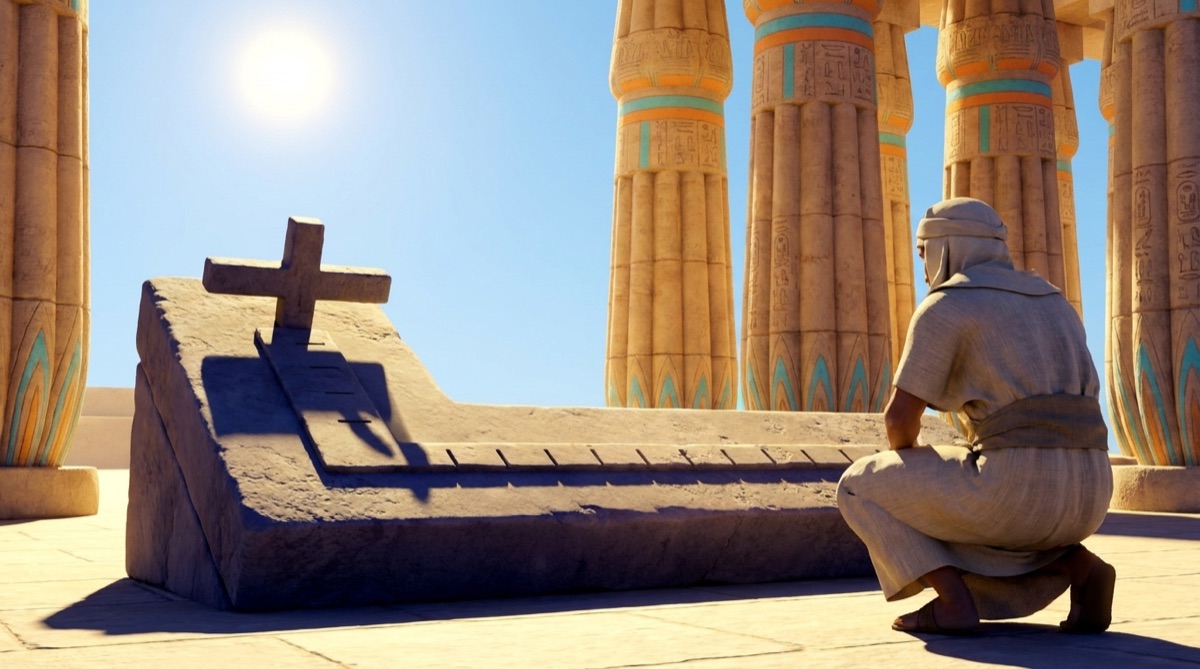
Shadow clocks: the hours of the day
An L-shaped instrument with a crossbar cast its shadow onto a graduated ruler that divided the day into hours. The oldest examples and descriptions are from the New Kingdom, including a fragment from the reign of Thutmose III. The hours were “seasonal”: longer in summer than in winter.
👤 Thutmose III · 📍 Egypt
📘 Shadows and the sundial 🧪 Day, night and the seasons GnomonAltitude above the horizon
Sources (2)
- Clagett, M. (1995). Ancient Egyptian Science, vol. II. American Philosophical Society, chapter on clocks.
- Neugebauer, O. & Parker, R. A. (1960). Egyptian Astronomical Texts I (description of the shadow clock in the cenotaph of Seti I).
- c. 1470 BCE
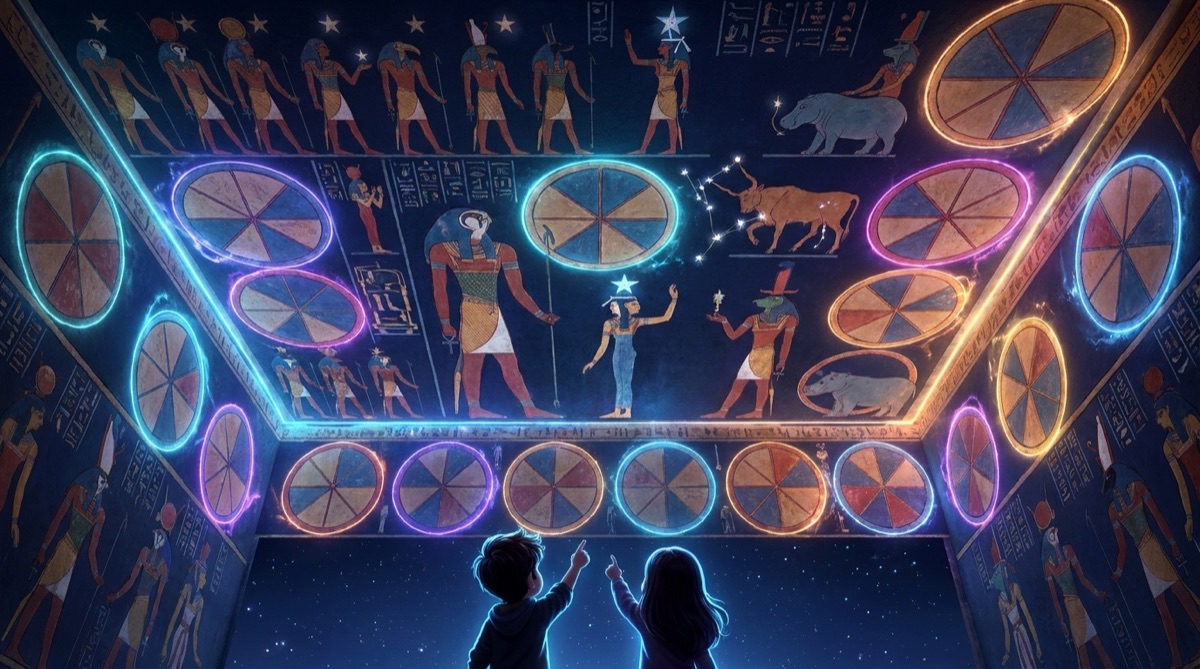
The astronomical ceiling of Senenmut
In the burial chamber of Senenmut, architect of Queen Hatshepsut, the oldest surviving celestial map in Egypt was painted: the list of decans with Orion and Sirius, the northern constellations with the Bull's Foreleg (our Ursa Major), the visible planets and twelve circles with the months of the lunar calendar.
👤 Senenmut, Hatshepsut · 📍 Deir el-Bahari, Thebes (tomb TT 353)
📘 Stars and constellations 🧪 Interactive planisphere Constellation
Sources (3)
- Metropolitan Museum of Art, New York: facsimile of the astronomical ceiling of Senenmut (Charles K. Wilkinson, no. 48.105.52).
- Dorman, P. F. (1991). The Tombs of Senenmut. Metropolitan Museum of Art.
- Neugebauer, O. & Parker, R. A. (1969). Egyptian Astronomical Texts III: Decans, Planets, Constellations and Zodiacs. Brown University Press.
- c. 1390–1350 BCE
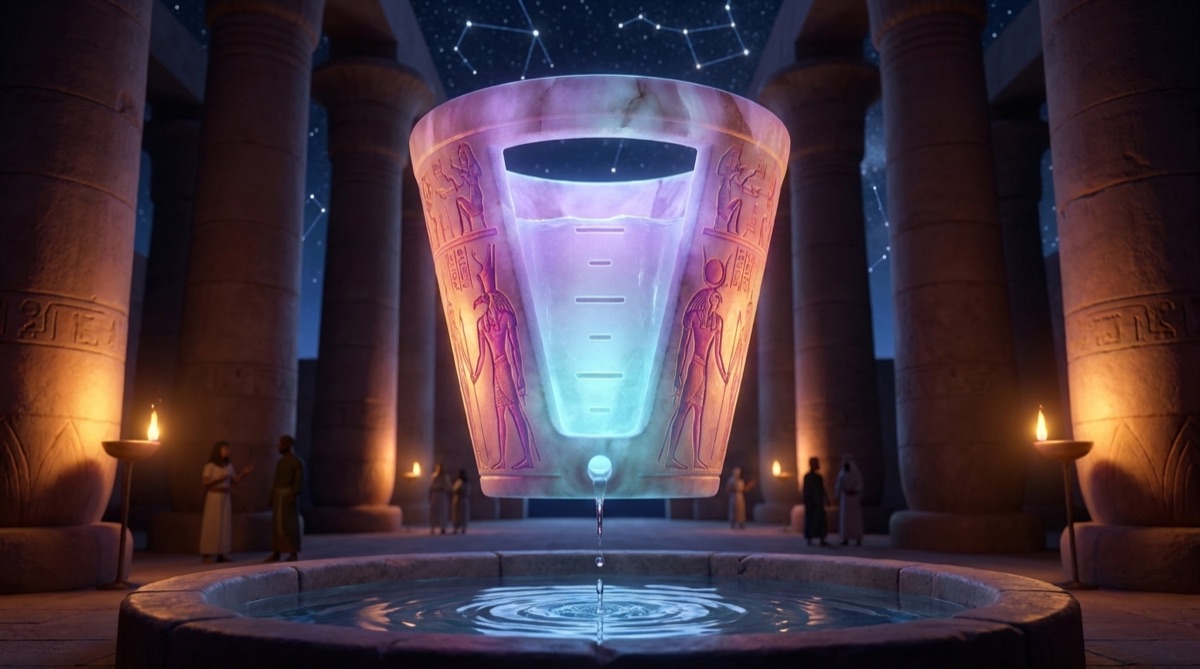
The Karnak clepsydra
An alabaster vessel with a hole in the base: as it emptied, the water level marked the hours of the night on different scales for each month. Found broken in the temple of Karnak in 1904 and dated to the reign of Amenhotep III, it is the oldest surviving water clock.
👤 Amenhotep III · 📍 Karnak, Egypt (Egyptian Museum, Cairo)
Sources (3)
- Egyptian Museum, Cairo: Karnak clepsydra.
- Cotterell, B., Dickson, F. P. & Kamminga, J. (1986). Ancient Egyptian water-clocks: a reappraisal. Journal of Archaeological Science 13(1), 31–50.
- Clagett, M. (1995). Ancient Egyptian Science, vol. II. American Philosophical Society.
- c. 1300–800 BCE

The Lapita expansion
Austronesian-speaking peoples, recognizable by their Lapita pottery, sail from the Bismarck Archipelago (New Guinea) to Fiji, Tonga and Samoa, crossing hundreds of kilometers of open sea for the first time. They are the direct ancestors of the Polynesians.
📍 From the Bismarck Archipelago to Tonga and Samoa (western Pacific)
Sources (2)
- Kirch, P. V. (2017). On the Road of the Winds, 2nd ed. University of California Press, ch. 4.
- Burley, D. V. & Connaughton, S. P. (2007). First Lapita settlement and its chronology in Vavaʻu, Kingdom of Tonga. Radiocarbon 49(1).
- c. 1290 BCE
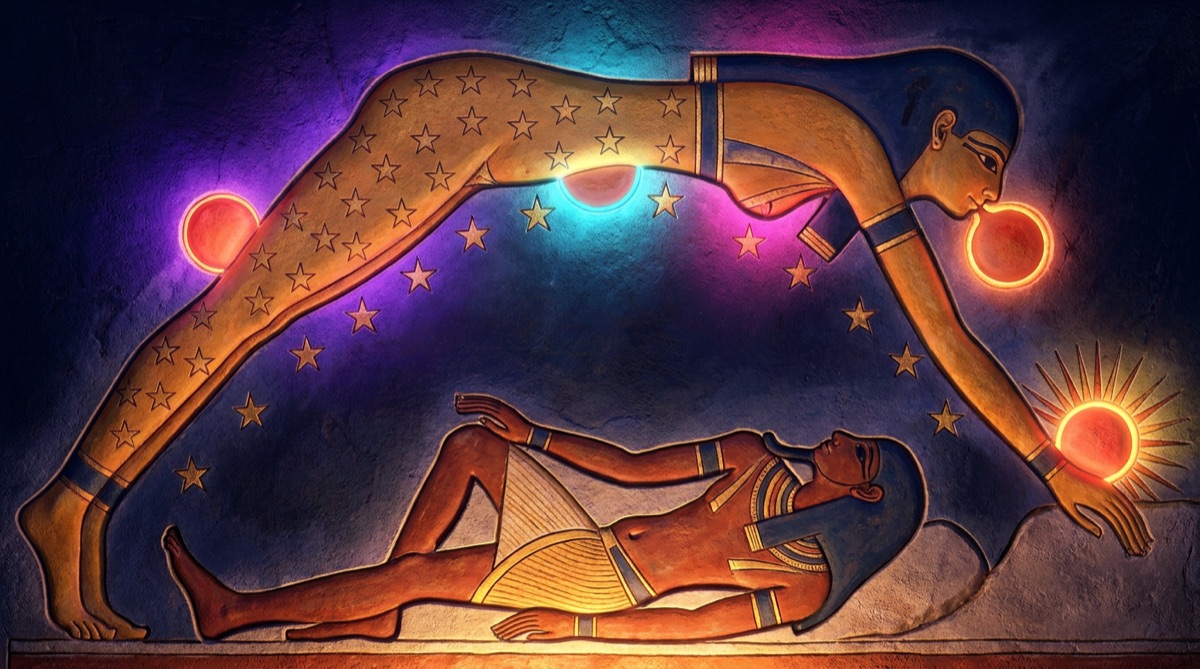
The Book of Nut in the cenotaph of Seti I
At Abydos an image was carved of the sky goddess, Nut, swallowing the Sun every evening and giving birth to it every morning, accompanied by a text that explains the 70 days of invisibility of each decan and how to use the shadow clock. It is Egyptian cosmology in its most complete form.
👤 Seti I · 📍 Abydos, Egypt
Sources (2)
- Neugebauer, O. & Parker, R. A. (1960). Egyptian Astronomical Texts I. Brown University Press.
- von Lieven, A. (2007). Grundriss des Laufes der Sterne: Das sogenannte Nutbuch. Museum Tusculanum Press (The Carlsberg Papyri 8).
- c. 1200 BCE
late 2nd millennium BCE
Enuma Anu Enlil, the great omen series
Some 70 tablets gather thousands of omens of the kind “if the Moon is eclipsed in such a month, the king of such a country will die”. They are not astronomy in the modern sense, but they forced people to observe the Moon, the eclipses and the planets regularly for centuries, and out of that habit mathematical astronomy was born.
📍 Babylonia and Assyria
Sources (2)
- Rochberg, F. (2004). The Heavenly Writing. Cambridge University Press, ch. 2–3.
- Hunger, H. & Pingree, D. (1999). Astral Sciences in Mesopotamia. Brill, section on Enuma Anu Enlil.
- c. 1200 BCE
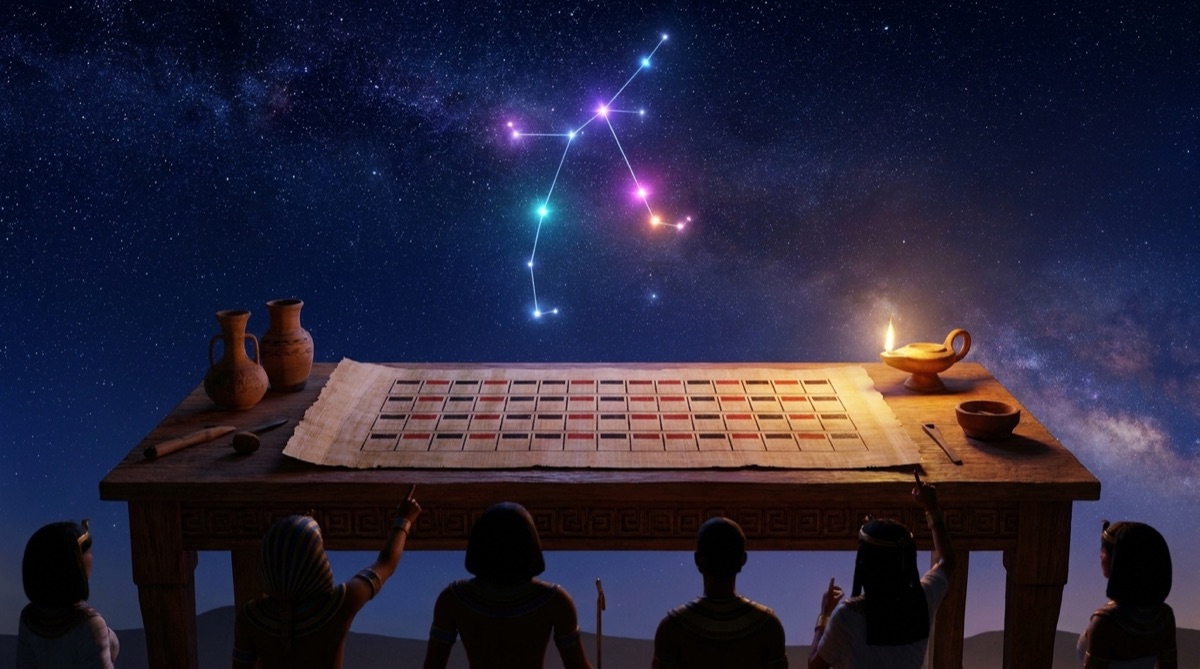
The Cairo Calendar and the Algol hypothesis
A Ramesside papyrus assigns to each day of the year a forecast of good or bad luck. In 2015 a Finnish team found in those forecasts a period of 2.85 days, that of the variable star Algol, and proposed that the Egyptians noticed its changes in brightness. It is a published and debated hypothesis, not a fact accepted by Egyptologists.
👤 Lauri Jetsu, Sebastian Porceddu · 📍 Egypt (papyrus Cairo 86637)
Sources (2)
- Jetsu, L. & Porceddu, S. (2015). Shifting milestones of natural sciences: the ancient Egyptian discovery of Algol's period confirmed. PLoS ONE 10(12), e0144140. https://doi.org/10.1371/journal.pone.0144140
- Leitz, C. (1994). Tagewählerei: Das Buch h3t nhh ph.wy dt und verwandte Texte. Harrassowitz (edition of the calendar).
- c. 1200 BCE

13th–12th centuries BCE
Oracle bones of Anyang
The diviners of the Shang dynasty carved questions and answers on turtle shells and ox shoulder blades. Among them appear eclipses of the Sun and Moon and perhaps a “new star”: they are the oldest astronomical records of East Asia.
📍 Anyang (Henan), China
📘 Eclipses Solar eclipseLunar eclipse
Sources (2)
- Xu, Pankenier & Jiang (2000), East Asian Archaeoastronomy, ch. 1 (oracle-bone inscriptions with eclipses).
- Stephenson, F. R. (1997). Historical Eclipses and Earth's Rotation, ch. 6 (eclipses on oracle bones and their dating).
- c. 1150 BCE
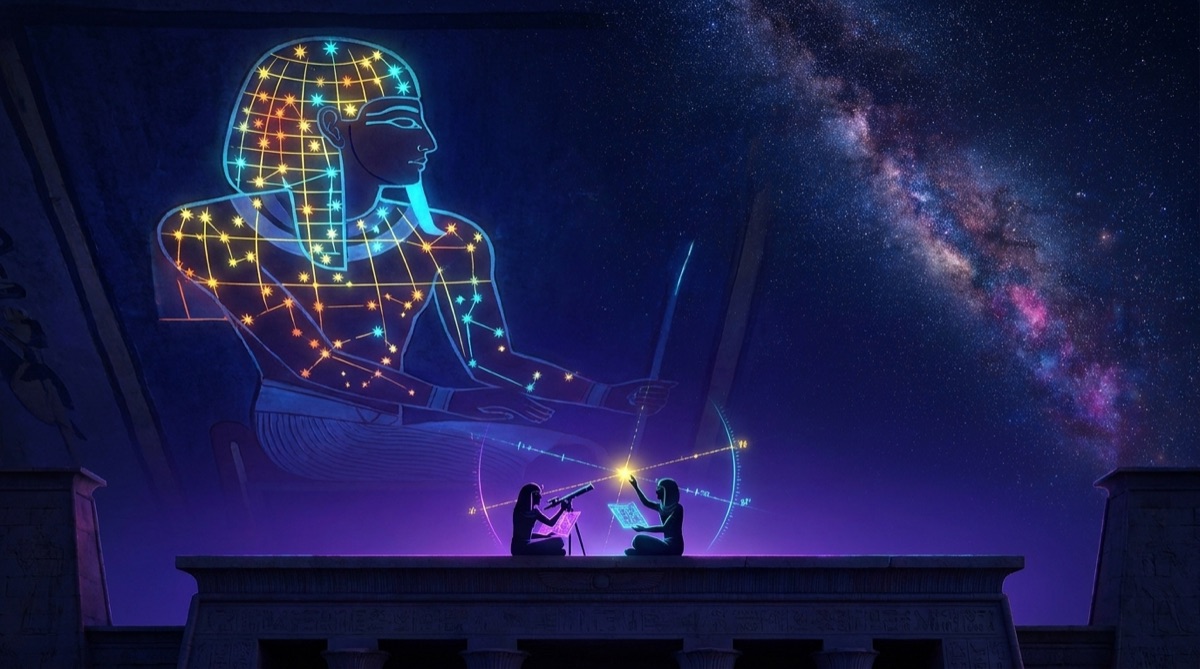
Ramesside star clocks
In the tombs of Ramesses VI, VII and IX, tables were painted with a seated figure: each hour of the night was announced when a star passed over his head, his eye or his shoulder, observed by one priest facing another. A method of transits, not of risings, closer to our sidereal time.
👤 Ramesses VI · 📍 Valley of the Kings, Egypt
📘 Solar time and sidereal time Sidereal timeZenith
Sources (2)
- Neugebauer, O. & Parker, R. A. (1964). Egyptian Astronomical Texts II: The Ramesside Star Clocks. Brown University Press.
- Leitz, C. (1995). Altägyptische Sternuhren. Peeters.
- c. 1000 BCE
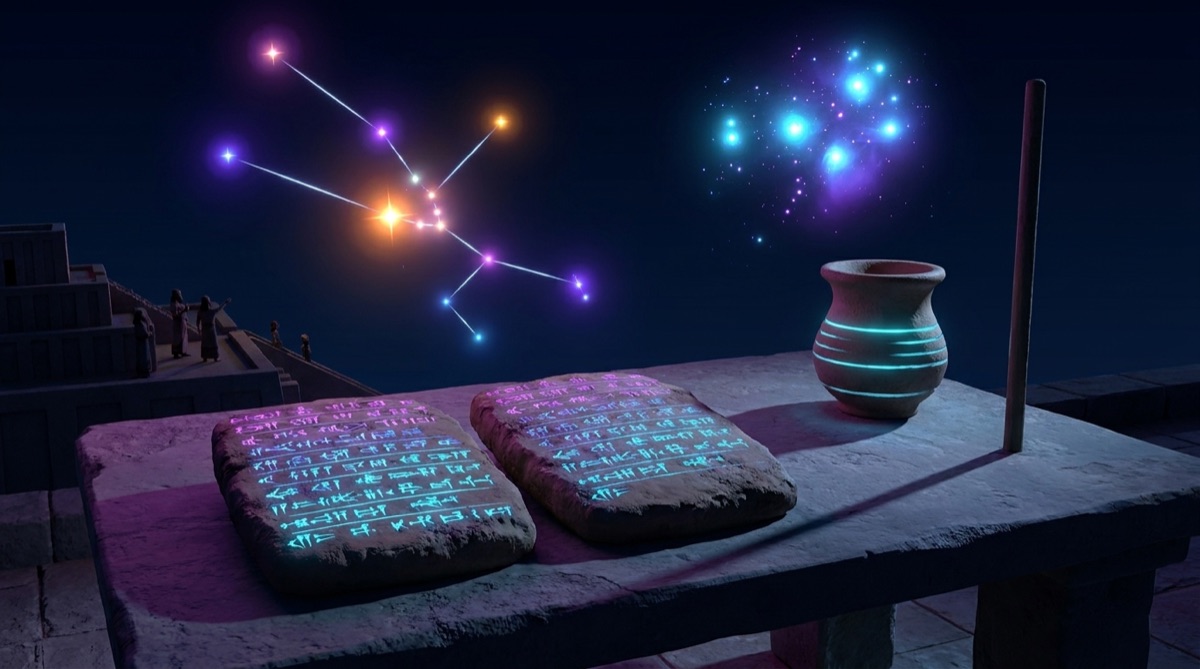
MUL.APIN, the compendium of the sky
Two tablets summarize everything that was known: lists of stars and constellations with their rising dates, the paths of the Moon and the planets, the length of day and night through the year, the use of the water clock and the gnomon, and rules for intercalating months. It was compiled around 1000 BCE; the oldest surviving copy dates from 687 BCE.
📍 Assyria and Babylonia
📘 Solar time and sidereal time 🧪 Interactive planisphere ConstellationEclipticGnomon
Sources (2)
- Hunger, H. & Pingree, D. (1989). MUL.APIN: An Astronomical Compendium in Cuneiform. Archiv für Orientforschung, Beiheft 24.
- Hunger, H. & Steele, J. (2018). The Babylonian Astronomical Compendium MUL.APIN. Routledge.
- c. 1000 BCE
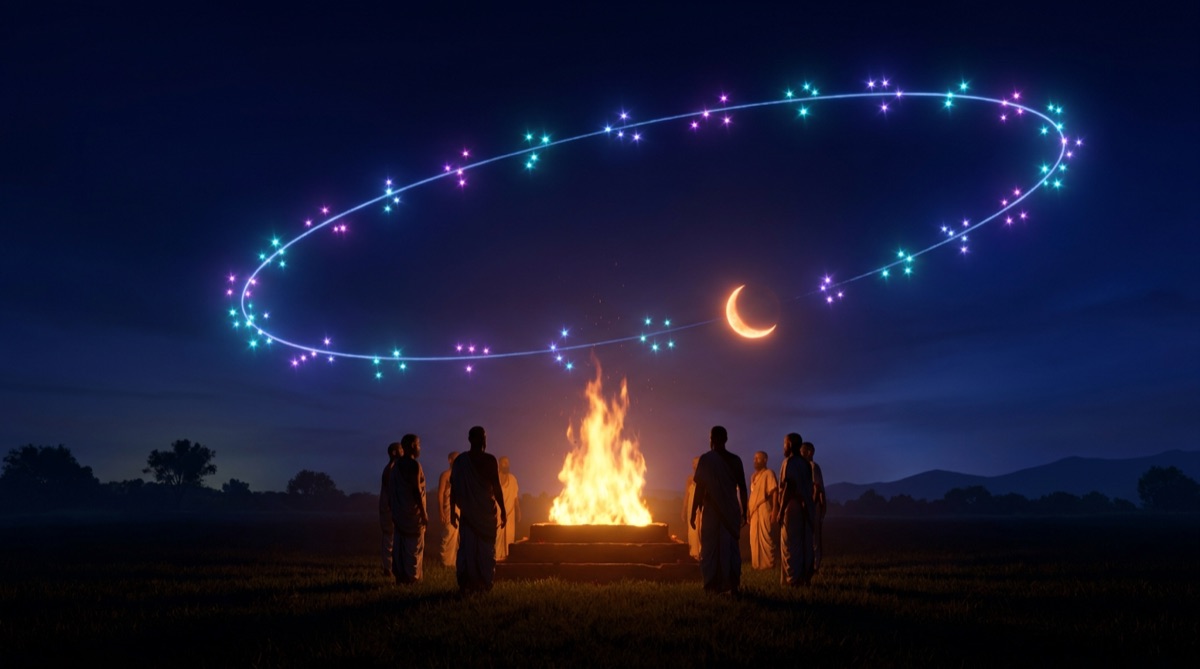
The nakshatras of the Vedic texts
The late Vedic texts list 27 or 28 nakshatras, the “mansions” through which the Moon passes each night of its journey around the sky. That system served to fix rituals and dates and is still alive in the traditional calendar of India.
📍 Northern India
📘 The lunar calendar 🧪 Phases of the Moon Sidereal monthConstellation
Sources (2)
- Pingree, D. (1978). History of mathematical astronomy in India. Dictionary of Scientific Biography, vol. 15, section I (Vedic astronomy).
- Plofker, K. (2009). Mathematics in India, ch. 2 (the Vedic texts and the calendar).
- 763 BCE
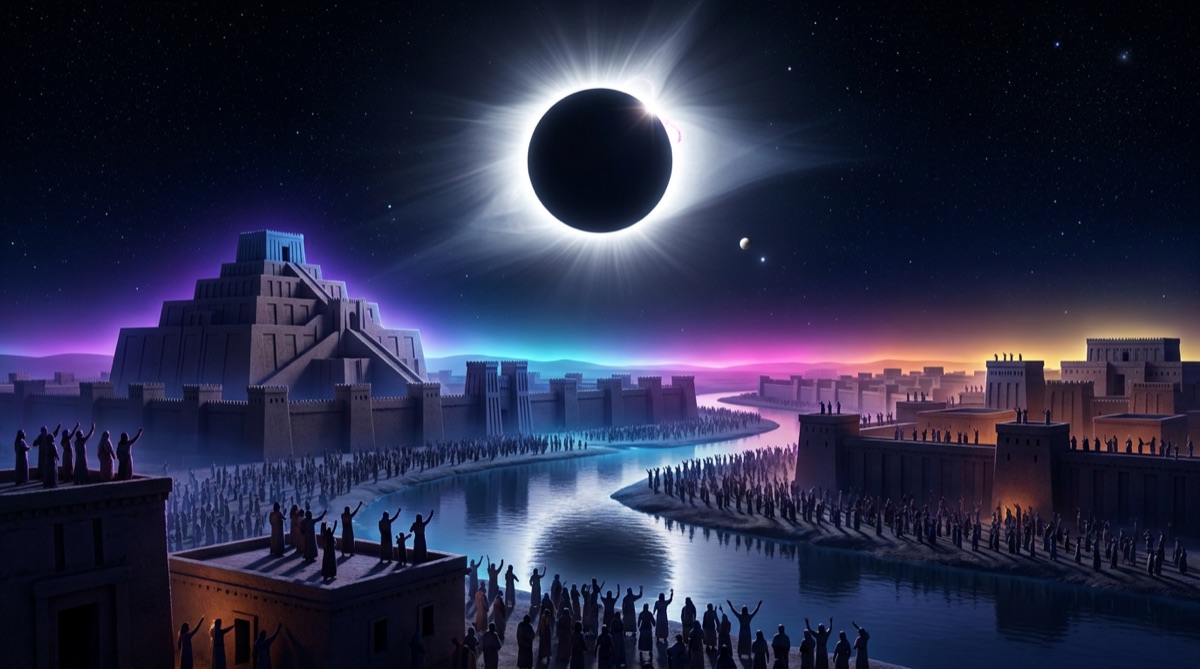
The Bur-Sagale eclipse
The Assyrian eponym chronicle notes, in the year of the official Bur-Sagale, that “the Sun was eclipsed” in the month of Simanu. It is identified with the solar eclipse of June 15, 763 BCE, and thanks to it the whole Assyrian chronology of the first millennium has an absolute date.
👤 Bur-Sagale, Ashur-dan III · 📍 Assyria, northern Iraq
📘 Phases of the Moon and eclipses Solar eclipse
Sources (2)
- Millard, A. (1994). The Eponyms of the Assyrian Empire 910–612 BC. State Archives of Assyria Studies 2, Helsinki.
- Espenak, F. & Meeus, J. (2006). Five Millennium Canon of Solar Eclipses: −1999 to +3000. NASA/TP-2006-214141 (eclipse of −762 June 15).
- 722 BCE – 481 BCE

The eclipses of the Spring and Autumn Annals
The chronicle of the state of Lu (Chunqiu) records 37 solar eclipses between 722 and 481 BCE. Compared with modern calculation, almost all of them are real: the oldest and most continuous series of dated eclipses in the world.
📍 State of Lu (Shandong), China
📘 Phases of the Moon and eclipses 🧪 Phases of the Moon Solar eclipse
Sources (2)
- Stephenson, F. R. (1997). Historical Eclipses and Earth's Rotation, ch. 8 (eclipses of the Chunqiu).
- Xu, Pankenier & Jiang (2000), East Asian Archaeoastronomy, table of solar eclipses.
- 721 BCE
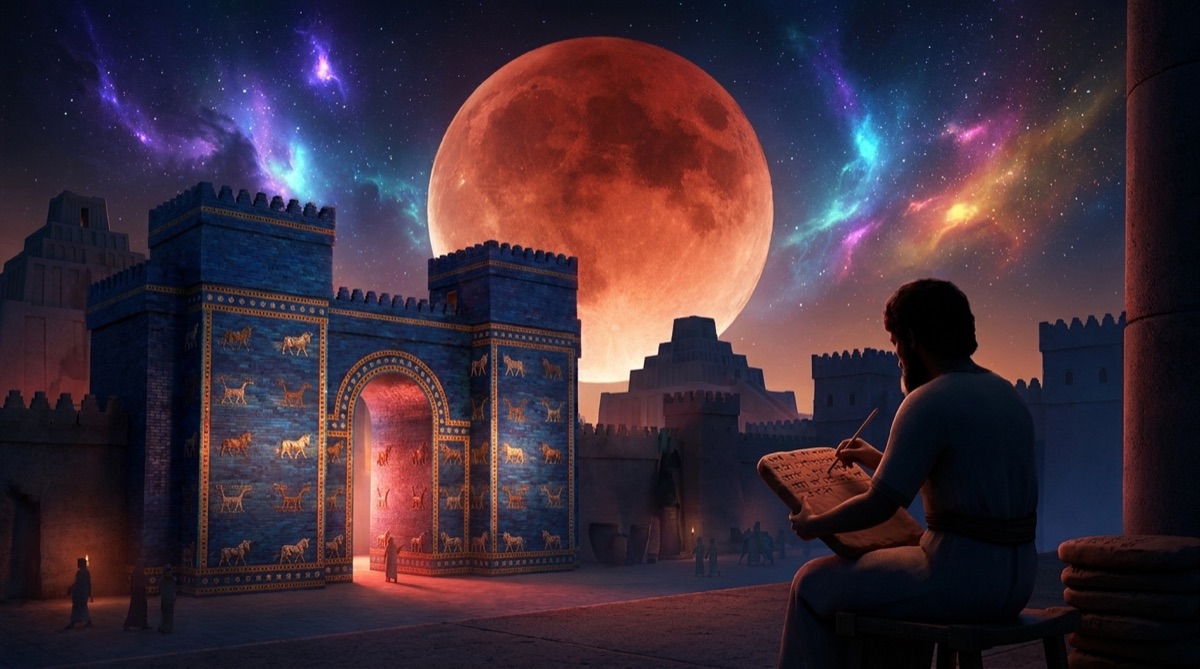
The Babylonian eclipses used by Ptolemy
A lunar eclipse observed in Babylon on March 19, 721 BCE is the oldest dated observation that Ptolemy cites in the Almagest, together with two others from 720 BCE. Ptolemy states that continuous observations had been kept since the reign of Nabonassar (747 BCE).
👤 Nabonassar, Ptolemy · 📍 Babylon
Sources (2)
- Ptolemy, Almagest, III.7 and IV.6 (trans. G. J. Toomer, Ptolemy's Almagest, Princeton University Press, 1998).
- Steele, J. M. (2000). Observations and Predictions of Eclipse Times by Early Astronomers. Kluwer.
- c. 680 BCE – 650 BCE
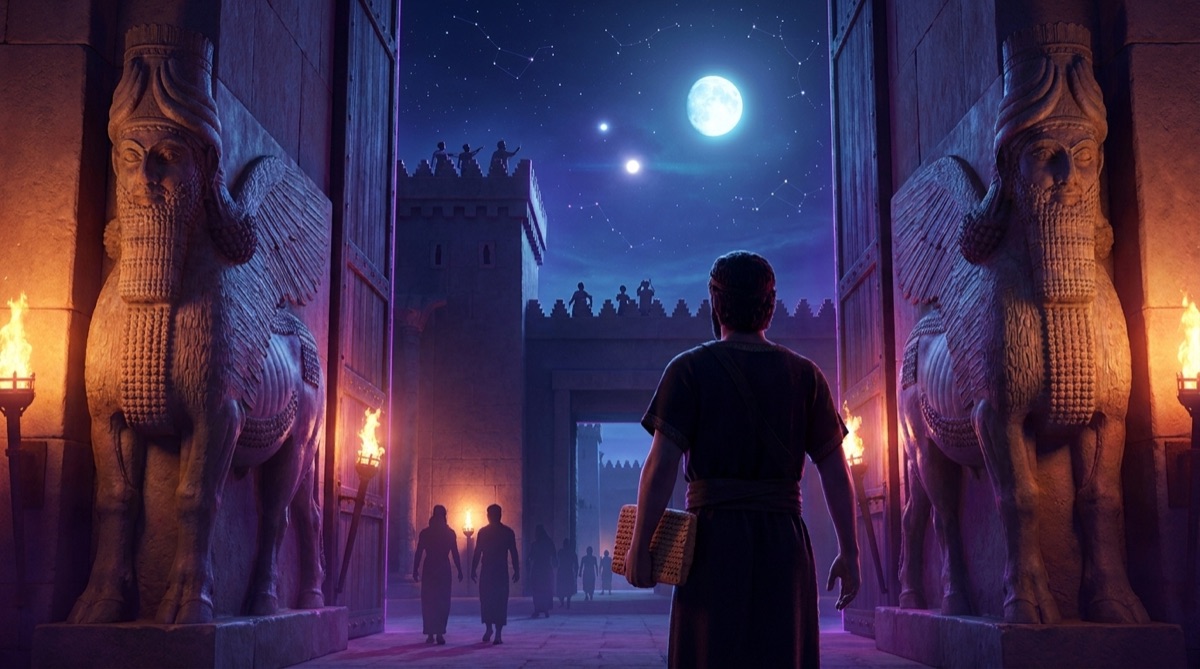
The astronomers of the Assyrian court
Kings Esarhaddon and Ashurbanipal received written reports from observers in several cities about the Moon, the eclipses and the planets, with their interpretation. Hundreds of those letters survive, and Ashurbanipal's library at Nineveh kept copies of every astronomical text of the period.
👤 Esarhaddon, Ashurbanipal · 📍 Nineveh, Assyria
Sources (2)
- Hunger, H. (1992). Astrological Reports to Assyrian Kings. State Archives of Assyria 8, Helsinki University Press.
- Parpola, S. (1993). Letters from Assyrian and Babylonian Scholars. State Archives of Assyria 10, Helsinki University Press.
- 652 BCE
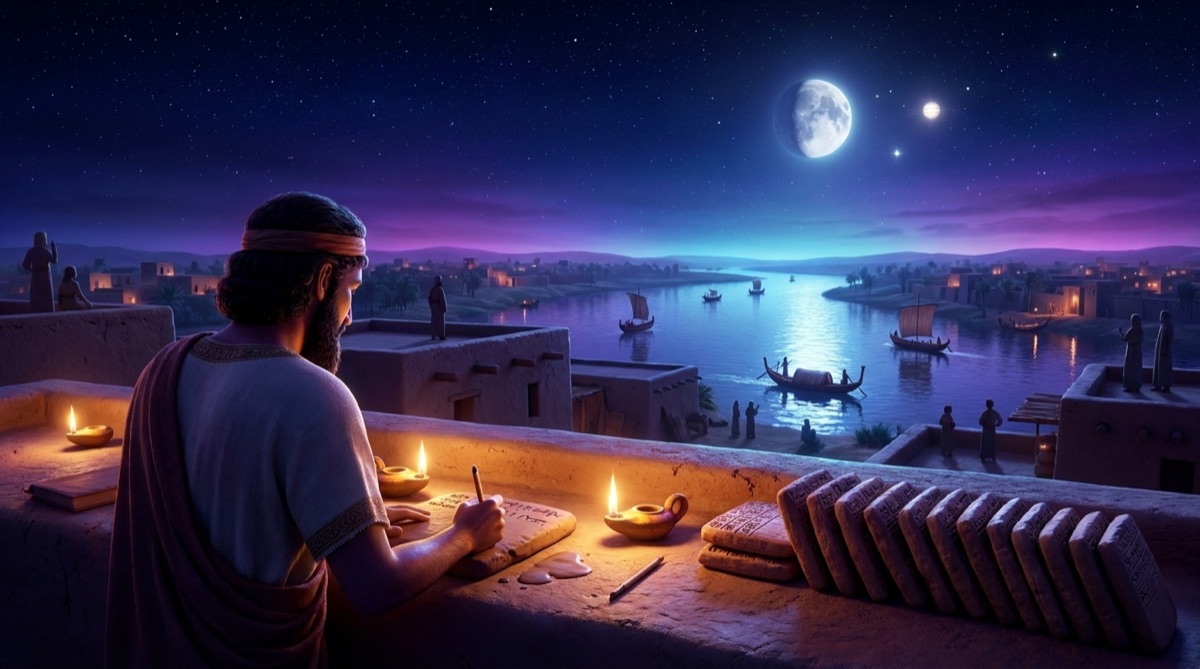
The Astronomical Diaries
The oldest surviving Diary is from the year 652 BCE. Night after night, for more than six centuries, the scribes of Babylon noted the position of the Moon and the planets relative to reference stars, the weather, the level of the Euphrates, prices and news. It is the longest series of scientific observations in history.
📍 Babylon
Sources (2)
- Sachs, A. J. & Hunger, H. (1988). Astronomical Diaries and Related Texts from Babylonia, vol. I: Diaries from 652 B.C. to 262 B.C. Österreichische Akademie der Wissenschaften.
- British Museum, collection of Astronomical Diaries from Babylon.
- 6th century BCE
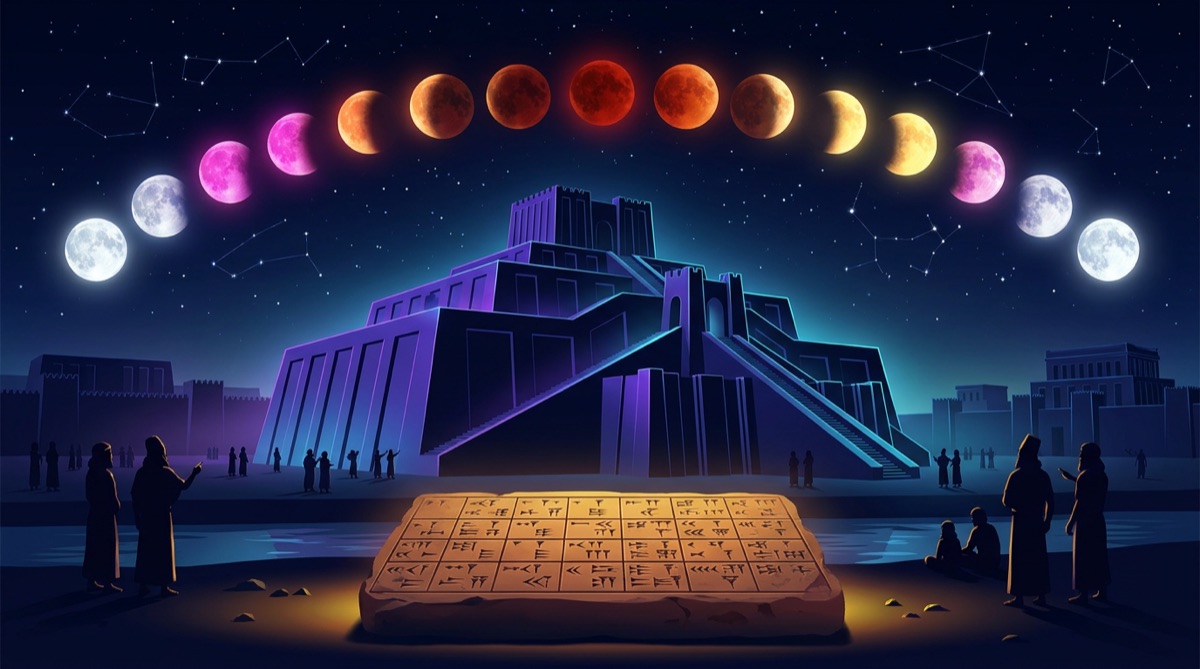
The Saros cycle and eclipse prediction
By comparing centuries of records, the Babylonians discovered that eclipses repeat every 223 lunar months, about 18 years and 11 days, and built tables of the months in which an eclipse was possible. That way they could warn the king in advance, even if they did not know whether the eclipse would be visible from Babylon.
📍 Babylon
📘 Phases of the Moon and eclipses 🧪 Phases of the Moon Lunar eclipseSolar eclipseSynodic monthOrbital nodes
Sources (3)
- Steele, J. M. (2000). Observations and Predictions of Eclipse Times by Early Astronomers. Kluwer, ch. 2.
- Brack-Bernsen, L. & Steele, J. M. (2005). Eclipse prediction and the length of the Saros in Babylonian astronomy. Centaurus 47(3), 181–206.
- Aaboe, A., Britton, J. P., Henderson, J. A., Neugebauer, O. & Sachs, A. J. (1991). Saros Cycle Dates and Related Babylonian Astronomical Texts. Transactions of the American Philosophical Society 81(6).
- c. 600 BCE
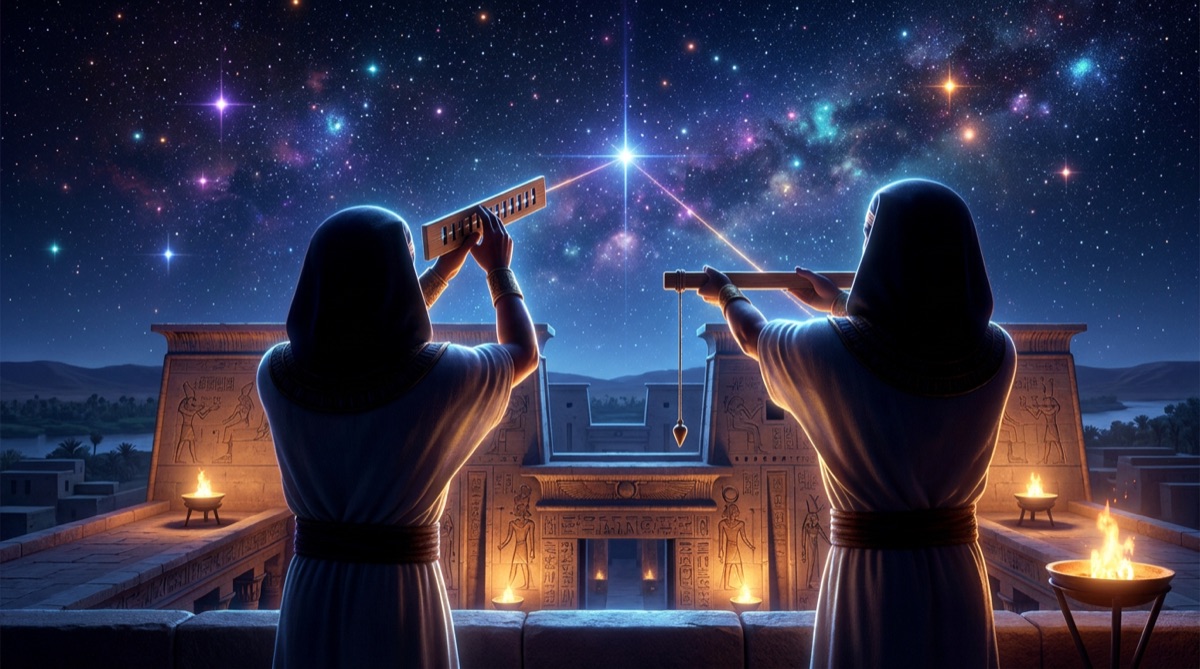
Merkhet and bay: instruments of a priest of the hours
The merkhet (a bar with a plumb line) and the bay (a palm rib with a slit) served to observe the passage of a star across the north–south line and thus tell the time; also to orient buildings. The surviving examples, in Berlin and London, belonged to priests “in charge of the hours”.
📍 Egypt (Egyptian Museum of Berlin and Science Museum, London)
Sources (2)
- Science Museum Group, London: Egyptian merkhet (object co500, c. 600 BCE, inscribed with the name of the priest Bes).
- Clagett, M. (1995). Ancient Egyptian Science, vol. II. American Philosophical Society.
- c. 600–400 BCE
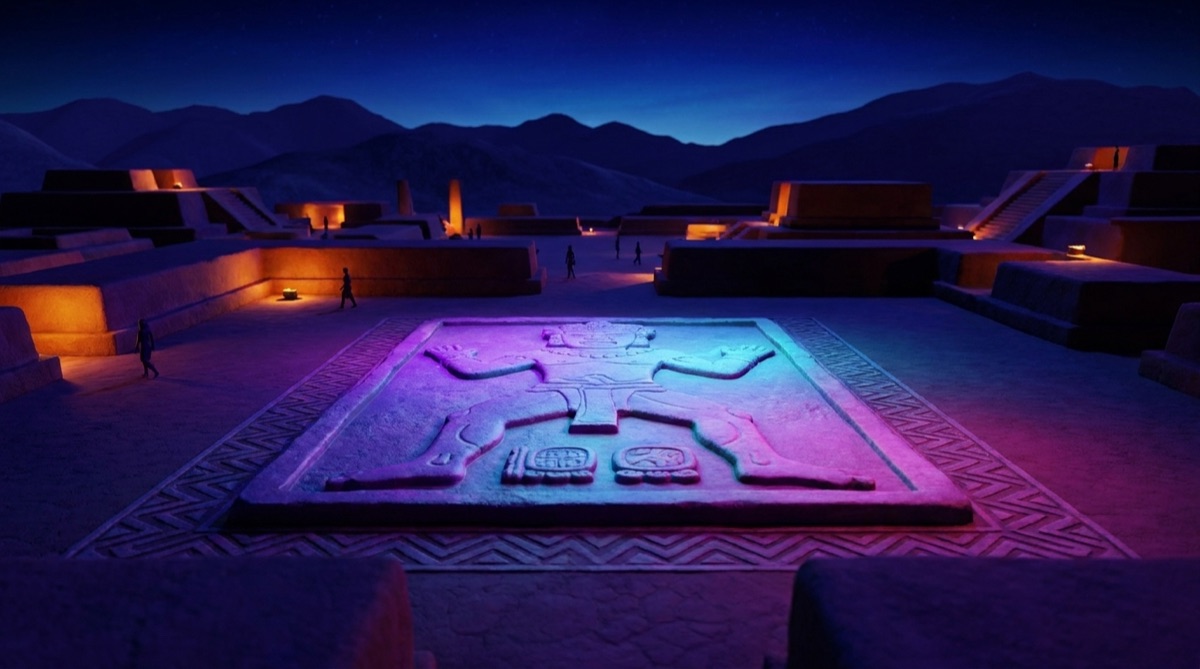
The late Olmecs and the first calendar signs
In the Valley of Oaxaca, Monument 3 of San José Mogote shows two glyphs that read as a day name of the 260-day calendar. It is the oldest candidate for calendrical writing in the Americas, although its date is debated between c. 600 and c. 100 BCE.
📍 San José Mogote, Oaxaca (Mexico)
Sources (2)
- Marcus, J. (1992). Mesoamerican Writing Systems. Princeton University Press, p. 36 (date of c. 600 BCE).
- Urcid, J. (2001). Zapotec Hieroglyphic Writing. Studies in Pre-Columbian Art and Archaeology 34, Dumbarton Oaks (discussion of later dates).
- c. 585 BCE
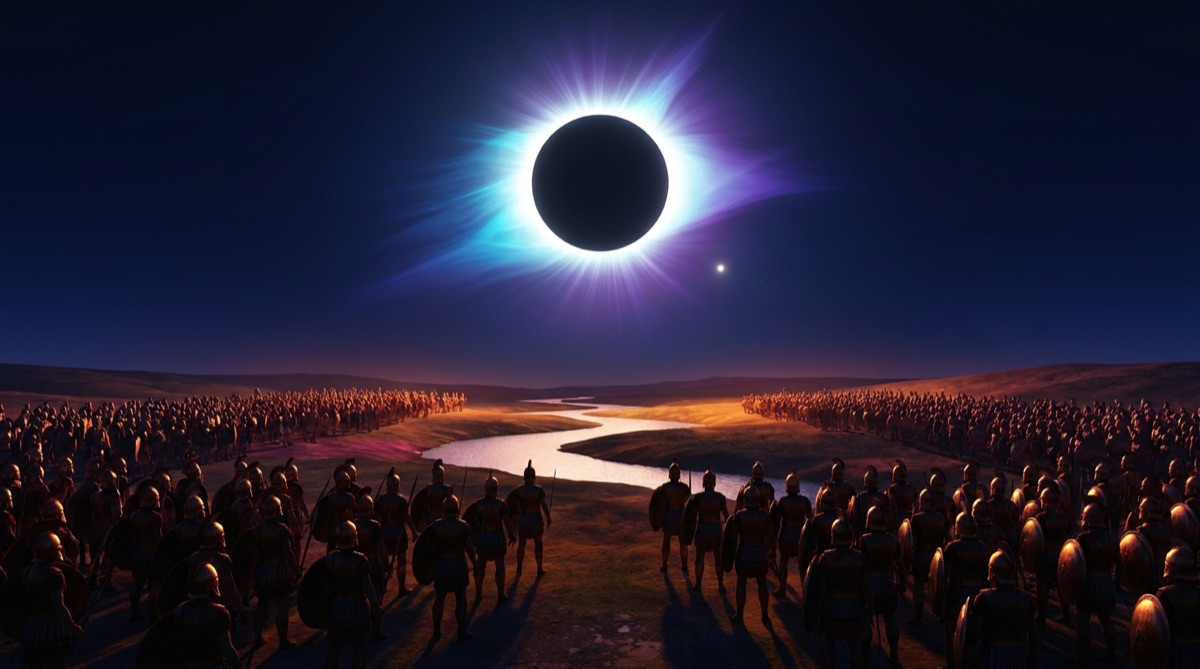
Thales and the eclipse of 585 BCE
Herodotus tells that Thales of Miletus announced to the Ionians the year in which a solar eclipse would occur, and that the eclipse interrupted a battle between Lydians and Medes. The eclipse of May 28, 585 BCE is real; whether Thales actually predicted it is doubtful, because the Greeks of that time did not have the data to do so.
👤 Thales of Miletus · 📍 Miletus (Ionia, present-day Turkey)
Sources (2)
- Herodotus, Histories, I.74 (Trans. C. Schrader, Gredos).
- Mosshammer, A. A. (1981). Thales' Eclipse. Transactions of the American Philological Association 111, 145–155.
- 568 BCE
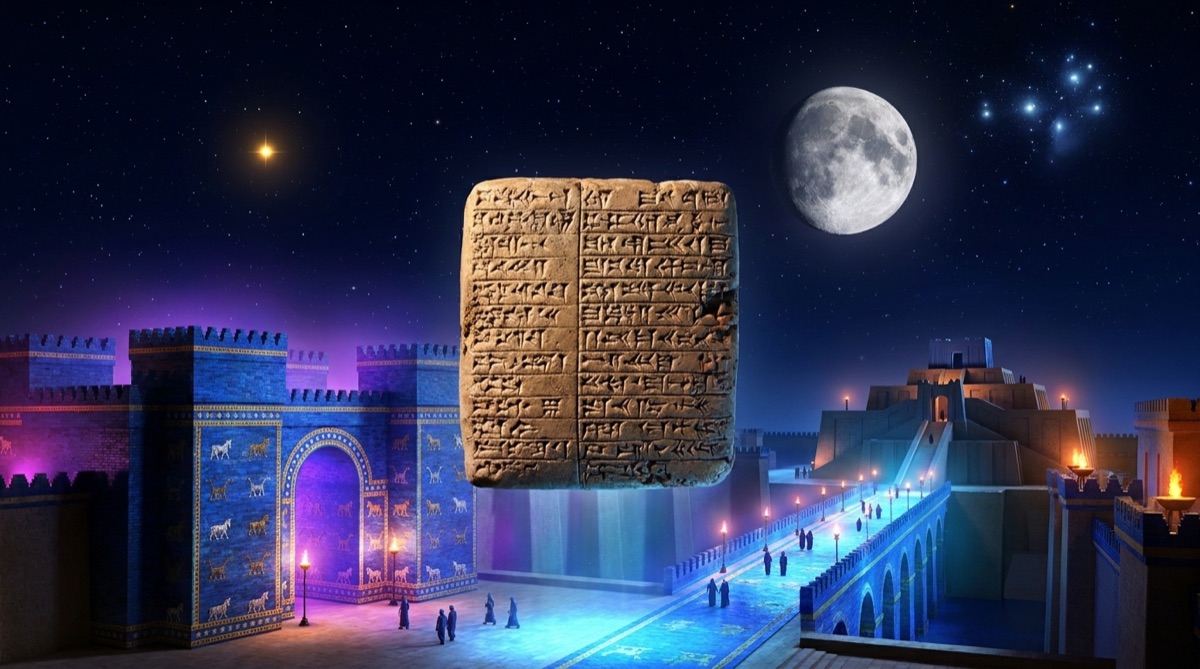
Tablet VAT 4956
A Diary from the 37th year of Nebuchadnezzar II describes the Moon and the planets in such detail that it only fits the sky of 568/567 BCE. It is one of the key pieces for dating the Neo-Babylonian empire, including the capture of Jerusalem.
👤 Nebuchadnezzar II · 📍 Babylon (tablet in the Vorderasiatisches Museum, Berlin)
Sources (2)
- Sachs, A. J. & Hunger, H. (1988). Astronomical Diaries and Related Texts from Babylonia, vol. I, text no. −567.
- Neugebauer, P. V. & Weidner, E. F. (1915). Ein astronomischer Beobachtungstext aus dem 37. Jahre Nebukadnezars II. Berichte der Sächsischen Akademie der Wissenschaften 67, 29–89.
- 6th century BCE
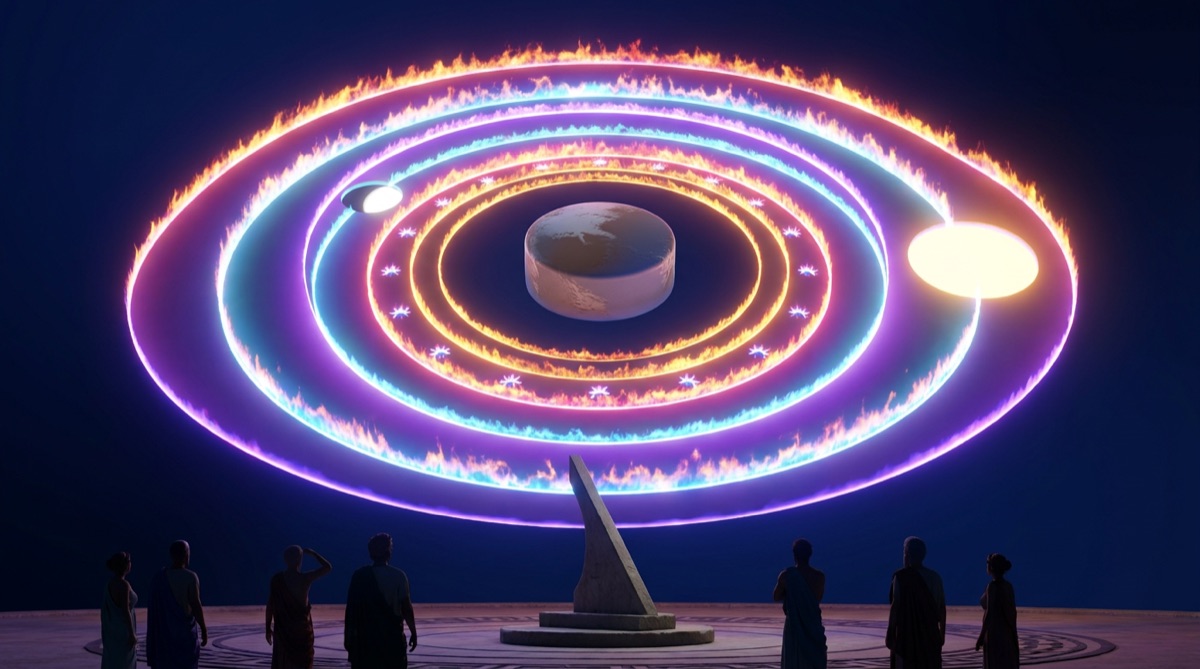
Anaximander: an Earth that floats unsupported
Anaximander of Miletus pictured the Earth as a drum suspended at the center of the cosmos, with nothing holding it up, surrounded by wheels of fire that we see as the Sun, the Moon and the stars. It is the first model of the universe that needs no physical support, and he is also credited with using the gnomon to mark solstices and equinoxes.
👤 Anaximander · 📍 Miletus
Sources (2)
- Couprie, D. L. (2011). Heaven and Earth in Ancient Greek Cosmology: From Thales to Heraclides Ponticus. Springer, chs. 8–12. https://doi.org/10.1007/978-1-4419-8116-5
- Diogenes Laertius, Lives of Eminent Philosophers, II.1–2 (Trans. C. García Gual, Alianza).
- c. 5th century BCE
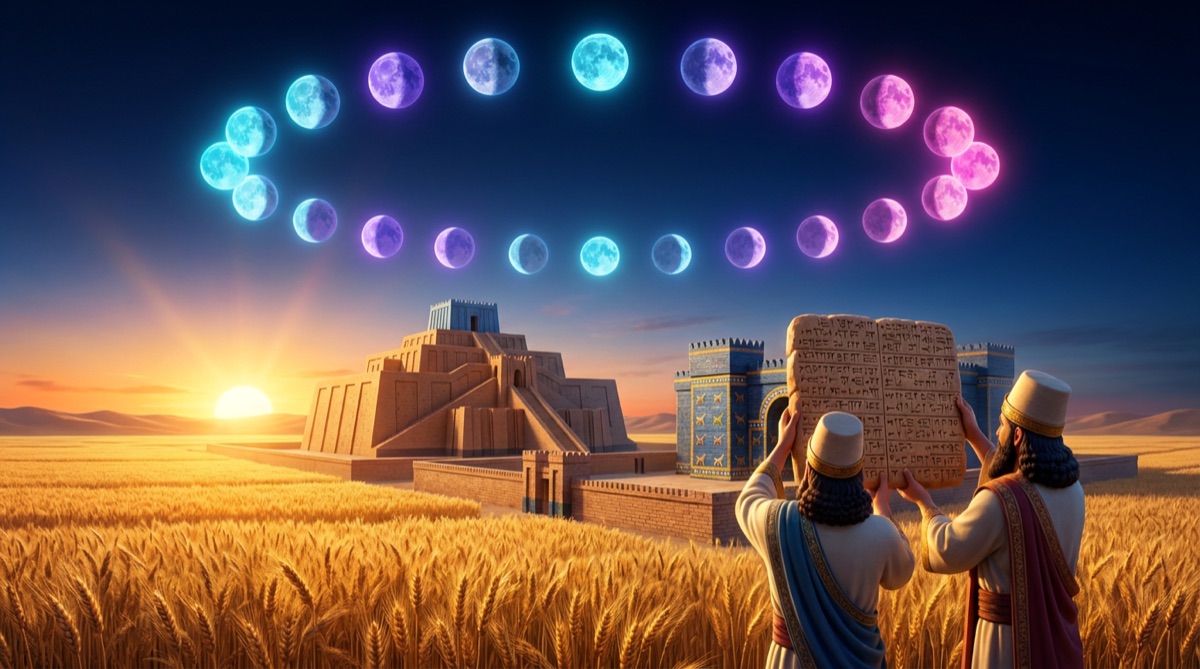
The 19-year cycle for the calendar
The Babylonians fixed a rule: 7 extra months in every 19 years, because 19 solar years are almost exactly equal to 235 lunar months. The calendar no longer depended on royal decrees. The Greeks learned the same rule from Meton (432 BCE), and the Hebrew calendar uses it today.
📍 Babylon
📘 The lunar calendar Synodic month
Sources (2)
- Britton, J. P. (2007). Calendars, intercalations and year-lengths in Mesopotamian astronomy. In Steele (ed.), Calendars and Years, Oxbow Books, 115–132.
- Parker, R. A. & Dubberstein, W. H. (1956). Babylonian Chronology 626 B.C.–A.D. 75. Brown University Press.
- c. 500 BCE
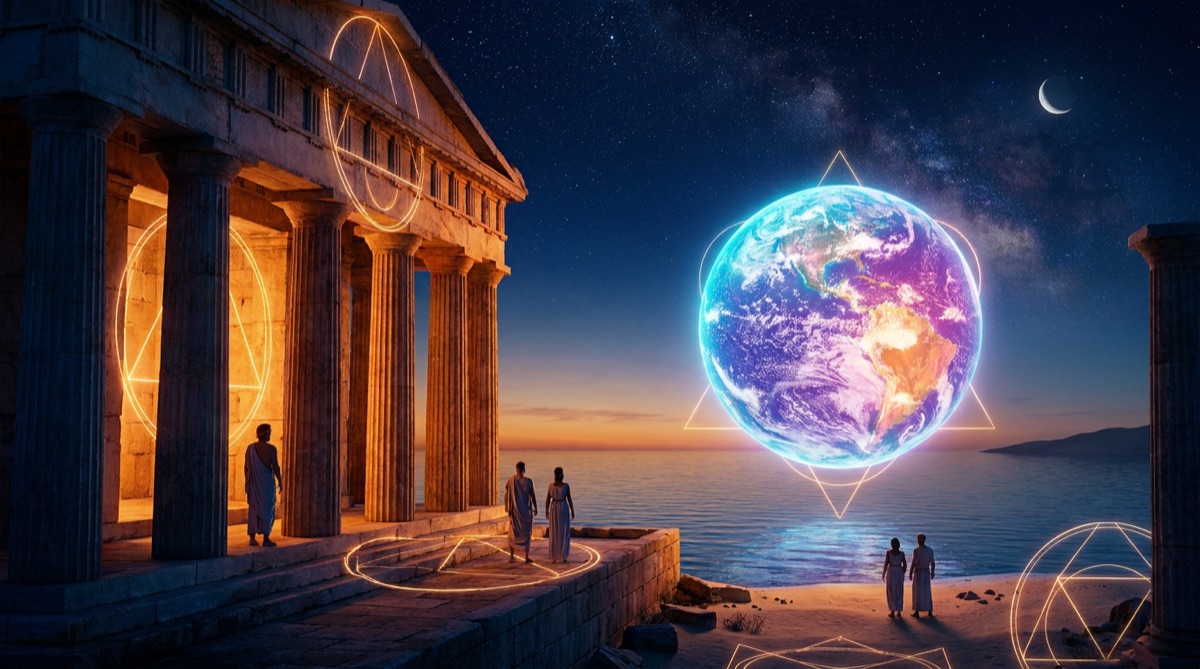
The Pythagoreans and the spherical Earth
The idea that the Earth is a sphere appears in the Pythagorean circles of southern Italy. Ancient authors attribute it to Pythagoras or to Parmenides, but neither of them left any writings: the attribution is uncertain, and sphericity probably took hold gradually, for aesthetic reasons rather than from evidence.
👤 Pythagoras, Parmenides · 📍 Croton and Elea (Magna Graecia)
Sources (2)
- Diogenes Laertius, Lives of Eminent Philosophers, VIII.48 and IX.21.
- Evans, J. (1998). The History and Practice of Ancient Astronomy. Oxford University Press, ch. 2.
- c. 500 BCE
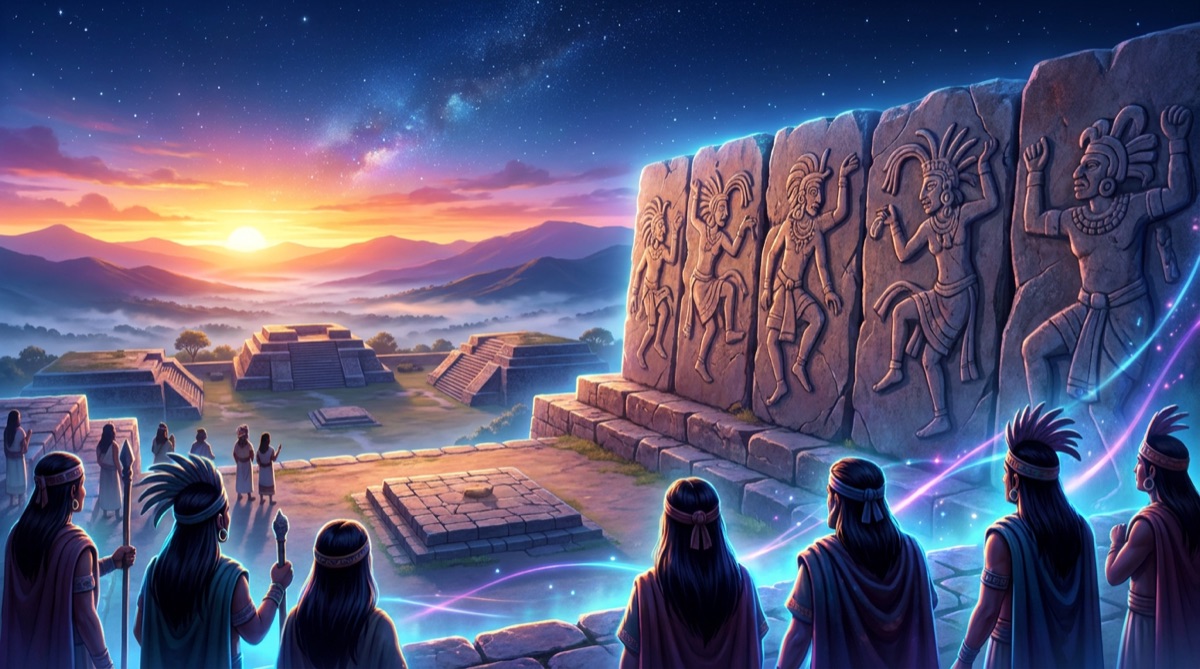
Founding of Monte Albán
The Zapotecs found their capital on a hill in the Valley of Oaxaca. Their “danzantes” stelae already carry day and year glyphs, proof that the 260- and 365-day calendar was in use.
📍 Monte Albán, Oaxaca (Mexico)
Sources (2)
- UNESCO, World Heritage List: Historic Centre of Oaxaca and Archaeological Site of Monte Albán (1987). https://whc.unesco.org/es/list/415
- Marcus, J. & Flannery, K. V. (1996). Zapotec Civilization. Thames & Hudson.
- c. 500 BCE
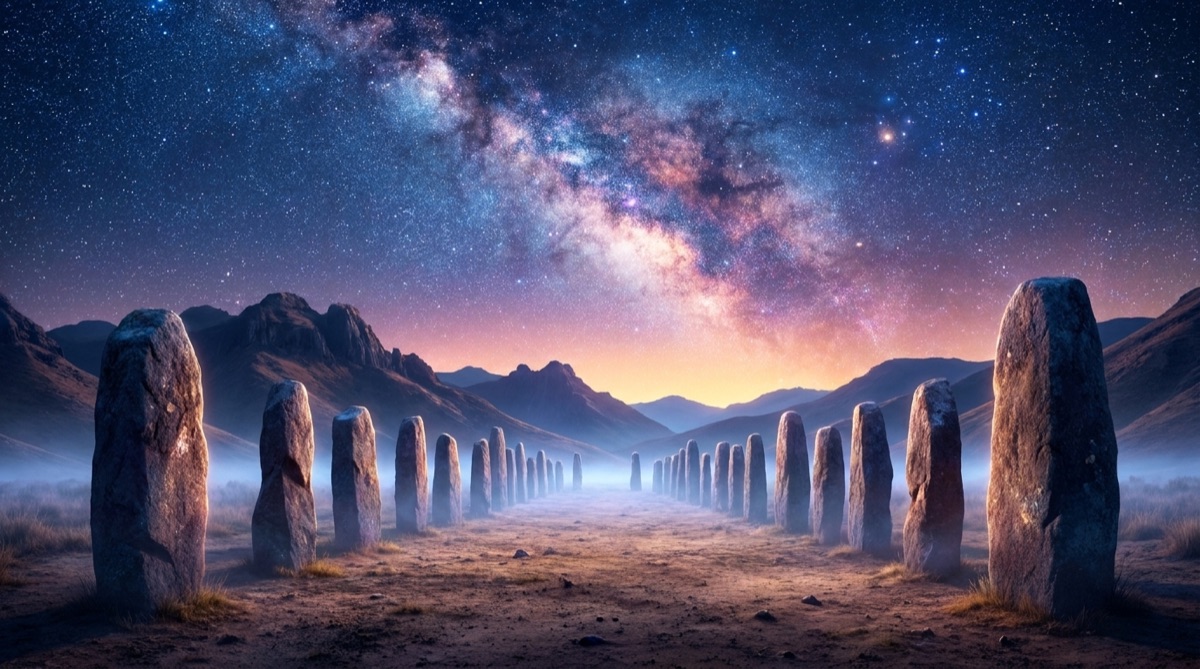
c. 9th century BCE – 2nd century BCE (strata); the columns' date is debated
El Infiernito (Monquirá), in Villa de Leyva
Two parallel rows of stone columns, more than a hundred in total, on the Cundinamarca–Boyacá high plateau. The radiocarbon dates of the excavated strata range from c. 900 BCE to c. 200 BCE, but the date of the columns and their use as an “observatory” (alignment with sunrise at the equinoxes) are still under discussion.
📍 Villa de Leyva, Boyacá (Colombia)
📘 Seasons and latitude Equinox
Sources (2)
- Silva Celis, E. (1981). Investigaciones arqueológicas en Villa de Leiva [Archaeological investigations in Villa de Leiva]. Boletín Museo del Oro 10 (Banco de la República, Bogotá).
- Acosta, J. (1848). Compendio histórico del descubrimiento y colonización de la Nueva Granada en el siglo décimo sexto [Historical compendium of the discovery and colonization of New Granada in the sixteenth century]. Paris (first description of the columns).
- 5th century BCE
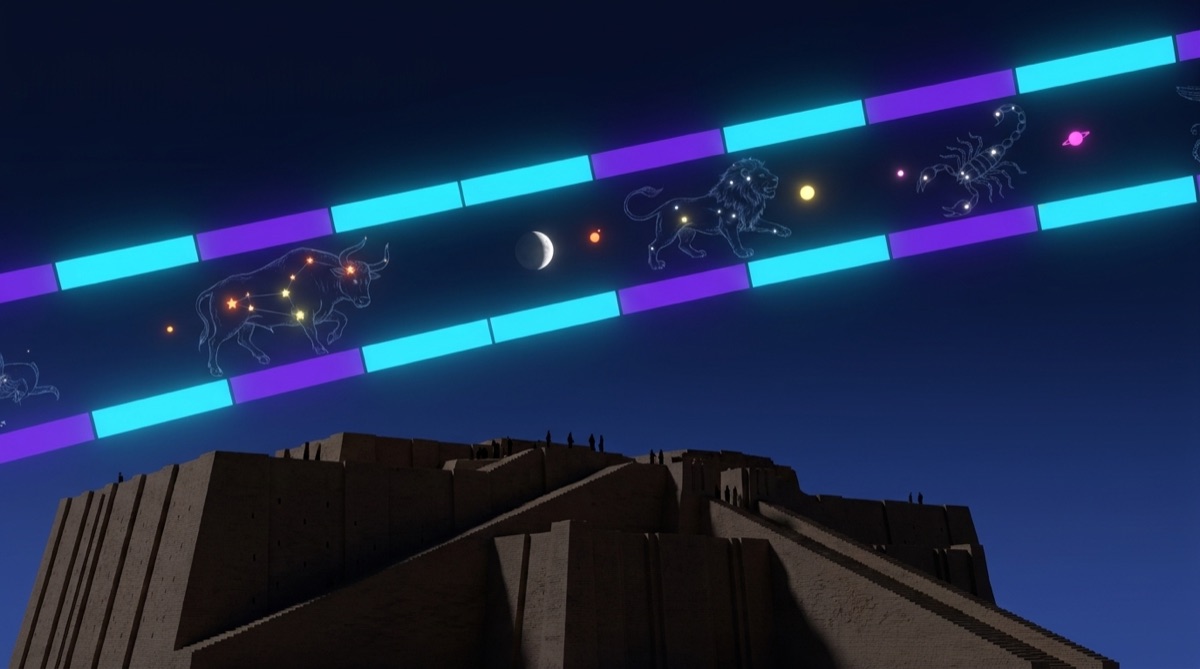
The zodiac of 12 equal signs
To compute positions, Babylonian astronomers divided the band of sky along which the Sun, the Moon and the planets move into 12 signs of 30° each, named after the nearby constellations. The oldest surviving horoscope is for a birth in 410 BCE.
📍 Babylon
📘 Celestial coordinates EclipticConstellation
Sources (2)
- Rochberg, F. (1998). Babylonian Horoscopes. Transactions of the American Philosophical Society 88(1).
- Britton, J. P. (2010). Studies in Babylonian lunar theory, part III: the introduction of the uniform zodiac. Archive for History of Exact Sciences 64, 617–663. https://doi.org/10.1007/s00407-010-0064-z
- 5th century BCE
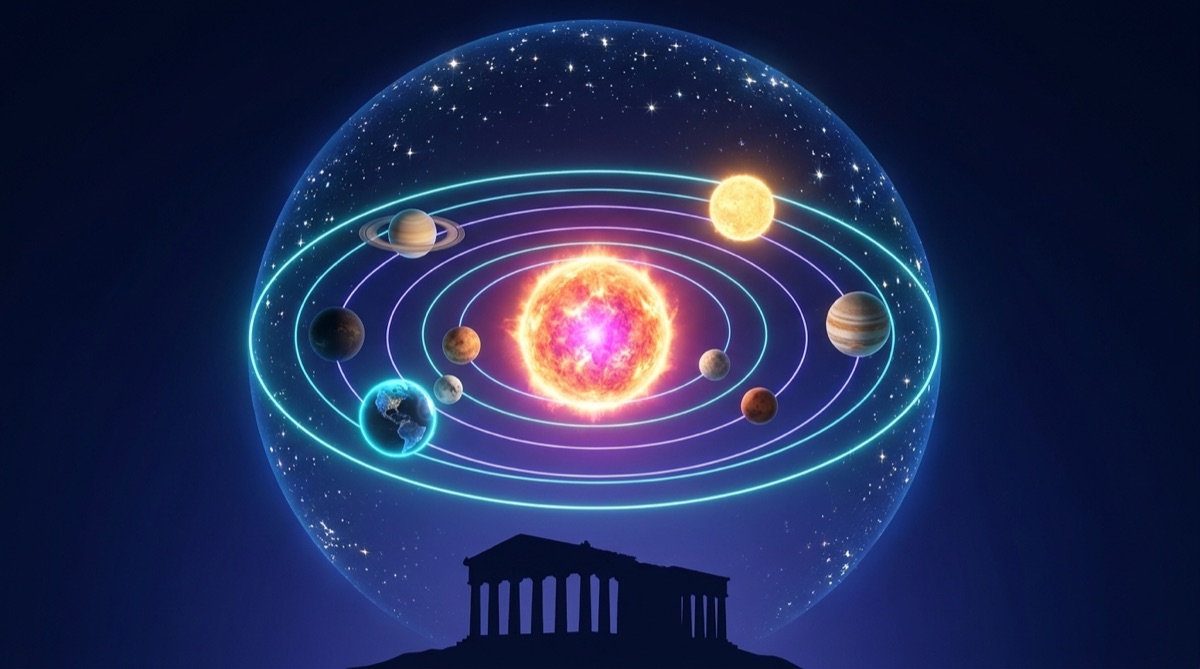
Philolaus: the Earth moves around a central fire
The Pythagorean Philolaus of Croton proposed that the Earth is not at the center but revolves, together with the Sun, the Moon and a “counter-Earth”, around an invisible central fire. It is not heliocentrism, but it is the first time anyone set the Earth in motion.
👤 Philolaus of Croton · 📍 Magna Graecia
Sources (2)
- Aristotle, On the Heavens, II.13, 293a (Trans. M. Candel, Gredos).
- Huffman, C. A. (1993). Philolaus of Croton: Pythagorean and Presocratic. Cambridge University Press.
- 432 BCE
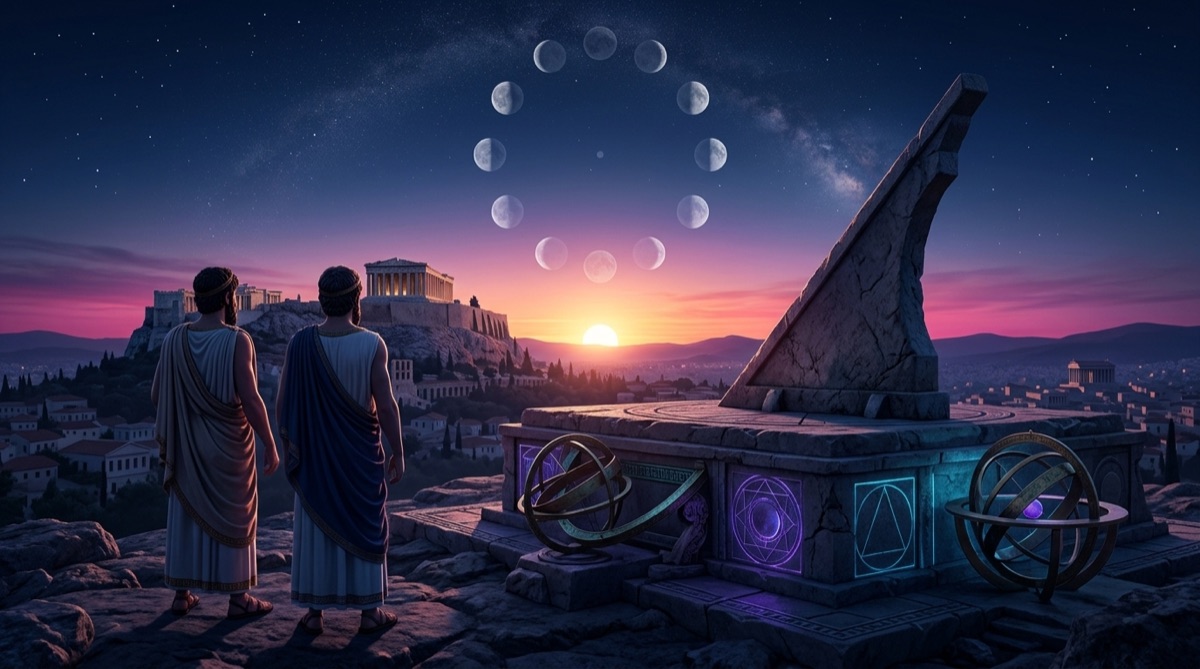
Meton and Euctemon: the solstice and the 19-year cycle
In Athens, Meton and Euctemon observed the summer solstice of June 27, 432 BCE, the oldest dated Greek observation cited by Ptolemy. Meton also proposed a 19-year cycle of 235 lunar months to fit the Moon's calendar to the Sun's: the “Metonic cycle”, already known to the Babylonians and still used to calculate the date of Easter.
👤 Meton of Athens, Euctemon · 📍 Athens
🧪 Phases of the Moon SolsticeSynodic month
Sources (2)
- Ptolemy, Almagest, III.1 (Trans. G. J. Toomer, Princeton University Press, 1998).
- Evans, J. (1998). The History and Practice of Ancient Astronomy. Oxford University Press, ch. 4 (“Calendars”).
- 4th–3rd centuries BCE
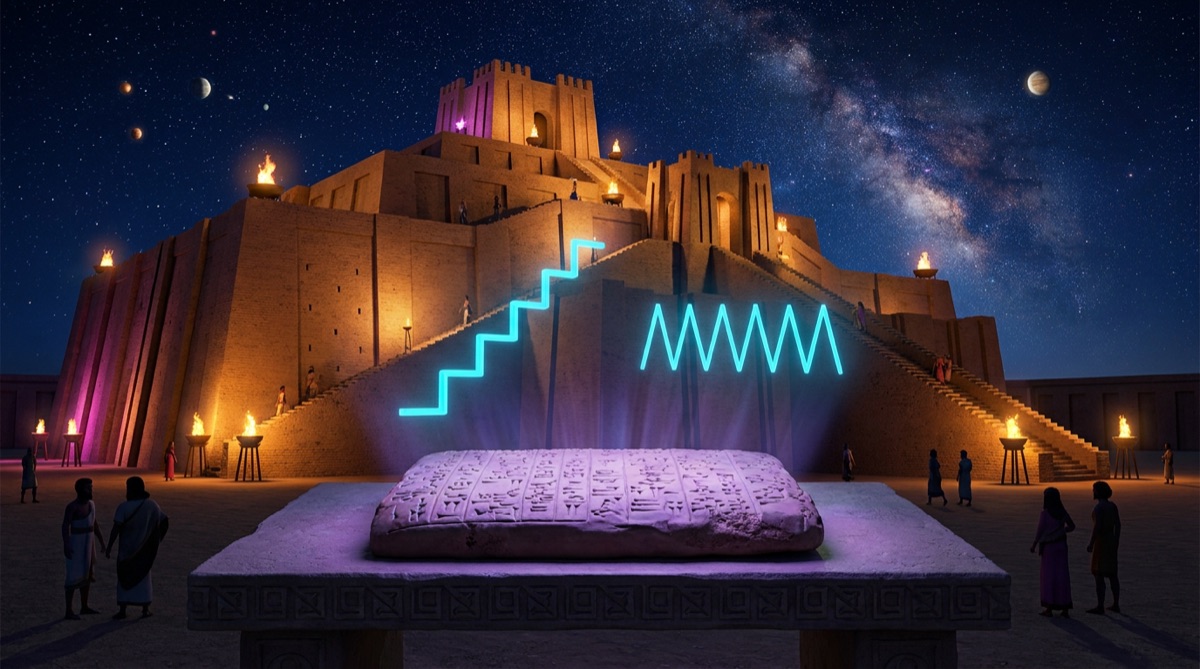
Mathematical astronomy: Systems A and B
Without any geometric model of the cosmos, Babylonian scribes computed with pure numerical tables when there would be a new Moon, an eclipse or a planetary rising. System A uses velocities that change in steps; System B, a zigzag function. The Greek tradition attributes these methods to Kidinnu and Naburimannu, but the attribution is doubtful.
👤 Kidinnu, Naburimannu · 📍 Babylon and Uruk
Sources (3)
- Neugebauer, O. (1955). Astronomical Cuneiform Texts. Lund Humphries (3 vols.).
- Ossendrijver, M. (2012). Babylonian Mathematical Astronomy: Procedure Texts. Springer.
- Neugebauer, O. (1975). A History of Ancient Mathematical Astronomy. Springer, book II.
- c. 400 BCE
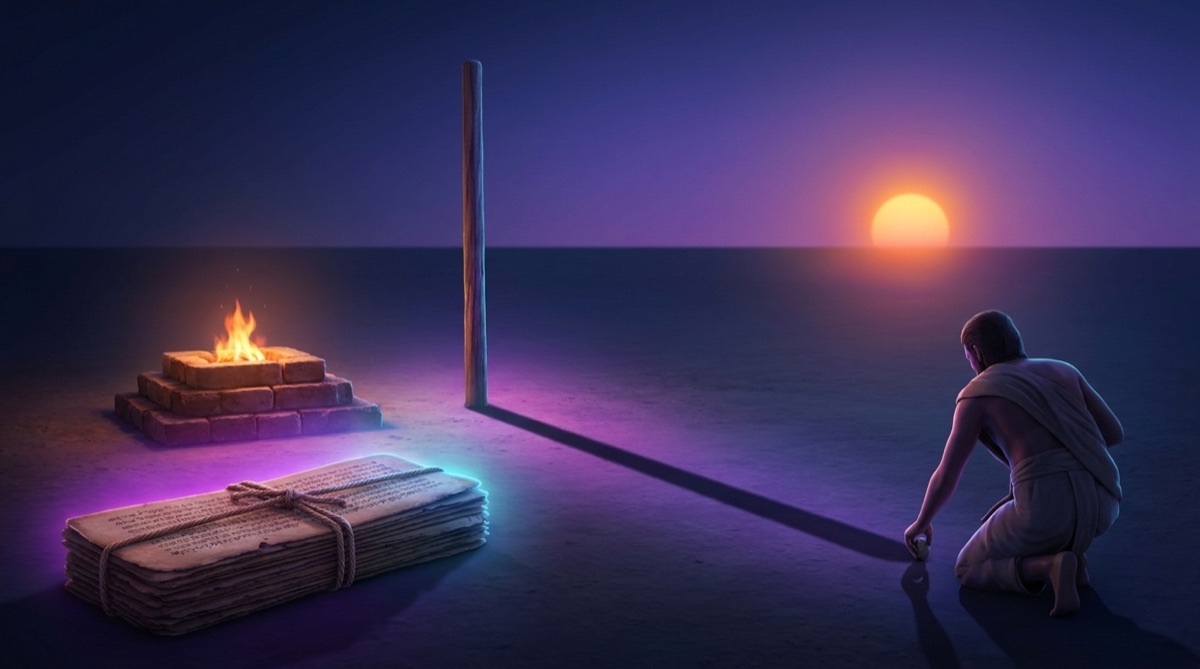
between the 12th and 4th centuries BCE, depending on the author
The Vedanga Jyotisha of Lagadha
The oldest treatise of Indian astronomy is a calendar manual: it organizes the years in cycles of five with intercalary months and gives arithmetical rules for the time of the solstices and the length of the day. Its date is much debated: it describes a sky of around 1200 BCE, but many specialists believe that the text we have was written down centuries later.
👤 Lagadha · 📍 Northern India
Sources (2)
- Pingree, D. (1973). The Mesopotamian origin of early Indian mathematical astronomy. JHA 4, 1–12 (discussion of the date).
- Plofker, K. (2009). Mathematics in India, pp. 35–40.
- c. 370 BCE
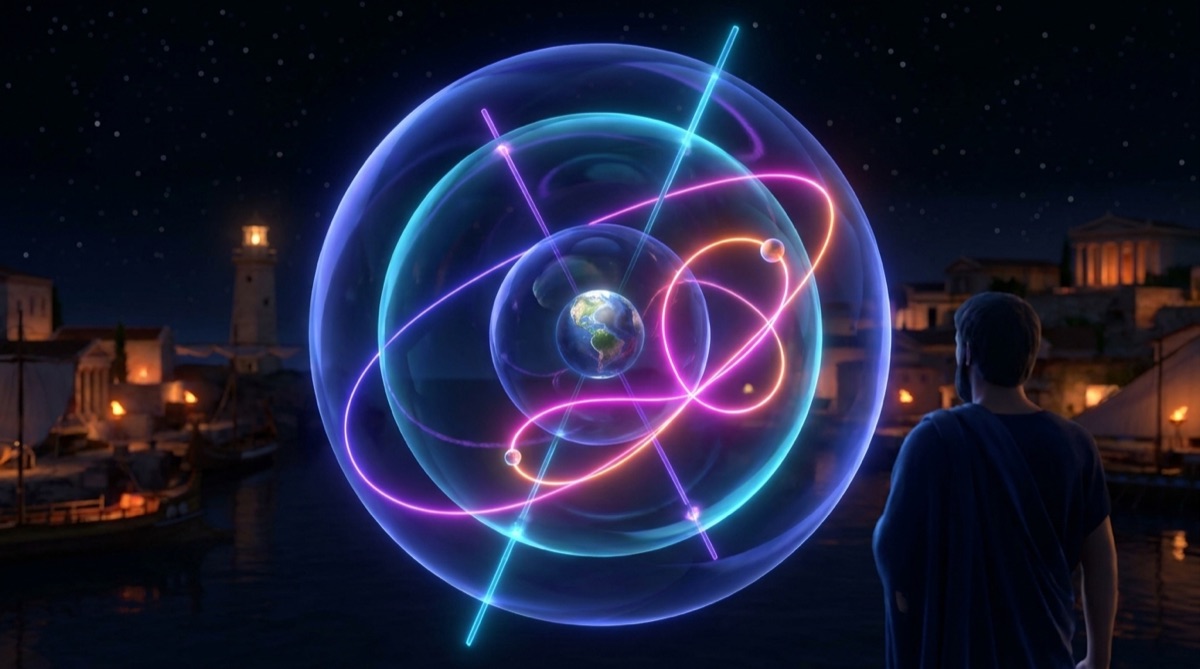
Eudoxus: the homocentric spheres
Eudoxus of Cnidus built the first geometric model of planetary motions: each celestial body rides on a set of nested spheres turning at different speeds around the Earth. With three or four spheres per planet he reproduced, approximately, the retrograde loops that the planets trace in the sky.
👤 Eudoxus of Cnidus · 📍 Cnidus and Athens
Sources (2)
- Aristotle, Metaphysics, XII.8, 1073b–1074a (Trans. T. Calvo, Gredos).
- Evans, J. (1998). The History and Practice of Ancient Astronomy. Oxford University Press, ch. 7.
- 4th century BCE

Gan De and Shi Shen: the first star catalogs
Two astronomers of the Warring States period compiled lists of stars with their positions, more than a century before Hipparchus. A fragment by Gan De describes a “small reddish star” next to Jupiter that some historians interpret as a moon of the planet seen with the naked eye; it is a hypothesis, not an established fact.
👤 Gan De, Shi Shen · 📍 States of Qi and Wei, China
Sources (2)
- Needham & Wang (1959), Science and Civilisation in China, vol. 3, pp. 197–200 and 263–270.
- Xi Zezong (1981). The sighting of Jupiter's satellite by Gan De 2000 years before Galileo. Chinese Astronomy and Astrophysics 5(3), 242–243. https://doi.org/10.1016/0275-1062(81)90078-7
- c. 350 BCE
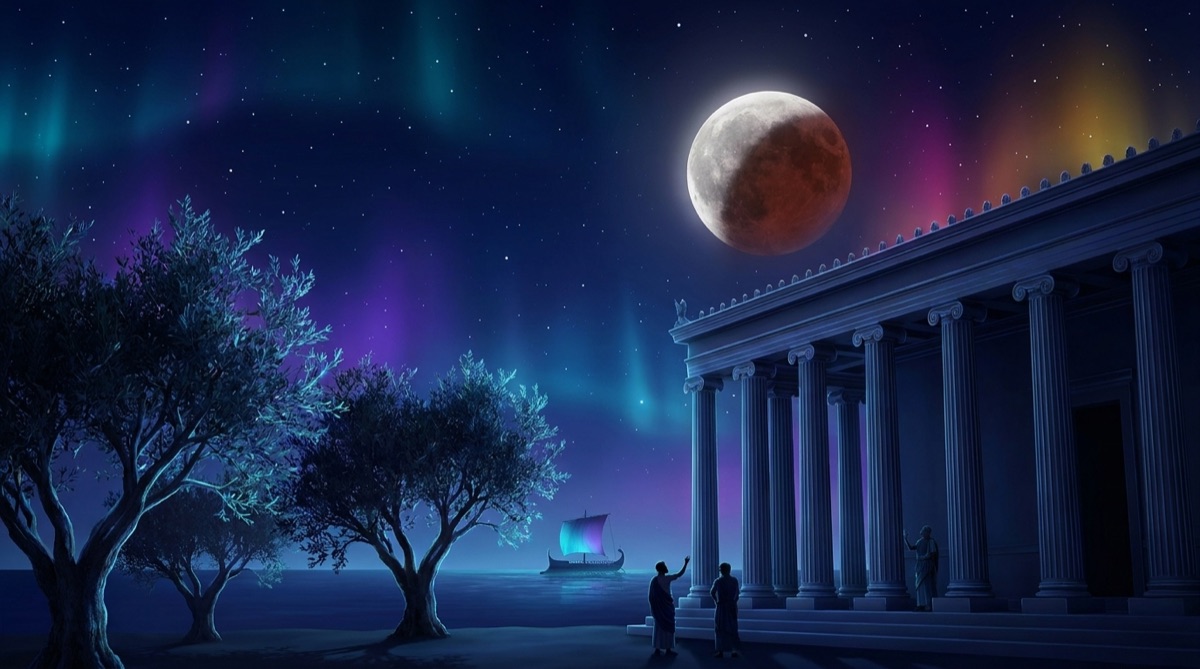
Aristotle proves that the Earth is round
In “On the Heavens”, Aristotle gathers evidence that the Earth is a sphere: the shadow it casts on the Moon during eclipses is always circular, and when traveling south, stars appear that cannot be seen from Greece. His arguments, not his authority, convinced scholars for two thousand years; no serious medieval astronomer believed in a flat Earth.
👤 Aristotle · 📍 Athens
📘 Eclipses Lunar eclipseLatitude
Sources (2)
- Aristotle, On the Heavens, II.14, 297b–298a (Trans. M. Candel, Gredos).
- Hoskin, M. (ed.) (1999). The Cambridge Concise History of Astronomy. Cambridge University Press, ch. 2.
- c. 340 BCE
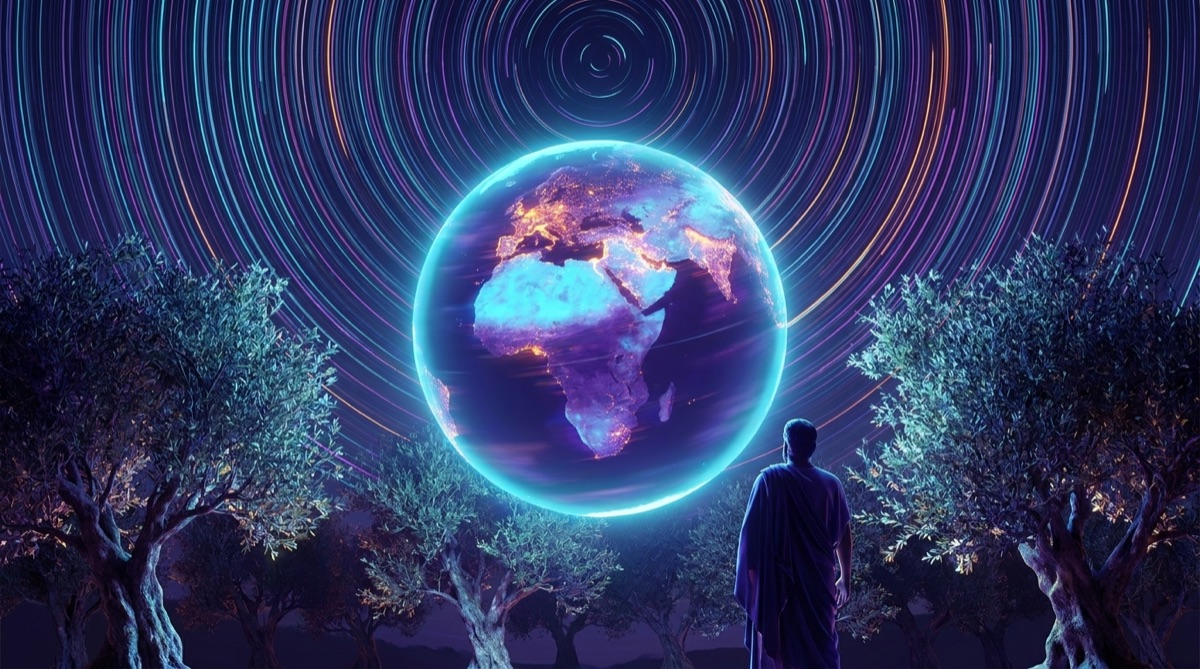
Heraclides Ponticus: the Earth spins on its axis
Heraclides, a pupil of Plato, explained the daily turning of the sky by saying that it is the Earth that makes one turn a day on its axis. He is often also credited with the idea that Mercury and Venus orbit the Sun, but current studies of the sources find no clear support for it.
👤 Heraclides Ponticus · 📍 Athens
Sources (2)
- Simplicius, Commentary on Aristotle's “On the Heavens”, 444.31–445.5 (cited in Neugebauer, O. (1975). A History of Ancient Mathematical Astronomy. Springer, pp. 694–696).
- Bowen, A. C. & Todd, R. B. (2009). Heraclides on the rotation of the Earth: texts, contexts and continuities. In W. W. Fortenbaugh & E. Pender (eds.), Heraclides of Pontus: Discussion. Transaction Publishers.
- 331 BCE
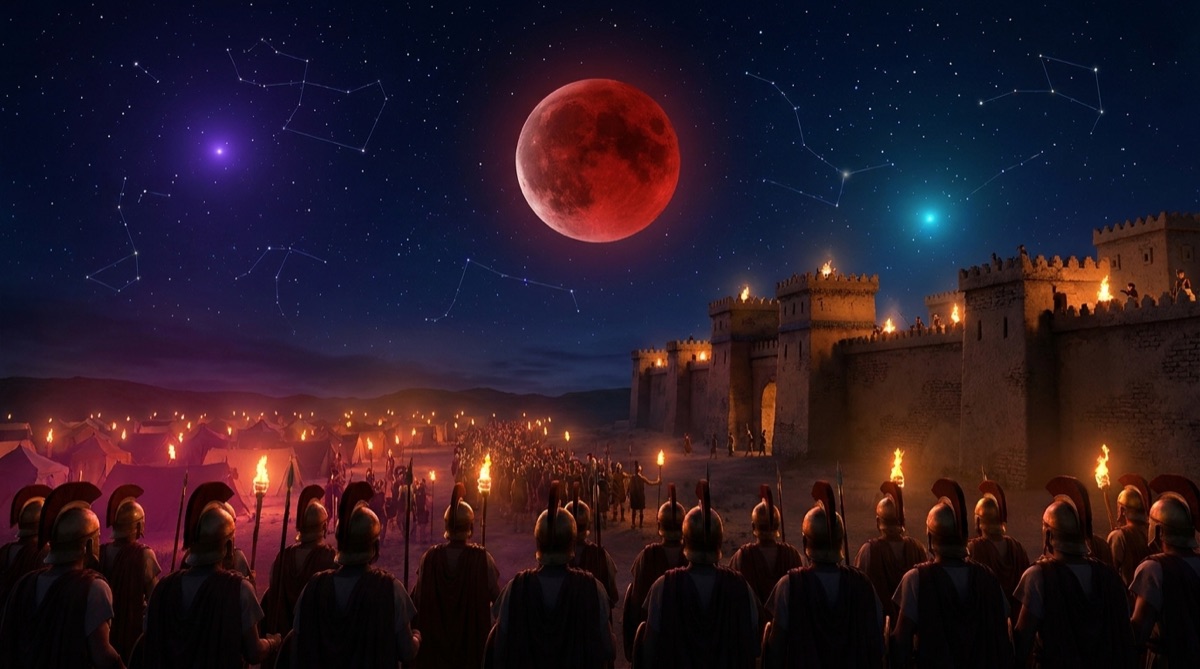
The eclipse before Gaugamela
The Diary for the year 331 BCE records the total lunar eclipse of September 20 and, days later, the defeat of the Persian king Darius III by Alexander the Great. With the conquest, Babylonian knowledge began to pass into the Greek world.
👤 Alexander the Great, Darius III · 📍 Babylon
📘 Phases of the Moon and eclipses Lunar eclipse
Sources (2)
- Sachs, A. J. & Hunger, H. (1988). Astronomical Diaries and Related Texts from Babylonia, vol. I, text no. −330.
- Steele, J. M. (2000). Observations and Predictions of Eclipse Times by Early Astronomers. Kluwer.
- c. 320 BCE

Pytheas sails north and measures latitudes
The navigator Pytheas of Massalia (Marseille) traveled to Britain and beyond; he measured the latitude of his city with a gnomon, described the midnight sun and linked the tides to the Moon. It is an early example of astronomy in the service of navigation.
👤 Pytheas of Massalia · 📍 Massalia (Marseille) and the North Atlantic
Sources (2)
- Strabo, Geography, I.4.2–5 and II.5.8 (Trans. J. L. García Ramón and J. García Blanco, Gredos).
- Roseman, C. H. (1994). Pytheas of Massalia: On the Ocean. Ares Publishers.
- c. 310 BCE
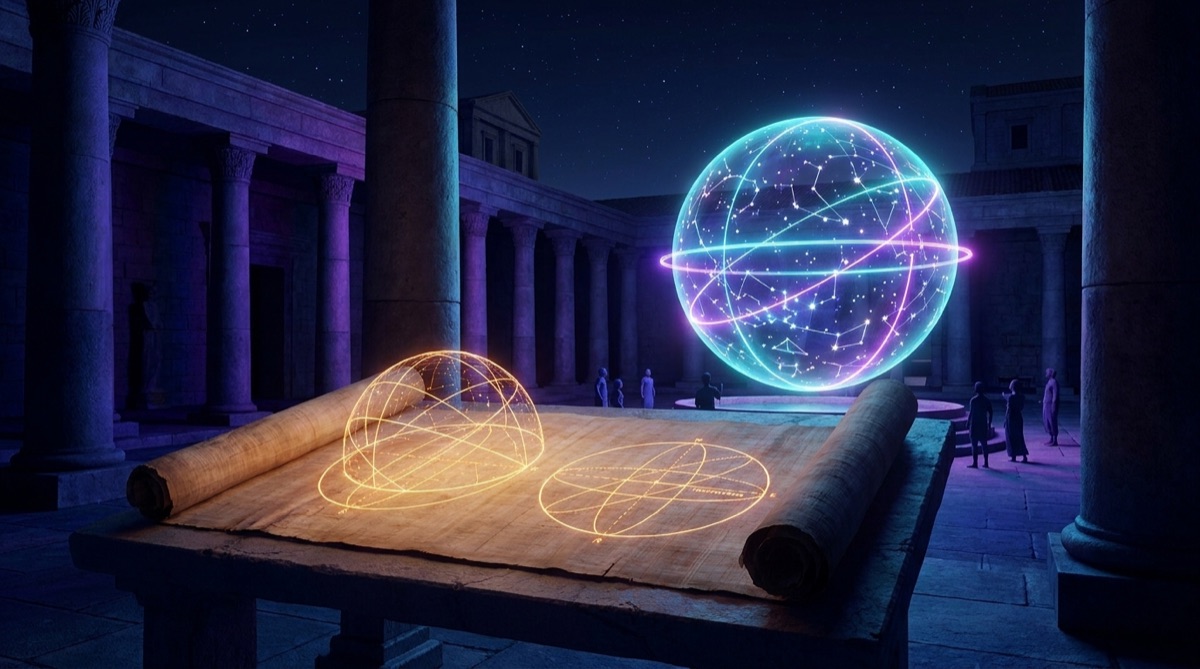
Autolycus and Euclid: astronomy as geometry of the sphere
“On the Moving Sphere”, by Autolycus of Pitane, and Euclid's “Phaenomena” are the oldest mathematical treatises on astronomy that survive complete. They prove with theorems how the stars rise and set on a rotating sphere: from here on, the sky is studied with the same logic as the “Elements”.
👤 Autolycus of Pitane, Euclid · 📍 Pitane and Alexandria
🧪 Interactive planisphere Celestial sphereHorizon
Sources (2)
- Berggren, J. L. & Thomas, R. S. D. (1996). Euclid's Phaenomena: A Translation and Study of a Hellenistic Treatise in Spherical Astronomy. Garland.
- Evans, J. (1998). The History and Practice of Ancient Astronomy. Oxford University Press, ch. 3.
- from c. 300 BCE
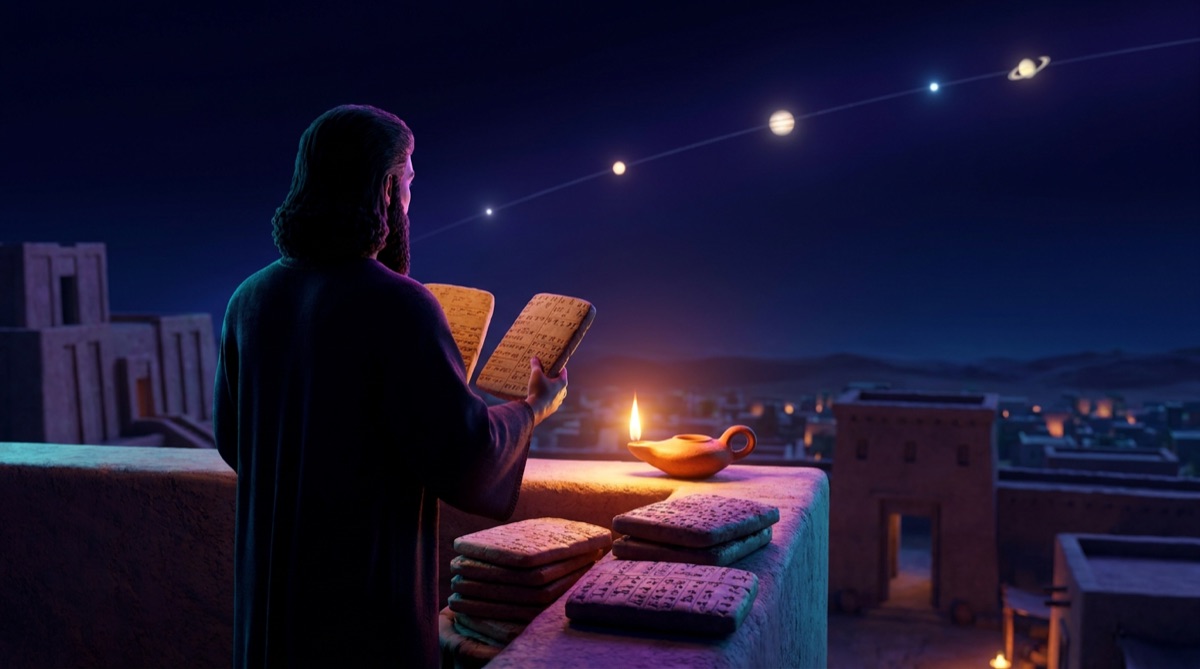
Goal-year texts and almanacs
To predict a year, the scribes copied what each planet had done a fixed number of years earlier: 8 for Venus, 59 for Saturn, 71 or 83 for Jupiter. From those repetitions they drew up almanacs with the expected dates of each phenomenon.
📍 Babylon
Orbital periodOrbital resonance
Sources (2)
- Hunger, H. (2006). Astronomical Diaries and Related Texts from Babylonia, vol. VI: Goal Year Texts. Österreichische Akademie der Wissenschaften.
- Gray, J. M. K. & Steele, J. M. (2008). Studies on Babylonian goal-year astronomy I: a comparison between planetary data in Goal-Year Texts, Almanacs and Normal Star Almanacs. Archive for History of Exact Sciences 62, 553–600.
- c. 300 BCE – 250 CE

The “Group E” of Uaxactún and the solar observation complexes
From a pyramid on the west, three temples on the east mark where the Sun rises at the solstices and the equinoxes. Frans Blom proposed it in 1924 and Aveni and Hartung measured it in the 1980s. There are dozens of “E groups” in the Maya lowlands; in many the alignments are not exact, so today it is debated how much they were used for observing and how much as a ritual stage.
👤 Frans Blom, Anthony Aveni, Horst Hartung · 📍 Uaxactún, Petén (Guatemala)
📘 Seasons and latitude SolsticeEquinox
Sources (2)
- Aveni, A. F., Dowd, A. S. & Vining, B. (2003). Maya Calendar Reform? Evidence from Orientations of Specialized Architectural Assemblages. Latin American Antiquity 14(2), 159–178.
- Aveni, A. F. (2001). Skywatchers. University of Texas Press, ch. 6.
- c. 290 BCE
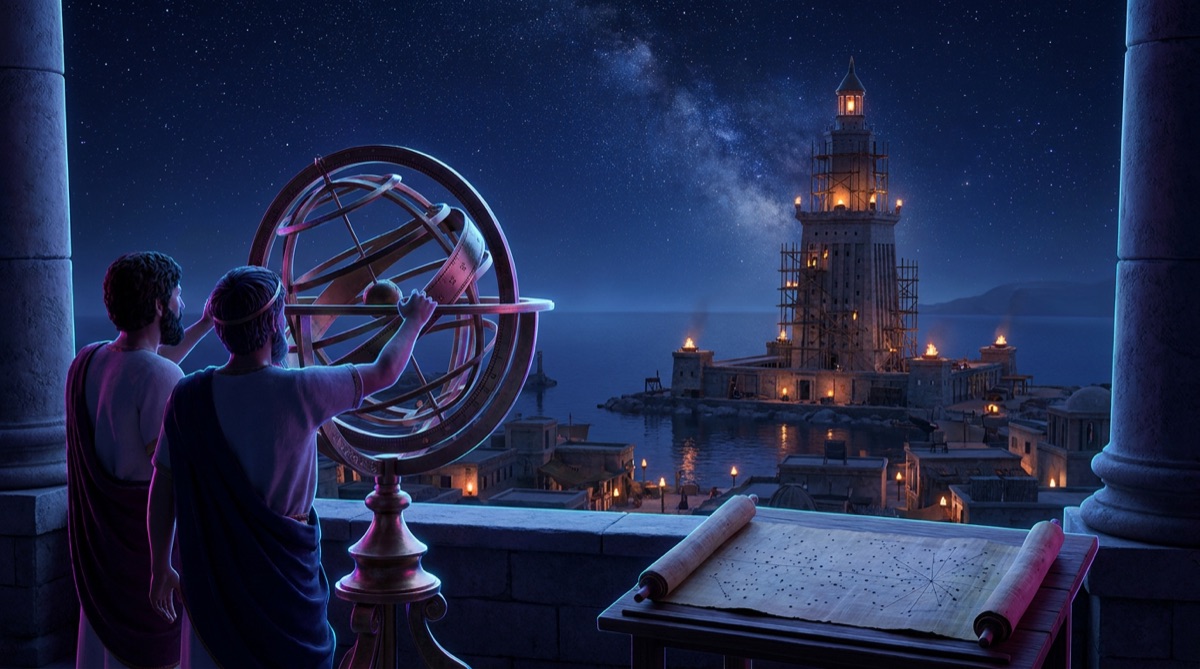
Timocharis and Aristyllus measure star positions in Alexandria
In the Alexandria of the first Ptolemies, Timocharis and Aristyllus recorded the positions of bright stars to a precision of a tenth of a degree. They are the oldest dated Greek stellar observations, and a century and a half later they allowed Hipparchus to discover precession.
👤 Timocharis, Aristyllus · 📍 Alexandria
Sources (2)
- Ptolemy, Almagest, VII.3 (Trans. G. J. Toomer, Princeton University Press, 1998).
- Brandt, J. C., Zimmer, P. & Jones, P. B. (2014). Declinations in the Almagest: accuracy, epoch, and observers. Journal of Astronomical History and Heritage 17(3), 326–338.
- c. 280 BCE
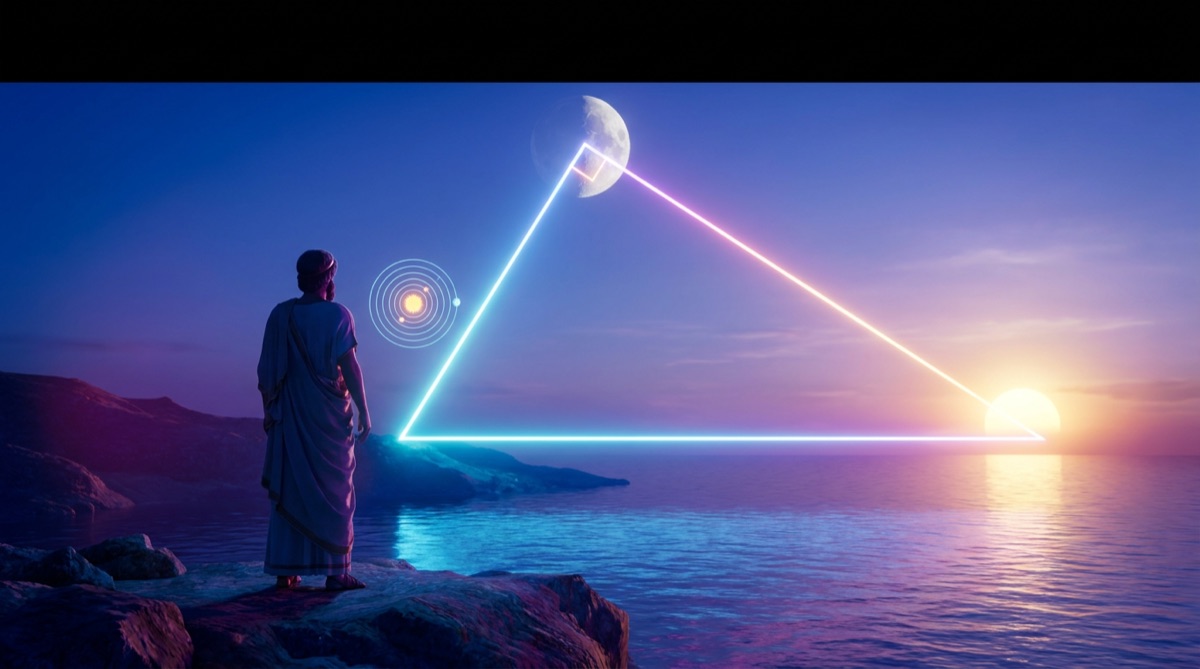
Aristarchus: sizes, distances and a Sun at the center
Aristarchus of Samos used geometry to calculate how many times farther away the Sun is than the Moon (about 19, according to his measurement of the angle at first quarter; the real value is about 390) and how much larger the Sun is than the Earth. According to Archimedes in “The Sand Reckoner”, he also proposed that the Earth revolves around the Sun, an idea that almost no one accepted in his time.
👤 Aristarchus of Samos, Archimedes · 📍 Samos and Alexandria
📘 Aristarchus: Earth–Moon–Sun distances Phases of the MoonLunar eclipse
Sources (2)
- Heath, T. L. (1913). Aristarchus of Samos, the Ancient Copernican. Clarendon Press (translation of “On the Sizes and Distances of the Sun and Moon”).
- Archimedes, The Sand Reckoner, 1 (in Heath, T. L. (1897). The Works of Archimedes. Cambridge University Press, pp. 221–222).
- 4th–3rd centuries BCE
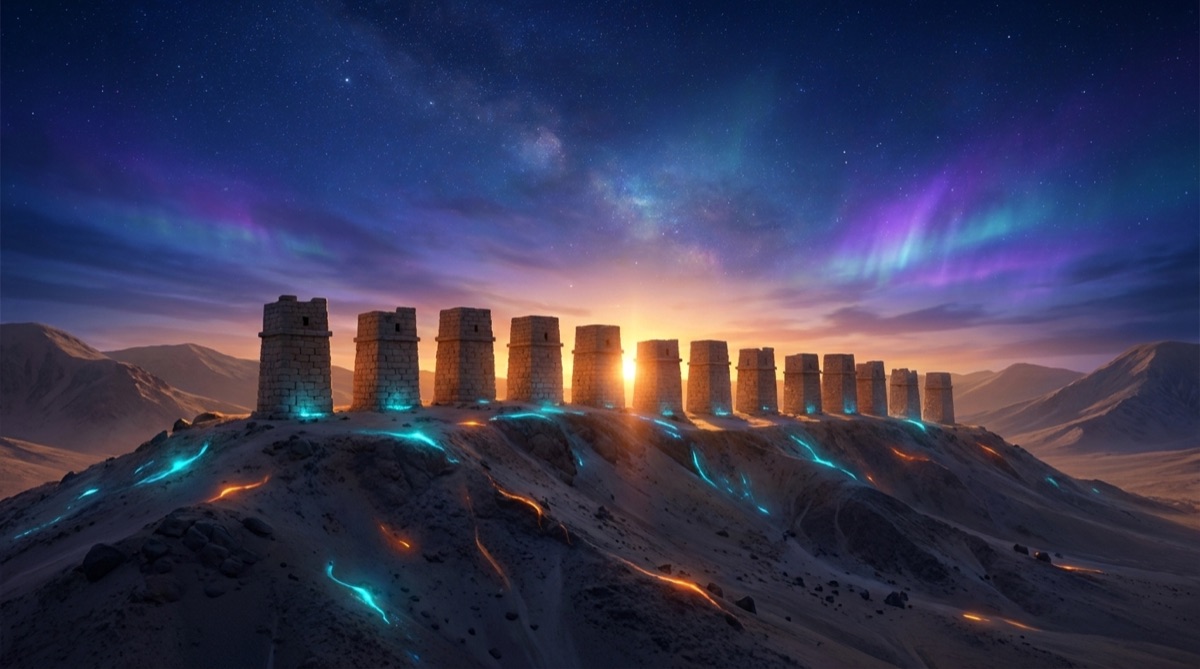
The thirteen towers of Chankillo
Thirteen stone towers stand in a row on a ridge in the Casma Valley. Seen from two observation points, they cover almost exactly the arc along which the Sun rises (and sets) over the year: at the June solstice it rises beside the northernmost tower, at the December solstice beside the southernmost. It is the oldest known solar observatory in the Americas.
📍 Chankillo, Casma Valley, Áncash (Peru)
📘 Seasons and latitude 🧪 Day, night and the seasons SolsticeHorizon
Sources (2)
- Ghezzi, I. & Ruggles, C. (2007). Chankillo: A 2300-Year-Old Solar Observatory in Coastal Peru. Science 315, 1239–1243. https://doi.org/10.1126/science.1136415
- UNESCO, World Heritage List: Chankillo Archaeoastronomical Complex (2021). https://whc.unesco.org/es/list/1624
- c. 240 BCE
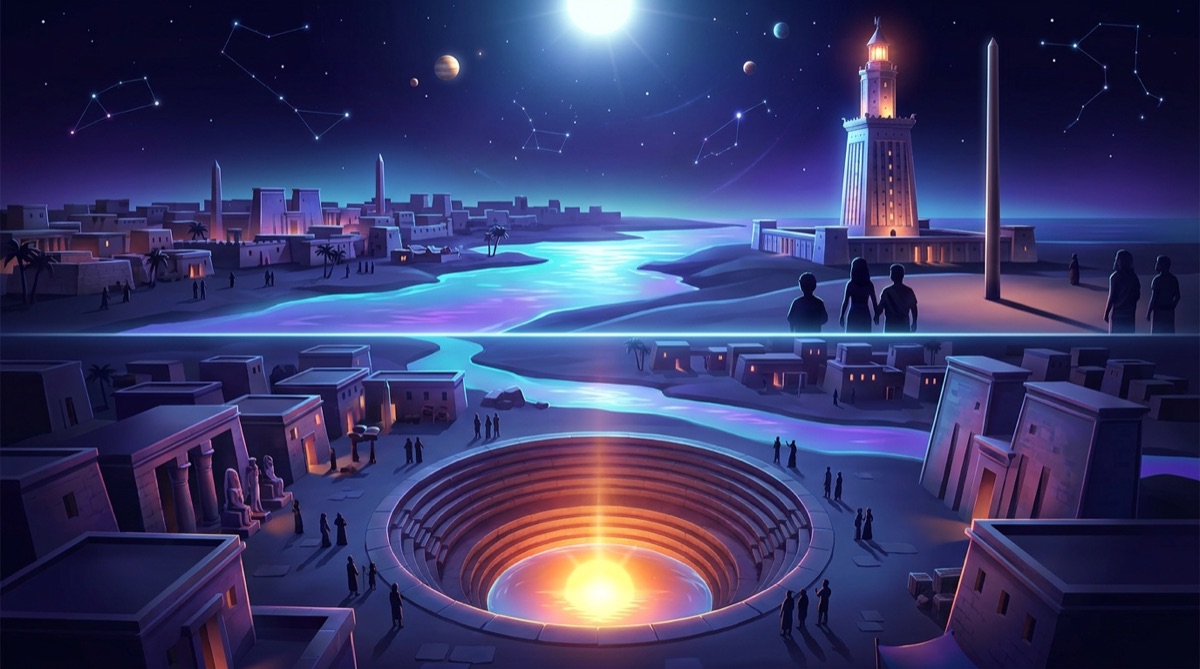
Eratosthenes measures the Earth from Alexandria
The librarian of Alexandria compared the noon shadow at the solstice in Alexandria with the absence of a shadow at Syene (Aswan) and calculated the circumference of the Earth as 250 000 stadia, a value surprisingly close to the real one. Egypt, with its north–south geography, made the experiment possible.
👤 Eratosthenes · 📍 Alexandria and Syene, Egypt
📘 Eratosthenes measures the Earth 🧪 Eratosthenes measures the Earth GnomonLatitudeSolstice
Sources (2)
- Cleomedes, Caelestia I.7 (Trans. A. C. Bowen & R. B. Todd, Cleomedes' Lectures on Astronomy, University of California Press, 2004).
- Evans, J. (1998). The History and Practice of Ancient Astronomy. Oxford University Press, 63–66.
- 240 BCE

Halley's Comet in the Records of the Grand Historian
The Shiji of Sima Qian describes a “broom star” that appeared in the east and then in the north in 240 BCE. It is the oldest record that astronomers accept with confidence as Halley's Comet; China recorded it at every one of its apparitions from then on.
👤 Sima Qian · 📍 China (Qin dynasty)
🧪 Keplerian orbit OrbitPerihelion
Sources (2)
- Kiang, T. (1972). The past orbit of Halley's comet. Memoirs of the Royal Astronomical Society 76, 27–66.
- Stephenson, F. R. & Yau, K. K. C. (1985). Far Eastern observations of Halley's comet: 240 BC to AD 1368. Journal of the British Interplanetary Society 38, 195–216.
- c. 240 BCE
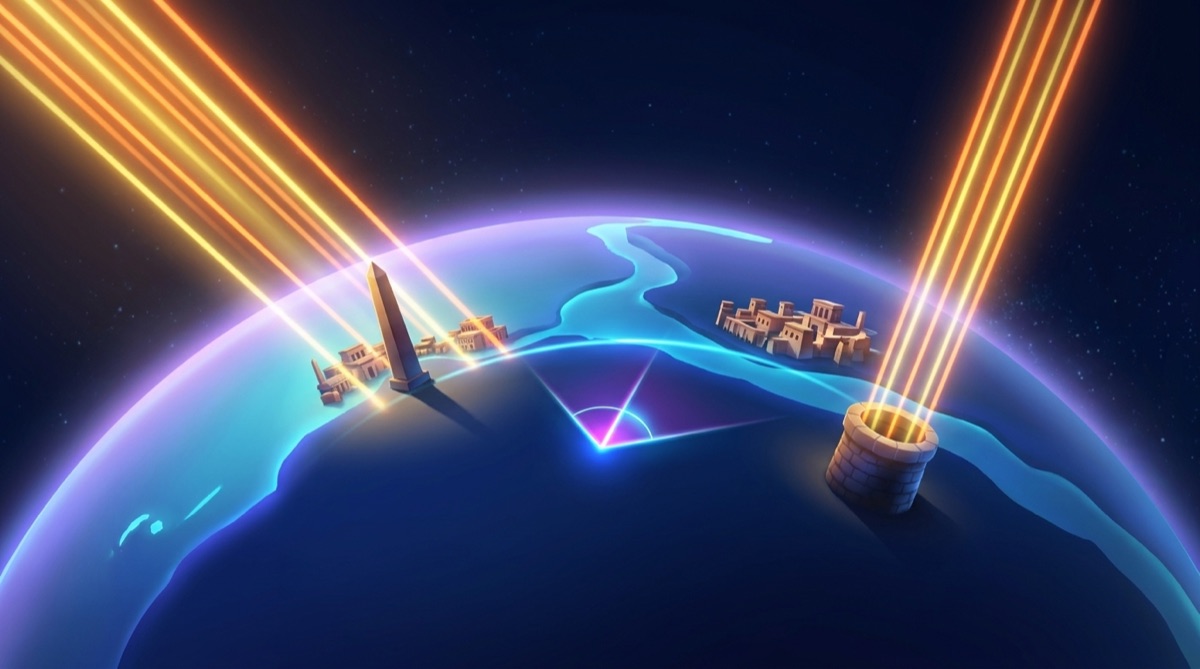
Eratosthenes measures the circumference of the Earth
Eratosthenes of Cyrene, head of the Library of Alexandria, compared the shadow of a gnomon in Alexandria with the absence of shadow in Syene (Aswan) at the solstice and obtained an angle of 1/50 of a circle. Multiplying by the distance between the two cities, 5 000 stadia, he estimated the Earth's circumference at 250 000 stadia, a result remarkably close to the real one.
👤 Eratosthenes of Cyrene · 📍 Alexandria and Syene (Aswan)
📘 Eratosthenes measures the Earth 🧪 Eratosthenes measures the Earth GnomonLatitude
Sources (2)
- Cleomedes, Caelestia, I.7 (Trans. A. C. Bowen & R. B. Todd, Cleomedes' Lectures on Astronomy, University of California Press, 2004).
- Evans, J. (1998). The History and Practice of Ancient Astronomy. Oxford University Press, pp. 63–66.
- 238 BCE
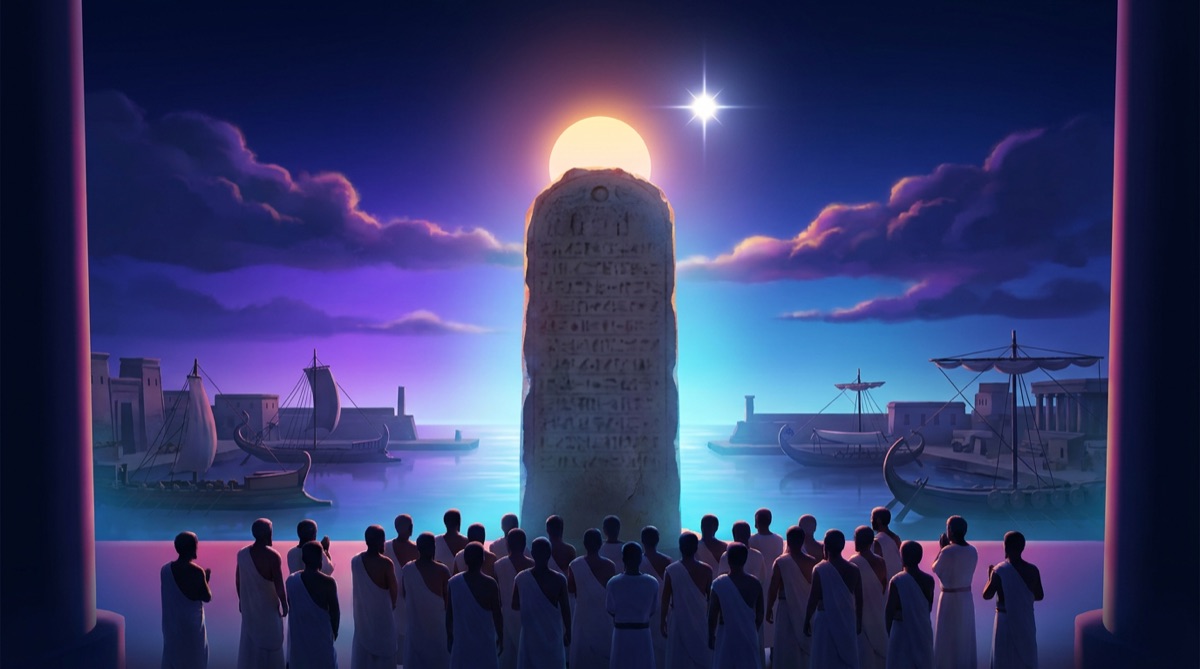
The Decree of Canopus proposes the leap year
On March 7, 238 BCE, under Ptolemy III, an assembly of priests decreed the addition of a sixth “added” day every four years so that the festivals would stop drifting through the seasons. The reform was not implemented, but it is the first documented proposal of a leap year.
👤 Ptolemy III Euergetes · 📍 Canopus, Egypt
Sources (3)
- Canopus Stone (found at Tanis in 1866; Egyptian Museum, Cairo), trilingual text in hieroglyphic, Demotic and Greek.
- Depuydt, L. (1997). Civil Calendar and Lunar Calendar in Ancient Egypt. Peeters.
- Clagett, M. (1995). Ancient Egyptian Science, vol. II. American Philosophical Society.
- between 350 and 50 BCE
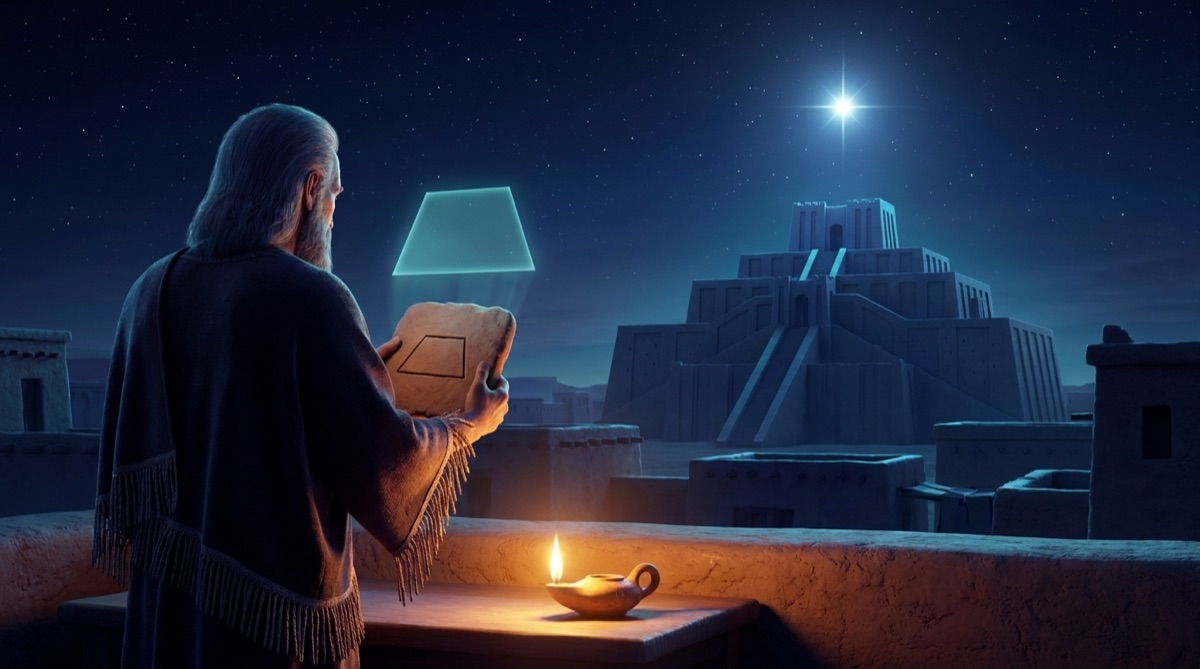
Jupiter's path computed with trapezoids
Four tablets in the British Museum show that the Babylonians computed how far Jupiter advances in 60 days as the area of a trapezoid on a graph of velocity against time. It is the same idea that integral calculus would use: a technique believed to have been invented in Oxford and Paris in the 14th century.
👤 Mathieu Ossendrijver · 📍 Babylon (tablets in the British Museum)
📘 Velocity, acceleration and derivatives Derivative
Sources (1)
- Ossendrijver, M. (2016). Ancient Babylonian astronomers calculated Jupiter's position from the area under a time-velocity graph. Science 351(6272), 482–484. https://doi.org/10.1126/science.aad8085
- c. 200 BCE
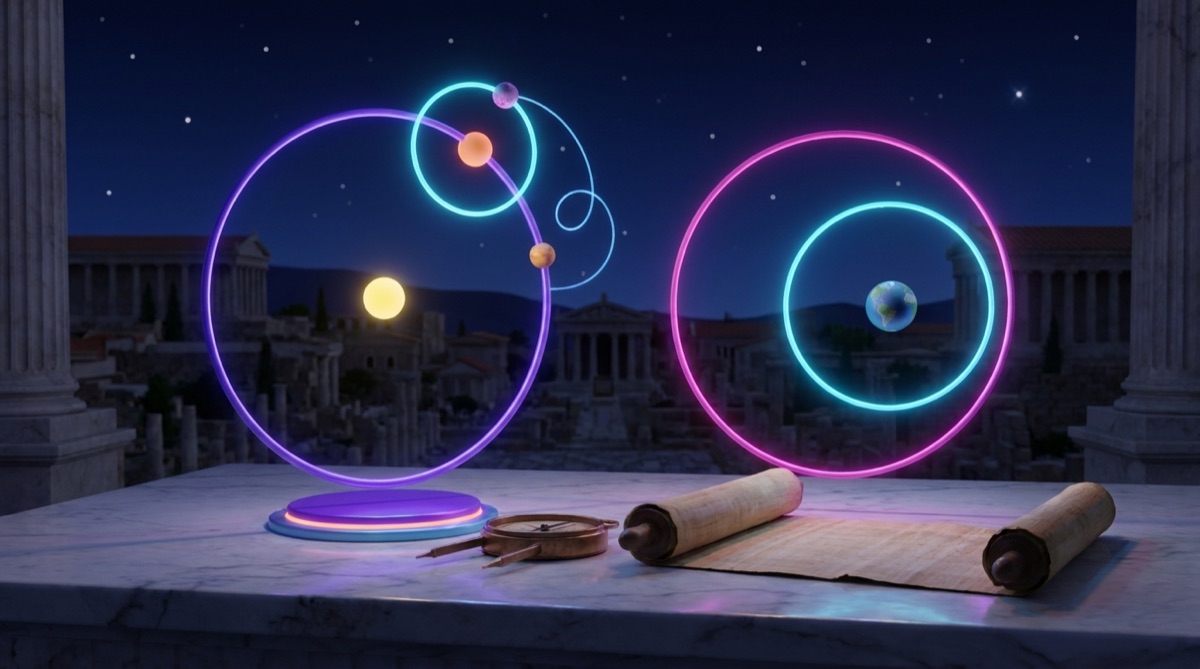
Apollonius: epicycles and eccentrics
Apollonius of Perga, the great geometer of the conics, studied two ways of explaining the planets' loops: a small circle (epicycle) turning on a larger one, or a circle off-center with respect to the Earth (eccentric). He proved when the two constructions are equivalent, and with them Hipparchus and Ptolemy would build their models.
👤 Apollonius of Perga · 📍 Perga and Alexandria
Sources (2)
- Ptolemy, Almagest, XII.1 (Trans. G. J. Toomer, Princeton University Press, 1998), where the theorem on planetary stations is attributed to Apollonius.
- Neugebauer, O. (1975). A History of Ancient Mathematical Astronomy. Springer, pp. 262–267.
- c. 200 BCE – 600 CE
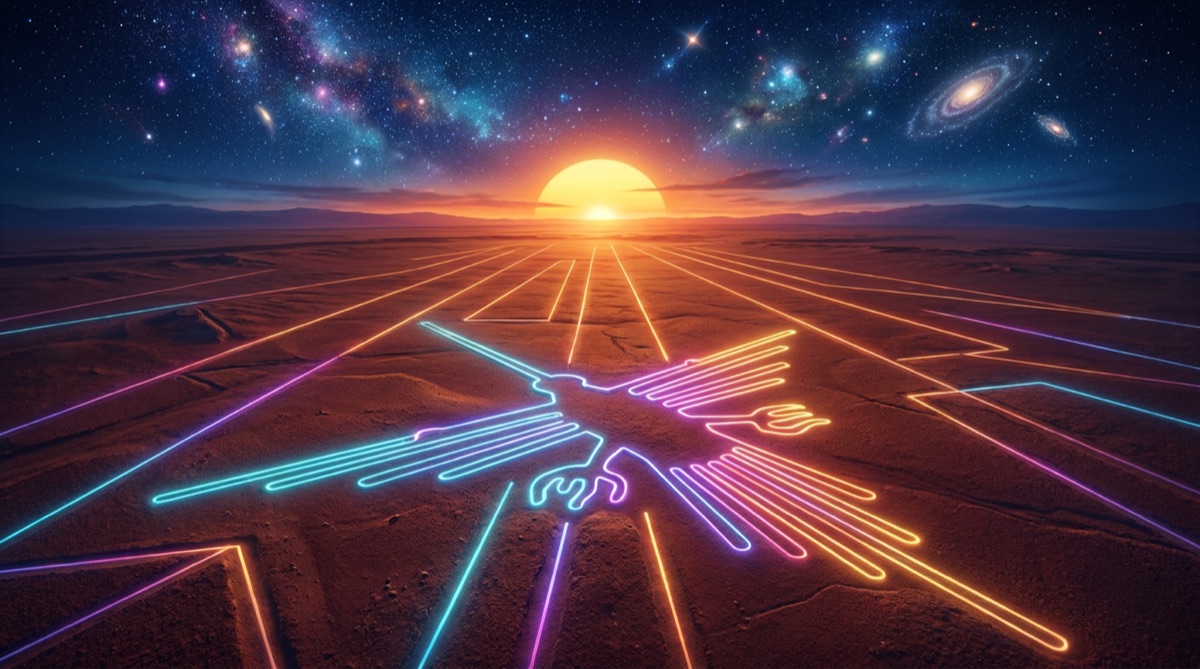
The Nazca lines and the astronomical hypothesis
The Nazca traced hundreds of lines and figures in the desert. Paul Kosok (1941) and María Reiche proposed that they were an “astronomy book” pointing to solstices and stars. Gerald Hawkins (1969) and Anthony Aveni (1990) measured the lines and found that they point at the sky no more often than chance would predict; today they are interpreted as ritual pathways related to water.
👤 Paul Kosok, María Reiche, Gerald Hawkins, Anthony Aveni · 📍 Nazca Pampa, Ica (Peru)
Sources (2)
- Aveni, A. F. (ed.) (1990). The Lines of Nazca. Memoirs of the American Philosophical Society 183.
- UNESCO, World Heritage List: Lines and Geoglyphs of Nasca and Palpa (1994). https://whc.unesco.org/es/list/700
- c. 168 BCE
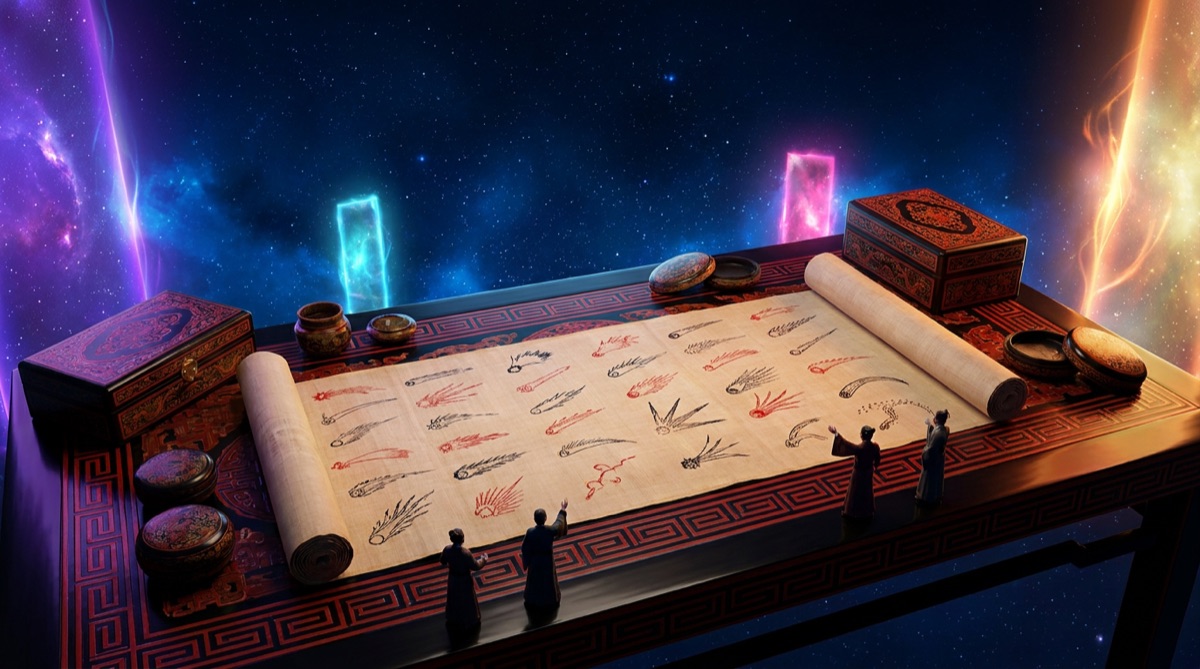
The Mawangdui comet atlas
In a tomb sealed around 168 BCE, a silk book was found with 29 drawings of comets of different shapes, each with its omen. It is the oldest known illustrated catalog of comets.
📍 Mawangdui, Changsha (Hunan), China
Sources (2)
- Xu, Pankenier & Jiang (2000), East Asian Archaeoastronomy, chapter on comets (Mawangdui silk manuscript).
- Needham & Wang (1959), Science and Civilisation in China, vol. 3, pp. 430–433 (description of the comet types).
- c. 140 BCE

Hipparchus adopts the Babylonian data
The Greek astronomer Hipparchus used the Babylonian eclipse records and their value of the lunar month (in sexagesimal notation 29;31,50,8,20, that is, 29.530594 days) to build his theory of the Moon. Greek and Babylonian astronomy merged, and from that union the Almagest would emerge.
👤 Hipparchus · 📍 Rhodes
📘 Hipparchus and the sky that moves slowly Synodic monthPrecession
Sources (2)
- Toomer, G. J. (1988). Hipparchus and Babylonian astronomy. In Leichty, E., Ellis, M. deJ. & Gerardi, P. (eds.), A Scientific Humanist: Studies in Memory of Abraham Sachs, Philadelphia, 353–362.
- Jones, A. (1991). The adaptation of Babylonian methods in Greek numerical astronomy. Isis 82(3), 441–453.
- c. 140 BCE
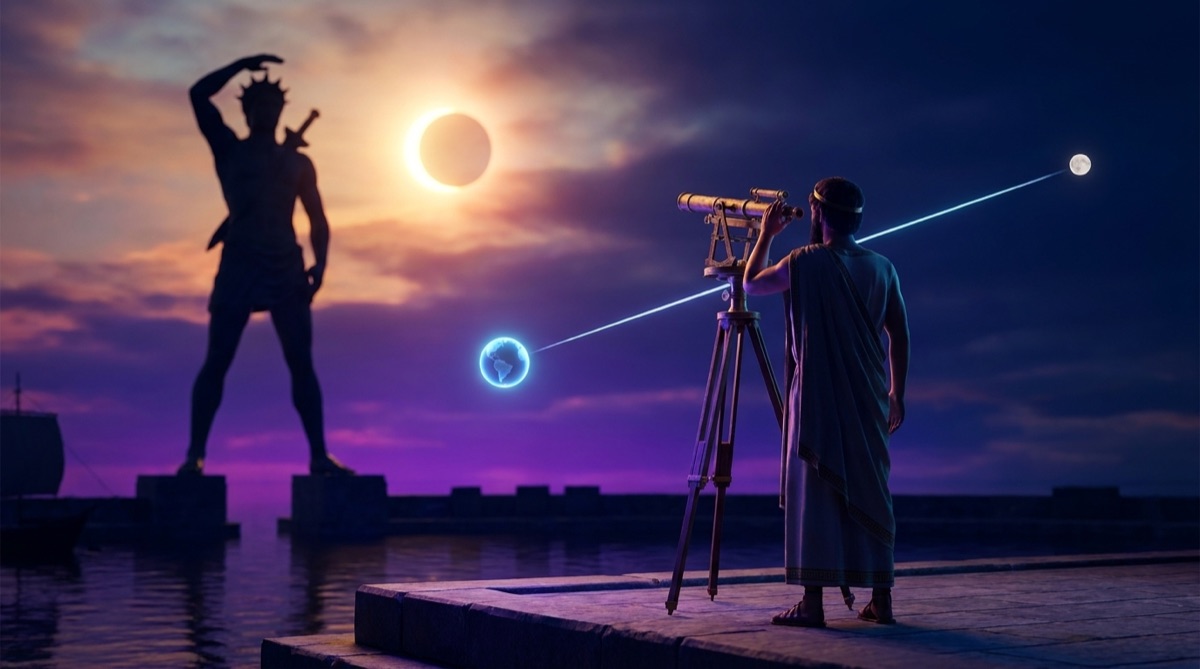
Hipparchus measures the distance to the Moon and the length of the year
Hipparchus of Nicaea used a solar eclipse seen as total at the Hellespont and partial in Alexandria to estimate the distance to the Moon at some 60 to 70 Earth radii, very close to the real value. He also measured the length of the year as 365 and a quarter days minus 1/300 of a day, with an error of only six minutes, and compiled the first trigonometric table (a table of chords).
👤 Hipparchus of Nicaea · 📍 Rhodes
📘 Parallax and trigonometry 🧪 Stellar parallax Parallax
Sources (2)
- Toomer, G. J. (1974). Hipparchus on the distances of the sun and moon. Archive for History of Exact Sciences 14, 126–142. https://doi.org/10.1007/BF00329826
- Ptolemy, Almagest, III.1 and V.11 (Trans. G. J. Toomer, Princeton University Press, 1998).
- c. 129 BCE
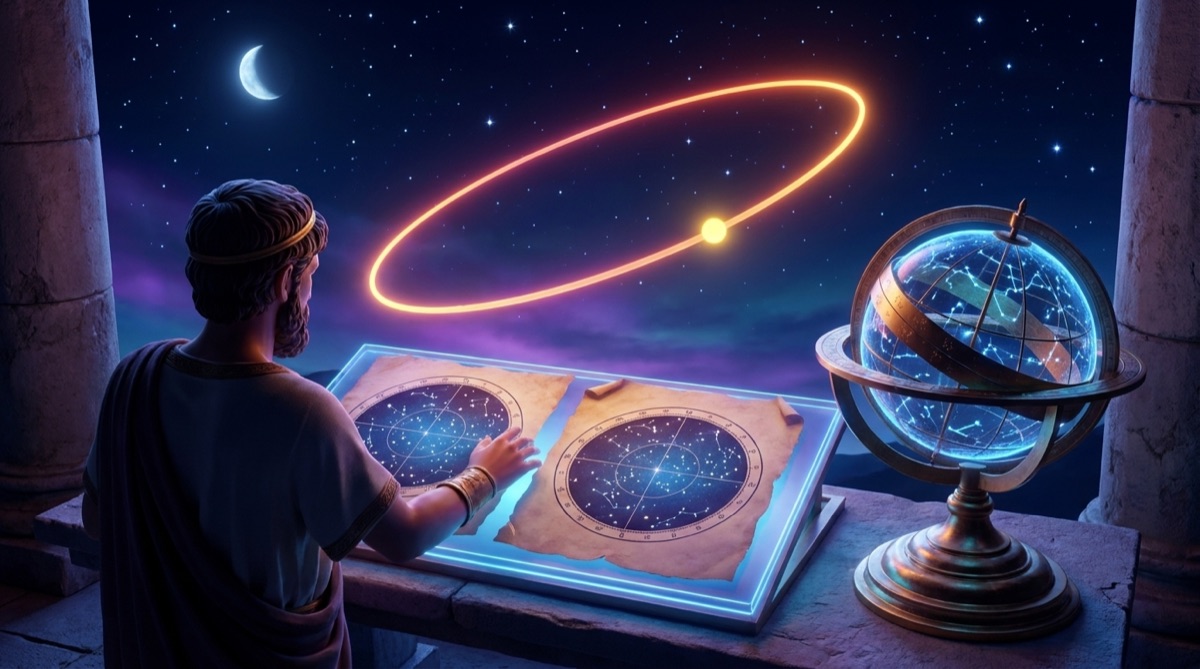
Hipparchus discovers the precession of the equinoxes
Comparing his star positions with those of Timocharis, 150 years earlier, Hipparchus saw that the whole sky had shifted about 2° with respect to the equinoxes: the Earth's axis moves slowly, at least 1° per century (today we know it is 1° every 72 years). He also compiled a catalog of about 850 stars with positions and brightnesses.
👤 Hipparchus of Nicaea · 📍 Rhodes
📘 Hipparchus and the sky that moves slowly PrecessionEquinoxApparent magnitude
Sources (2)
- Ptolemy, Almagest, VII.1–3 (Trans. G. J. Toomer, Princeton University Press, 1998).
- Toomer, G. J. (1978). Hipparchus. In Dictionary of Scientific Biography, vol. 15, 207–224. Scribner's.
- 2nd century BCE
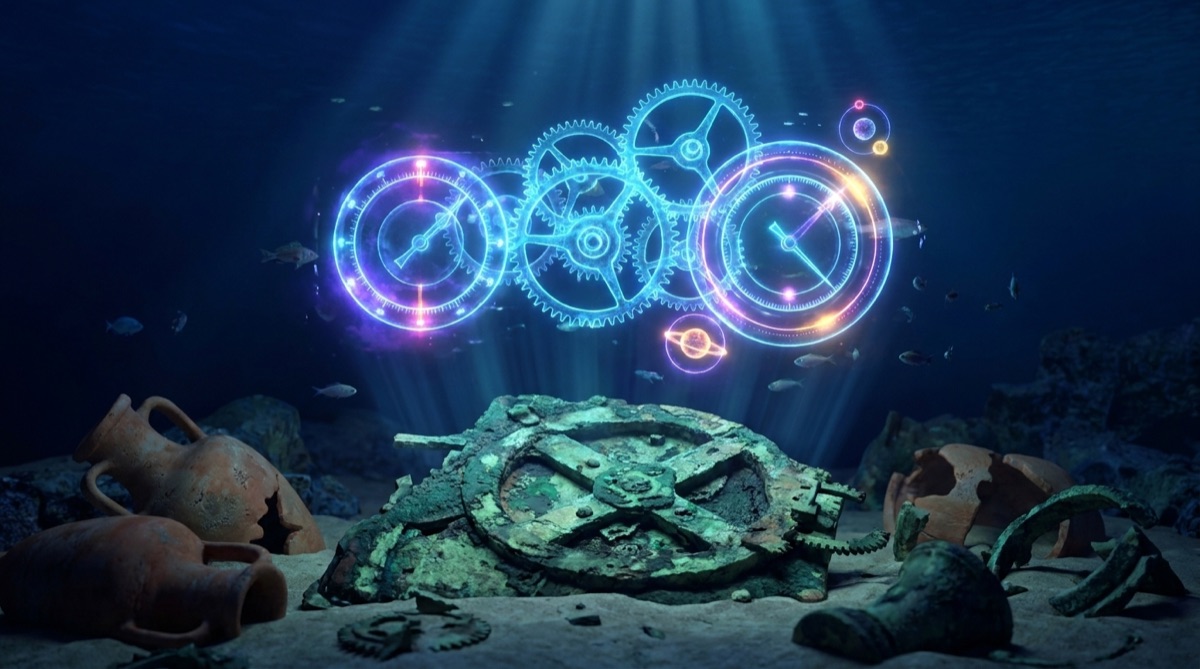
The Antikythera mechanism
A bronze device with at least 30 gears, recovered in 1901 from a shipwreck off the island of Antikythera, reproduced the cycles of the Moon and the Sun, predicted eclipses and tracked the calendar of the Panhellenic games. The style of its lettering places it in the second half of the 2nd century BCE, although some authors propose that its eclipse calendar starts around 205 BCE; it is the most complex calculating instrument we know from antiquity.
📍 Antikythera shipwreck (National Archaeological Museum, Athens)
Sources (3)
- Freeth, T. et al. (2006). Decoding the ancient Greek astronomical calculator known as the Antikythera Mechanism. Nature 444, 587–591. https://doi.org/10.1038/nature05357
- Freeth, T. et al. (2021). A model of the cosmos in the ancient Greek Antikythera Mechanism. Scientific Reports 11, 5821. https://doi.org/10.1038/s41598-021-84310-w
- Carman, C. C. & Evans, J. (2014). On the epoch of the Antikythera mechanism and its eclipse predictor. Archive for History of Exact Sciences 68, 693–774. https://doi.org/10.1007/s00407-014-0145-5
- 104 BCE
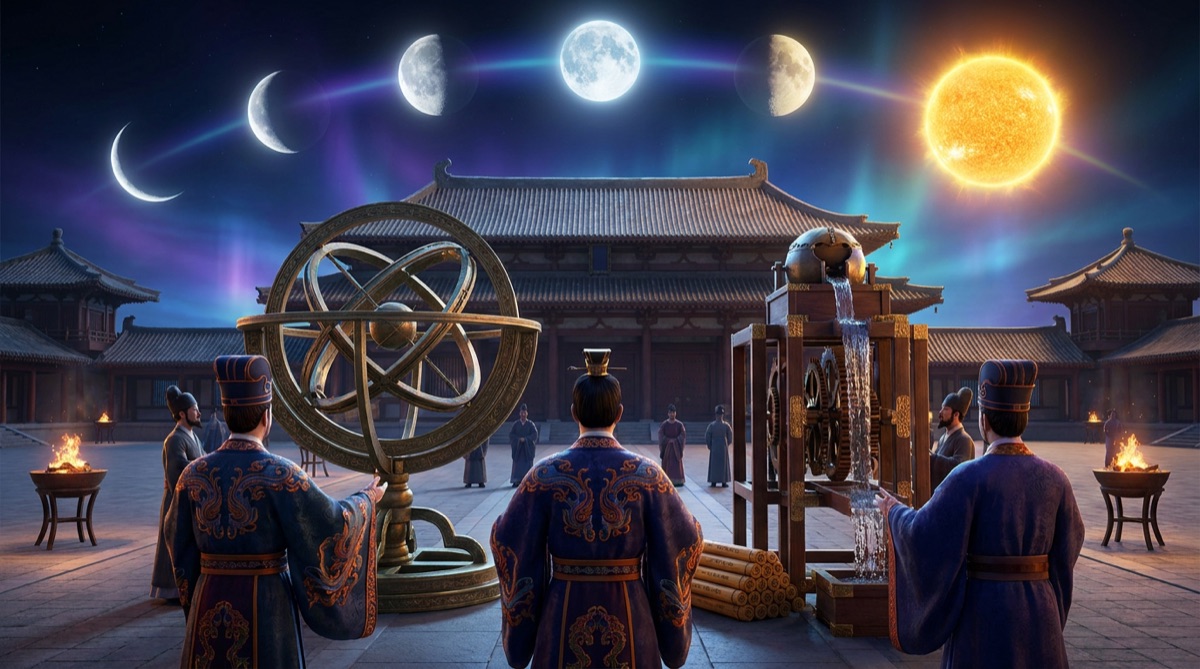
The Taichu calendar reform
Emperor Wu of Han promulgated an official lunisolar calendar, with months that follow the Moon and an extra month every so often to keep in step with the seasons. It set the model that China would revise dozens of times over two thousand years.
👤 Emperor Wu of Han, Luoxia Hong · 📍 Chang'an (Xi'an), China
📘 The lunar calendar Synodic month
Sources (2)
- Sivin, N. (2009). Granting the Seasons, ch. 2 (history of the Chinese calendar reforms).
- Needham & Wang (1959), Science and Civilisation in China, vol. 3, pp. 390–408.
- c. 100 BCE – 550 CE
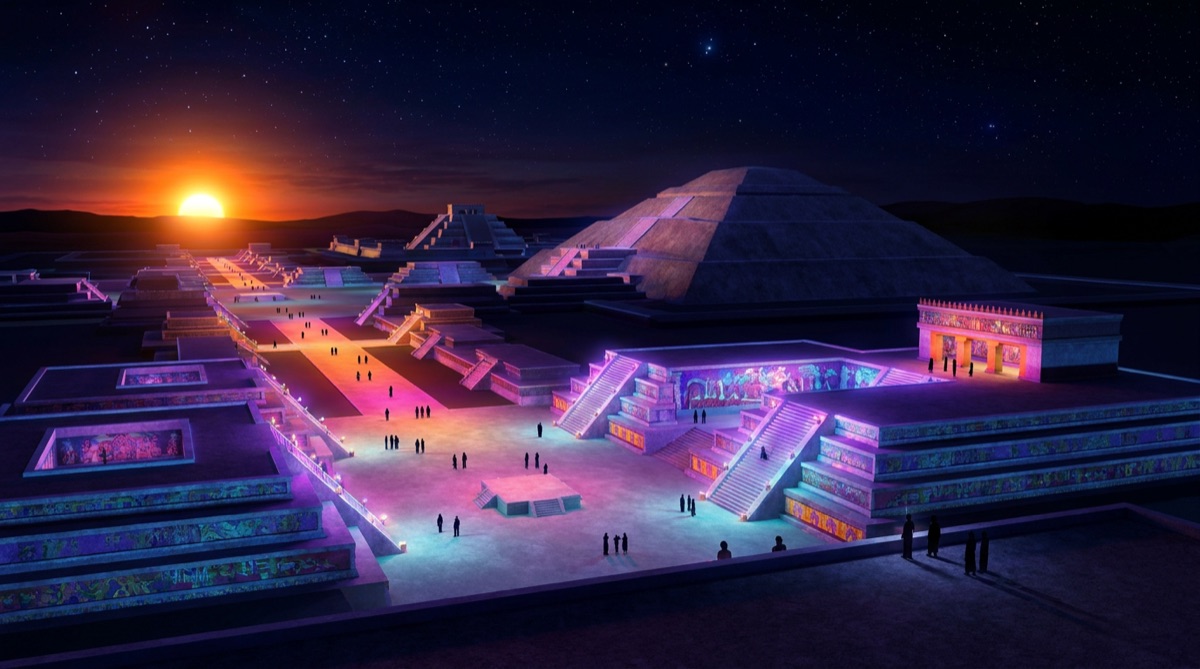
Teotihuacan, a city rotated 15.5°
The largest city of the ancient Americas is laid out on a grid skewed about 15.5° east of north. According to Ivan Šprajc, that orientation makes the Pyramid of the Sun mark sunrises and sunsets on dates separated by multiples of 20 days and by 260 days, a horizon calendar for agriculture and ritual.
📍 Teotihuacan, State of Mexico (Mexico)
🧪 Day, night and the seasons Cardinal pointsHorizon
Sources (2)
- Šprajc, I. (2000). Astronomical Alignments at Teotihuacan, Mexico. Latin American Antiquity 11(4), 403–415. https://doi.org/10.2307/972004
- UNESCO, World Heritage List: Pre-Hispanic City of Teotihuacan (1987). https://whc.unesco.org/es/list/414
- c. 100 BCE – 200 CE
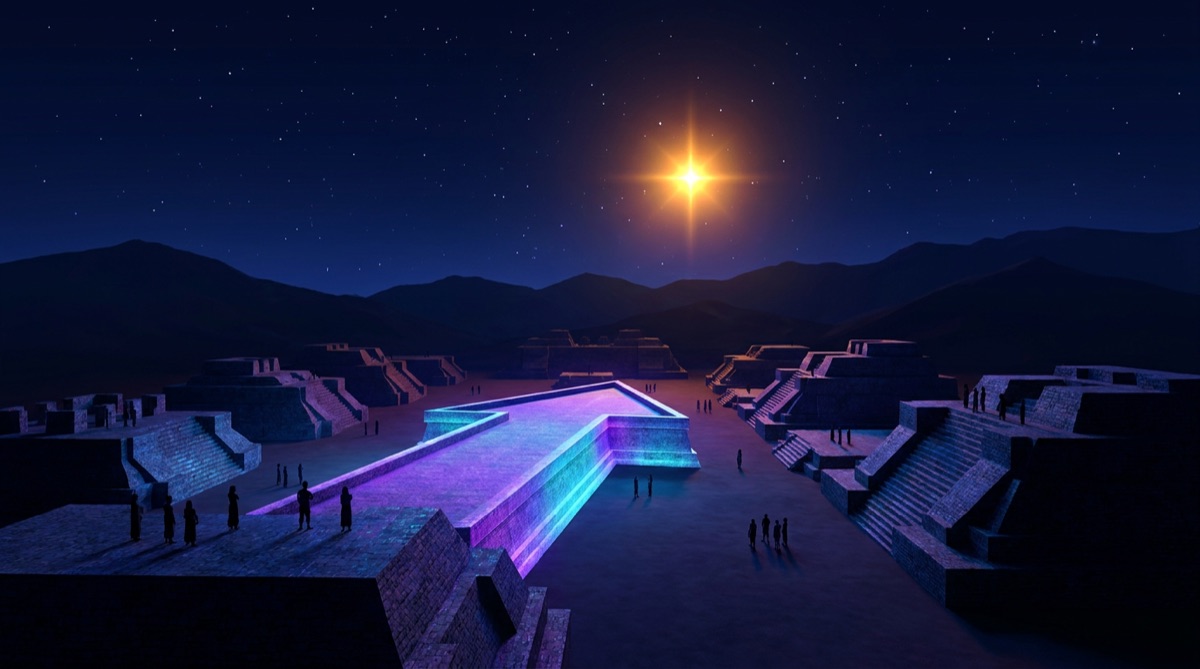
Building J of Monte Albán
A building with an arrowhead-shaped plan, unique in the city, points in a direction different from all the others. In 1972 Aveni and Linsley proposed that it marked the rising of the star Capella on a day of the Sun's zenith passage; a new measurement (Peeler and Winter, 1995) ruled out the star but kept the calendrical character of the building.
👤 Anthony Aveni, Robert Linsley · 📍 Monte Albán, Oaxaca (Mexico)
Sources (2)
- Aveni, A. F. & Linsley, R. M. (1972). Mound J, Monte Alban: Possible Astronomical Orientation. American Antiquity 37(4), 528–530.
- Peeler, D. E. & Winter, M. (1995). Building J at Monte Albán: A Correction and Reassessment of the Astronomical Hypothesis. Latin American Antiquity 6(4), 362–369.
- c. 90 BCE
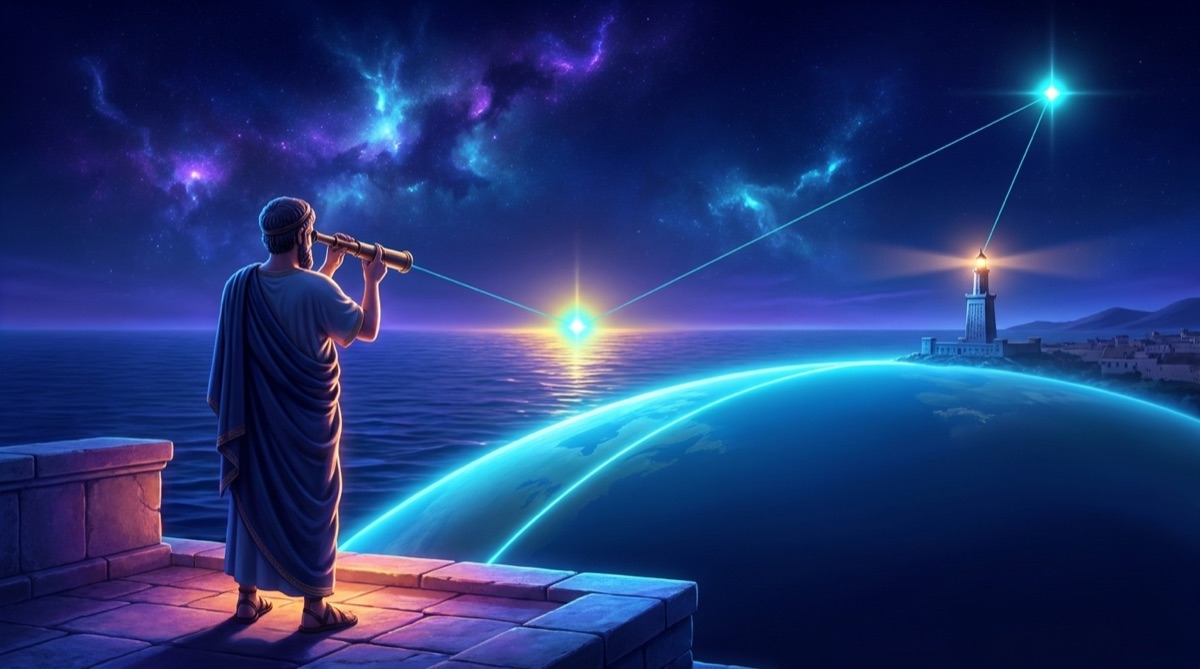
Posidonius measures the Earth again with the star Canopus
The Stoic philosopher Posidonius repeated Eratosthenes' idea with another method: the altitude of the star Canopus seen from Rhodes and from Alexandria. He first obtained about 240 000 stadia; a smaller value that circulated later (180 000) was the one Ptolemy adopted and, centuries later, encouraged Columbus to believe that Asia was close.
👤 Posidonius of Apamea · 📍 Rhodes
Altitude above the horizonLatitude
Sources (2)
- Cleomedes, Caelestia, I.7 (Trans. A. C. Bowen & R. B. Todd, University of California Press, 2004).
- Strabo, Geography, II.2.2 (Trans. J. L. García Ramón and J. García Blanco, Gredos).
- 1st century BCE
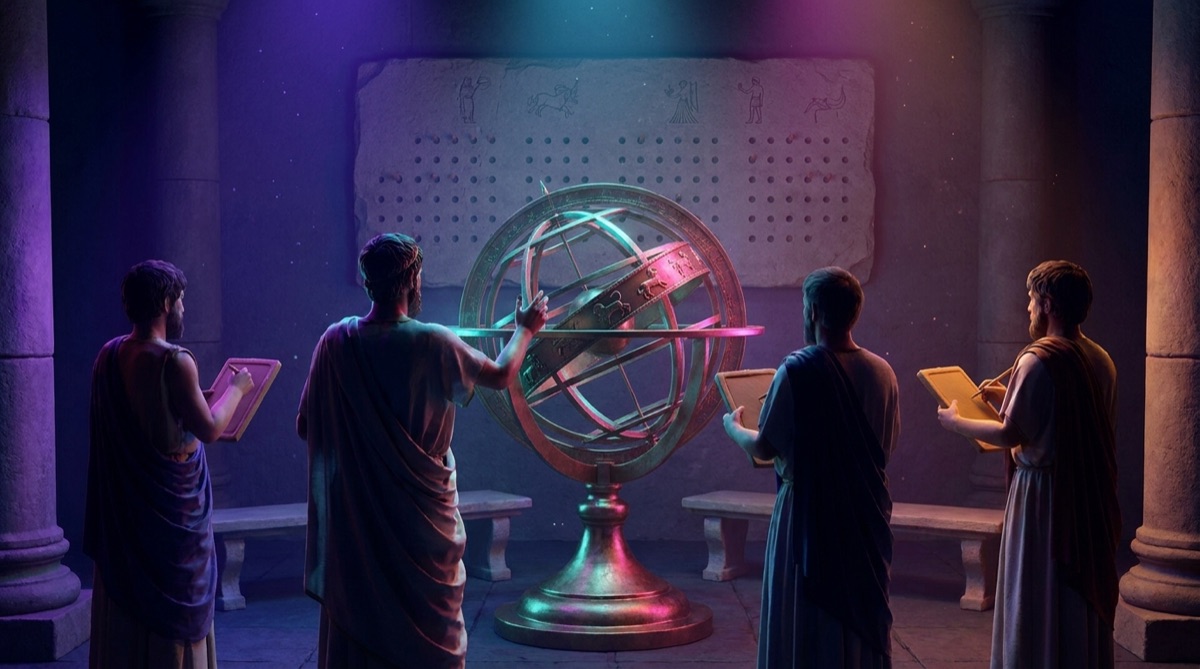
Geminus writes an introduction to astronomy
The “Introduction to the Phenomena” by Geminus of Rhodes is the best-preserved Greek school textbook of astronomy: it explains the zodiac, the constellations, lunisolar calendars and why the signs are not the same as the stars. It shows us what an educated student of the 1st century BCE knew.
👤 Geminus of Rhodes · 📍 Rhodes
Sources (1)
- Evans, J. & Berggren, J. L. (2006). Geminos's Introduction to the Phenomena: A Translation and Study of a Hellenistic Survey of Astronomy. Princeton University Press.
- c. 50 BCE
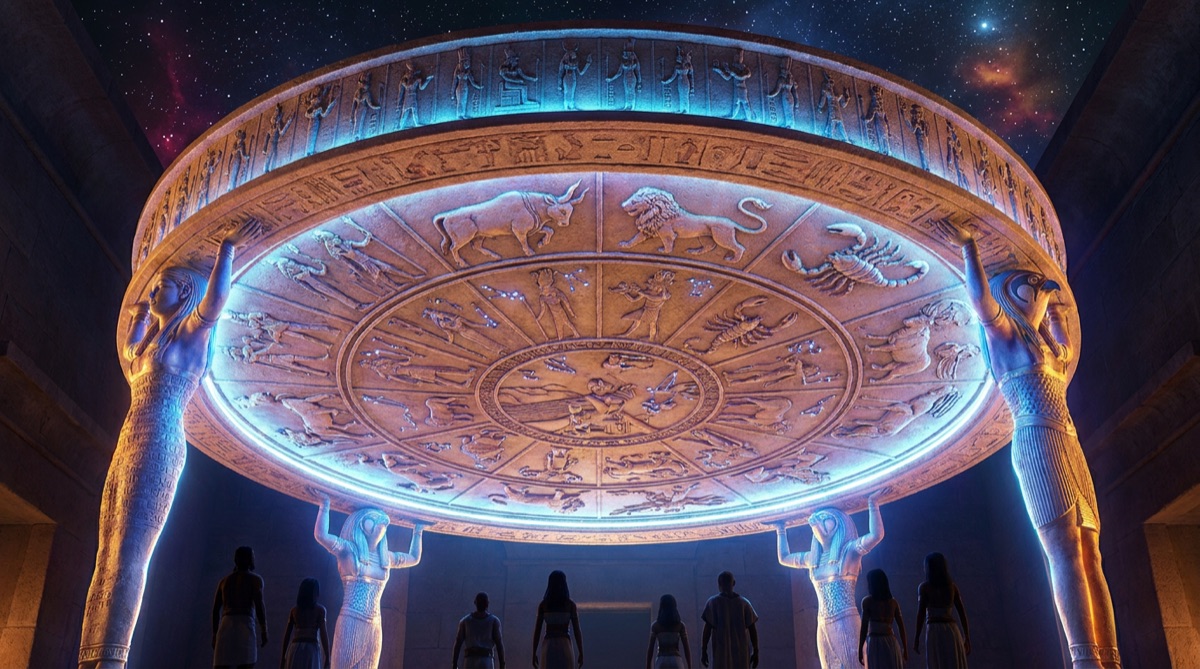
The Dendera zodiac
On the ceiling of a chapel in the temple of Hathor, a circular map of the sky was sculpted with the Egyptian constellations, the 36 decans and the 12 signs of the zodiac imported from Babylon and Greece. The positions of the planets and two eclipses depicted allow it to be dated to around 50 BCE.
📍 Dendera, Egypt (original in the Louvre Museum, Paris)
🧪 Interactive planisphere EclipticConstellation
Sources (3)
- Louvre Museum, Paris: Zodiaque de Dendéra (D 38).
- Aubourg, É. (1995). La date de conception du zodiaque du temple d'Hathor à Dendera. Bulletin de l'Institut Français d'Archéologie Orientale 95, 1–10.
- Cauville, S. (1997). Le zodiaque d'Osiris. Peeters.
- 46 BCE
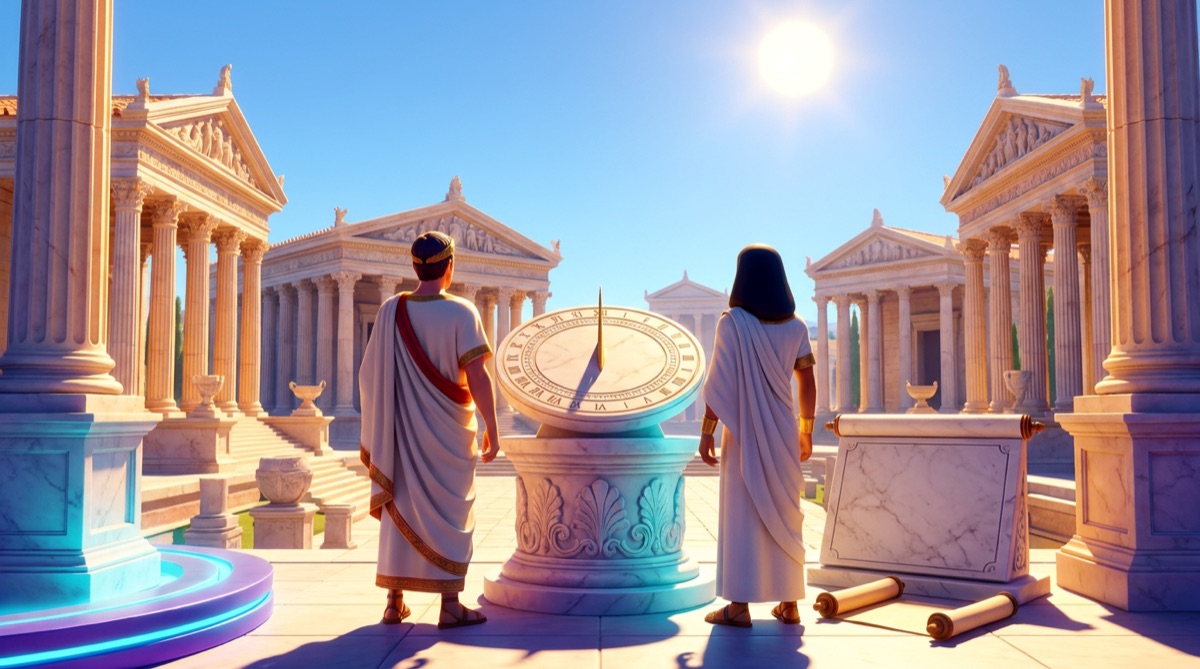
Julius Caesar and the Julian calendar
Advised by the astronomer Sosigenes, Caesar adopted the Egyptian 365-day model and added to it the leap day every four years that Canopus had proposed. The year 46 BCE lasted 445 days to correct the drift, and the new calendar began on January 1, 45 BCE. With the Gregorian correction of 1582, it is the calendar we use today.
👤 Julius Caesar, Sosigenes · 📍 Rome
📘 The lunar calendar Seasons of the year
Sources (3)
- Pliny the Elder, Natural History, XVIII.211 (Sosigenes as Caesar's adviser).
- Macrobius, Saturnalia, I.14 (description of the reform).
- Hannah, R. (2005). Greek and Roman Calendars: Constructions of Time in the Classical World. Duckworth.
- 46 BCE
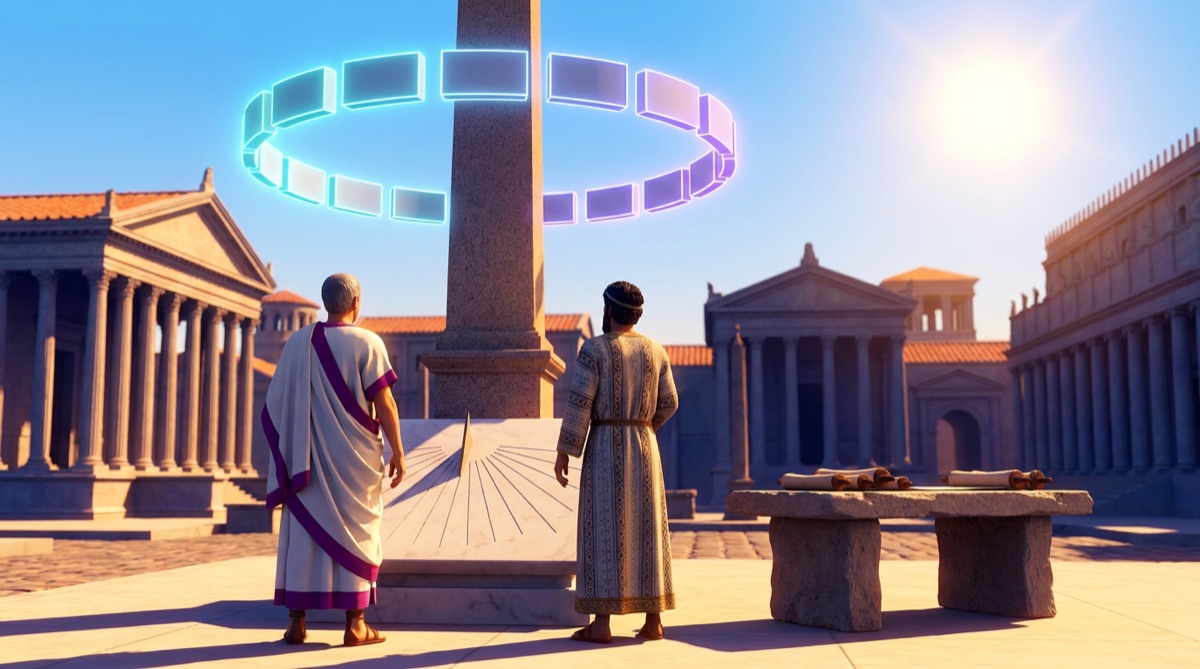
Sosigenes and the Julian calendar
Julius Caesar commissioned the Alexandrian astronomer Sosigenes to reform the Roman calendar: a year of 365 days with an extra day every four years, based on Greek astronomy of the solar year. The Julian calendar governed Europe until 1582 and is the direct ancestor of ours.
👤 Sosigenes of Alexandria, Julius Caesar · 📍 Rome and Alexandria
Sources (2)
- Pliny the Elder, Natural History, XVIII.211–212 (Trans. Gredos).
- Hannah, R. (2005). Greek and Roman Calendars: Constructions of Time in the Classical World. Duckworth, ch. 4.
- 36 BCE

The oldest known Long Count date
Stela 2 of Chiapa de Corzo records the date 7.16.3.2.13, which with the GMT correlation corresponds to December 36 BCE. A few years later, Stela C of Tres Zapotes (32 BCE) does the same. Both are in Epi-Olmec style, not Maya: the Long Count was born before the great Maya kingdoms.
📍 Chiapa de Corzo, Chiapas, and Tres Zapotes, Veracruz (Mexico)
Sources (3)
- Lee, T. A. (1969). The Artifacts of Chiapa de Corzo, Chiapas, Mexico. Papers of the New World Archaeological Foundation 26, BYU (Stela 2).
- Stirling, M. W. (1940). An Initial Series from Tres Zapotes, Vera Cruz, Mexico. National Geographic Society, Contributed Technical Papers, Mexican Archaeology Series 1(1).
- Thompson, J. E. S. (1950). Maya Hieroglyphic Writing. Carnegie Institution, Pub. 589.
- 28 BCE

First dated sunspot
The Book of Han records that on May 10, 28 BCE, a spot “like a coin” was seen on the Sun. From then on Chinese chroniclers recorded more than a hundred naked-eye sunspots, an archive of solar activity from 1 600 years before the telescope.
📍 China (Han dynasty)
Sources (2)
- Yau, K. K. C. & Stephenson, F. R. (1988). A revised catalogue of Far Eastern observations of sunspots (165 BC to AD 1918). Quarterly Journal of the Royal Astronomical Society 29, 175–197.
- Needham & Wang (1959), Science and Civilisation in China, vol. 3, pp. 434–436.
- c. 25 BCE

The Alexandrian calendar
Under Augustus, the Egyptian civil calendar finally received its leap day every four years and was fixed relative to the Julian one. That “Alexandrian” calendar survives as the Coptic and Ethiopian calendar, with its 12 months of 30 days and its short month of 5 or 6 days.
👤 Augustus · 📍 Alexandria, Egypt
Sources (2)
- Hannah, R. (2005). Greek and Roman Calendars. Duckworth.
- Depuydt, L. (1997). Civil Calendar and Lunar Calendar in Ancient Egypt. Peeters.
- 79 – 80
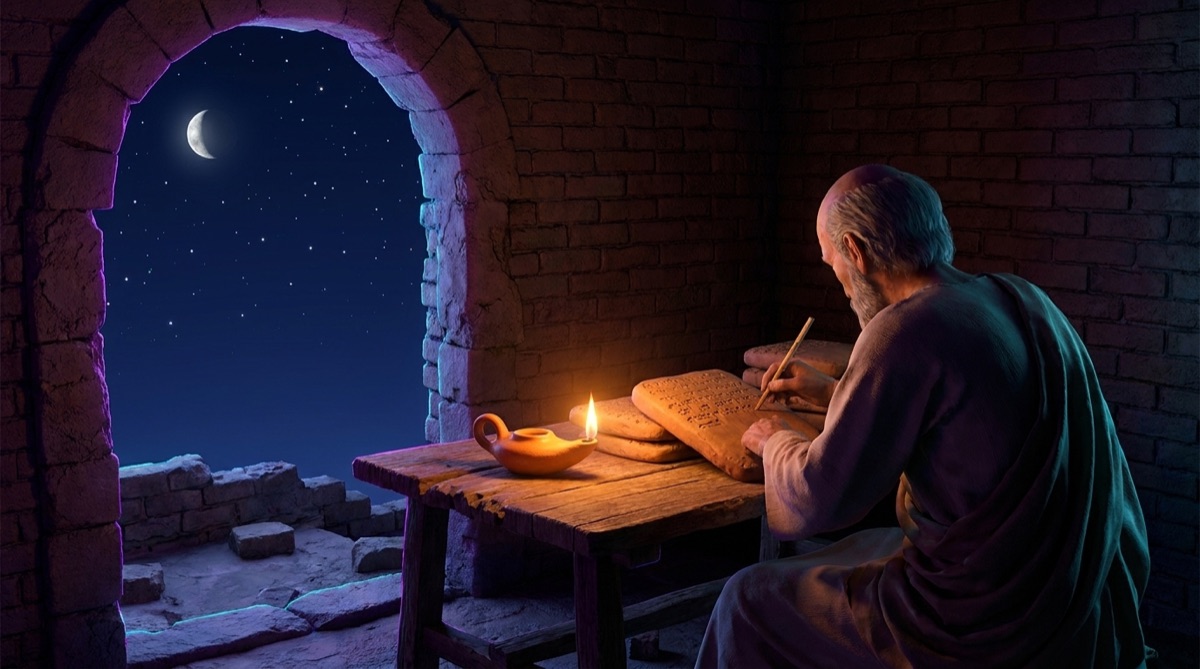
The last astronomical tablet
An almanac from Uruk with the predicted positions of the planets for the year 79/80 CE is the most recent datable cuneiform text known. After three thousand years, writing on clay died out, but its methods already lived on in Greek.
📍 Uruk, southern Iraq
Sources (1)
- Hunger, H. & de Jong, T. (2014). Almanac W22340a from Uruk: the latest datable cuneiform tablet. Zeitschrift für Assyriologie und vorderasiatische Archäologie 104(2), 182–194.
- 132
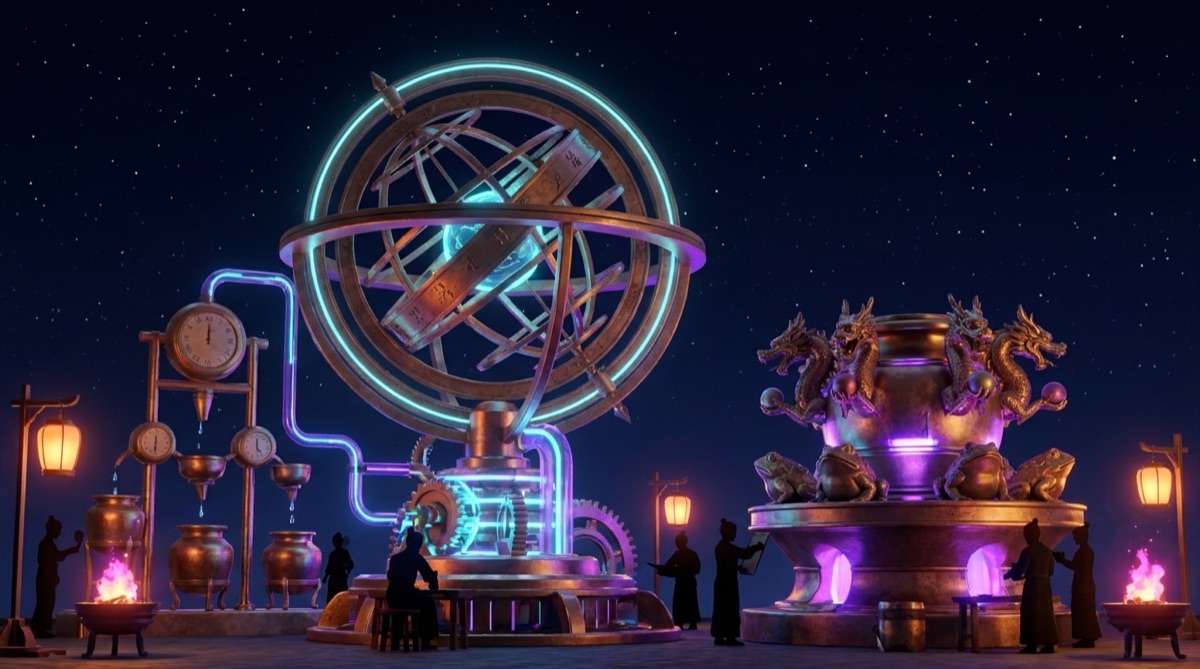
Zhang Heng: water-driven armillary sphere and seismoscope
Zhang Heng built an armillary sphere that turned with the power of a water clock, following the sky, and in 132 presented a bronze seismoscope that indicated the direction of an earthquake. He was also the one who explained that the Moon shines by reflecting the light of the Sun.
👤 Zhang Heng · 📍 Luoyang, China
📘 The phases of the Moon Phases of the MoonCelestial sphere
Sources (2)
- Needham & Wang (1959), Science and Civilisation in China, vol. 3, pp. 216–219 and 626–635.
- MacTutor History of Mathematics, biography of Zhang Heng (University of St Andrews).
- 2nd century CE
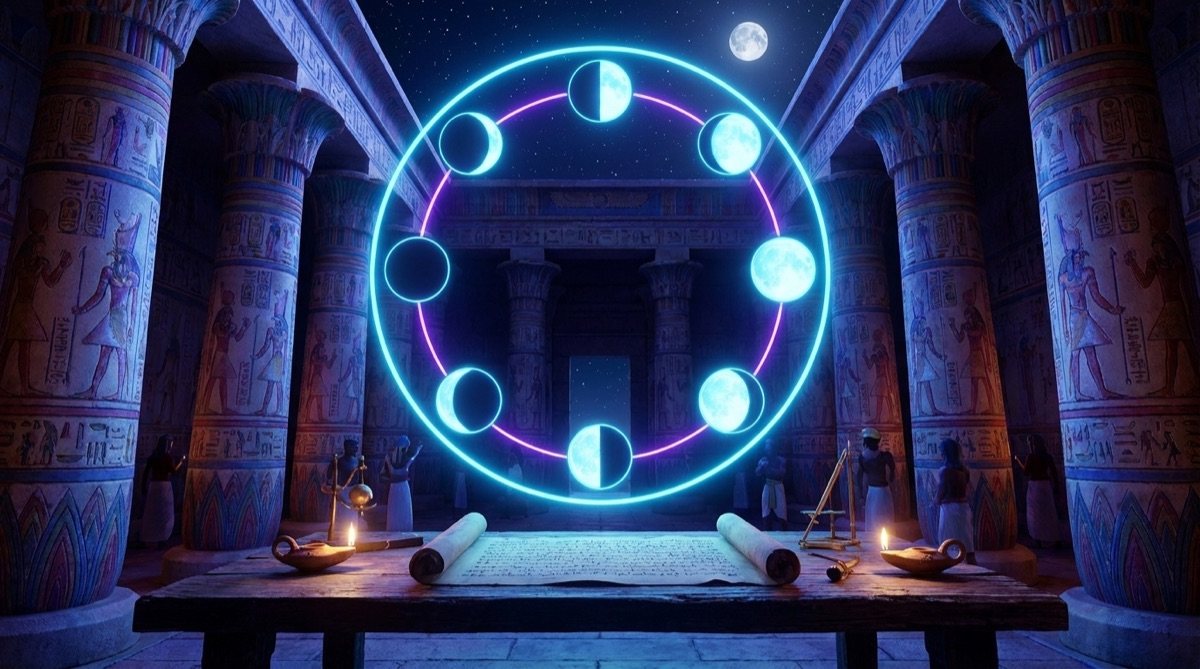
The 25-year lunar cycle of Papyrus Carlsberg 9
A Demotic papyrus explains how to calculate the beginning of the lunar months with a cycle of 25 civil years, which equal almost exactly 309 lunar months. The scheme, with a cycle beginning in 144 CE, shows that the old lunar calendar of the temples was still alive in Roman times.
📍 Egypt (papyrus in the Carlsberg collection, Copenhagen)
📘 The lunar calendar Synodic month
Sources (2)
- Neugebauer, O. & Volten, A. (1938). Untersuchungen zur antiken Astronomie IV: Ein demotischer astronomischer Papyrus (Pap. Carlsberg 9). Quellen und Studien zur Geschichte der Mathematik B 4, 383–406.
- Parker, R. A. (1950). The Calendars of Ancient Egypt. University of Chicago Press.
- 2nd–4th centuries
Hellenistic astronomy arrives
With trade with the Roman world, Greek astrology and the geometric models of epicycles entered India. The Yavanajataka (“horoscopy of the Greeks”) is the oldest witness; its date, formerly placed at 269, is now debated and could be later.
👤 Sphujidhvaja · 📍 Ujjain and the west coast of India
Sources (2)
- Pingree, D. (1978). The Yavanajataka of Sphujidhvaja. Harvard Oriental Series 48.
- Mak, B. M. (2013). The date and nature of Sphujidhvaja's Yavanajataka reconsidered. History of Science in South Asia 1, 1–20. https://doi.org/10.18732/H2PC7K
- c. 150
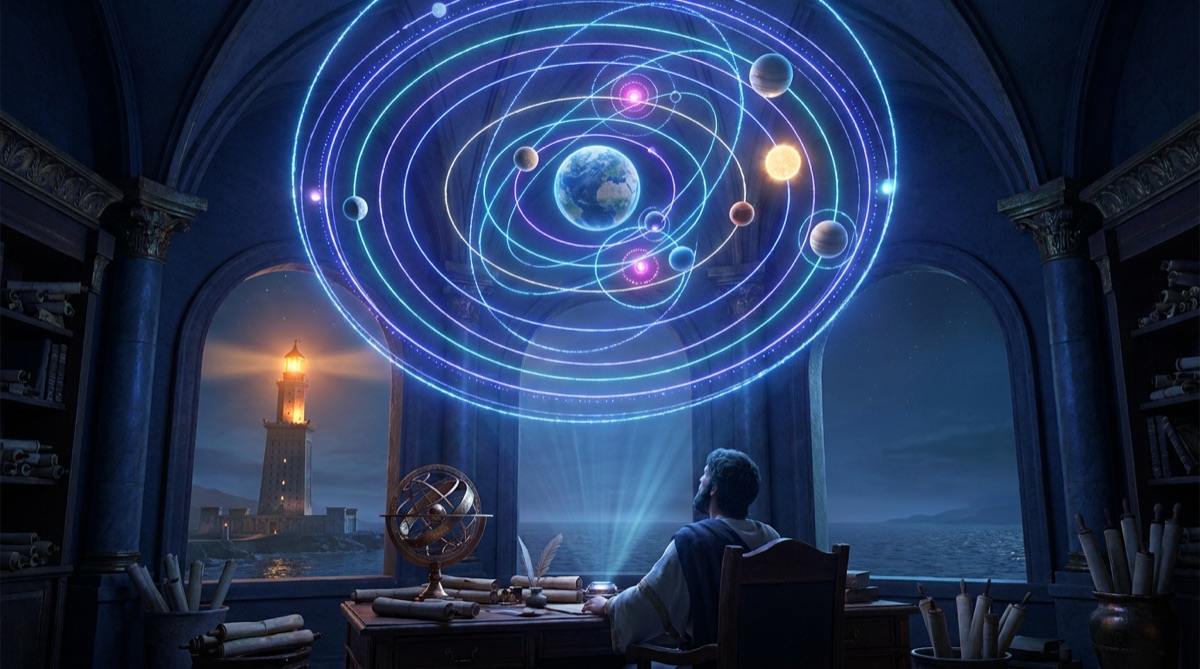
Ptolemy publishes the “Almagest”
Claudius Ptolemy, in Alexandria, gathered all of Greek astronomy into a mathematical treatise with tables for calculating the position of the Sun, the Moon and the planets on any date, and a catalog of 1 025 stars. His geocentric model with epicycles and an “equant” worked so well that it was the reference in Greek, Arabic and Latin for 1 400 years.
👤 Claudius Ptolemy · 📍 Alexandria
🧪 Interactive planisphere Celestial sphereEclipticRight ascension
Sources (2)
- Toomer, G. J. (Trans.) (1998). Ptolemy's Almagest. Princeton University Press.
- Pedersen, O. (2011). A Survey of the Almagest (ed. A. Jones). Springer. https://doi.org/10.1007/978-0-387-84826-6
- c. 160
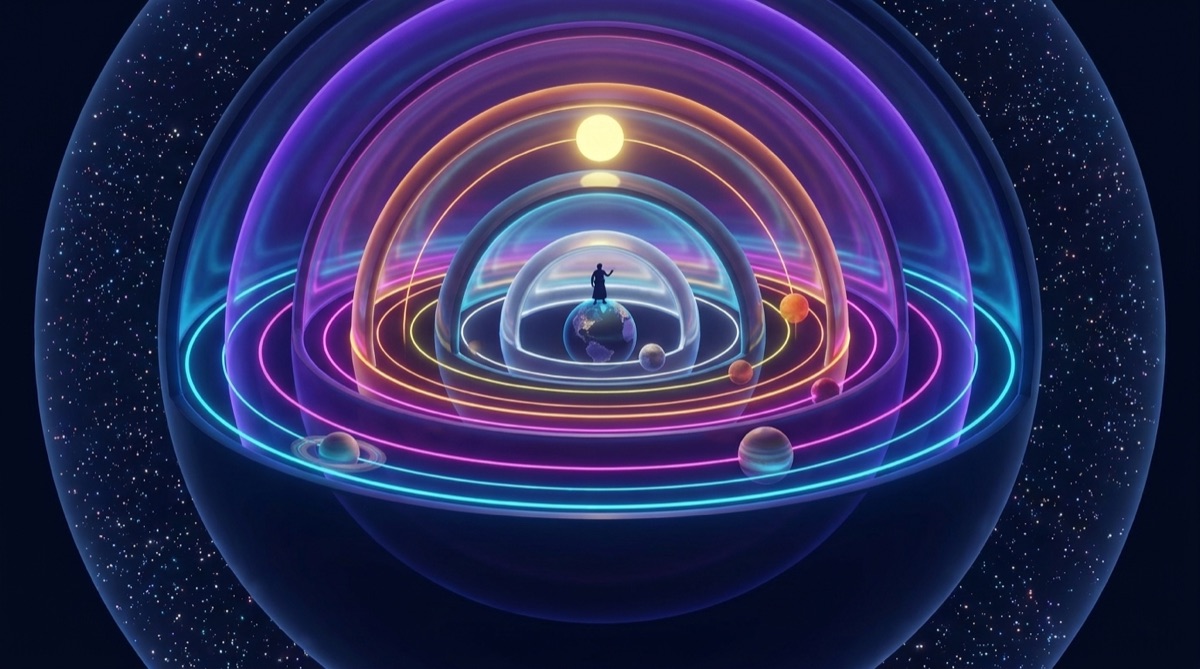
The “Planetary Hypotheses”: a cosmos with a size
In a later work, Ptolemy nested the spheres of each planet one inside another, with no gaps, and so calculated the distance to each body and the size of the universe: about 20 000 Earth radii out to the fixed stars. That image of a closed, measurable cosmos was the one the Middle Ages inherited.
👤 Claudius Ptolemy · 📍 Alexandria
🧪 The Solar System to scale Astronomical unit
Sources (1)
- Goldstein, B. R. (1967). The Arabic version of Ptolemy's Planetary Hypotheses. Transactions of the American Philosophical Society 57(4), 3–55. https://doi.org/10.2307/1006040
- 4th–9th centuries
Maya stelae date kings by the day, the Moon and the 819-day cycle
During the Classic period, every important Maya monument carries its Long Count date and a “Lunar Series” giving the age of the Moon on that day. In Copán the scribes used the equivalence 149 lunations = 4 400 days (29.53 days per lunation, almost the current value), as John Teeple deciphered in 1930.
👤 John E. Teeple · 📍 Tikal, Copán, Palenque, Quiriguá (Guatemala, Honduras, Mexico)
📘 The lunar calendar 🧪 Phases of the Moon Synodic monthPhases of the Moon
Sources (2)
- Teeple, J. E. (1930). Maya Astronomy. Contributions to American Archaeology 1(2), Carnegie Institution of Washington, Pub. 403.
- Thompson, J. E. S. (1950). Maya Hieroglyphic Writing. Carnegie Institution, Pub. 589, ch. 10 (Lunar Series).
- c. 336

Yu Xi discovers precession
Comparing the position of the Sun at the winter solstice with ancient records, Yu Xi found that it had shifted relative to the stars by about one degree every fifty years. He arrived at the same phenomenon as Hipparchus four centuries earlier, without knowing of him.
👤 Yu Xi · 📍 China (Jin dynasty)
📘 Hipparchus and the sky that moves slowly PrecessionSolstice
Sources (2)
- Needham & Wang (1959), Science and Civilisation in China, vol. 3, p. 270 (Yu Xi and precession).
- Hockey, T. et al. (eds.) (2007). Biographical Encyclopedia of Astronomers, entry “Yu Xi”. Springer.
- c. 370
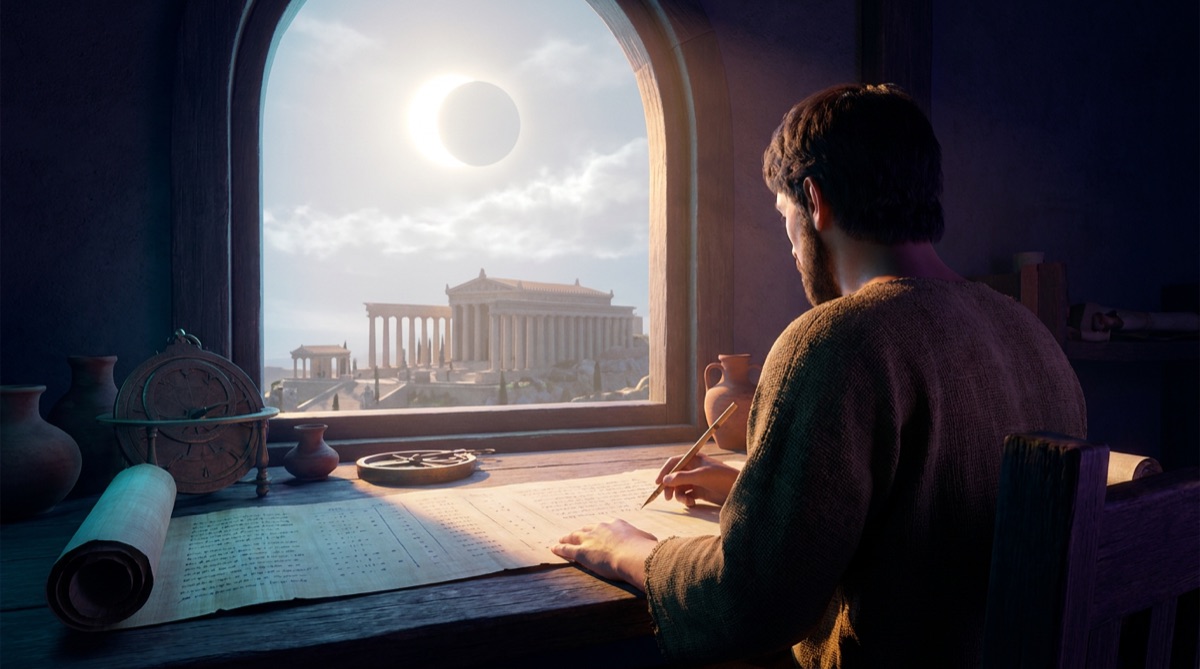
Theon of Alexandria comments on the “Almagest”
Theon, a mathematician of the Museum of Alexandria, wrote commentaries on Ptolemy's “Almagest” and “Handy Tables” so that they would remain in use for teaching. He observed the eclipses of 364, and his edition of Euclid's “Elements” was the one Europe read until the 19th century.
👤 Theon of Alexandria · 📍 Alexandria
Sources (2)
- Toomer, G. J. (1976). Theon of Alexandria. In Dictionary of Scientific Biography, vol. 13, 321–325. Scribner's.
- Jones, A. (1990). Ptolemy's First Commentator. Transactions of the American Philosophical Society 80(7). https://doi.org/10.2307/1006597
- 4th–5th centuries
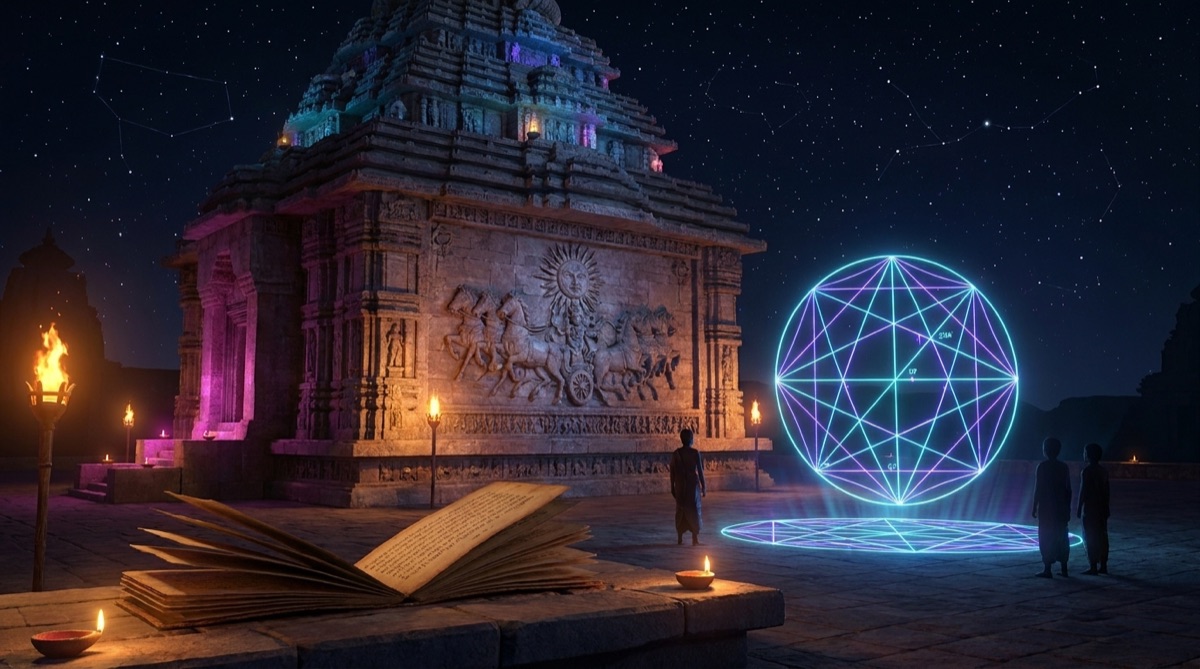
The first Surya Siddhanta
The siddhantas are treatises that calculate positions of the Sun, Moon and planets with geometry and sine tables. The old version of the Surya Siddhanta is known from Varahamihira's summary; the text we read today was revised around 800 and kept being retouched for centuries.
📍 India
Sources (2)
- Plofker, K. (2009). Mathematics in India, chs. 3 and 4 (the siddhantas and their dating).
- Pingree, D. (1978). History of mathematical astronomy in India. Dictionary of Scientific Biography, vol. 15.
- 415
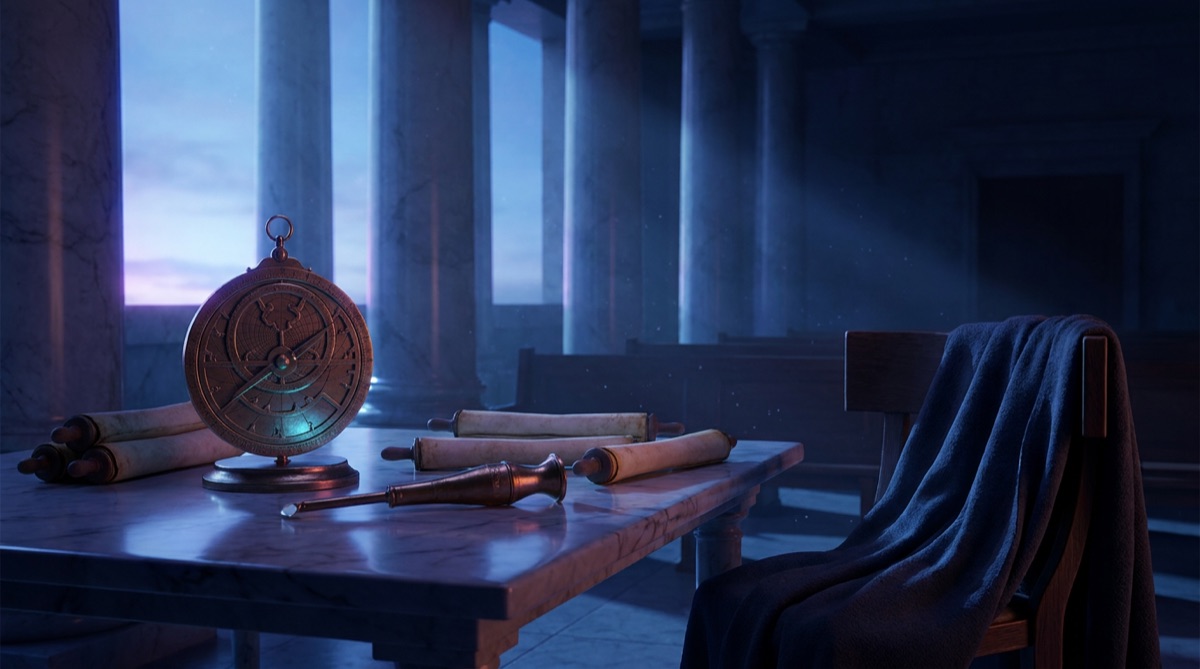
Death of Hypatia
Hypatia, Theon's daughter, taught mathematics and astronomy in Alexandria and revised with her father the commentary on the “Almagest”. In March 415 she was murdered by a mob amid a political conflict between the prefect Orestes and the bishop Cyril. Her death is often taken as a symbol of the end of Greek astronomy in Alexandria, although teaching continued there for some time.
👤 Hypatia of Alexandria · 📍 Alexandria
Sources (2)
- Socrates Scholasticus, Ecclesiastical History, VII.15.
- Dzielska, M. (1995). Hypatia of Alexandria. Harvard University Press.
- 462
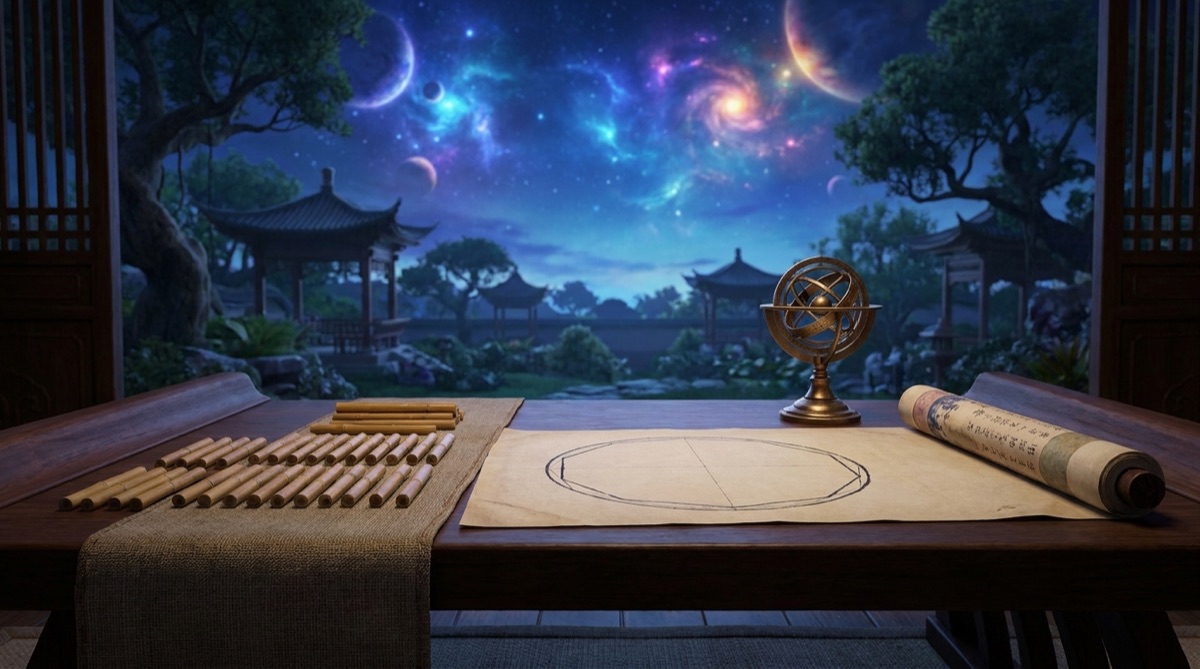
Zu Chongzhi builds precession into the calendar
The mathematician Zu Chongzhi, famous for his value of π with seven correct digits, proposed in 462 the Daming calendar, the first to take precession into account. It was rejected by the court and adopted only in 510, thanks to his son.
👤 Zu Chongzhi, Zu Gengzhi · 📍 Jiankang (Nanjing), China
Sources (2)
- MacTutor History of Mathematics, biography of Zu Chongzhi (University of St Andrews).
- Hockey, T. et al. (eds.) (2007). Biographical Encyclopedia of Astronomers, entry “Zu Chongzhi”. Springer.
-
Middle Ages
476 – 1492 - 499
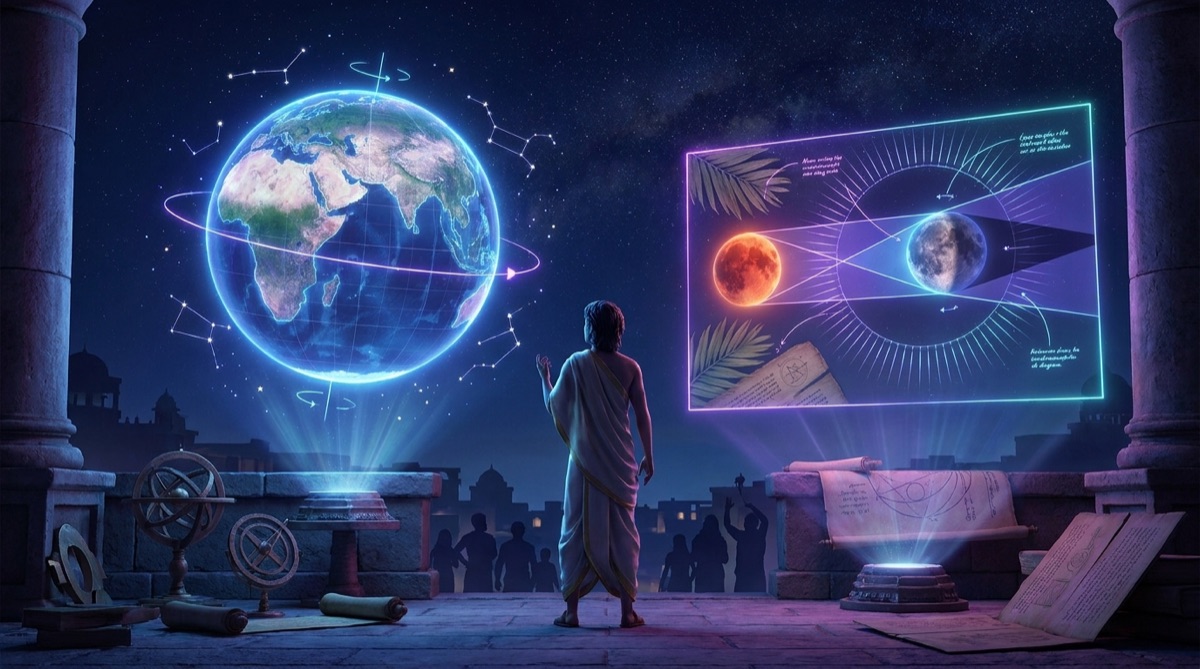
Aryabhata and the Aryabhatiya
At the age of 23 Aryabhata wrote in verse a treatise that states that the Earth rotates on its axis and that the sky only appears to move, explains eclipses as shadows of the Earth and of the Moon, and gives π ≈ 3.1416 and a table of sines. It is the starting point of all later Indian mathematical astronomy.
👤 Aryabhata · 📍 Kusumapura (Pataliputra, present-day Patna), India
📘 Day and night 🧪 Day, night and the seasons Lunar eclipseSidereal day
Sources (2)
- Shukla, K. S. & Sarma, K. V. (eds.) (1976). Aryabhatiya of Aryabhata. Indian National Science Academy (Gola, verses 9–10 on rotation; Ganita, verse 10 on π).
- MacTutor History of Mathematics, biography of Aryabhata (University of St Andrews).
- c. 500–900

Tiwanaku and the Kalasasaya temple
On the shores of Lake Titicaca, at 3 800 m, Tiwanaku was the capital of a great Andean state. Its Kalasasaya temple has walls and gateways with solar orientations (equinoxes and solstices). In the 1940s Arthur Posnansky used those alignments to date the site to 15 000 BCE; archaeology rejects this: the city flourished between the 6th and 10th centuries.
👤 Arthur Posnansky · 📍 Tiwanaku, La Paz (Bolivia)
Sources (2)
- UNESCO, World Heritage List: Tiwanaku, Spiritual and Political Centre of the Tiwanaku Culture (2000). https://whc.unesco.org/es/list/567
- Posnansky, A. (1945). Tihuanacu: The Cradle of American Man. J. J. Augustin, New York (the astronomical dating, now discarded).
- c. 505
Varahamihira summarizes five schools
In the Pancha-Siddhantika, Varahamihira compares the five astronomical systems of his time, two of them of Greek origin. Thanks to this summary we know treatises that would otherwise have been lost. The year 505 appears in the text as the reference date for his calculations.
👤 Varahamihira · 📍 Ujjain, India
Sources (2)
- Neugebauer, O. & Pingree, D. (eds.) (1970–71). The Pancasiddhantika of Varahamihira. Royal Danish Academy of Sciences and Letters.
- Plofker, K. (2009). Mathematics in India, pp. 67–71.
- 628
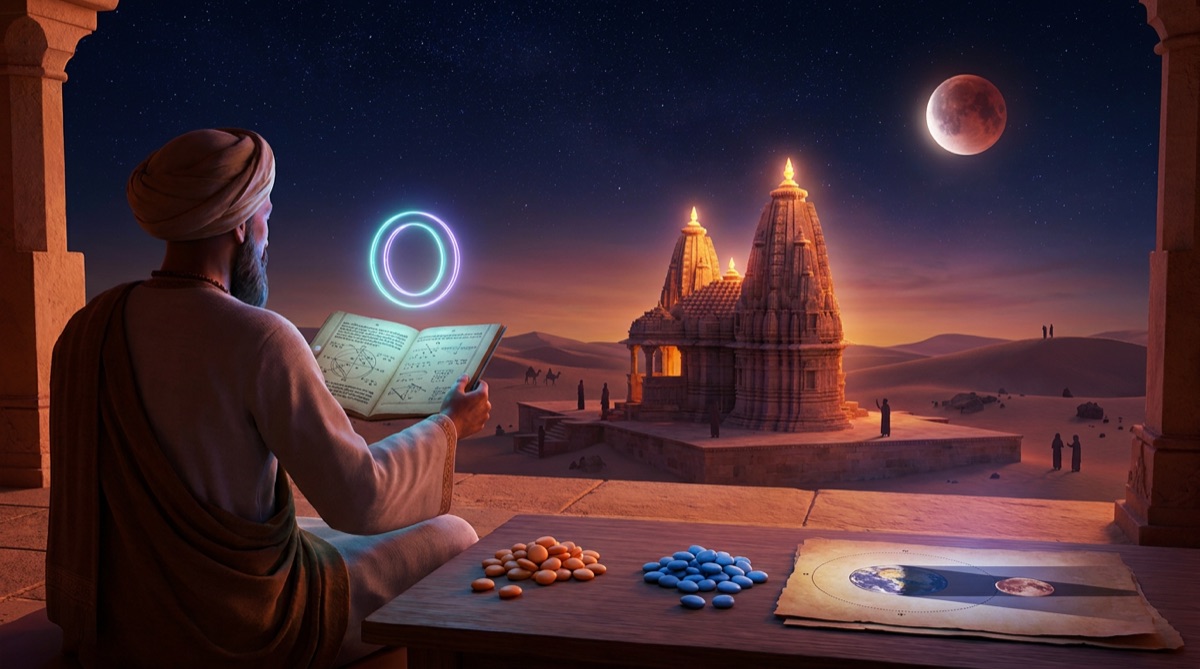
Brahmagupta and the Brahmasphutasiddhanta
At the age of 30 Brahmagupta wrote an astronomical treatise that includes the first known rules for operating with zero and negative numbers, and methods for eclipses, conjunctions and the positions of the planets. Translated into Arabic in Baghdad, it carried decimal numeration to the Islamic world.
👤 Brahmagupta · 📍 Bhillamala (Bhinmal, Rajasthan), India
📘 Big numbers Scientific notation
Sources (2)
- Plofker, K. (2009). Mathematics in India, ch. 5 (Brahmagupta).
- MacTutor History of Mathematics, biography of Brahmagupta (University of St Andrews).
- c. 629
Bhaskara I comments on Aryabhata
The first great commentator on Aryabhata explained and extended his work and gave an approximate formula for the sine, simple and very accurate, which was used for centuries to calculate the positions of celestial bodies without tables.
👤 Bhaskara I · 📍 Valabhi (Gujarat) and Ashmaka, India
Sources (2)
- Shukla, K. S. (ed.) (1960). Mahabhaskariya of Bhaskara I. Lucknow University.
- Plofker, K. (2009). Mathematics in India, pp. 71–82.
- c. 632 – 647
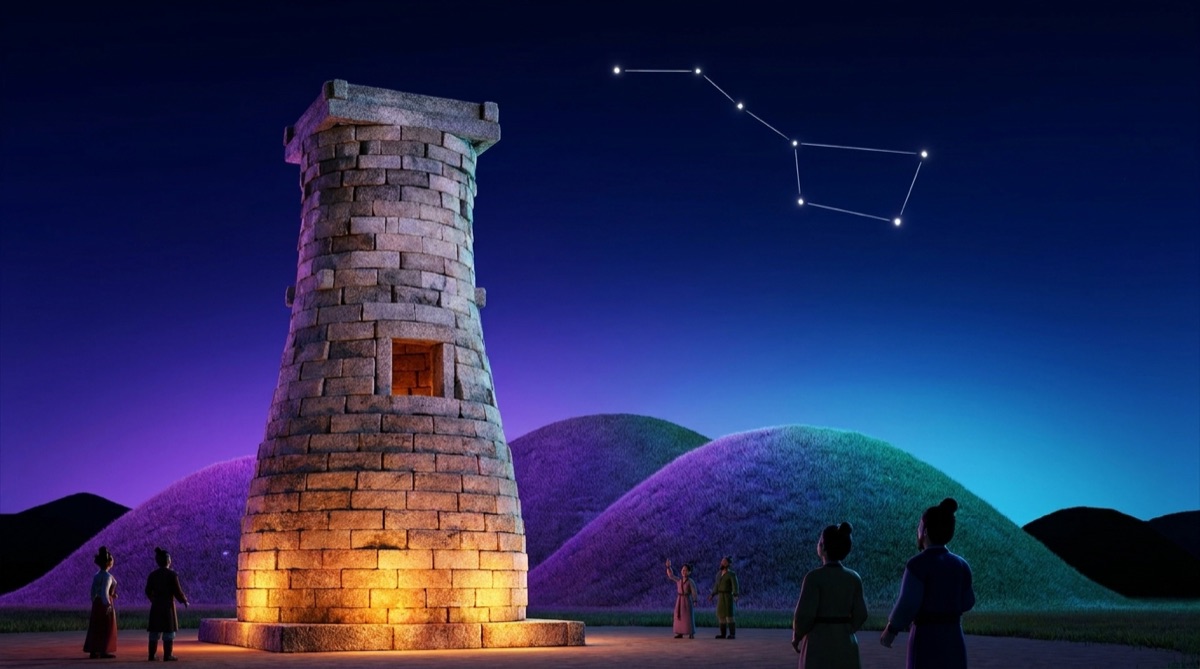
Cheomseongdae, the tower of Silla
In Gyeongju, capital of the Korean kingdom of Silla, a stone tower about nine meters tall was raised under Queen Seondeok; tradition identifies it as an observatory. It is the oldest surviving astronomical structure in East Asia, although exactly how it was used is still debated.
👤 Queen Seondeok of Silla · 📍 Gyeongju, Korea
Sources (2)
- Cultural Heritage Administration of Korea: Cheomseongdae, National Treasure No. 31 (heritage.go.kr).
- Selin, H. (ed.) (2008). Encyclopaedia of the History of Science, Technology, and Medicine in Non-Western Cultures, entry “Astronomy in Korea”.
- c. 649 – 684
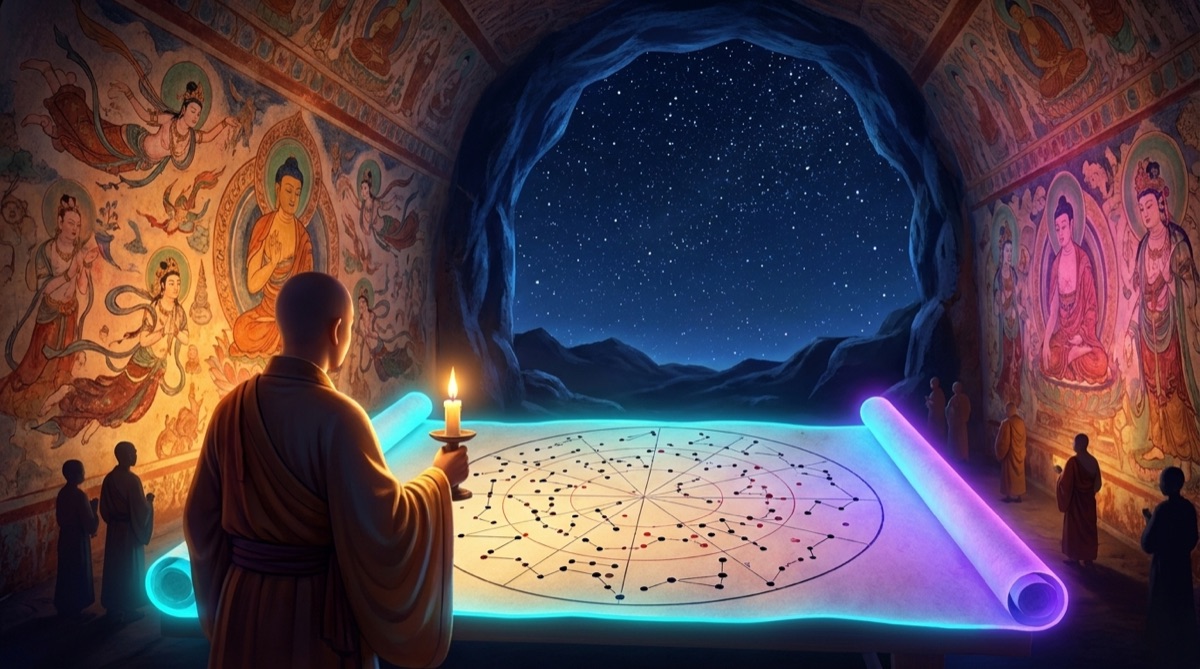
The Dunhuang star map
A paper scroll found in the Dunhuang caves draws more than 1 300 stars in 12 maps plus a circumpolar one, with a careful projection. Dated to around 649–684, it is the oldest complete atlas of the sky preserved anywhere in the world.
📍 Dunhuang (Gansu), China
📘 Stars and constellations 🧪 Interactive planisphere ConstellationCelestial pole
Sources (2)
- Bonnet-Bidaud, J.-M., Praderie, F. & Whitfield, S. (2009). The Dunhuang Chinese sky. Journal of Astronomical History and Heritage 12(1), 39–59.
- British Library, manuscript Or.8210/S.3326 (International Dunhuang Programme).
- c. 650–900
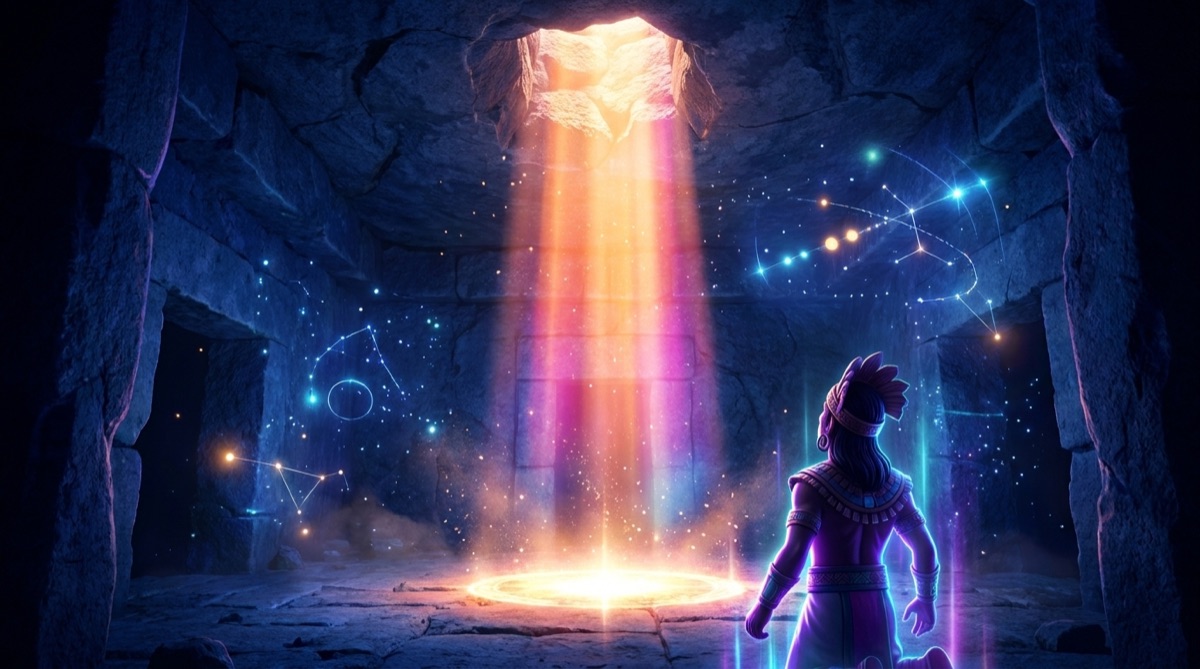
The zenith chamber of Xochicalco
Beneath the city there is a cave with a vertical shaft about 8.7 m long. When the Sun passes through the zenith (May 14–15 and July 28–29 at that latitude), a beam of light falls on the floor. It is the clearest instrument we have for measuring the zenith passage, the phenomenon that defines the tropical agricultural year.
📍 Xochicalco, Morelos (Mexico)
📘 Length of the day and altitude of the Sun 🧪 Day, night and the seasons ZenithLatitude
Sources (2)
- UNESCO, World Heritage List: Archaeological Monuments Zone of Xochicalco (1999). https://whc.unesco.org/es/list/939
- Aveni, A. F. (2001). Skywatchers. University of Texas Press, ch. 6 (zenith tubes of Xochicalco and Monte Albán).
- 724 – 725
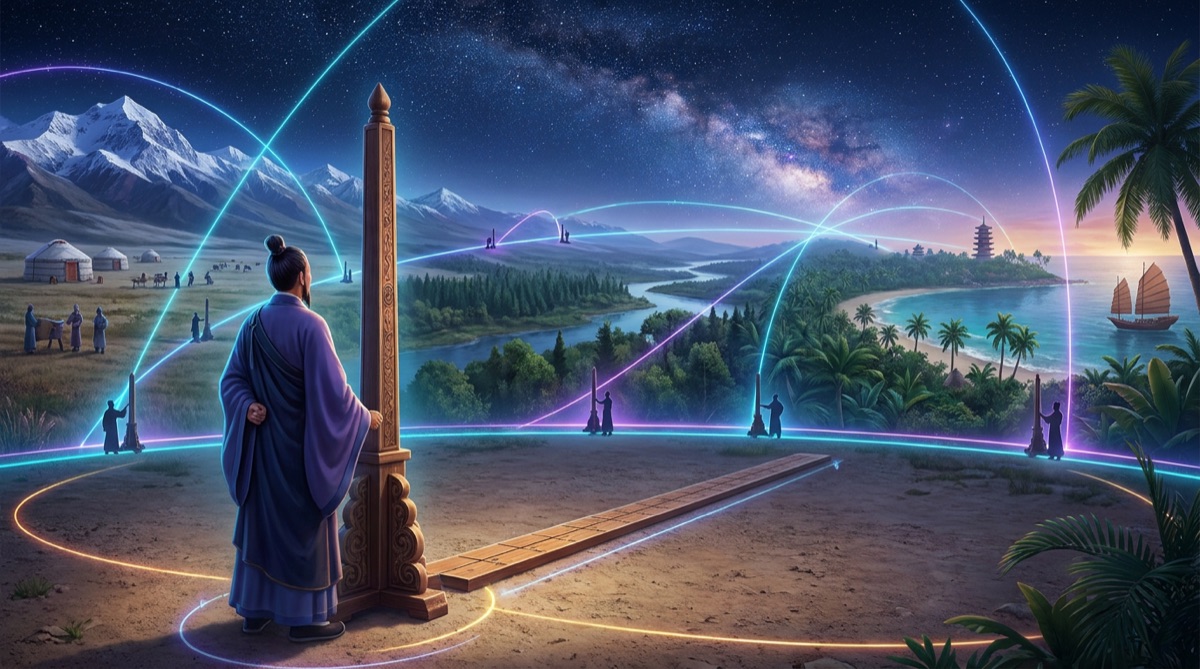
Yi Xing measures the meridian
The monk and astronomer Yi Xing organized, with Nangong Yue, a chain of gnomon stations from southern Vietnam to Mongolia to measure how much the shadow changes with latitude. It was the first measurement of a meridian arc carried out by a state, and it served his Dayan calendar (729).
👤 Yi Xing, Nangong Yue · 📍 China (Tang dynasty)
📘 Angles, parallel lines and shadows 🧪 Eratosthenes measures the Earth GnomonLatitude
Sources (2)
- Beer, A. et al. (1961). An 8th-century meridian line: I-Hsing's chain of gnomons and the pre-history of the metric system. Vistas in Astronomy 4, 3–28. https://doi.org/10.1016/0083-6656(61)90003-2
- Needham & Wang (1959), Science and Civilisation in China, vol. 3, pp. 292–294.
- c. 773

The siddhantas travel to Baghdad
An Indian embassy brought to the court of the caliph al-Mansur an astronomical treatise, probably derived from Brahmagupta, which al-Fazari translated into Arabic as the Sindhind. With it the Indian numerals and the sine tables passed to the Islamic world.
👤 Al-Fazari · 📍 Baghdad, Iraq
Sources (2)
- Pingree, D. (1970). The fragments of the works of al-Fazari. Journal of Near Eastern Studies 29(2), 103–123. https://doi.org/10.1086/372158
- Hoskin, M. (ed.) (1999). The Cambridge Concise History of Astronomy, ch. 3.
- c. 773

The Sindhind arrives in Baghdad
An Indian embassy brought to the court of the caliph al-Mansur an astronomical treatise derived from Brahmagupta. Al-Fazari translated it into Arabic as the Sindhind: with it the Indian numerals, the sine tables and the methods for calculating eclipses entered the Islamic world.
👤 Al-Fazari, Al-Mansur · 📍 Baghdad, Iraq
Sources (2)
- Pingree, D. (1970). The fragments of the works of al-Fazari. Journal of Near Eastern Studies 29(2), 103–123. https://doi.org/10.1086/372158
- Hoskin, M. (ed.) (1999). The Cambridge Concise History of Astronomy, ch. 3.
- 8th–9th centuries

The astrolabe is perfected in Baghdad
The astrolabe, a flat rotating map of the sky over a plate with the local horizon, was a Greek invention, but it was in Baghdad that it was produced in quantity, described in treatises and given scales for the hour of prayer and the direction of Mecca. The oldest surviving ones are from the 10th century.
👤 Al-Fazari, Ali ibn Isa al-Asturlabi · 📍 Baghdad and Harran
📘 Celestial coordinates 🧪 Interactive planisphere ZenithAzimuthAltitude above the horizonHorizon
Sources (2)
- King, D. A. (2005). In Synchrony with the Heavens, vol. 2, part XIII (the oldest astrolabes).
- History of Science Museum, Oxford, astrolabe collection (hsm.ox.ac.uk).
- 813 – 833

Al-Ma'mun, the House of Wisdom and the Almagest in Arabic
The caliph al-Ma'mun sponsored systematic translations from Greek, Persian and Sanskrit, among them Ptolemy's Almagest, and ordered observations in Baghdad (828) and Damascus to check its tables. It is the start of Islamic astronomy as a research program.
👤 Al-Ma'mun, Al-Hajjaj ibn Yusuf, Yahya ibn Abi Mansur · 📍 Baghdad and Damascus
Sources (2)
- Saliba, G. (2007). Islamic Science and the Making of the European Renaissance, chs. 1–2.
- Sayili, A. (1960). The Observatory in Islam, ch. 2 (al-Ma'mun's observations).
- c. 820
Al-Khwarizmi and his tables
Muhammad ibn Musa al-Khwarizmi compiled in Baghdad a zij, a manual with tables for calculating the positions of celestial bodies, based on Indian methods. His books on arithmetic and algebra gave the world the words “algorithm” (from his name) and “algebra” (from al-jabr).
👤 Al-Khwarizmi · 📍 Baghdad, Iraq
Sources (2)
- Neugebauer, O. (1962). The Astronomical Tables of al-Khwarizmi. Royal Danish Academy of Sciences and Letters.
- MacTutor History of Mathematics, biography of al-Khwarizmi (University of St Andrews).
- c. 827
A degree of meridian is measured on the plain of Sinjar
By order of al-Ma'mun, two teams walked north and south from the same point until the altitude of the pole changed by one degree, and measured the distance covered. They obtained about 56 2/3 Arabic miles per degree: a repetition, with rope and astrolabe, of Eratosthenes' method.
👤 Al-Ma'mun, Ali ibn Isa al-Asturlabi, Khalid al-Marwarrudhi · 📍 Plain of Sinjar, Iraq
📘 Eratosthenes measures the Earth 🧪 Eratosthenes measures the Earth LatitudeCelestial pole
Sources (2)
- Al-Biruni, Kitab Tahdid nihayat al-amakin (Trans. J. Ali, The Determination of the Coordinates of Cities, American University of Beirut, 1967).
- King, D. A. (2008). Astronomy in the Islamic world. In Selin (ed.), Encyclopaedia of the History of Science, Technology, and Medicine in Non-Western Cultures. Springer.
- c. 900
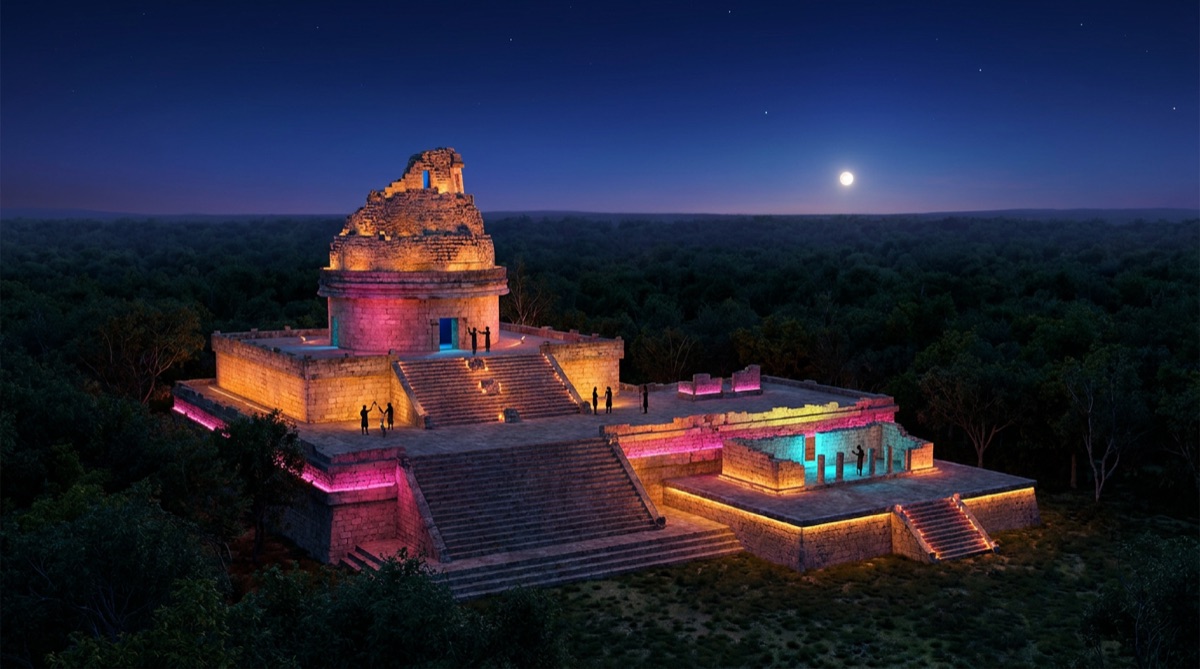
The Caracol of Chichén Itzá
A round tower with narrow windows, rare in Maya architecture. Aveni, Gibbs and Hartung (1975) showed that several of its sight lines coincide with the extreme positions of Venus on the horizon and with equinox sunsets. Part of the tower was lost, so not all the hypotheses can be tested.
👤 Anthony Aveni, Sharon Gibbs, Horst Hartung · 📍 Chichén Itzá, Yucatán (Mexico)
🧪 Interactive planisphere HorizonAzimuth
Sources (2)
- Aveni, A. F., Gibbs, S. L. & Hartung, H. (1975). The Caracol Tower at Chichen Itza: An Ancient Astronomical Observatory? Science 188, 977–985.
- UNESCO, World Heritage List: Pre-Hispanic City of Chichen-Itza (1988). https://whc.unesco.org/es/list/483
- c. 880–918
Al-Battani measures the year and precession
Over some forty years of observation in Raqqa, al-Battani obtained a tropical year of 365 days, 5 hours, 46 minutes and 24 seconds (about two minutes less than the real value), a precession of 1° every 66 years and better values for the obliquity of the ecliptic and the solar orbit. Copernicus cites him dozens of times.
👤 Al-Battani · 📍 Raqqa, Syria
📘 Hipparchus and the sky that moves slowly PrecessionObliquity of the eclipticEquinox
Sources (2)
- Hockey, T. et al. (eds.) (2007). Biographical Encyclopedia of Astronomers, entry “Battani”. Springer.
- Nallino, C. A. (ed.) (1899–1907). Al-Battani sive Albatenii Opus Astronomicum (3 vols.). Milan.
- 964

Al-Sufi and the Book of Fixed Stars
Abd al-Rahman al-Sufi revised Ptolemy's catalog star by star, corrected brightnesses and added the traditional Arabic names. He described a “little cloud” in Andromeda, the first written mention of that galaxy. He is often also credited with the first description of the Large Magellanic Cloud (al-Bakr, “the white ox”, visible from southern Arabia), but specialists debate whether the passage really refers to it.
👤 Abd al-Rahman al-Sufi · 📍 Isfahan and Shiraz, Persia
📘 The Milky Way and other galaxies GalaxyApparent magnitudeConstellation
Sources (2)
- Hafez, I. (2010). Abd al-Rahman al-Sufi and his Book of the Fixed Stars: a journey of re-discovery. Doctoral thesis, James Cook University.
- Kunitzsch, P. & Smart, T. (2006). A Dictionary of Modern Star Names. Sky Publishing (introduction).
- c. 1000
El Castillo of Chichén Itzá and the equinox “serpent”
At sunset near the equinoxes, the corners of the pyramid cast triangles of light on the north balustrade, which looks like a serpent descending. The effect is real, but it lasts several weeks, not one day, and no Maya source mentions it: the first descriptions are from the 20th century, so specialists debate whether it was intentional.
📍 Chichén Itzá, Yucatán (Mexico)
Sources (2)
- Carlson, J. B. (1999). Pilgrimage and the Equinox “Serpent of Light and Shadow” Phenomenon at the Castillo, Chichén Itzá, Yucatán. Archaeoastronomy: The Journal of Astronomy in Culture 14(1).
- Šprajc, I. & Sánchez Nava, P. F. (2013). Astronomía en la arquitectura de Chichén Itzá: una reevaluación [Astronomy in the architecture of Chichén Itzá: a reassessment]. Estudios de Cultura Maya 41, 31–60.
- 1006

The supernova of 1006
In the spring of 1006 the brightest star ever recorded in history appeared in Lupus. Chinese chroniclers described its position and brightness; Japan, Egypt, Iraq and Europe also recorded it. Today its remnant is observed in radio and X-rays.
📍 China, Japan, Egypt
Sources (2)
- Stephenson, F. R. & Green, D. A. (2002). Historical Supernovae and their Remnants, ch. 6 (SN 1006).
- Goldstein, B. R. (1965). Evidence for a supernova of A.D. 1006. Astronomical Journal 70, 105–114. https://doi.org/10.1086/109679
- 1006

Ali ibn Ridwan describes the supernova of 1006
From Cairo, the physician and astrologer Ali ibn Ridwan described a new star in Lupus “two and a half or three times larger than Venus” and with light like that of a quarter Moon. His account, together with the Chinese and Japanese ones, allowed modern astronomers to classify the explosion.
👤 Ali ibn Ridwan · 📍 Cairo, Egypt
📘 The lives of stars Supernova
Sources (2)
- Goldstein, B. R. (1965). Evidence for a supernova of A.D. 1006. Astronomical Journal 70, 105–114. https://doi.org/10.1086/109679
- Stephenson, F. R. & Green, D. A. (2002). Historical Supernovae and their Remnants. Oxford University Press, ch. 6.
- c. 1007
Ibn Yunus and the Hakimi Zij
In Cairo, Ibn Yunus gathered in a great manual his observations of eclipses and conjunctions and those of his predecessors, with very accurate trigonometric tables. His eclipses are used today to measure the slowing of the Earth's rotation.
👤 Ibn Yunus · 📍 Cairo, Egypt
Sources (2)
- King, D. A. (1976). Ibn Yunus. In Dictionary of Scientific Biography, vol. 14, 574–580. Scribner's.
- Stephenson, F. R. (1997). Historical Eclipses and Earth's Rotation. Cambridge University Press, ch. 12 (medieval Arab eclipses).
- c. 1025
Al-Biruni measures the radius of the Earth from a mountain
At the fortress of Nandana (present-day Pakistan), al-Biruni measured the height of a hill and the angle by which the horizon “dips” seen from the top; with trigonometry he deduced the radius of the Earth with an error of a few percent. Around 1030 he also wrote the best medieval description of Indian science.
👤 Al-Biruni · 📍 Nandana (Punjab)
📘 How Eratosthenes measured the Earth with a stick and a shadow Horizon
Sources (2)
- Hockey, T. et al. (eds.) (2007). Biographical Encyclopedia of Astronomers, entry “Biruni”. Springer.
- MacTutor History of Mathematics, biography of al-Biruni (University of St Andrews).
- c. 1025–1120

Arrival in the Society Islands (Tahiti)
After almost two thousand years in Tonga and Samoa, the Polynesians leap into the central Pacific. The analysis of 1 434 carbon-14 dates (Wilmshurst et al., 2011) places the settlement of Tahiti and its neighbors between 1025 and 1120, centuries later than was believed.
📍 Society Islands (French Polynesia)
Sources (1)
- Wilmshurst, J. M. et al. (2011). High-precision radiocarbon dating shows recent and rapid initial human colonization of East Polynesia. PNAS 108(5), 1815–1820.
- c. 1028
Ibn al-Haytham: Doubts about Ptolemy
The great scholar of optics pointed out that Ptolemy's equant (a point from which the motion appears uniform without being so) contradicts the physics of rotating spheres. His critique opened two centuries of attempts to build models without an equant.
👤 Ibn al-Haytham · 📍 Cairo, Egypt
Sources (2)
- Sabra, A. I. (1978). An eleventh-century refutation of Ptolemy's planetary theory. Studia Copernicana 16, 117–131.
- Saliba, G. (2007). Islamic Science and the Making of the European Renaissance, ch. 3.
- c. 1030
Al-Biruni describes Indian science
After years in northern India learning Sanskrit, the Persian scholar al-Biruni wrote a book on its astronomy, mathematics and calendar. It is the best external description of medieval Indian science and a key source for knowing lost texts.
👤 Al-Biruni · 📍 Ghazni and the Punjab
Sources (2)
- Sachau, E. C. (Trans.) (1888). Alberuni's India. Trübner & Co.
- Hockey, T. et al. (eds.) (2007). Biographical Encyclopedia of Astronomers, entry “Biruni”. Springer.
- 1054
The “guest star” of 1054
On July 4, 1054, the Song astronomers recorded a new star near Tianguan (ζ Tauri), visible by day for 23 days and by night for almost two years. In the 20th century it was identified with the explosion that left the Crab Nebula and its pulsar.
👤 Yang Weide · 📍 Kaifeng, China
📘 The lives of stars SupernovaNeutron star
Sources (2)
- Stephenson, F. R. & Green, D. A. (2002). Historical Supernovae and their Remnants, ch. 5 (SN 1054).
- Duyvendak, J. J. L. (1942). Further data bearing on the identification of the Crab Nebula with the supernova of 1054 A.D. Publications of the Astronomical Society of the Pacific 54, 91–94. https://doi.org/10.1086/125409
- c. 1080
Al-Zarqali and the Toledan Tables
In Toledo, a group led by the qadi Said al-Andalusi and the instrument maker Ibrahim ibn Yahya al-Zarqali (Arzachel) compiled astronomical tables based on al-Khwarizmi and al-Battani. Al-Zarqali also designed the saphaea, a universal astrolabe that works at any latitude, and measured the slow motion of the solar apogee.
👤 Al-Zarqali (Arzachel), Said al-Andalusi · 📍 Toledo, al-Andalus
📘 Celestial coordinates 🧪 Interactive planisphere LatitudePerihelion
Sources (2)
- Pedersen, F. S. (2002). The Toledan Tables: A Review of the Manuscripts and the Textual Versions (4 vols.). Royal Danish Academy of Sciences and Letters.
- Samsó, J. (2011). Las ciencias de los antiguos en al-Andalus (2nd ed.), ch. 6.
- 1088
Shen Kuo and the Dream Pool Essays
The official and scientist Shen Kuo completed in 1088 a miscellany in which he describes the magnetic needle, explains the round shape of the Moon from its phases and tells how he measured for months the distance between the pole star and the true pole. With Wei Pu he planned a five-year program of planetary observations.
👤 Shen Kuo, Wei Pu · 📍 Runzhou (Zhenjiang), China
📘 Polaris and the Southern Cross Celestial polePhases of the Moon
Sources (2)
- Sivin, N. (1975). Shen Kua. In Dictionary of Scientific Biography, vol. 12, 369–393. Scribner's.
- Needham & Wang (1959), Science and Civilisation in China, vol. 3, pp. 262 and 415–416.
- 1088 – 1092
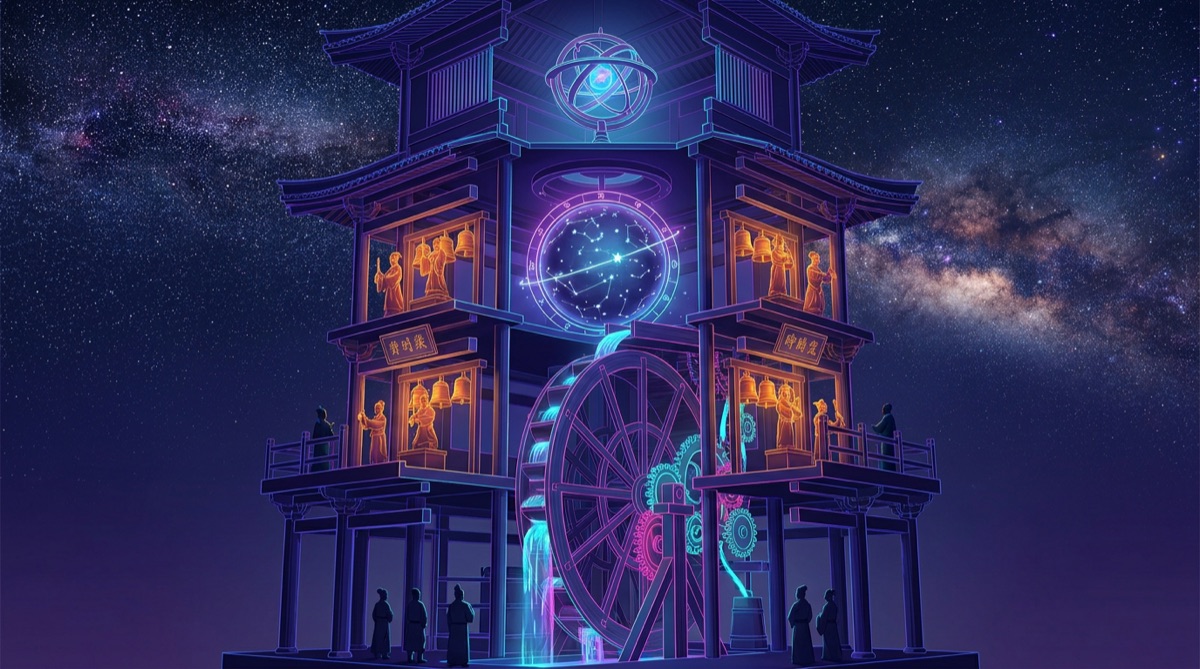
Su Song's astronomical clock tower
In Kaifeng, Su Song directed the construction of a tower more than ten meters tall in which a water wheel with an escapement drove an armillary sphere, a celestial globe and figurines that marked the hours. His treatise of 1094 preserves the plans: it is the best-documented astronomical mechanical clock of the Middle Ages.
👤 Su Song, Han Gonglian · 📍 Kaifeng, China
📘 Solar time and sidereal time Sidereal time
Sources (2)
- Needham, Wang & Price (1960). Heavenly Clockwork, ch. 2–4.
- Hockey, T. et al. (eds.) (2007). Biographical Encyclopedia of Astronomers, entry “Su Song”. Springer.
- 1150
Bhaskara II and the Siddhanta Shiromani
The Siddhanta Shiromani (“crown jewel of the treatises”) brings together arithmetic, algebra, planetary astronomy and astronomy of the sphere. Bhaskara carefully calculated the apparent size of the Sun and the Moon, treated the instantaneous motion of the planets and described observing instruments.
👤 Bhaskara II · 📍 Ujjain and Vijjadavida (Maharashtra), India
Sources (2)
- Plofker, K. (2009). Mathematics in India, ch. 6 (Bhaskara II).
- MacTutor History of Mathematics, biography of Bhaskara II (University of St Andrews).
- c. 1175
Toledo translates into Latin
After the Christian conquest of Toledo (1085), translators such as Gerard of Cremona rendered into Latin the Almagest, the tables of al-Khwarizmi and al-Battani, and the astrolabe treatises. By that route Arabic astronomy, and Greek astronomy with it, entered the European universities.
👤 Gerard of Cremona, John of Seville · 📍 Toledo, Castile
Sources (2)
- Hoskin, M. (ed.) (1999). The Cambridge Concise History of Astronomy, chs. 3–4.
- Burnett, C. (2001). The coherence of the Arabic-Latin translation program in Toledo in the twelfth century. Science in Context 14, 249–288. https://doi.org/10.1017/S0269889701000096
- c. 1190–1290
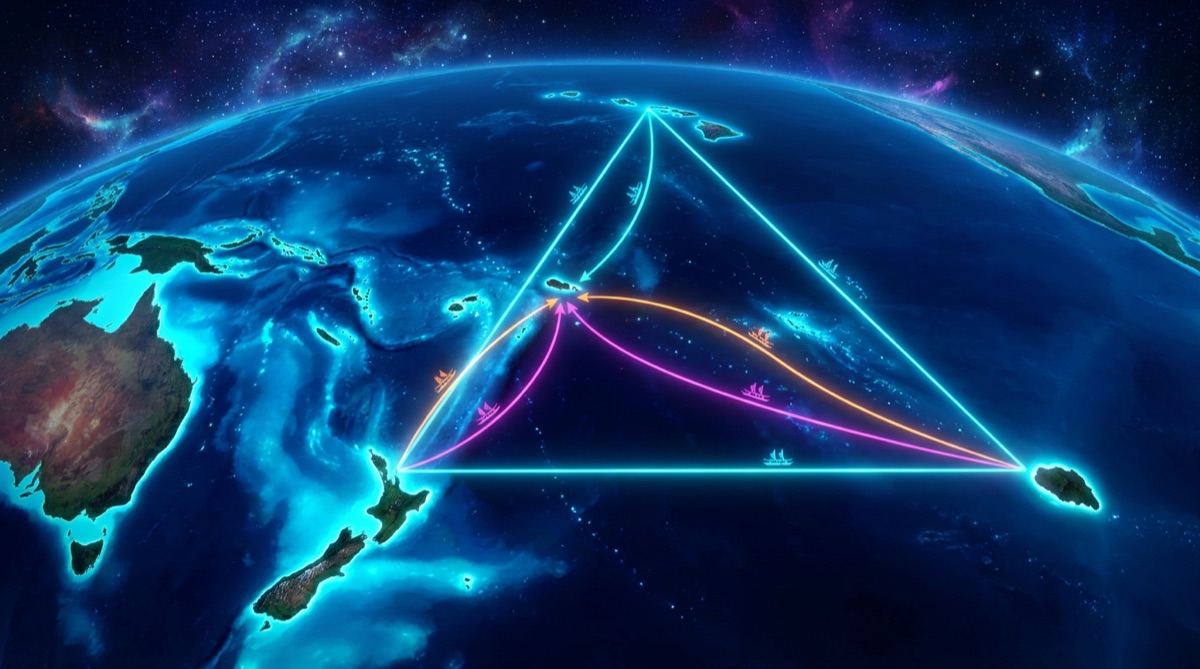
The great leap: Hawaiʻi, Rapa Nui and Aotearoa
In barely a century, the navigators reach the three corners of the “Polynesian triangle”: Hawaiʻi (4 000 km to the north, crossing the equator), Rapa Nui (Easter Island) and Aotearoa (New Zealand, around 1280 according to the rat bones dated by Wilmshurst). It is the fastest and most extensive maritime expansion in preindustrial history.
📍 Hawaiʻi, Rapa Nui, Aotearoa
📘 Polaris and the Southern Cross Latitude
Sources (2)
- Wilmshurst, J. M. et al. (2011). PNAS 108(5), 1815–1820.
- Wilmshurst, J. M., Anderson, A. J., Higham, T. F. G. & Worthy, T. H. (2008). Dating the late prehistoric dispersal of Polynesians to New Zealand using the commensal Pacific rat. PNAS 105(22), 7676–7680.
- 11th–14th centuries
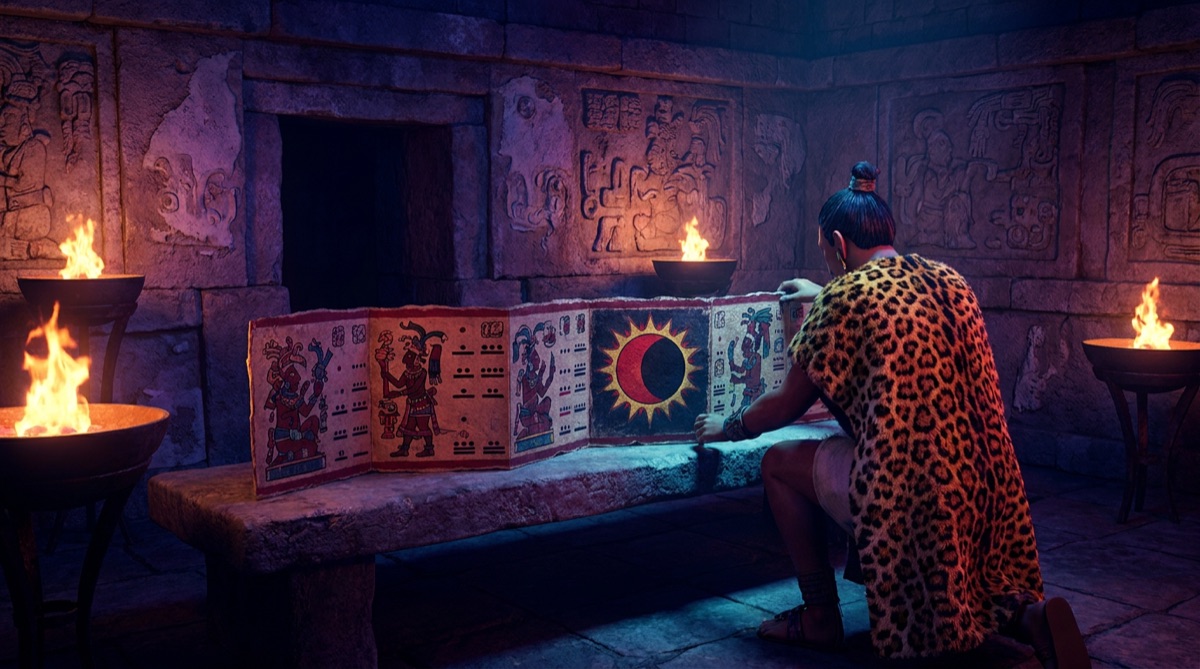
The Dresden Codex: Venus and eclipse tables
The best-preserved Maya book contains a Venus table (5 cycles of 584 days = 8 years of 365) and an eclipse table of 405 lunations = 11 960 days, with the dates on which an eclipse was possible. The copy is dated between the 11th and 14th centuries; the content is older.
📍 Yucatán (Mexico); today in the Sächsische Landesbibliothek, Dresden
📘 Phases of the Moon and eclipses 🧪 Phases of the Moon Solar eclipseLunar eclipseSynodic monthOrbital period
Sources (3)
- Sächsische Landesbibliothek – Staats- und Universitätsbibliothek Dresden (SLUB), Mscr.Dresd.R.310 (Codex Dresdensis), digital edition at digital.slub-dresden.de.
- Förstemann, E. (1880). Die Mayahandschrift der Königlichen öffentlichen Bibliothek zu Dresden. Leipzig.
- Aveni, A. F. (2001). Skywatchers, ch. 5 (Venus and eclipse tables).
- c. 1200
Al-Bitruji and the Andalusian revolt against Ptolemy
Following the philosophers of Córdoba (Ibn Tufayl, Averroes), al-Bitruji (Alpetragius) tried to explain the planets using only spheres centered on the Earth, without epicycles or eccentrics. The model did not predict well, but it showed that Ptolemy's cosmology could be debated.
👤 Al-Bitruji, Averroes · 📍 Seville, al-Andalus
Sources (2)
- Goldstein, B. R. (1971). Al-Bitruji: On the Principles of Astronomy (2 vols.). Yale University Press.
- Samsó, J. (2011). Las ciencias de los antiguos en al-Andalus (2nd ed.), ch. 9.
- c. 1200
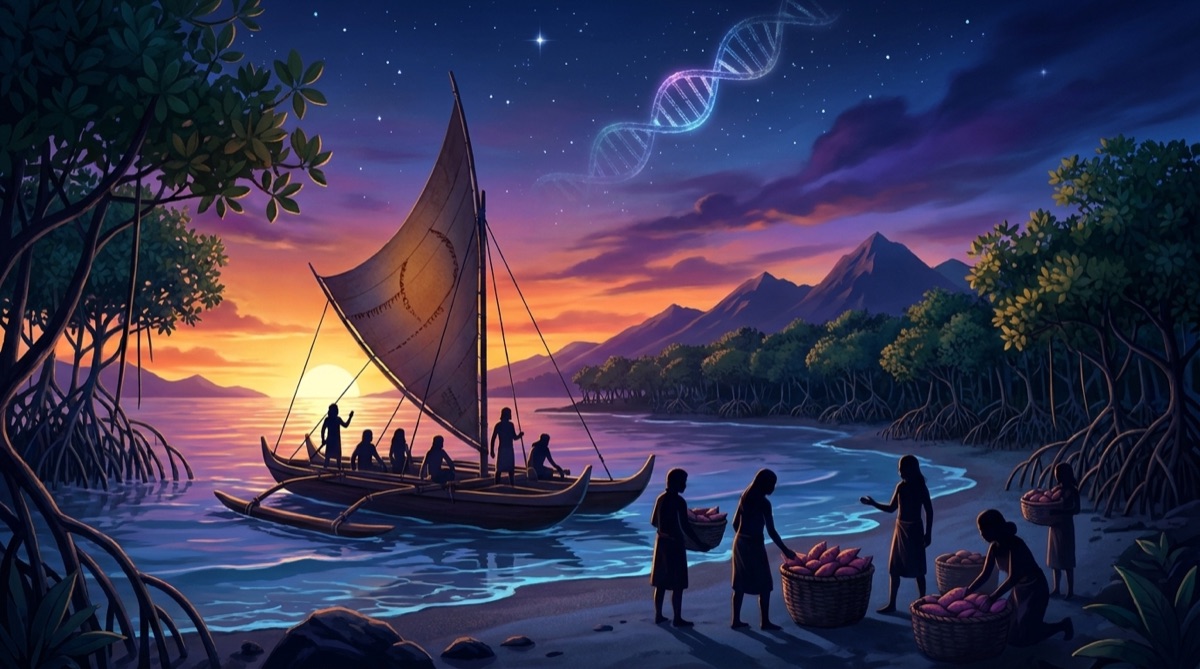
Contact with the Americas: a genetic trail that points to Colombia
The DNA of the inhabitants of the Marquesas, Mangareva and Rapa Nui preserves a small Native American component, incorporated around 1200, before the settlement of Rapa Nui. The closest American people are the Zenú of the Caribbean coast of Colombia. We do not know whether the Polynesians reached America or the Americans reached Polynesia, but the encounter did happen.
📍 Eastern Polynesia and the Pacific coast of South America
Sources (1)
- Ioannidis, A. G. et al. (2020). Native American gene flow into Polynesia predating Easter Island settlement. Nature 583, 572–577. https://doi.org/10.1038/s41586-020-2487-2
- c. 1230

The Japanese Meigetsuki records the supernovae
The courtier poet Fujiwara no Teika copied into his diary, around 1230, the records of the “guest stars” of 1006, 1054 and 1181 kept by the Bureau of Astronomy in Kyoto. Thanks to that copy, Japan provides independent testimony of the three supernovae.
👤 Fujiwara no Teika · 📍 Kyoto, Japan
Sources (2)
- Stephenson, F. R. & Green, D. A. (2002). Historical Supernovae and their Remnants (Japanese records of 1006, 1054 and 1181).
- Xu, Pankenier & Jiang (2000), East Asian Archaeoastronomy, section on Japanese records.
- c. 1230

Sacrobosco writes “De sphaera”
John of Sacrobosco, a teacher in Paris, summarized in a small book the astronomy of Ptolemy as it arrived through the Arabs: the spherical Earth, the celestial spheres, the circles of the sky and the eclipses. It was the astronomy textbook of every European university for four centuries.
👤 John of Sacrobosco · 📍 Paris
Sources (2)
- Thorndike, L. (1949). The Sphere of Sacrobosco and Its Commentators. University of Chicago Press.
- Hoskin, M. (ed.) (1999). The Cambridge Concise History of Astronomy. Cambridge University Press, ch. 3.
- 1247
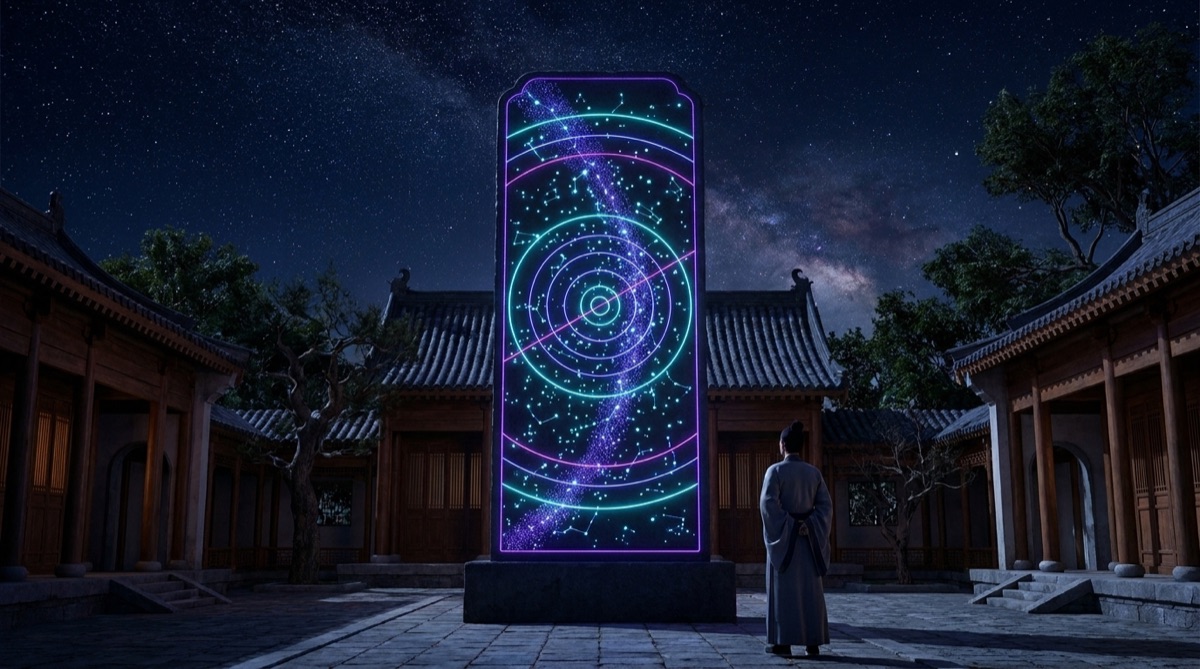
The Suzhou planisphere
A stone stele carved in 1247 reproduces a map of the sky drawn by Huang Shang around 1193, with some 1 400 stars, the equator, the ecliptic and the Milky Way, accompanied by a text that explains the sky to a prince. It is one of the most complete ancient star maps in existence.
👤 Huang Shang, Wang Zhiyuan · 📍 Suzhou, China
📘 Celestial coordinates EclipticCelestial sphere
Sources (2)
- Rufus, W. C. & Tien Hsing-chih (1945). The Soochow Astronomical Chart. University of Michigan Press.
- Needham & Wang (1959), Science and Civilisation in China, vol. 3, pp. 278–281.
- c. 1252
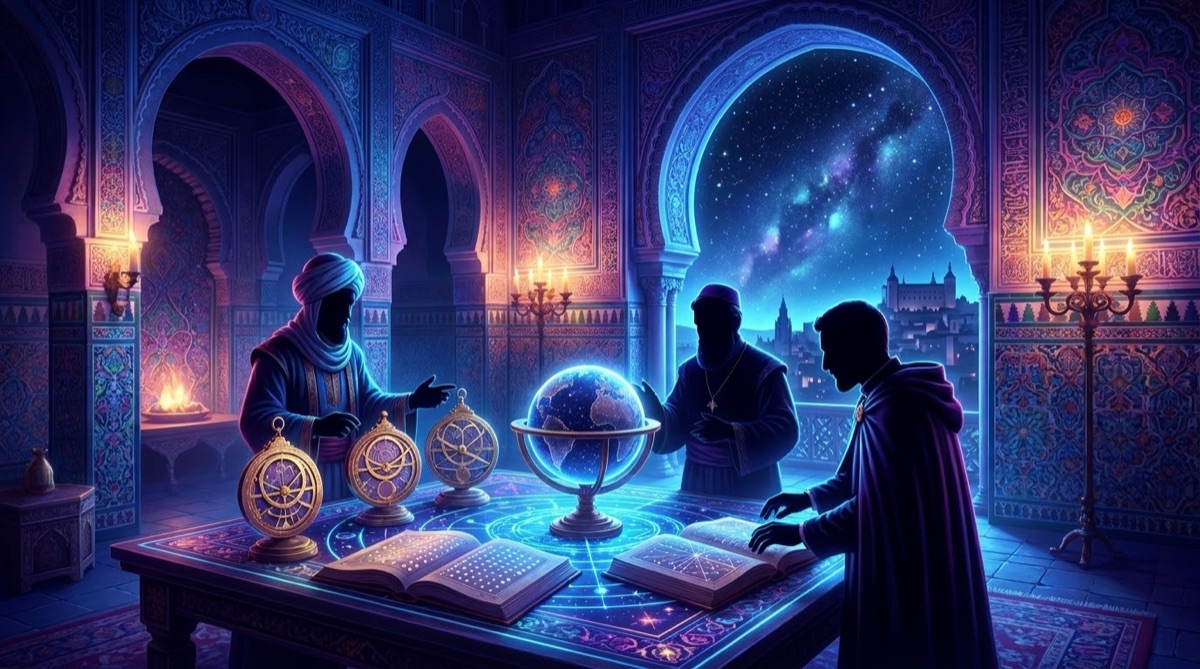
The Alfonsine Tables
In Toledo, the astronomers of Alfonso X the Wise, led by the Jewish scholar Isaac ibn Sid, computed new tables for predicting planetary positions with epoch 1252, the year of the king's coronation. Probably compiled between 1263 and 1272 and spread from Paris, they were the reference tables in Europe until Copernicus, who used the printed edition of 1492.
👤 Alfonso X of Castile, Isaac ibn Sid, Judah ben Moses · 📍 Toledo
Sources (2)
- Chabás, J. & Goldstein, B. R. (2003). The Alfonsine Tables of Toledo. Kluwer (Archimedes, vol. 8).
- Hoskin, M. (ed.) (1999). The Cambridge Concise History of Astronomy. Cambridge University Press, ch. 3.
- 1259
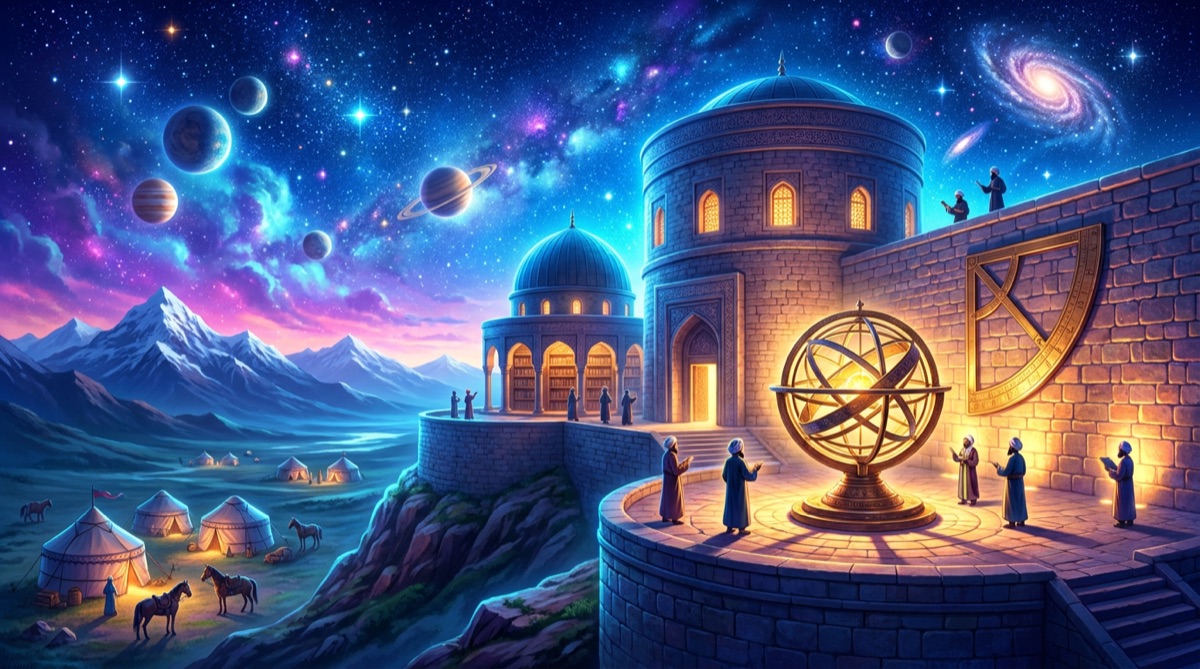
The Maragha observatory
With the support of the Mongol Hulagu, Nasir al-Din al-Tusi founded in Maragha an observatory with a library, large instruments designed by al-Urdi and an international team. Its tables (Zij-i Ilkhani, around 1272) and its school of planetary models were influential for three centuries.
👤 Nasir al-Din al-Tusi, Muayyad al-Din al-Urdi, Hulagu · 📍 Maragha, Iranian Azerbaijan
Sources (2)
- Sayili, A. (1960). The Observatory in Islam, ch. 6 (Maragha).
- Saliba, G. (2007). Islamic Science and the Making of the European Renaissance, ch. 4.
- c. 1261
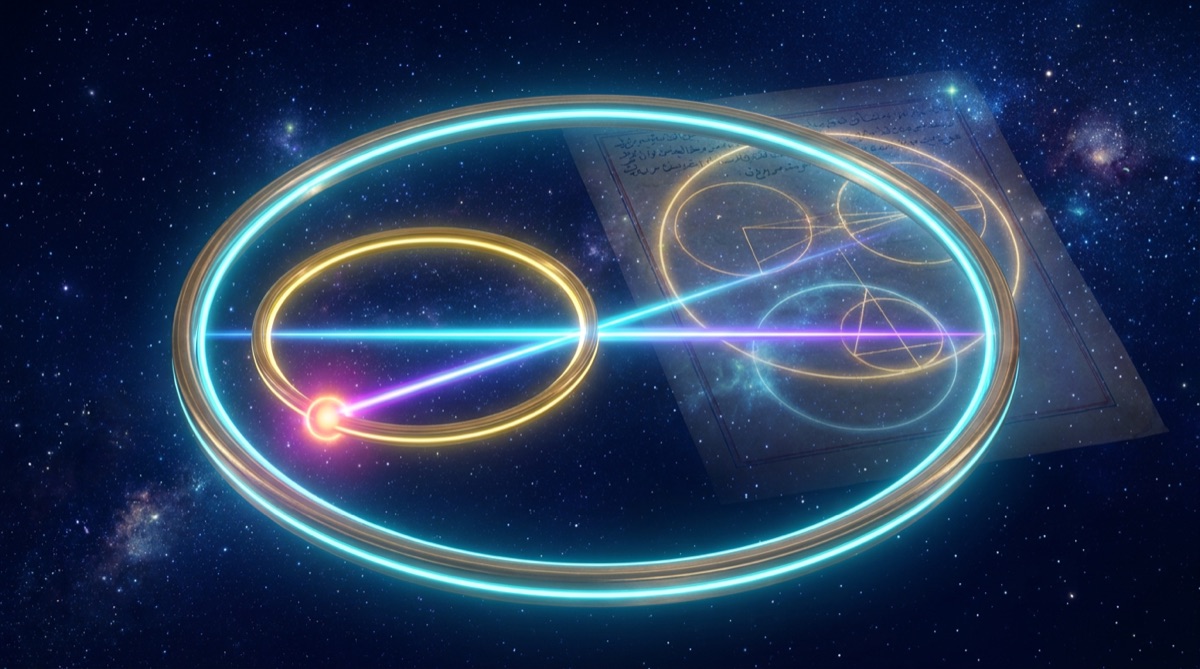
The Tusi couple
In his Tadhkira, al-Tusi showed that two rotating circles, one inside another of twice the radius, produce a back-and-forth motion in a straight line. With that mechanism he replaced Ptolemy's equant with uniform motions; Copernicus would use exactly the same device in 1543.
👤 Nasir al-Din al-Tusi · 📍 Maragha
Sources (2)
- Ragep, F. J. (1993). Nasir al-Din al-Tusi's Memoir on Astronomy (al-Tadhkira fi 'ilm al-hay'a). Springer, vol. 1, II.11.
- Saliba, G. (2007). Islamic Science and the Making of the European Renaissance, ch. 4.
- 1276 – 1281
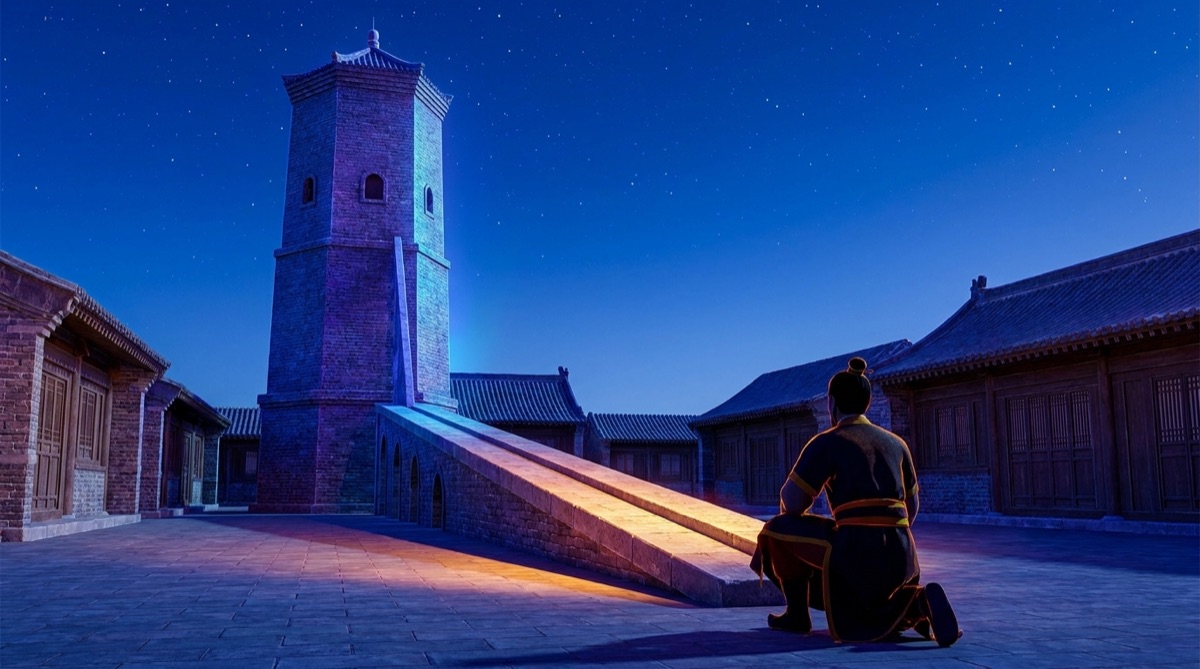
Guo Shoujing and the Shoushi calendar
Commissioned by Kublai Khan, Guo Shoujing built new instruments, among them the gnomon tower of Dengfeng, about 12 meters tall, and organized observations at 27 stations. The Shoushi calendar, promulgated in 1281, uses a year of 365.2425 days, the same value the Gregorian calendar would adopt three centuries later.
👤 Guo Shoujing, Wang Xun, Xu Heng · 📍 Dengfeng (Henan) and Dadu (Beijing), China
📘 Shadows and the sundial 🧪 Day, night and the seasons GnomonSolstice
Sources (2)
- Sivin, N. (2009). Granting the Seasons: The Chinese Astronomical Reform of 1280. Springer.
- UNESCO, World Heritage List: Historic Monuments of Dengfeng in “The Centre of Heaven and Earth” (ref. 1305, 2010).
- c. 1325

Founding of Tenochtitlan
The Mexica found their capital on an island in Lake Texcoco. The Templo Mayor, with its twin shrines, was oriented so that, seen from its base, the equinox Sun would rise between the two, according to the study by Aveni, Calnek and Hartung.
📍 Tenochtitlan (Mexico City)
📘 The cardinal directions EquinoxCardinal points
Sources (1)
- Aveni, A. F., Calnek, E. E. & Hartung, H. (1988). Myth, Environment, and the Orientation of the Templo Mayor of Tenochtitlan. American Antiquity 53(2), 287–309.
- c. 1350

Ibn al-Shatir, the timekeeper of Damascus
In charge of the hours of prayer at the Umayyad mosque, Ibn al-Shatir built models of the Moon and the planets without an equant that are, mathematically, the same ones Copernicus would publish two centuries later, though centered on the Earth. How those ideas reached Europe is still not known with certainty.
👤 Ibn al-Shatir · 📍 Damascus, Syria
📘 Tycho and Kepler, or how eight minutes of arc changed the universe 🧪 Keplerian orbit OrbitKepler's laws
Sources (2)
- Roberts, V. (1957). The solar and lunar theory of Ibn ash-Shatir: a pre-Copernican Copernican model. Isis 48(4), 428–432. https://doi.org/10.1086/348609
- Kennedy, E. S. & Roberts, V. (1959). The planetary theory of Ibn al-Shatir. Isis 50(3), 227–235. https://doi.org/10.1086/348774
- 1377
Oresme debates whether the Earth rotates
In his “Book of the Heavens and the World” (1377), Nicole Oresme carefully examined the idea that the Earth turns on itself once a day and showed that no observation or argument refutes it: what we see would be the same. He concluded, however, that the Earth is at rest. His analysis anticipates by two centuries the reasoning of Copernicus and Galileo.
👤 Nicole Oresme · 📍 Paris
Sources (2)
- Oresme, N. Le Livre du ciel et du monde, book II, ch. 25 (ed. and trans. A. D. Menut & A. J. Denomy, University of Wisconsin Press, 1968).
- Grant, E. (1994). Planets, Stars, and Orbs: The Medieval Cosmos, 1200–1687. Cambridge University Press, ch. 20.
- c. 1340–1425
Madhava and infinite series
In Kerala, Madhava of Sangamagrama discovered that the sine, the cosine and the arctangent can be calculated by adding infinitely many ever-smaller terms, and in this way obtained π to eleven decimal places. They are the same series that Newton, Gregory and Leibniz would find in Europe more than two centuries later.
👤 Madhava of Sangamagrama · 📍 Irinjalakuda (Kerala), India
📘 Velocity, acceleration and derivatives
Sources (2)
- Plofker, K. (2009). Mathematics in India, ch. 7 (the Kerala school).
- Katz, V. J. (1995). Ideas of calculus in Islam and India. Mathematics Magazine 68(3), 163–174. https://doi.org/10.2307/2691411
- 1395
Cheonsang Yeolcha Bunyajido, the star map of Joseon
The first king of Joseon had a planisphere with 1 467 stars carved in black stone, based on a lost map from the kingdom of Goguryeo and adjusted to the latitude of Korea. It was reproduced in printed copies for centuries and is National Treasure No. 228 of Korea.
👤 Taejo of Joseon, Kwon Keun · 📍 Hanseong (Seoul), Korea
Sources (2)
- National Palace Museum of Korea: Cheonsang Yeolcha Bunyajido, National Treasure No. 228.
- Selin, H. (ed.) (2008). Encyclopaedia of the History of Science, Technology, and Medicine in Non-Western Cultures, entry “Astronomy in Korea”.
- 15th century
The Codex Borgia
A ritual book painted before the conquest in the Puebla–Tlaxcala region. It organizes the tonalpohualli (260 days) into almanacs and devotes pages to the cycle of Venus. It is now in the Vatican Library.
📍 Puebla–Tlaxcala (Mexico); today in the Vatican Apostolic Library
Sources (2)
- Biblioteca Apostolica Vaticana, Borg.mess.1 (Codex Borgia), digital edition at digi.vatlib.it.
- Milbrath, S. (2013). Heaven and Earth in Ancient Mexico: Astronomy and Seasonal Cycles in the Codex Borgia. University of Texas Press.
- c. 1420 – 1437

Ulugh Beg and the Samarkand observatory
The Timurid prince Ulugh Beg built in the 1420s an observatory with a meridian arc of about 40 meters in radius. With al-Kashi and Qadi Zada he measured the sidereal year with an error of less than a minute and cataloged 1 018 stars (1437), the first new catalog since Ptolemy and the most accurate until Tycho Brahe.
👤 Ulugh Beg, Al-Kashi, Qadi Zada al-Rumi, Ali Qushji · 📍 Samarkand, Uzbekistan
📘 Tycho and Kepler, or how eight minutes of arc changed the universe Sidereal timeConstellation
Sources (3)
- Knobel, E. B. (1917). Ulugh Beg's Catalogue of Stars. Carnegie Institution of Washington.
- Hockey, T. et al. (eds.) (2007). Biographical Encyclopedia of Astronomers, entry “Ulugh Beg”. Springer.
- UNESCO, World Heritage List: Samarkand – Crossroad of Cultures (ref. 603, 2001).
- c. 1431

Parameshvara corrects the tables with eclipses
A disciple of Madhava, Parameshvara observed eclipses for more than half a century and, seeing that the old tables failed, proposed in the Drigganita a system corrected by observation. It is an early example of testing theory against data.
👤 Parameshvara · 📍 Alathiyur (Kerala), India
📘 Phases of the Moon and eclipses Solar eclipseLunar eclipse
Sources (2)
- MacTutor History of Mathematics, biography of Paramesvara (University of St Andrews).
- Plofker, K. (2009). Mathematics in India, pp. 221–224.
- c. 1400–1450
Pachacuti reorganizes Cusco and the ceque system
According to the chroniclers, the Inca Pachacuti rebuilds Cusco. From the Coricancha, the temple of the Sun, radiated 41 imaginary lines (ceques) that linked 328 shrines (huacas) and organized the space, the kinship and the ritual calendar of the city.
👤 Pachacuti · 📍 Cusco (Peru)
Sources (2)
- Cobo, B. (1653). Historia del Nuevo Mundo [History of the New World], book XIII, ch. 13–16 (account of the ceques).
- Bauer, B. S. (1998). The Sacred Landscape of the Inca: The Cusco Ceque System. University of Texas Press.
- c. 1450
Machu Picchu: the Torreón and the Intihuatana
In Pachacuti's royal estate, the northeast window of the Torreón frames the sunrise at the June solstice, as Dearborn and White measured in 1983. The Intihuatana, a carved stone with a pillar, is often called a “sundial”, but no Inca document explains its use: all we know is that it casts a shadow like any gnomon.
📍 Machu Picchu, Cusco (Peru)
📘 Shadows and the sundial SolsticeGnomon
Sources (2)
- Dearborn, D. S. P. & White, R. E. (1983). The “Torreon” of Machu Picchu as an Observatory. Archaeoastronomy 5 (supplement to the Journal for the History of Astronomy 14), S37–S49.
- UNESCO, World Heritage List: Historic Sanctuary of Machu Picchu (1983). https://whc.unesco.org/es/list/274
- 1474
Regiomontanus prints ephemerides in Nuremberg
Johannes Müller, Regiomontanus, founded in Nuremberg the first scientific printing press and published ephemerides with day-by-day planetary positions for 1475–1506; Columbus carried a copy to America. His “Epitome of the Almagest”, finished in 1462 and printed in 1496, was the book from which Copernicus learned Ptolemy.
👤 Regiomontanus (Johannes Müller), Georg von Peuerbach · 📍 Nuremberg
Sources (2)
- Zinner, E. (1990). Regiomontanus: His Life and Work. Trans. E. Brown. North-Holland.
- Swerdlow, N. M. & Neugebauer, O. (1984). Mathematical Astronomy in Copernicus's De Revolutionibus. Springer, part 1.
-
Early Modern period
1492 – 1789 - c. 1500
The solar pillars (sukanka) on the Cusco horizon
The chroniclers describe stone pillars on the hills surrounding Cusco: seen from a fixed point in the plaza, they marked where the Sun set at the solstices and on the planting dates. No pillar survived, but Bauer and Dearborn found the descriptions of Garcilaso, Betanzos and Cobo consistent.
📍 Cusco (Peru)
🧪 Day, night and the seasons SolsticeHorizonAzimuth
Sources (2)
- Garcilaso de la Vega, Inca (1609). Comentarios reales de los incas [Royal Commentaries of the Incas], book II, ch. 22. Lisbon.
- Bauer, B. S. & Dearborn, D. S. P. (1995). Astronomy and Empire in the Ancient Andes. University of Texas Press, ch. 4–5.
- c. 1500
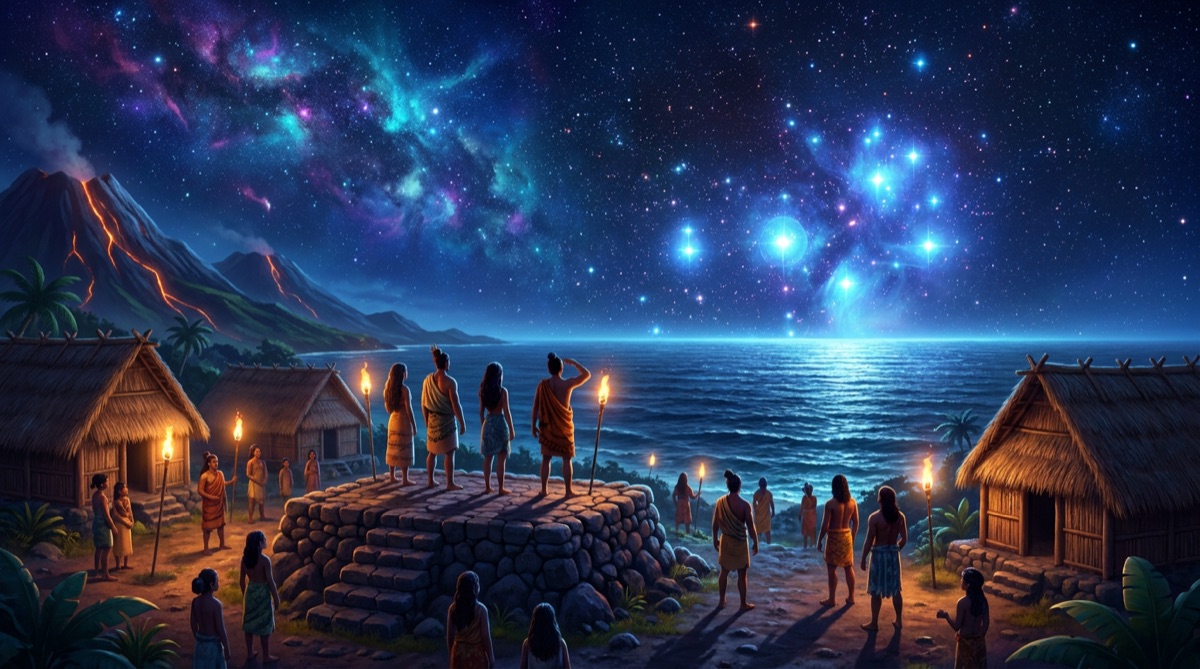
before 1778 (Hawaiian oral tradition)
The Hawaiian Makahiki begins with the Pleiades
In Hawaiʻi, the new year and the Makahiki festival season began when the Pleiades (Makaliʻi) were seen rising at dusk, around November. The Hawaiian historian David Malo recorded it in the 19th century; when the custom originated is not known.
👤 David Malo · 📍 Hawaiian Islands
🧪 Interactive planisphere Constellation
Sources (1)
- Malo, D. (1951). Hawaiian Antiquities (Moolelo Hawaii), trans. N. B. Emerson, 2nd ed. Bishop Museum Press, Honolulu (chapter on the Makahiki).
- c. 1500

before 1769 (Māori oral tradition)
Matariki: the Māori new year
In Aotearoa, the reappearance of Matariki (the Pleiades) before dawn, in June or July, marked the start of the year in the lunar calendar (maramataka). Each star of the group was associated with an aspect of the year ahead: food, weather, the dead who are remembered.
📍 Aotearoa (New Zealand)
🧪 Interactive planisphere Constellation
Sources (1)
- Mātāmua, R. (2017). Matariki: The Star of the Year. Huia Publishers, Wellington.
- c. 1501
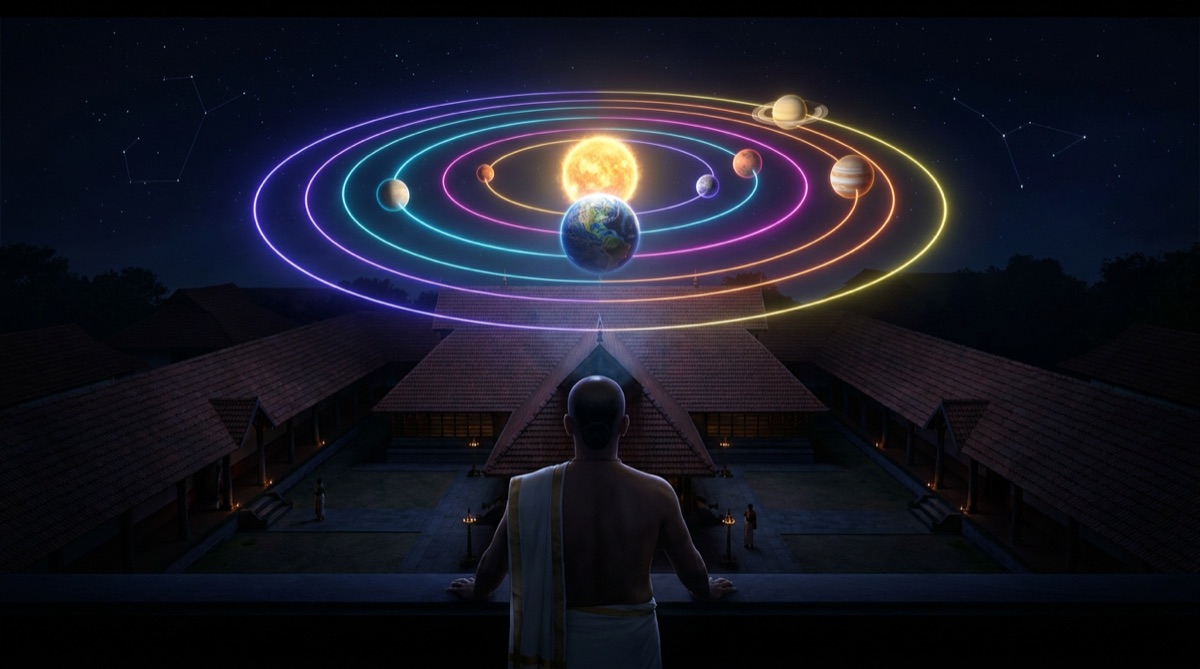
Nilakantha and an almost heliocentric system
In the Tantrasangraha (completed around 1500–1501) and in his commentary on the Aryabhatiya, Nilakantha Somayaji proposed that the five planets revolve around the Sun and the Sun around the Earth, a scheme similar to the one Tycho Brahe would defend in Europe in 1588. His calculation for Mercury and Venus was the most accurate until Kepler.
👤 Nilakantha Somayaji · 📍 Trikkantiyur (Kerala), India
📘 Tycho and Kepler, or how eight minutes of arc changed the universe 🧪 Keplerian orbit OrbitKepler's laws
Sources (2)
- Ramasubramanian, K., Srinivas, M. D. & Sriram, M. S. (1994). Modification of the earlier Indian planetary theory by the Kerala astronomers (c. 1500 AD) and the implied heliocentric picture of planetary motion. Current Science 66(10), 784–790.
- Ramasubramanian, K. & Sriram, M. S. (2011). Tantrasangraha of Nilakantha Somayaji. Springer.
- 1507
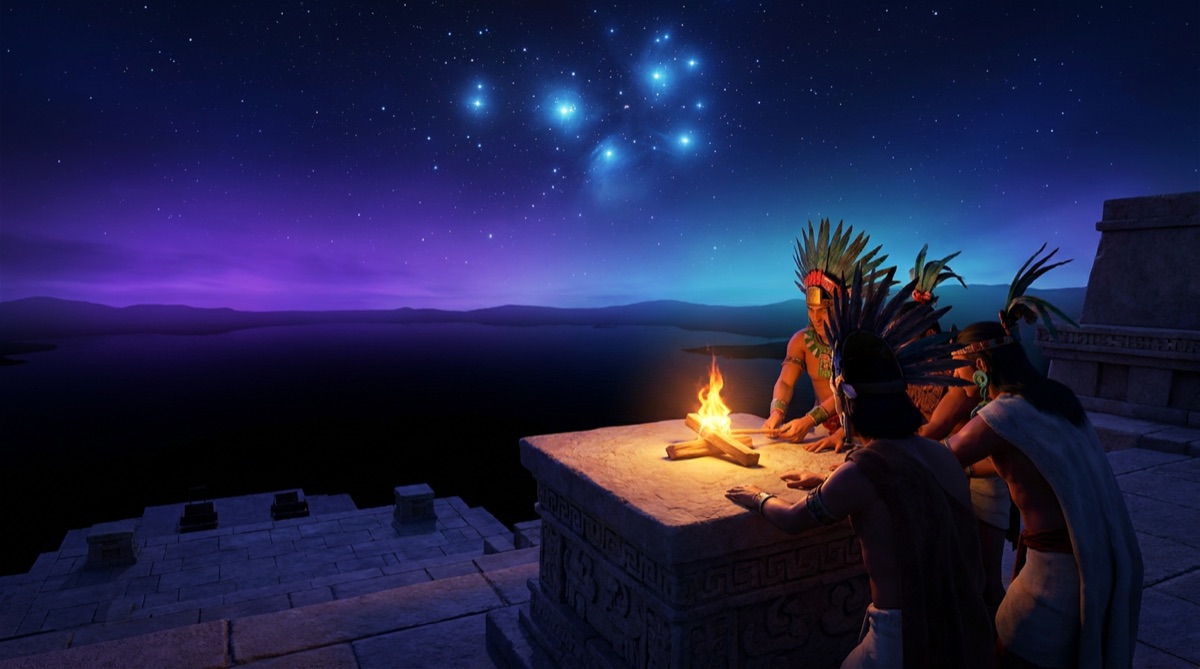
The last New Fire
Every 52 years, when the xiuhmolpilli (“binding of the years”) closed, the Mexica put out all fires and the priests climbed Huixachtlan hill to wait for the Pleiades to cross the meridian at midnight; then they lit the new fire. The ceremony of 1507, under Moctezuma Xocoyotzin, was the last one celebrated.
👤 Moctezuma Xocoyotzin · 📍 Cerro de la Estrella (Huixachtlan), Iztapalapa (Mexico)
🧪 Interactive planisphere Constellation
Sources (2)
- Sahagún, B. de (c. 1577). Historia general de las cosas de Nueva España (Florentine Codex), book VII, chs. 9–12.
- Pérez Negrete, M. (2005). El Cerro de la Estrella: sistema de asentamiento y Fuego Nuevo [Cerro de la Estrella: settlement system and New Fire]. FAMSI, report. https://www.ancientamericas.org/sites/default/files/01082PerezNegrete01.pdf
- c. 1502–1521
The Sun Stone
A basalt disk 3.6 m across and weighing about 24 tons, carved under Moctezuma II, represents the five “suns” or ages of the world and the 20 day signs. It is not a calendar for counting dates but a cosmological monument. It was found in 1790 beneath the Zócalo of Mexico City.
👤 Moctezuma Xocoyotzin · 📍 Tenochtitlan; today in the National Museum of Anthropology (Mexico City)
Sources (2)
- Museo Nacional de Antropología (INAH), Mexica Hall: Piedra del Sol.
- León y Gama, A. de (1792). Descripción histórica y cronológica de las dos piedras [Historical and chronological description of the two stones]. Mexico (find of December 17, 1790).
- 1521
Conquest of Tenochtitlan
The fall of the Mexica capital closes autonomous Mesoamerican astronomy. The friars destroy codices, but some, like Sahagún, collect from Nahua informants what they knew about the Sun, the Moon, comets and the stars.
👤 Bernardino de Sahagún · 📍 Tenochtitlan (Mexico)
Sources (1)
- Sahagún, B. de (c. 1577). Historia general de las cosas de Nueva España (Florentine Codex), book VII.
- c. 1530
The Yuktibhasa: the proofs of Kerala
Jyeshthadeva wrote in Malayalam, the local language rather than Sanskrit, a book that proves step by step the results of Madhava and Nilakantha, including the infinite series. It is one of the few ancient Indian texts devoted entirely to mathematical proofs.
👤 Jyeshthadeva · 📍 Kerala, India
Sources (1)
- Sarma, K. V., Ramasubramanian, K., Srinivas, M. D. & Sriram, M. S. (2008). Ganita-Yukti-Bhasa of Jyesthadeva. Springer. https://doi.org/10.1007/978-1-84882-072-2
- 1532
Cajamarca: the conquest of Tawantinsuyu
The capture of Atahualpa at Cajamarca begins the Spanish conquest. From then on, what we know of Inca astronomy comes through chronicles written by Spaniards or by mestizos such as Garcilaso, with the biases of someone describing a religion they want to suppress.
👤 Atahualpa, Francisco Pizarro · 📍 Cajamarca (Peru)
Sources (1)
- Hemming, J. (1970). The Conquest of the Incas. Macmillan.
- 1537

The Temple of the Sun at Sogamoso burns
The soldiers of Jiménez de Quesada set fire to the temple of the Sun at Suamox (Sogamoso), the main sanctuary of the Muisca. Friar Pedro Simón records the episode; of the temple only descriptions and archaeological remains excavated in the 20th century survive.
👤 Gonzalo Jiménez de Quesada · 📍 Sogamoso, Boyacá (Colombia)
Sources (2)
- Simón, P. (c. 1625). Noticias historiales de las conquistas de Tierra Firme en las Indias Occidentales [Historical accounts of the conquests of Tierra Firme in the West Indies], part two (ed. Biblioteca Banco Popular, Bogotá, 1981).
- Silva Celis, E. (1945). Investigaciones arqueológicas en Sogamoso [Archaeological investigations in Sogamoso]. Boletín de Arqueología 1 (Bogotá).
- 1543
Copernicus: “De revolutionibus”
Nicolaus Copernicus put the Sun at the center and set the Earth in motion: turning on itself every day and around the Sun every year. In this way he explained the loops of the planets naturally and fixed for the first time the order and the relative distances of the orbits. The book was printed in Nuremberg in 1543, the year of his death.
👤 Nicolaus Copernicus, Georg Joachim Rheticus · 📍 Frombork (Poland) and Nuremberg
🧪 The Solar System to scale OrbitAstronomical unit
Sources (2)
- Copernicus, N. (1543). De revolutionibus orbium coelestium. Trans. E. Rosen, On the Revolutions, Johns Hopkins University Press, 1992.
- Gingerich, O. (2004). The Book Nobody Read: Chasing the Revolutions of Nicolaus Copernicus. Walker & Co.
- 1572
Tycho Brahe and the “new star” of 1572
On November 11, 1572, a star as bright as Venus appeared in Cassiopeia. Tycho Brahe measured that it did not change position relative to the neighboring stars: it was not an atmospheric phenomenon but something new in the sky of the fixed stars, which according to Aristotle was unchangeable. Today we know it was a supernova.
👤 Tycho Brahe · 📍 Herrevad (Scania, then Denmark)
📘 Tycho and Kepler, or how eight minutes of arc changed the universe SupernovaParallax
Sources (2)
- Brahe, T. (1573). De nova et nullius aevi memoria prius visa stella. Copenhagen.
- Thoren, V. E. (1990). The Lord of Uraniborg: A Biography of Tycho Brahe. Cambridge University Press, ch. 2.
- 1576 – 1597

Uraniborg: Tycho's observatory and the comet of 1577
With the support of the king of Denmark, Tycho built on the island of Hven the observatory of Uraniborg, with enormous instruments that measured positions with an error of one arcminute, the best before the telescope. From there he showed that the comet of 1577 was farther away than the Moon, which shattered the supposed solid spheres of the heavens. Twenty years of data from Hven would be Kepler's raw material.
👤 Tycho Brahe, Frederick II of Denmark · 📍 Island of Hven (now Sweden)
Sources (2)
- Thoren, V. E. (1990). The Lord of Uraniborg: A Biography of Tycho Brahe. Cambridge University Press.
- Christianson, J. R. (2000). On Tycho's Island: Tycho Brahe and His Assistants, 1570–1601. Cambridge University Press.
- 1577 – 1580
Taqi al-Din in Istanbul
Sultan Murad III funded an observatory in Istanbul directed by Taqi al-Din, who observed the great comet of 1577 and used a mechanical clock to time his observations, almost at the same time as Tycho Brahe in Denmark. It was demolished in 1580 under political and religious pressure.
👤 Taqi al-Din, Murad III · 📍 Istanbul, Ottoman Empire
📘 Tycho and Kepler, or how eight minutes of arc changed the universe
Sources (2)
- Sayili, A. (1960). The Observatory in Islam, ch. 8 (the Istanbul observatory).
- Hockey, T. et al. (eds.) (2007). Biographical Encyclopedia of Astronomers, entry “Taqi al-Din”. Springer.
- 1582
The Gregorian calendar
Because the Julian year was 11 minutes too long, the equinox had moved forward ten days since the Council of Nicaea. The reform of Pope Gregory XIII, based on the calculations of the astronomer Luigi Lilio and the Jesuit Christopher Clavius, dropped ten days (October 4, 1582 was followed by the 15th) and adjusted the centurial leap years. It is the calendar that almost the whole world uses today.
👤 Gregory XIII, Luigi Lilio, Christopher Clavius · 📍 Rome
Sources (2)
- Gregory XIII (1582). Bull Inter gravissimas (February 24, 1582).
- Coyne, G. V., Hoskin, M. A. & Pedersen, O. (eds.) (1983). Gregorian Reform of the Calendar: Proceedings of the Vatican Conference. Pontificia Academia Scientiarum and Specola Vaticana.
- c. 1600
The Huarochirí Manuscript describes the celestial llama (Yacana)
A Quechua text compiled by the clergy of Huarochirí tells how the Yacana, a dark llama drawn by the dust clouds of the Milky Way, comes down at midnight to drink from the sea. It is the oldest and most systematic description of the Andean “dark constellations”, which are still alive in Quechua communities.
👤 Francisco de Ávila · 📍 Huarochirí, Lima (Peru)
📘 Stars and constellations 🧪 Interactive planisphere Constellation
Sources (2)
- Salomon, F. & Urioste, G. L. (Trans.) (1991). The Huarochirí Manuscript. University of Texas Press, ch. 29.
- Urton, G. (1981). At the Crossroads of the Earth and the Sky. University of Texas Press, ch. 6.
- 1600
Giordano Bruno is executed in Rome
The philosopher Giordano Bruno, who imagined an infinite universe with countless suns and inhabited worlds, was burned in Rome on February 17, 1600. His condemnation by the Inquisition was due above all to his theological doctrines; Bruno was not an astronomer and made no observations, so presenting him as a “martyr of science” oversimplifies the story.
👤 Giordano Bruno · 📍 Rome (Campo de' Fiori)
Sources (2)
- Rowland, I. D. (2008). Giordano Bruno: Philosopher/Heretic. Farrar, Straus and Giroux.
- Knox, D. (2019). Giordano Bruno. Stanford Encyclopedia of Philosophy. https://plato.stanford.edu/entries/bruno/
- 1601
Matteo Ricci arrives in Beijing
The Italian Jesuit Matteo Ricci was admitted to the Ming court in 1601 thanks to his clocks, maps and mathematical knowledge. With Xu Guangqi he translated Euclid's Elements into Chinese and opened the dialogue between Chinese and European astronomy.
👤 Matteo Ricci, Xu Guangqi · 📍 Beijing, China
Sources (2)
- Hockey, T. et al. (eds.) (2007). Biographical Encyclopedia of Astronomers, entry “Ricci, Matteo”. Springer.
- Udías, A. (2015). Jesuit Contribution to Science: A History. Springer, ch. 3.
- 1608

The telescope: Lipperhey's application
In October 1608, the spectacle maker Hans Lipperhey, of Middelburg, applied to the States General of the Netherlands for a patent on a tube with two lenses that brought distant objects closer. It was refused because others claimed the same invention, but the news spread across Europe and within a year the telescope was pointed at the sky.
👤 Hans Lipperhey · 📍 Middelburg and The Hague
Sources (1)
- Van Helden, A. (1977). The Invention of the Telescope. Transactions of the American Philosophical Society 67(4). https://doi.org/10.2307/1006276
- 1609

Garcilaso publishes the Royal Commentaries
The Inca Garcilaso de la Vega, son of an Inca princess and a Spanish captain, describes the Inti Raymi, the festival of the Sun at the June solstice, the pillars for fixing the solstices and the way of observing the equinoxes at the Coricancha. It is a valuable source, but written in Spain forty years after he left Cusco.
👤 Inca Garcilaso de la Vega · 📍 Lisbon (Portugal), about Cusco
Sources (1)
- Garcilaso de la Vega, Inca (1609). Comentarios reales de los incas [Royal Commentaries of the Incas], book II, ch. 22, and book VI, ch. 20–22. Lisbon.
- 1609
Kepler: “Astronomia nova” and elliptical orbits
After years of struggling with Tycho's data on Mars, Kepler found that a circular orbit left an error of 8 arcminutes, small but larger than Tycho's precision. He refused to ignore it and discovered that the orbit is an ellipse with the Sun at one focus and that the planet sweeps out equal areas in equal times: his first two laws.
👤 Johannes Kepler · 📍 Prague
📘 Kepler's three laws 🧪 Keplerian orbit Kepler's lawsEllipseEccentricity
Sources (2)
- Kepler, J. (1609). Astronomia nova. Trans. W. H. Donahue, New Astronomy, Cambridge University Press, 1992, ch. 19 and 58–60.
- Voelkel, J. R. (2001). The Composition of Kepler's Astronomia Nova. Princeton University Press.
- 1610
Galileo: “Sidereus nuncius”
In March 1610 Galileo published what he had seen with his telescope since the previous autumn: mountains on the Moon, many more stars than are visible to the naked eye, the Milky Way resolved into stars, and four moons circling Jupiter. Those moons proved that not everything revolves around the Earth.
👤 Galileo Galilei · 📍 Padua and Venice
Sources (1)
- Galilei, G. (1610). Sidereus nuncius. Trans. A. Van Helden, University of Chicago Press, 1989.
- 1610 – 1613
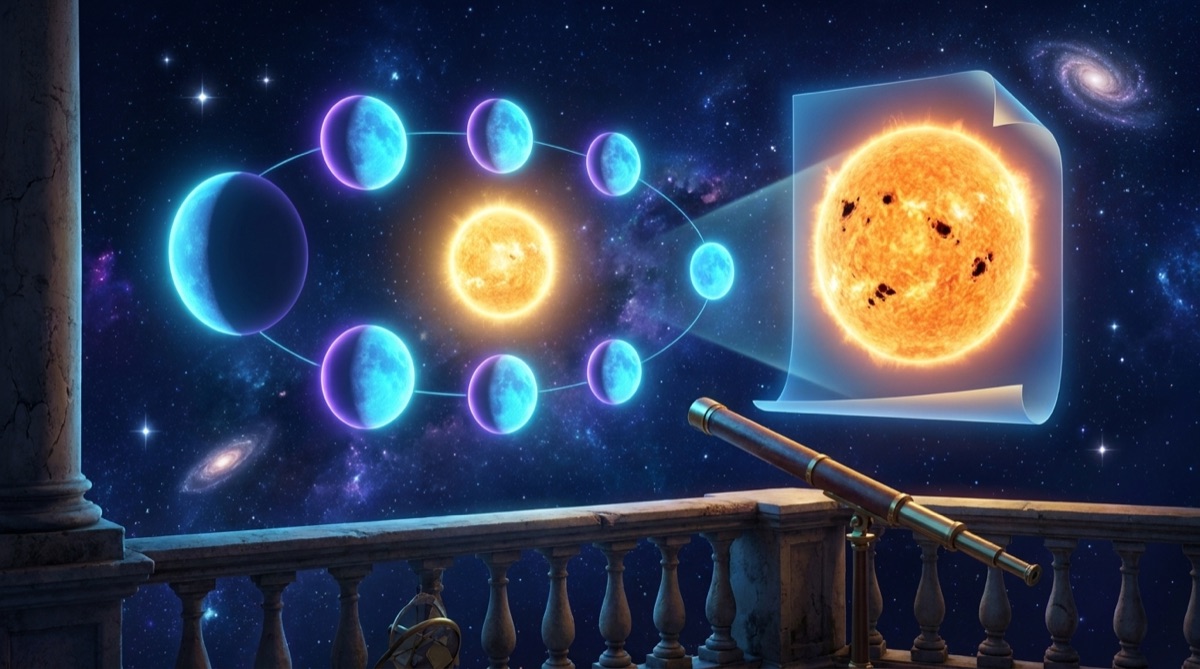
Phases of Venus and sunspots
In late 1610 Galileo verified that Venus shows a full set of phases, like the Moon, which is impossible in Ptolemy's model and requires Venus to revolve around the Sun. Between 1611 and 1613, Fabricius, Harriot, Scheiner and Galileo himself observed spots on the Sun; Galileo showed in 1613 that they lie on the solar surface and that the Sun rotates.
👤 Galileo Galilei, Johannes Fabricius, Thomas Harriot, Christoph Scheiner · 📍 Florence
Sources (2)
- Palmieri, P. (2001). Galileo and the discovery of the phases of Venus. Journal for the History of Astronomy 32, 109–129. https://doi.org/10.1177/002182860103200202
- Galilei, G. & Scheiner, C. On Sunspots. Trans. E. Reeves & A. Van Helden, University of Chicago Press, 2010.
- 1619
Kepler's third law
In “Harmonices mundi” Kepler published the relation he had sought since his youth: the square of a planet's period is proportional to the cube of its mean distance from the Sun. With his three laws, the “Rudolphine Tables” of 1627 predicted planetary positions with a precision ten times better than earlier ones.
👤 Johannes Kepler · 📍 Linz
📘 Kepler's three laws 🧪 Keplerian orbit Orbital periodSemi-major axis
Sources (1)
- Kepler, J. (1619). Harmonices mundi, book V, ch. 3. Trans. E. J. Aiton, A. M. Duncan & J. V. Field, The Harmony of the World, American Philosophical Society, 1997.
- c. 1625

Friar Pedro Simón describes the Muisca year
The Franciscan chronicler writes that the Muisca had “a year of twelve moons or months” and that they counted the days in three groups of ten. It is the most direct colonial source on the Muisca calendar, and the basis of later reconstructions.
👤 Pedro Simón · 📍 Santafé de Bogotá (Colombia)
📘 The lunar calendar 🧪 Phases of the Moon Synodic monthPhases of the Moon
Sources (2)
- Simón, P. (c. 1625). Noticias historiales de las conquistas de Tierra Firme en las Indias Occidentales [Historical accounts of the conquests of Tierra Firme in the West Indies], part two (ed. Biblioteca Banco Popular, Bogotá, 1981).
- Izquierdo Peña, M. A. (2008). The Muisca Calendar. Université de Montréal, arXiv:0812.0574, ch. 2.
- 1631
Gassendi observes the transit of Mercury
On November 7, 1631, in Paris, Pierre Gassendi saw Mercury cross the disc of the Sun, just as Kepler had predicted with the Rudolphine Tables. It was the first observation of a planetary transit and showed that Mercury was much smaller than had been believed.
👤 Pierre Gassendi, Johannes Kepler · 📍 Paris
🧪 Light curve of a transit Transit
Sources (2)
- Gassendi, P. (1632). Mercurius in Sole visus et Venus invisa. Paris.
- Van Helden, A. (1976). The importance of the transit of Mercury of 1631. Journal for the History of Astronomy 7, 1–10.
- 1633
The trial of Galileo
In June 1633 the Roman Inquisition condemned Galileo for “vehement suspicion of heresy” after he published the “Dialogue Concerning the Two Chief World Systems” (1632), which defended Copernicanism. He abjured and spent the rest of his life under house arrest, where he wrote his work on motion, the “Discorsi” (1638).
👤 Galileo Galilei, Urban VIII · 📍 Rome
Sources (1)
- Finocchiaro, M. A. (1989). The Galileo Affair: A Documentary History. University of California Press.
- 1644 – 1674
Schall, Verbiest and the Beijing Ancient Observatory
After successfully predicting eclipses, Johann Adam Schall von Bell was appointed director of the Astronomical Bureau by the new Qing dynasty in 1644 and reformed the calendar. His successor Ferdinand Verbiest built between 1669 and 1674 six large bronze instruments that are still on display at the Beijing Ancient Observatory.
👤 Johann Adam Schall von Bell, Ferdinand Verbiest, Kangxi Emperor · 📍 Beijing, China
📘 Tycho and Kepler, or how eight minutes of arc changed the universe Solar eclipse
Sources (2)
- Udías, A. (2015). Jesuit Contribution to Science: A History. Springer, ch. 3 (the Jesuits at the Astronomical Bureau in Beijing).
- Hockey, T. et al. (eds.) (2007). Biographical Encyclopedia of Astronomers, entries “Schall von Bell” and “Verbiest”. Springer.
- 1653

Cobo records the ceques of Cusco
The Jesuit Bernabé Cobo copies into his Historia del Nuevo Mundo a complete account of the 41 ceques and 328 huacas of Cusco, probably from an earlier document by Polo de Ondegardo. Without that list we would not know the system.
👤 Bernabé Cobo · 📍 Lima (Peru)
Sources (1)
- Cobo, B. (1653). Historia del Nuevo Mundo [History of the New World], book XIII, ch. 13–16 (ed. BAE, Madrid, 1956).
- 1655 – 1659
Huygens: Titan and the ring of Saturn
Christiaan Huygens discovered Titan, Saturn's largest moon, on March 25, 1655, with a telescope he had built with his brother. In “Systema Saturnium” (1659) he explained the strange “handles” of Saturn that Galileo had been unable to interpret: a thin, flat ring that surrounds the planet without touching it.
👤 Christiaan Huygens · 📍 The Hague
Sources (2)
- Huygens, C. (1659). Systema Saturnium. The Hague.
- Van Helden, A. (1974). Saturn and his anses. Journal for the History of Astronomy 5, 105–121.
- 1675
Cassini discovers the division in the rings
From the new Paris Observatory (founded in 1667), Giovanni Domenico Cassini saw that Saturn's ring is split by a dark band, the “Cassini Division”. He also discovered four moons of Saturn (Iapetus, Rhea, Tethys and Dione) and published tables of Jupiter's moons that would serve to measure longitudes on land.
👤 Giovanni Domenico Cassini · 📍 Paris Observatory
Sources (2)
- Débarbat, S. & Wilson, C. (1989). The Galilean satellites of Jupiter from Galileo to Cassini, Römer and Bradley. In R. Taton & C. Wilson (eds.), Planetary Astronomy from the Renaissance to the Rise of Astrophysics, Part A. Cambridge University Press, pp. 144–157.
- NASA Science. Cassini Division. https://science.nasa.gov/saturn/facts/
- 1676
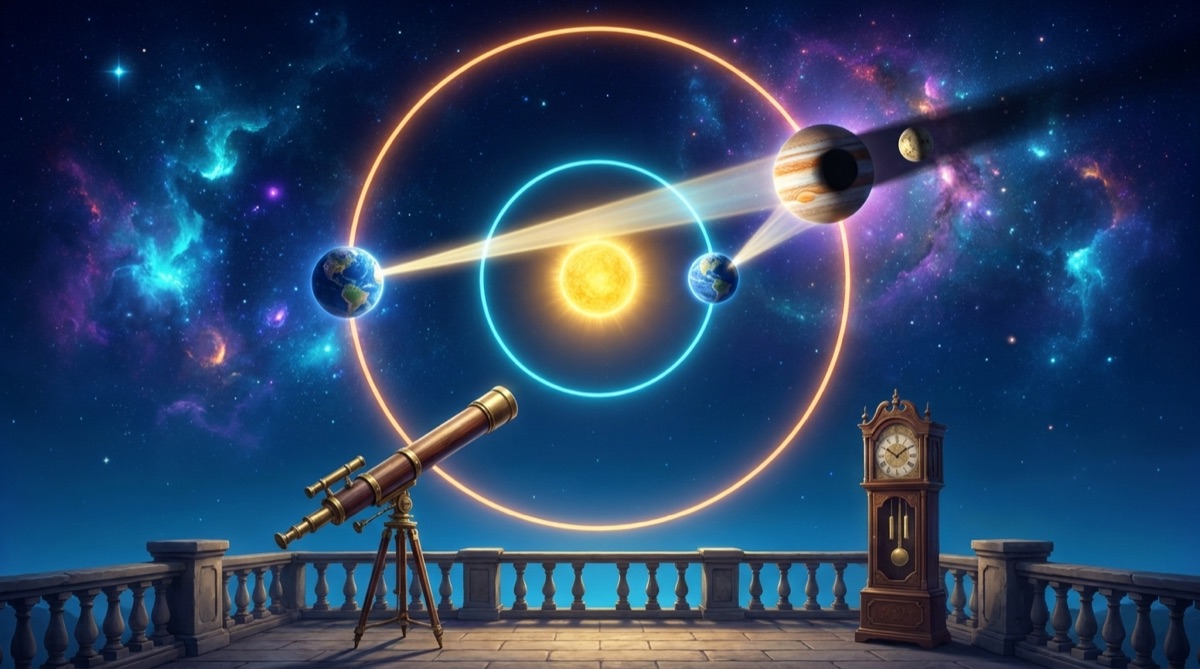
Rømer: light takes time to arrive
Ole Rømer noticed that the eclipses of Io, a moon of Jupiter, ran late when the Earth was moving away from Jupiter and early when it was approaching. He concluded that light has a finite speed and estimated that it takes about 22 minutes to cross the Earth's orbit (today: about 16.6 minutes). It was the first proof that light is not instantaneous.
👤 Ole Rømer · 📍 Paris Observatory
📘 The speed of light and the light-year Speed of lightAstronomical unit
Sources (2)
- Rømer, O. (1676). Démonstration touchant le mouvement de la lumière. Journal des sçavans, December 7, 1676, pp. 233–236.
- Bobis, L. & Lequeux, J. (2008). Cassini, Rømer and the velocity of light. Journal of Astronomical History and Heritage 11(2), 97–105.
- 1687
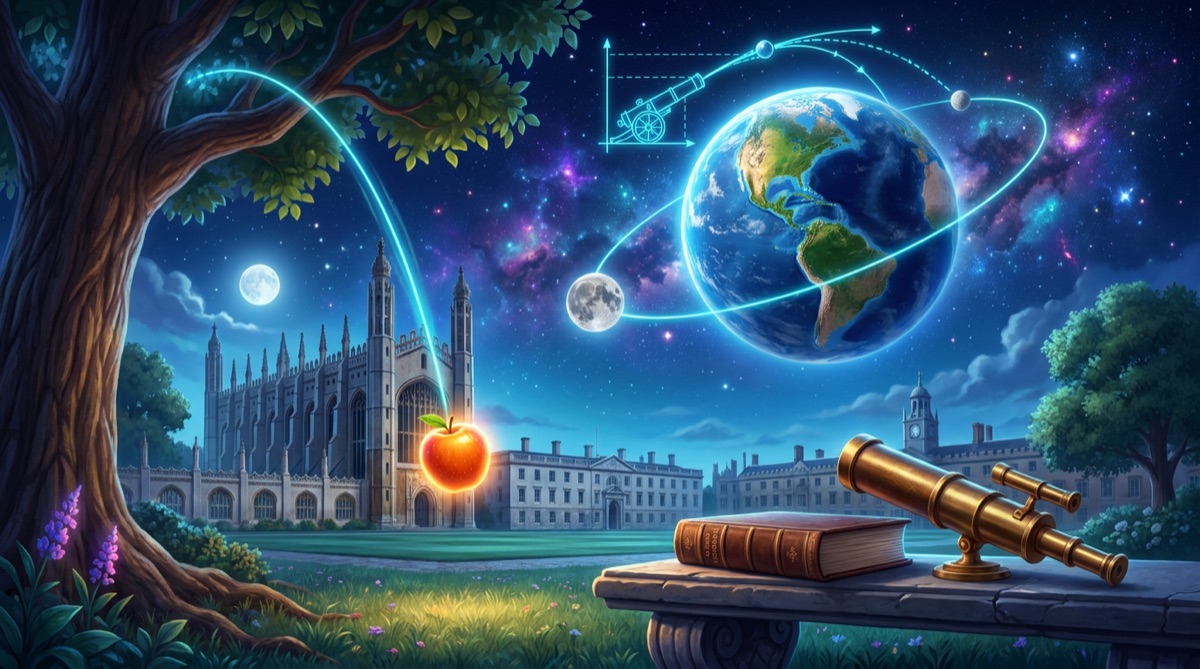
Newton: the “Principia”
Isaac Newton proved that a single force, gravitation, which attracts bodies with a strength proportional to their masses and inversely proportional to the square of the distance, explains at once the fall of an apple, Kepler's laws, the tides, precession and the orbits of comets. The heavens and the Earth were brought under the same laws.
👤 Isaac Newton, Edmond Halley · 📍 Cambridge and London
📘 Universal gravitation and satellites 🧪 Newton’s cannonball Law of universal gravitationGravityOrbital velocity
Sources (2)
- Newton, I. (1687). Philosophiae naturalis principia mathematica. Trans. I. B. Cohen & A. Whitman, University of California Press, 1999.
- Westfall, R. S. (1980). Never at Rest: A Biography of Isaac Newton. Cambridge University Press, ch. 10.
- 1724
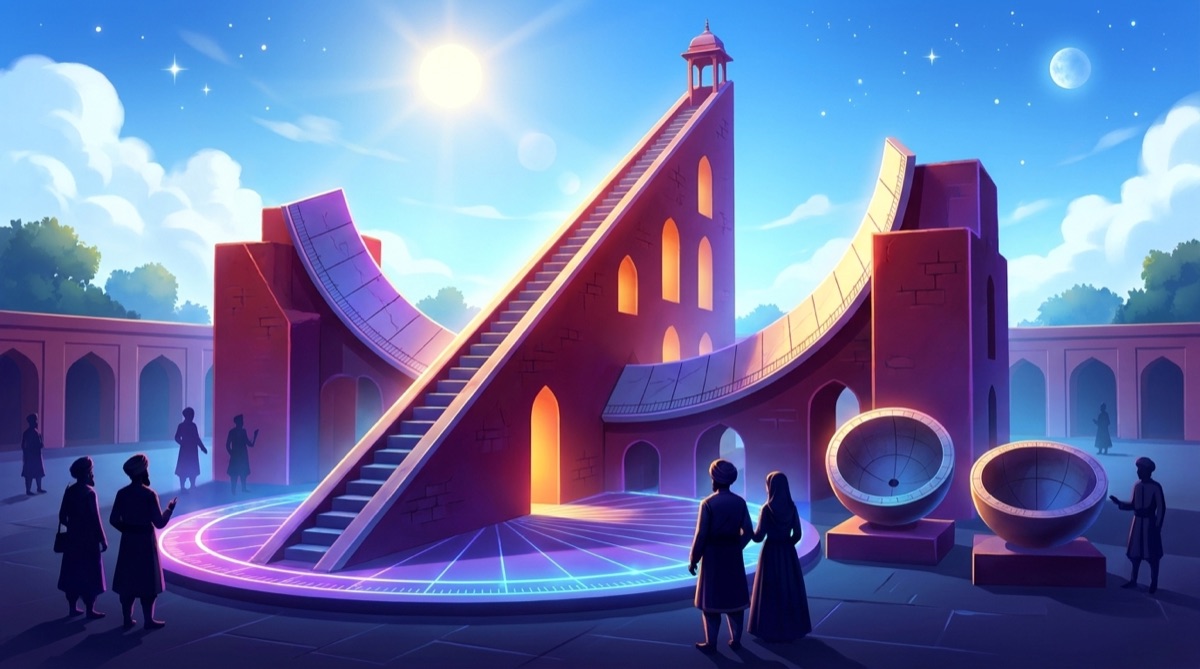
The Jantar Mantar of Delhi
The raja Sawai Jai Singh II built in Delhi the first of his five observatories of giant masonry instruments: sundials, sextants and quadrants several meters across for measuring time and the positions of celestial bodies without a telescope.
👤 Sawai Jai Singh II · 📍 Delhi, India
GnomonAltitude above the horizon
Sources (2)
- Sharma, V. N. (1995). Sawai Jai Singh and His Astronomy. Motilal Banarsidass, ch. 4.
- Archnet, entry “Jantar Mantar (Delhi)”.
- c. 1728 – 1734
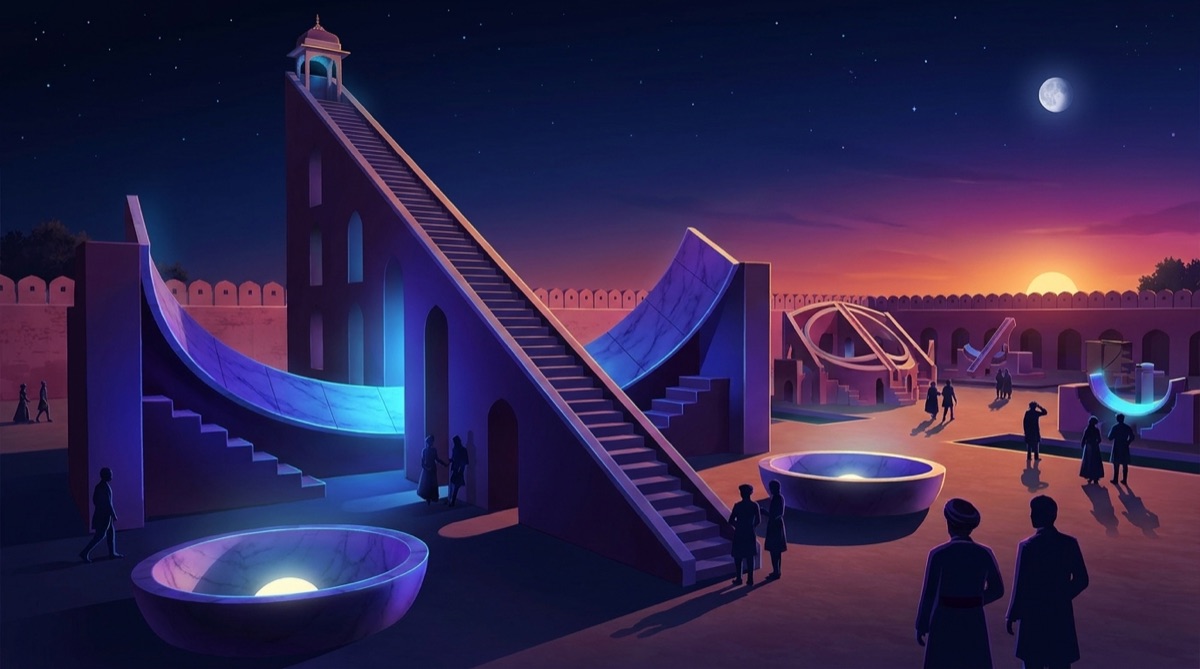
The Jantar Mantar of Jaipur and the tables of Muhammad Shah
The Jaipur observatory, the largest and best preserved, has a 27-meter sundial that gives the time to a precision of two seconds. With its measurements Jai Singh compiled the Zij-i Muhammad Shahi (around 1732), which corrected the tables of Ulugh Beg. It has been a World Heritage Site since 2010.
👤 Sawai Jai Singh II, Jagannatha Samrat · 📍 Jaipur (Rajasthan), India
📘 Shadows and the sundial 🧪 Interactive planisphere GnomonDeclination
Sources (2)
- UNESCO, World Heritage List: The Jantar Mantar, Jaipur (ref. 1338, inscribed in 2010).
- Sharma, V. N. (1995). Sawai Jai Singh and His Astronomy. Motilal Banarsidass, chs. 5–7.
- 1729
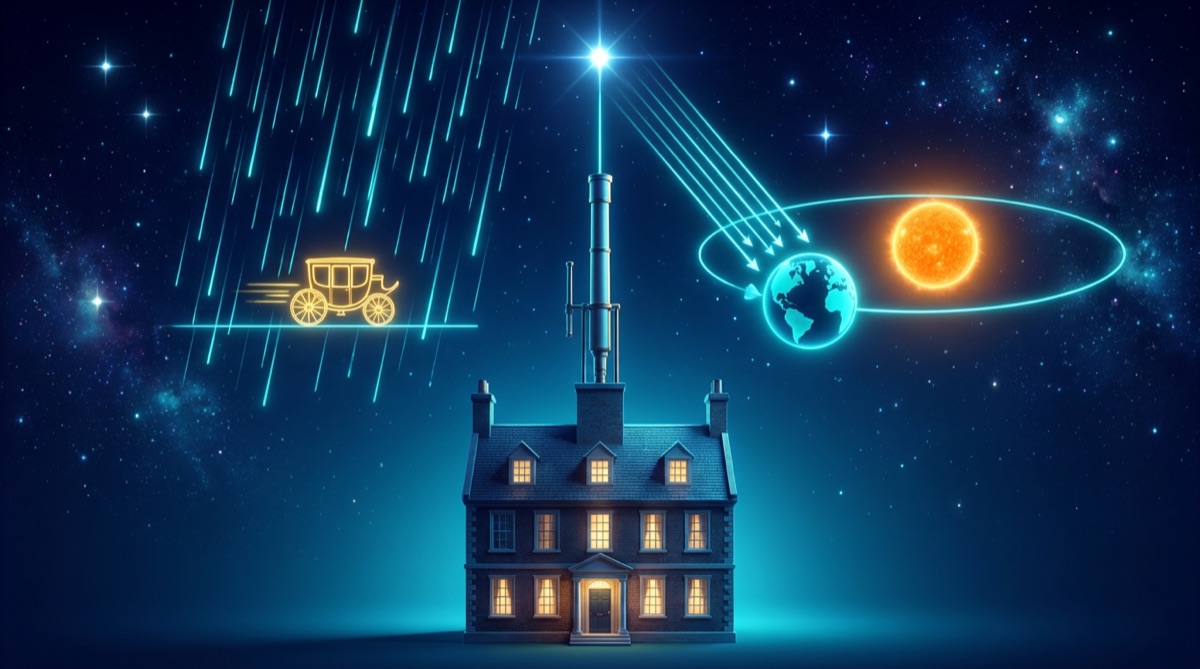
Bradley discovers the aberration of light
While searching for stellar parallax, James Bradley found another annual displacement, of about 20 arcseconds, that did not depend on distance: aberration, caused by the Earth's velocity combined with that of light. It was the first direct proof that the Earth moves, and it gave a value of the speed of light with an error of only 1 %.
👤 James Bradley · 📍 Wanstead and Kew (England)
📘 Precession, nutation, aberration and refraction ParallaxSpeed of light
Sources (1)
- Bradley, J. (1729). A letter from the Reverend Mr. James Bradley… giving an account of a new discovered motion of the fix'd stars. Philosophical Transactions 35, 637–661. https://doi.org/10.1098/rstl.1727.0064
- 1740
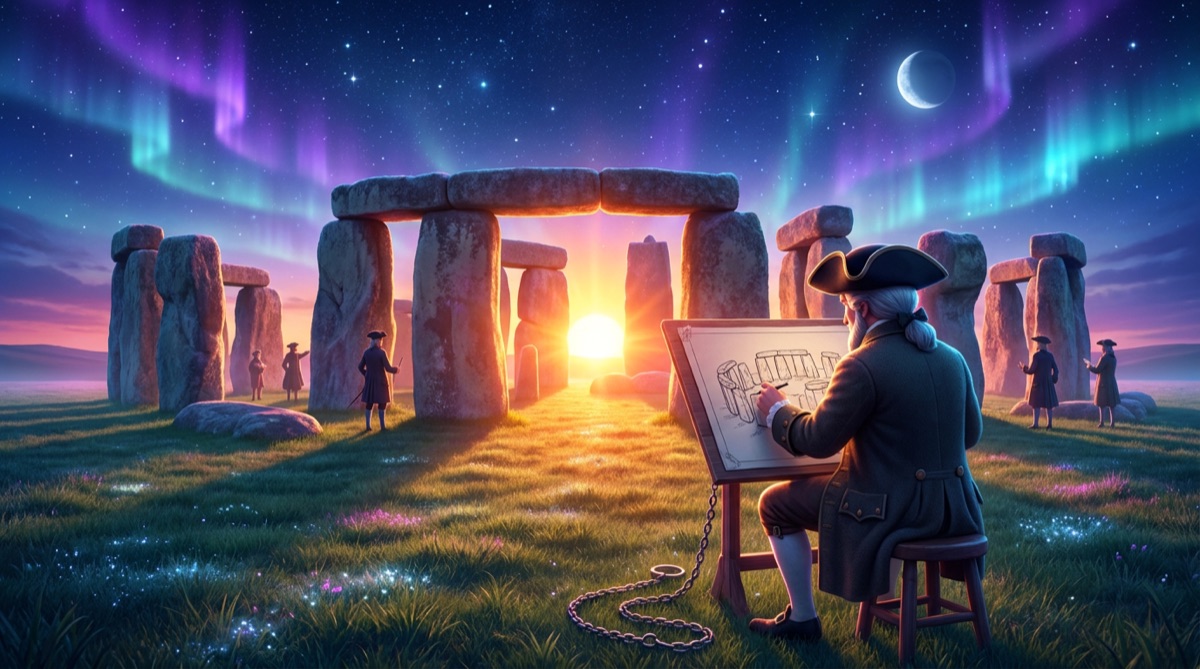
Stukeley notes the solstitial axis of Stonehenge
The antiquarian William Stukeley published that the axis of Stonehenge and of its avenue points approximately to sunrise at the summer solstice. It is the first modern observation of an astronomical alignment in a prehistoric monument.
👤 William Stukeley · 📍 England
Sources (2)
- Stukeley, W. (1740). Stonehenge: A Temple Restor'd to the British Druids. London.
- Ruggles, C. L. N. (1999). Astronomy in Prehistoric Britain and Ireland. Yale University Press.
- 1758 – 1759
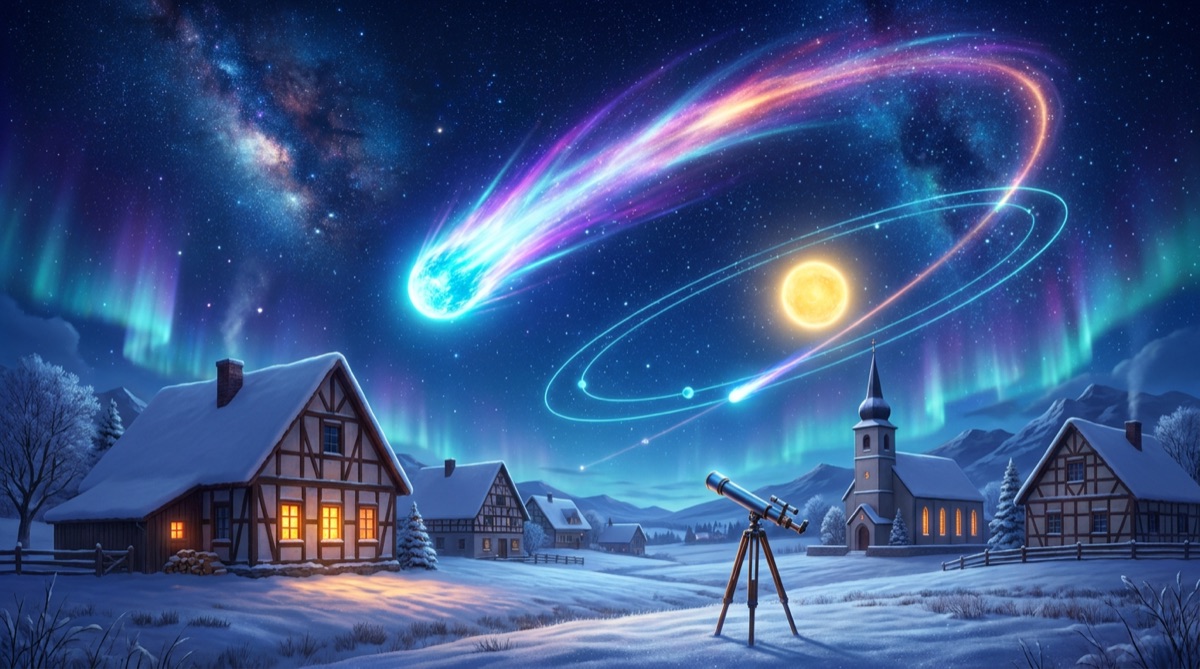
Halley's comet returns as predicted
In 1705 Edmond Halley had noticed that the comets of 1531, 1607 and 1682 followed almost identical orbits and predicted its return for 1758. Clairaut, Lalande and Nicole-Reine Lepaute computed the perturbations by Jupiter and Saturn; the farmer and amateur astronomer Johann Palitzsch saw it on December 25, 1758, and it passed perihelion on March 13, 1759. It was the great public triumph of Newton's gravitation.
👤 Edmond Halley, Alexis Clairaut, Nicole-Reine Lepaute, Jérôme Lalande, Johann Georg Palitzsch · 📍 Prohlis (near Dresden) and Paris
🧪 N bodies: integrators and chaos OrbitPerturbationPerihelion
Sources (2)
- Halley, E. (1705). Astronomiae cometicae synopsis. Philosophical Transactions 24, 1882–1899. https://doi.org/10.1098/rstl.1704.0064
- Yeomans, D. K. (1991). Comets: A Chronological History of Observation, Science, Myth, and Folklore. Wiley, ch. 5.
- 1761 – 1769
The transits of Venus and the size of the Solar System
Following an idea of Halley's, hundreds of observers from many countries traveled to remote places to time the transits of Venus of June 6, 1761 and June 3, 1769 (James Cook did so from Tahiti). By comparing the times measured from different latitudes, the Earth–Sun distance was obtained with an error of only 2 %: at last the Solar System had a scale.
👤 Edmond Halley, James Cook, Jérôme Lalande, Maximilian Hell · 📍 Expeditions all over the world
📘 Astronomical unit, light-year and parsec Astronomical unitTransitParallax
Sources (2)
- Woolf, H. (1959). The Transits of Venus: A Study of Eighteenth-Century Science. Princeton University Press.
- NASA Eclipse Web Site. Transits of Venus: Six Millennium Catalog. https://eclipse.gsfc.nasa.gov/transit/catalog/VenusCatalog.html
- 1762
Mutis opens the chair of mathematics and teaches Copernicus
José Celestino Mutis, a physician from Cádiz who arrived in Santafé in 1761, inaugurated on March 13, 1762, the chair of mathematics at the Colegio Mayor del Rosario, where he explained the Copernican system and Newton's physics. The date of his most famous lecture in defense of Copernicus is disputed (1762 or December 1773).
👤 José Celestino Mutis · 📍 Colegio Mayor de Nuestra Señora del Rosario, Santafé de Bogotá
Sources (2)
- Lértora Mendoza, C. A. (1995). Introducción de las teorías newtonianas en el Río de la Plata y en Nueva Granada [The introduction of Newtonian theories in the Río de la Plata and New Granada]. Revista de la Academia Colombiana de Ciencias Exactas, Físicas y Naturales 19 (75).
- Universidad del Rosario, Archivo Histórico, “La cátedra de matemáticas de Mutis” [Mutis's chair of mathematics] (urosario.edu.co).
- 1769
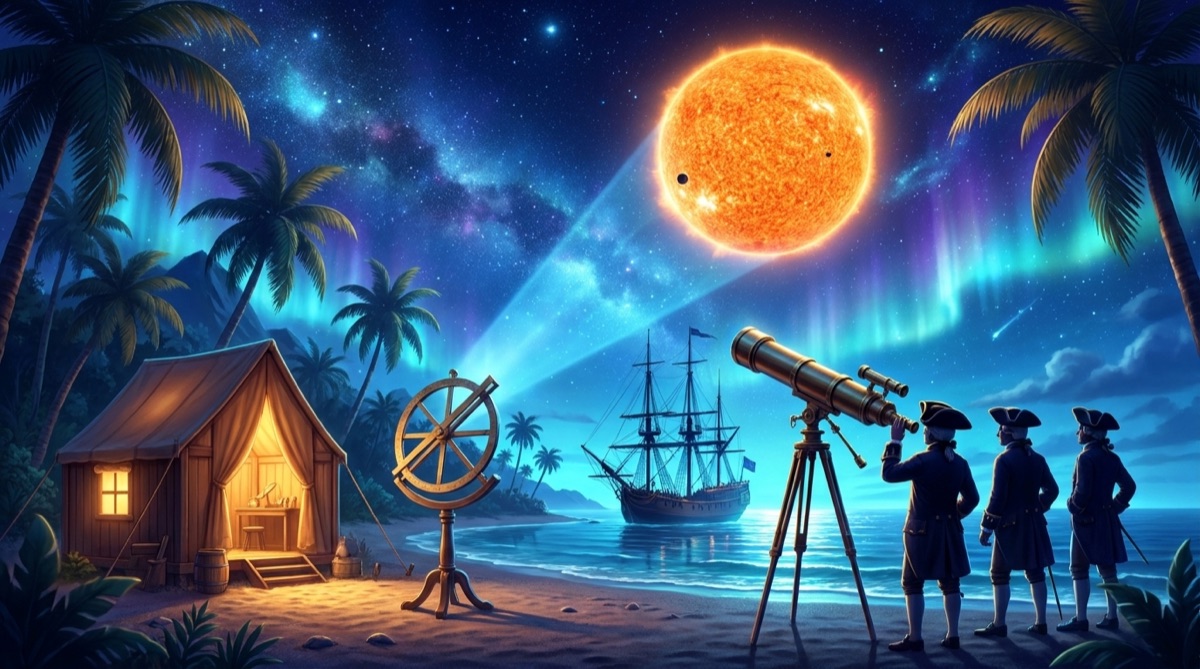
Cook observes the transit of Venus in Tahiti
On June 3, 1769, James Cook, Charles Green and Joseph Banks observe from Point Venus the passage of Venus across the face of the Sun, part of a worldwide effort to measure the Earth–Sun distance. It is the official reason for the Endeavour's voyage, and what brings Europeans into the heart of Polynesia.
👤 James Cook, Charles Green, Joseph Banks · 📍 Point Venus, Tahiti
🧪 Light curve of a transit Astronomical unitTransit
Sources (2)
- Orchiston, W. (2017). Cook, Green, Maskelyne and the 1769 transit of Venus: the legacy of the Tahitian observations. Journal of Astronomical History and Heritage 20(1).
- Cook, J. (1768–1771). Journal of H.M.S. Endeavour, entry for June 3, 1769 (National Library of Australia, MS 1).
- 1769
Tupaia draws his map of the Pacific
The Tahitian priest and navigator Tupaia boards Cook's ship in July 1769 and draws a chart with 74 islands over a radius of thousands of kilometers. For two centuries it was considered an enigma; in 2019 Eckstein and Schwarz showed that it uses a system of its own, with the bearing of each island referred to the position of the Sun at noon (avatea). Tupaia died in Batavia in December 1770.
👤 Tupaia, James Cook · 📍 Aboard the Endeavour, South Pacific
📘 The cardinal directions Cardinal pointsAzimuth
Sources (2)
- Eckstein, L. & Schwarz, A. (2019). The Making of Tupaia's Map. Journal of Pacific History 54(1), 1–95.
- British Library, Add MS 21593 C (copy of Tupaia's chart).
- 1774 – 1781
The Messier catalog
Charles Messier, a comet hunter in Paris, made a list of the fuzzy patches that could be mistaken for one: 45 objects in 1774 and 103 in the 1781 edition. Without intending to, he cataloged the brightest nebulae, clusters and galaxies in the sky; M31, M42 and M45 are still the names amateurs use.
👤 Charles Messier, Pierre Méchain · 📍 Paris (Hôtel de Cluny)
Sources (2)
- Messier, C. (1781). Catalogue des nébuleuses et des amas d'étoiles. Connaissance des Temps pour 1784, pp. 227–267.
- Observatoire de Paris, Bibliothèque numérique. Charles Messier (1730–1817). https://bibnum.obspm.fr/exhibits/show/messier_english
- 1781
William Herschel discovers Uranus
On March 13, 1781, from the garden of his house in Bath, the musician and amateur astronomer William Herschel saw with a telescope of his own making an object that was not a point: he thought it was a comet, but its orbit turned out to be nearly circular and very distant. It was the first planet discovered in history, and at a stroke it doubled the size of the known Solar System.
👤 William Herschel, Caroline Herschel · 📍 Bath (England)
🧪 The Solar System to scale Gas giantOrbit
Sources (2)
- Herschel, W. (1781). Account of a Comet. Philosophical Transactions 71, 492–501. https://doi.org/10.1098/rstl.1781.0056
- Hoskin, M. (2011). Discoverers of the Universe: William and Caroline Herschel. Princeton University Press.
- 1783

The Royal Botanical Expedition
Approved by royal decree in November 1783, the expedition led by Mutis was the largest scientific enterprise of the colony: botany, but also astronomical and meteorological observations, which served to fix the latitudes and longitudes of the territory. It trained the generation of Caldas.
👤 José Celestino Mutis · 📍 Mariquita (1783–1791) and Santafé de Bogotá
Sources (2)
- Real Jardín Botánico (CSIC), “Real Expedición Botánica del Nuevo Reino de Granada” [Royal Botanical Expedition of the New Kingdom of Granada] (rjb.csic.es).
- Museo Nacional de Colombia, “Mutis y la Expedición Botánica” [Mutis and the Botanical Expedition] (museonacional.gov.co).
-
Modern era
1789 – 1957 - 1795
Duquesne reconstructs the Muisca calendar
The priest José Domingo Duquesne, parish priest in Muisca villages of Boyacá, dedicates to José Celestino Mutis a dissertation describing a lunisolar calendar with a cycle of 37 moons and a “century” of 20 years. Today we know that he mixed genuine information with interpretations of his own: it is a reconstruction, not an indigenous document.
👤 José Domingo Duquesne, José Celestino Mutis · 📍 Santafé de Bogotá (Colombia)
Sources (2)
- Duquesne, J. D. (1795). Disertación sobre el calendario de los muyscas, indios naturales de este Nuevo Reino de Granada [Dissertation on the calendar of the Muysca, native Indians of this New Kingdom of Granada]. Published in Acosta, J. (1848), Compendio histórico, appendix.
- Izquierdo, M. A. (2011). Contributions to the study of the Muisca calendar. Proceedings IAU Symposium 278 (Oxford IX). https://doi.org/10.1017/S174392131101252X
- 1800
Herschel discovers infrared radiation
William Herschel placed thermometers in each color of the solar spectrum and one more beyond the red, where nothing could be seen: that one registered the highest temperature. There was invisible light, and astronomy stopped being limited to what the eye sees.
👤 William Herschel · 📍 Slough, England
Sources (2)
- Herschel, W. (1800). Experiments on the Refrangibility of the Invisible Rays of the Sun. Philosophical Transactions of the Royal Society 90, 284–292. https://doi.org/10.1098/rstl.1800.0015
- NASA/IPAC, “Herschel discovers infrared light” (ipac.caltech.edu/Outreach/Edu/Herschel/backyard.html).
- 1801
Caldas invents the hypsometer
In Popayán, without European books or instruments, Francisco José de Caldas discovered that water boils at a lower temperature the higher the altitude, and derived a formula for measuring heights with a thermometer. Humboldt later used that method on his travels.
👤 Francisco José de Caldas · 📍 Popayán
Sources (3)
- Real Academia Española, Diccionario histórico de la lengua española, entry “hipsómetro” (rae.es/dhle/hipsómetro).
- Universidad Nacional de Colombia, Cátedra Caldas, “Caldas meteorólogo” [Caldas the meteorologist] (ingenieria.bogota.unal.edu.co).
- Bateman, A. D. (1953). Francisco José de Caldas, el hombre y el sabio [Francisco José de Caldas, the man and the scholar].
- 1801
Humboldt visits Mutis in Santafé
Alexander von Humboldt and Aimé Bonpland traveled up the Magdalena from Cartagena to meet Mutis and see his herbarium; they reached Santafé in July 1801. Humboldt measured latitudes, longitudes and heights with his instruments and, in Quito, recommended Caldas to direct the future observatory.
👤 Alexander von Humboldt, Aimé Bonpland, José Celestino Mutis, Francisco José de Caldas · 📍 Santafé de Bogotá
Sources (2)
- Universidad del Rosario, Archivo Histórico, chronicle “Oh larga y negra partida” [Oh long and black departure] (urosario.edu.co/blog-archivo-historico).
- Alcaldía de Bogotá, “Observatorio Astronómico, una obra para el pensamiento y la ciencia” [Astronomical Observatory, a work for thought and science] (bogota.gov.co).
- 1802 – 1803
The Astronomical Observatory of Santafé is built
On Mutis's initiative and with plans by the Capuchin friar Domingo de Petrés, the octagonal tower was raised between May 1802 and August 20, 1803, next to the house of the Botanical Expedition. It is the oldest surviving building constructed expressly as an observatory in the Americas.
👤 José Celestino Mutis, Domingo de Petrés · 📍 Santafé de Bogotá (today inside the Casa de Nariño)
📘 Hipparchus and the sky that moves slowly 🧪 Interactive planisphere LatitudeCelestial sphere
Sources (2)
- Sociedad Geográfica de Colombia (1937). Reseña histórica del Observatorio Astronómico Nacional [Historical outline of the National Astronomical Observatory] (sogeocol.edu.co): work begun on May 24, 1802, and finished on August 20, 1803.
- Universidad Nacional de Colombia, Observatorio Astronómico Nacional, “Historia” (oan.unal.edu.co).
- 1805
Caldas, first director of the Observatory
Caldas arrived from Quito in 1805 and took charge of the observatory: he measured the latitude and longitude of Santafé, observed eclipses and kept daily meteorological records. After the death of Mutis (1808) he remained as director.
👤 Francisco José de Caldas · 📍 Astronomical Observatory, Santafé de Bogotá
🧪 Interactive planisphere LatitudeLunar eclipse
Sources (2)
- Alcaldía de Bogotá, “Observatorio Astronómico, una obra para el pensamiento y la ciencia” [Astronomical Observatory, a work for thought and science] (bogota.gov.co).
- Universidad Nacional de Colombia, institutional repository, “Cronología del Observatorio Astronómico Nacional” [Chronology of the National Astronomical Observatory] (repositorio.unal.edu.co).
- 1808

The Semanario del Nuevo Reino de Granada
On January 3, 1808, Caldas published the first issue of the Semanario, in which appeared his “Estado de la geografía del Virreinato” [State of the geography of the Viceroyalty] and works on astronomy, geography and climate. It was the country's first scientific journal.
👤 Francisco José de Caldas · 📍 Santafé de Bogotá
Sources (2)
- Universidad del Rosario, Archivo Histórico, “Francisco José de Caldas y el Semanario” [Francisco José de Caldas and the Semanario] (urosario.edu.co).
- Biblioteca Nacional de Colombia, Semanario del Nuevo Reino de Granada (1808–1810), digital collection.
- 1810 – 1813

Humboldt takes the Muisca calendar to Europe
Alexander von Humboldt, who met Duquesne in Santafé in 1801, publishes his reconstruction in Vues des Cordillères. By that route the Muisca calendar entered European literature, and so did the criticism: in 1892 Vicente Restrepo dismissed it as the priest's invention.
👤 Alexander von Humboldt, Vicente Restrepo · 📍 Paris (France)
Sources (2)
- Humboldt, A. von (1810–1813). Vues des Cordillères et monumens des peuples indigènes de l'Amérique. Paris (chapter on the Muisca calendar).
- Restrepo, V. (1892). Crítica de los trabajos arqueológicos del Dr. José Domingo Duquesne [Critique of the archaeological works of Dr. José Domingo Duquesne]. Bogotá.
- 1814
Fraunhofer maps the dark lines of the Sun
Joseph von Fraunhofer, a lens maker in Munich, saw that the Sun's spectrum is crossed by hundreds of dark lines and cataloged them with letters (A, B, C… the D line of sodium). Nobody yet knew what they were, but the map remained.
👤 Joseph von Fraunhofer · 📍 Munich
📘 Spectra and the Doppler effect Spectrum
Sources (2)
- Fraunhofer, J. (1817). Bestimmung des Brechungs- und des Farbenzerstreuungs-Vermögens verschiedener Glasarten. Denkschriften der Königlichen Akademie der Wissenschaften zu München 5 (1814–1815), 193–226.
- Hearnshaw, J. B. (2014). The Analysis of Starlight, ch. 2. Cambridge University Press.
- October 1816
Execution of Caldas
During the Spanish reconquest, Caldas was shot in Santafé at the end of October 1816 (on the 28th or the 29th, depending on the source) by order of Pablo Morillo. With him died the scientific project of the Expedition, and the observatory was left almost unused for decades.
👤 Francisco José de Caldas, Pablo Morillo · 📍 Santafé de Bogotá
Sources (2)
- Revista Nuevas Lecturas de Historia (UPTC), “Francisco José de Caldas” (revistas.uptc.edu.co): shot on October 29, 1816.
- Semana (2016). “Bicentenario de Francisco José de Caldas, Camilo Torres y Jorge Tadeo Lozano” [Bicentennial of Francisco José de Caldas, Camilo Torres and Jorge Tadeo Lozano].
- 1822
Champollion deciphers the hieroglyphs
A year after the Dendera zodiac was torn out and taken to Paris (1821), Jean-François Champollion announced the decipherment of hieroglyphic writing. From then on Egyptian astronomical texts could be read, and the zodiac itself, which some believed to be 15 000 years old, turned out to be from the Greco-Roman period.
👤 Jean-François Champollion · 📍 Paris
Sources (2)
- Champollion, J.-F. (1822). Lettre à M. Dacier relative à l'alphabet des hiéroglyphes phonétiques. Firmin Didot, Paris.
- Buchwald, J. Z. & Josefowicz, D. G. (2010). The Zodiac of Paris. Princeton University Press (history of the removal and the controversy over its date).
- 1838
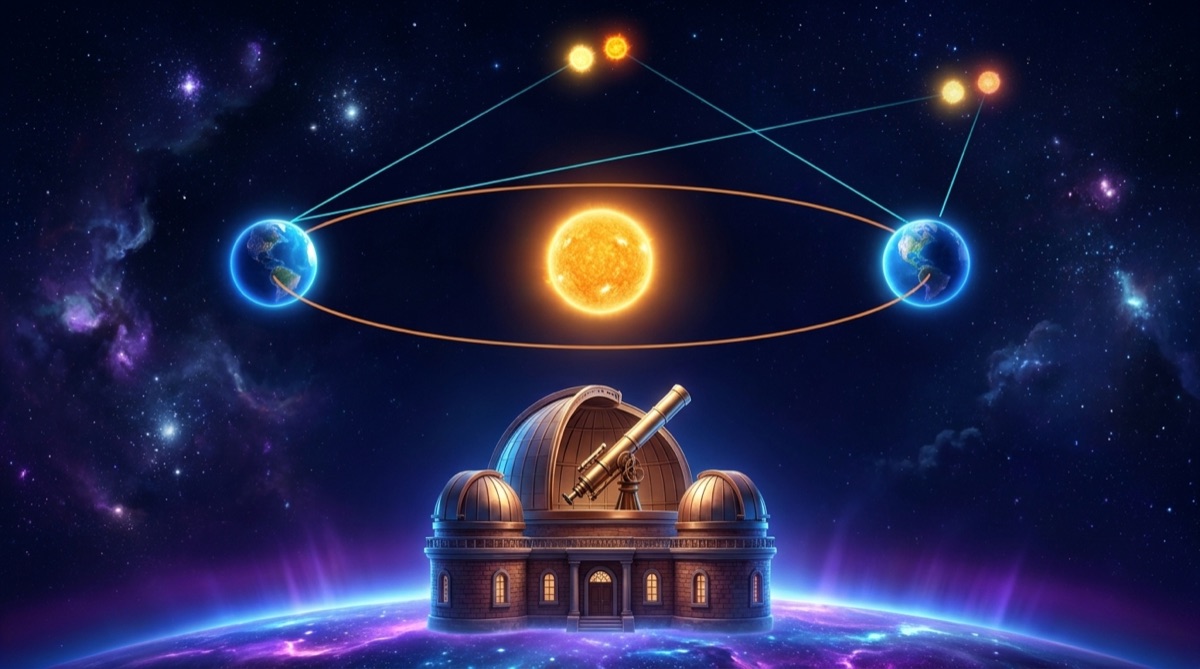
Bessel measures the first distance to a star
Friedrich Bessel measured in Königsberg the parallax of 61 Cygni, 0.31 arcseconds, and converted it into a distance. It was the first direct proof of how far away the stars are and that the Earth moves.
👤 Friedrich Wilhelm Bessel · 📍 Königsberg (now Kaliningrad)
📘 Parallax and trigonometry 🧪 Stellar parallax ParallaxParsec
Sources (2)
- Bessel, F. W. (1838). Bestimmung der Entfernung des 61sten Sterns des Schwans. Astronomische Nachrichten 16, 65–96. https://doi.org/10.1002/asna.18390160502
- Hoskin, M. (ed.) (1999). The Cambridge Concise History of Astronomy, ch. 6.
- 1846
Neptune, discovered with pencil and paper
Urbain Le Verrier calculated where an unknown planet perturbing Uranus had to be. Johann Galle and Heinrich d'Arrest found it in Berlin on the night of September 23, 1846, less than a degree from the predicted spot. Newton's gravitation worked beyond what had been seen.
👤 Urbain Le Verrier, Johann Gottfried Galle, Heinrich d'Arrest, John Couch Adams · 📍 Berlin
PerturbationLaw of universal gravitation
Sources (2)
- Britannica, “Neptune: Neptune's discovery” (britannica.com/place/Neptune-planet/Neptunes-discovery).
- Grosser, M. (1962). The Discovery of Neptune. Harvard University Press.
- 1857
Cuneiform is deciphered
The Royal Asiatic Society of London gave Rawlinson, Hincks, Oppert and Fox Talbot the same Assyrian inscription to translate separately; the four versions agreed and the decipherment was proven. Without that step, no astronomical tablet could be read.
👤 Henry Rawlinson, Edward Hincks, Julius Oppert, William Henry Fox Talbot · 📍 London
Sources (2)
- Royal Asiatic Society (1857). Inscription of Tiglath Pileser I, King of Assyria, B.C. 1150, as translated by Sir Henry Rawlinson, Fox Talbot, Esq., Dr. Hincks, and Dr. Oppert. London.
- Daniels, P. T. (1995). The decipherment of Ancient Near Eastern scripts. In Sasson, J. M. (ed.), Civilizations of the Ancient Near East, Scribner, vol. 1, 81–93.
- 1859

Kirchhoff and Bunsen: every element has its signature
In Heidelberg, Gustav Kirchhoff and Robert Bunsen showed that each chemical element emits and absorbs light in lines of its own, and that Fraunhofer's dark lines are the fingerprint of the elements in the Sun. Spectroscopy was born: at last one could know what the stars are made of.
👤 Gustav Kirchhoff, Robert Bunsen · 📍 Heidelberg
📘 Spectra and the Doppler effect Spectrum
Sources (3)
- Kirchhoff, G. (1860). Ueber die Fraunhofer'schen Linien. Annalen der Physik 185 (2), 148–150. https://doi.org/10.1002/andp.18601850115
- Kirchhoff, G. & Bunsen, R. (1860). Chemische Analyse durch Spectralbeobachtungen. Annalen der Physik 186 (6), 161–189. https://doi.org/10.1002/andp.18601860602
- Britannica, “Astronomy: The rise of astrophysics”.
- 1864 – 1924
From Huggins and Secchi to Harvard: classifying stars by their spectrum
William Huggins verified in 1864 that some nebulae are hot gas, and Angelo Secchi, in Rome, grouped thousands of stars into a few spectral types. At Harvard, under Edward Pickering, a team of women computers (Fleming, Maury, Cannon) classified hundreds of thousands of spectra; Annie Jump Cannon fixed the O, B, A, F, G, K, M sequence of the Henry Draper Catalogue (1918–1924).
👤 William Huggins, Angelo Secchi, Edward C. Pickering, Williamina Fleming, Antonia Maury, Annie Jump Cannon · 📍 London, Rome and the Harvard College Observatory
📘 The H–R diagram 🧪 Blackbody spectrum SpectrumBlackbody
Sources (4)
- Huggins, W. (1864). On the Spectra of Some of the Nebulae. Philosophical Transactions of the Royal Society 154, 437–444. https://doi.org/10.1098/rstl.1864.0013
- Gray, R. O. & Corbally, C. J. (2019). Spectral classification of stars over the last 200, 100, 75 years and in the future. Proceedings IAU Symposium 339. https://doi.org/10.1017/S1743921319000656
- Cannon, A. J. & Pickering, E. C. (1918–1924). The Henry Draper Catalogue. Annals of the Astronomical Observatory of Harvard College 91–99.
- Sobel, D. (2016). The Glass Universe. Viking.
- 1867
The Observatory passes to the Universidad Nacional
With the creation of the Universidad Nacional de los Estados Unidos de Colombia (law of September 22, 1867), the observatory was attached to it: it is today its oldest unit. In the following decades José María González Benito revived it with new instruments.
👤 José María González Benito · 📍 Bogotá
Sources (2)
- Universidad Nacional de Colombia, Observatorio Astronómico Nacional, “Historia” (oan.unal.edu.co).
- Revista de la Academia Colombiana de Ciencias Exactas, Físicas y Naturales, “Prehistoria del Observatorio Astronómico Nacional: registros meteorológicos” [Prehistory of the National Astronomical Observatory: meteorological records] (raccefyn.co).
- 1880
Förstemann deciphers the tables of the Dresden Codex
The Dresden librarian Ernst Förstemann publishes the first scholarly edition of the codex and recognizes the Long Count, the vigesimal system with zero and the Venus table. It is the beginning of the modern reading of Maya astronomy.
👤 Ernst Förstemann · 📍 Dresden (Germany)
Sources (2)
- Förstemann, E. (1880). Die Mayahandschrift der Königlichen öffentlichen Bibliothek zu Dresden. Leipzig.
- Britannica, “Dresden Codex”. https://www.britannica.com/topic/Dresden-Codex
- 1889
Epping and Strassmaier read the first Babylonian astronomy
Two Jesuits, the astronomer Joseph Epping and the Assyriologist Johann Strassmaier, published Astronomisches aus Babylon: they identified the Babylonian names of the planets for the first time and showed that the tablets contained computations of new and full Moons. It was the discovery of a lost science.
👤 Joseph Epping, Johann Nepomuk Strassmaier · 📍 Freiburg, Germany
Sources (2)
- Epping, J. & Strassmaier, J. N. (1889). Astronomisches aus Babylon oder das Wissen der Chaldäer über den gestirnten Himmel. Herder, Freiburg.
- Neugebauer, O. (1975). A History of Ancient Mathematical Astronomy. Springer, historical introduction.
- c. 1892
Julio Garavito directs the Observatory
The Bogotá-born engineer and mathematician Julio Garavito Armero (1865–1920) was appointed director (1891 or 1892, depending on the source) and led it until his death. He studied the motion of the Moon and of comets, directed the determination of the country's geographic coordinates and published works on celestial mechanics and optics in the Anales de Ingeniería.
👤 Julio Garavito Armero · 📍 Observatorio Astronómico Nacional, Bogotá
📘 Phases of the Moon and eclipses 🧪 Phases of the Moon Synodic monthPerturbation
Sources (2)
- Universidad Nacional de Colombia, institutional repository, “Cronología del Observatorio Astronómico Nacional” [Chronology of the National Astronomical Observatory] (repositorio.unal.edu.co): Garavito appointed director in 1891.
- Revista de la Academia Colombiana de Ciencias Exactas, Físicas y Naturales, biographical article on Julio Garavito (raccefyn.co/index.php/raccefyn/article/download/1172/2690).
- 1906
Lockyer and the first “archaeoastronomy”
Norman Lockyer, founder of the journal Nature, published an astronomical study of Stonehenge and other British monuments after having done the same with the Egyptian temples. His attempt to date Stonehenge by the slow drift of the sunrise point was pioneering, although the result turned out to be wrong.
👤 Norman Lockyer · 📍 England
Sources (2)
- Lockyer, J. N. (1906). Stonehenge and Other British Stone Monuments Astronomically Considered. Macmillan.
- Lockyer, J. N. (1894). The Dawn of Astronomy. Cassell (Egyptian temples).
- 1907 – 1988
Kugler, Neugebauer, Sachs and Hunger reconstruct the system
Franz Xaver Kugler (from 1907) and Otto Neugebauer (Astronomical Cuneiform Texts, 1955) deciphered the rules of Babylonian mathematical astronomy; Abraham Sachs and Hermann Hunger began the complete edition of the Diaries in 1988. Almost everything we know today passes through these editions.
👤 Franz Xaver Kugler, Otto Neugebauer, Abraham Sachs, Hermann Hunger · 📍 Germany, United States and Austria
Sources (3)
- Kugler, F. X. (1907–1924). Sternkunde und Sterndienst in Babel. Aschendorff, Münster.
- Neugebauer, O. (1955). Astronomical Cuneiform Texts. Lund Humphries.
- Sachs, A. J. & Hunger, H. (1988–2014). Astronomical Diaries and Related Texts from Babylonia, vols. I–VII. Österreichische Akademie der Wissenschaften.
- 1911 – 1914
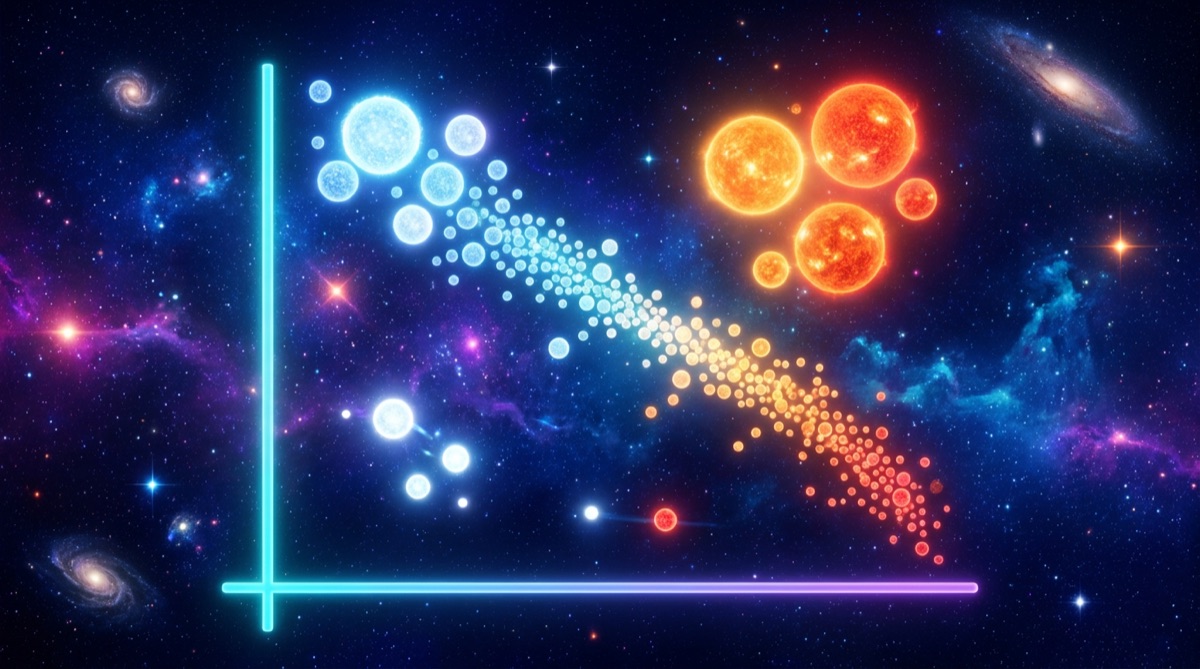
The Hertzsprung–Russell diagram
Ejnar Hertzsprung (1911) and Henry Norris Russell (1913–1914) plotted, independently, the brightness of stars against their color or spectral type. Stars are not scattered at random: most fall along a band, the main sequence. That diagram is today the map of the lives of stars.
👤 Ejnar Hertzsprung, Henry Norris Russell · 📍 Potsdam and Princeton
📘 The H–R diagram Hertzsprung–Russell diagramMain sequence
Sources (3)
- Hertzsprung, E. (1911). Über die Verwendung photographischer effektiver Wellenlängen zur Bestimmung von Farbenäquivalenten. Publikationen des Astrophysikalischen Observatoriums zu Potsdam 22 (63).
- Russell, H. N. (1914). Relations Between the Spectra and Other Characteristics of the Stars. Nature 93, 227–230, 252–258, 281–286. https://doi.org/10.1038/093252a0
- Linda Hall Library, “Scientist of the Day: Ejnar Hertzsprung” (lindahall.org/ejnar-hertzsprung).
- 1912
Leavitt: Cepheids tell how far away they are
Henrietta Leavitt, studying 25 variables in the Small Magellanic Cloud, found that the longer a Cepheid's period, the brighter it is. With that period–luminosity relation it became possible, for the first time, to measure the distance to other galaxies.
👤 Henrietta Swan Leavitt, Edward C. Pickering · 📍 Harvard College Observatory
📘 Henrietta Leavitt and the stars that tell you how far away they are Light curveAbsolute magnitudeLuminosity
Sources (1)
- Leavitt, H. S. & Pickering, E. C. (1912). Periods of 25 Variable Stars in the Small Magellanic Cloud. Harvard College Observatory Circular 173, 1–3 (ADS 1912HarCi.173....1L).
- 1915
Einstein presents general relativity
On November 25, 1915, Albert Einstein presented to the Prussian Academy of Sciences the definitive equations of his theory: gravity is the curvature of spacetime. It immediately explained the anomalous precession of Mercury and predicted that light bends as it passes near the Sun.
👤 Albert Einstein · 📍 Berlin
📘 The precession of Mercury's perihelion 🧪 Orbits around a black hole General relativityGeodesicPerihelion precession
Sources (2)
- Einstein, A. (1915). Die Feldgleichungen der Gravitation. Sitzungsberichte der Königlich Preußischen Akademie der Wissenschaften, 844–847 (session of November 25, 1915).
- Discover Magazine, “Einstein's Discovery of General Relativity, 1905–1915” (discovermagazine.com).
- 1919
The eclipse that confirmed Einstein
On May 29, 1919, British expeditions led by Eddington and Dyson photographed stars next to the eclipsed Sun from Príncipe and Sobral. The stars appeared shifted by the amount general relativity predicted. The result was announced in London on November 6, 1919, and Einstein became famous.
👤 Arthur Eddington, Frank Dyson, Andrew Crommelin · 📍 Príncipe Island and Sobral (Brazil)
📘 Deflection of light and gravitational lenses Gravitational lensSolar eclipse
Sources (2)
- Dyson, F. W., Eddington, A. S. & Davidson, C. (1920). A Determination of the Deflection of Light by the Sun's Gravitational Field. Philosophical Transactions of the Royal Society A 220, 291–333. https://doi.org/10.1098/rsta.1920.0009
- Kennefick, D. (2019). No Shadow of a Doubt: The 1919 Eclipse That Confirmed Einstein's Theory of Relativity. Princeton University Press.
- 1925
Hubble: Andromeda is another galaxy
On January 1, 1925, at a meeting of the American Astronomical Society in Washington, Edwin Hubble's paper on Cepheids in the Andromeda nebula was read: it lay nearly a million light-years away, far outside the Milky Way. The 1920 “Great Debate” between Shapley and Curtis was settled: the universe is full of galaxies.
👤 Edwin Hubble, Harlow Shapley, Heber Curtis, Henry Norris Russell · 📍 Mount Wilson Observatory, California
📘 The Milky Way and other galaxies Galaxy
Sources (2)
- Hubble, E. (1925). Cepheids in Spiral Nebulae. Popular Astronomy 33, 252–255 (ADS 1925PA.....33..252H); abstract of the paper read on January 1, 1925.
- Trimble, V. (1995). The 1920 Shapley–Curtis Discussion: Background, Issues, and Aftermath. PASP 107, 1133–1144. https://doi.org/10.1086/133671
- 1925
Payne: stars are almost all hydrogen
In her doctoral thesis, Cecilia Payne applied atomic physics to stellar spectra and concluded that stars are made mostly of hydrogen and helium, not of the same elements as the Earth. The idea was received with skepticism and confirmed a few years later.
👤 Cecilia Payne-Gaposchkin, Henry Norris Russell · 📍 Harvard College Observatory / Radcliffe College
📘 The blackbody and the color of the stars SpectrumNuclear fusion
Sources (2)
- Payne, C. H. (1925). Stellar Atmospheres: A Contribution to the Observational Study of High Temperature in the Reversing Layers of Stars. Doctoral thesis, Radcliffe College; Harvard Observatory Monographs 1.
- Harvard Library / CfA, “Cecilia Payne-Gaposchkin: Education and Doctoral Thesis” (library.cfa.harvard.edu/cecilia-payne-gaposchkin/education-and-doctoral-thesis).
- 1905–1935
The GMT correlation
Goodman (1905), Martínez Hernández (1926) and Thompson (1927, revised in 1935) propose how to convert the Long Count to our calendar: the base date 13.0.0.0.0 falls on August 11, 3114 BCE (or the 13th, depending on the variant). It is the correlation used by almost all current research.
👤 Joseph Goodman, Juan Martínez Hernández, J. Eric S. Thompson · 📍 Mexico, United States and United Kingdom
Sources (2)
- Thompson, J. E. S. (1935). Maya Chronology: The Correlation Question. Contributions to American Archaeology 3(14), Carnegie Institution of Washington, Pub. 456.
- Thompson, J. E. S. (1950). Maya Hieroglyphic Writing, ch. 2.
- 1927 – 1929
Lemaître and Hubble: the universe is expanding
Georges Lemaître deduced in 1927, from general relativity, that the universe is expanding and that galaxies must recede faster the farther away they are. In 1929 Edwin Hubble published the relation between distance and velocity measured with 24 galaxies: the Hubble–Lemaître law.
👤 Georges Lemaître, Edwin Hubble, Milton Humason, Vesto Slipher · 📍 Leuven and Mount Wilson
📘 The universe is expanding 🧪 Expansion of the universe Hubble–Lemaître lawHubble constantRedshift
Sources (2)
- Lemaître, G. (1927). Un univers homogène de masse constante et de rayon croissant, rendant compte de la vitesse radiale des nébuleuses extra-galactiques. Annales de la Société Scientifique de Bruxelles A47, 49–59.
- Hubble, E. (1929). A relation between distance and radial velocity among extra-galactic nebulae. PNAS 15 (3), 168–173. https://doi.org/10.1073/pnas.15.3.168
- c. 1930
Jorge Álvarez Lleras and the Academy of Sciences
The engineer Jorge Álvarez Lleras took over the direction of the observatory around 1930 and from there promoted the creation of the Academia Colombiana de Ciencias Exactas, Físicas y Naturales, which still publishes the country's main scientific journal.
👤 Jorge Álvarez Lleras · 📍 Bogotá
Sources (2)
- Universidad Nacional de Colombia, institutional repository, “Cronología del Observatorio Astronómico Nacional” [Chronology of the National Astronomical Observatory] (repositorio.unal.edu.co).
- Academia Colombiana de Ciencias Exactas, Físicas y Naturales, “Historia” (accefyn.org.co).
- 1933
Zwicky and the “dark matter” of the Coma cluster
Fritz Zwicky measured the velocities of galaxies in the Coma cluster and saw that they were moving too fast for the visible mass: the cluster had to contain a great deal of “dunkle Materie”, dark matter. Decades passed before it was taken seriously.
👤 Fritz Zwicky · 📍 Caltech, Pasadena
📘 Vera Rubin and the galaxies that spin too fast Dark matterVirial theorem
Sources (1)
- Zwicky, F. (1933). Die Rotverschiebung von extragalaktischen Nebeln. Helvetica Physica Acta 6, 110–127 (English translation: Andernach & Zwicky, arXiv:1711.01693).
- 1933
Jansky listens to the Milky Way: radio astronomy is born
Searching for the source of interference in transatlantic communications, the engineer Karl Jansky found a hiss that repeated every sidereal day: it came from the center of the Milky Way. It was the first detection of radio waves of cosmic origin.
👤 Karl Jansky · 📍 Bell Telephone Laboratories, Holmdel (New Jersey)
Sources (2)
- Jansky, K. G. (1933). Electrical Disturbances Apparently of Extraterrestrial Origin. Proceedings of the IRE 21 (10), 1387–1398. https://doi.org/10.1109/JRPROC.1933.227458
- Jansky, K. G. (1933). Radio waves from outside the solar system. Nature 132, 66. https://doi.org/10.1038/132066a0
- 1939 – 1948

Bethe and Gamow: where the energy comes from and where the elements come from
Hans Bethe explained in 1939 how stars shine by fusing hydrogen into helium (proton–proton chain and CNO cycle). In 1948 Alpher and Gamow proposed that the light elements formed in the first minutes of a hot universe, and Alpher and Herman predicted a residual radiation of a few kelvin.
👤 Hans Bethe, George Gamow, Ralph Alpher, Robert Herman · 📍 Cornell and George Washington University
📘 Stellar nucleosynthesis and solar neutrinos Nuclear fusionStellar nucleosynthesisBig Bang
Sources (3)
- Bethe, H. A. (1939). Energy Production in Stars. Physical Review 55 (5), 434–456. https://doi.org/10.1103/PhysRev.55.434
- Alpher, R. A., Bethe, H. & Gamow, G. (1948). The Origin of Chemical Elements. Physical Review 73 (7), 803–804. https://doi.org/10.1103/PhysRev.73.803
- Alpher, R. A. & Herman, R. (1948). Evolution of the Universe. Nature 162, 774–775. https://doi.org/10.1038/162774b0
- 1944
The Inti Raymi is reborn in Cusco
Banned by Viceroy Toledo in 1572, the festival of the Sun at the June solstice is reconstructed in 1944 as a theatrical performance at Sacsayhuamán, with a script by Faustino Espinoza Navarro based on Garcilaso. It has been celebrated every June 24 since then.
👤 Faustino Espinoza Navarro · 📍 Sacsayhuamán, Cusco (Peru)
Sources (2)
- Garcilaso de la Vega, Inca (1609). Comentarios reales [Royal Commentaries], book VI, ch. 20–22 (original description of the Inti Raymi).
- Mendoza, Z. S. (2008). Creating Our Own: Folklore, Performance, and Identity in Cuzco, Peru. Duke University Press (the 1944 reconstruction).
- 1947

The Kon-Tiki and the American hypothesis
Thor Heyerdahl crosses by raft from Peru to the Tuamotus to argue that Polynesia was settled from the Americas. The crossing was a feat, but linguistics, archaeology and genetics show that the Polynesians came from the west; the contact with America (around 1200) was an episode, not the origin.
👤 Thor Heyerdahl · 📍 From Callao (Peru) to Raroia (Tuamotu)
Sources (2)
- Heyerdahl, T. (1950). Kon-Tiki: Across the Pacific by Raft. Rand McNally.
- Kirch, P. V. (2017). On the Road of the Winds, 2nd ed., ch. 1 (history of the hypotheses on Polynesian origins).
- 1956

Andrew Sharp: accidental voyages?
The New Zealand historian Andrew Sharp argues that the Polynesians could not navigate deliberately to distant islands and that the settlement happened by accidental drift. His book provoked two decades of debate and, in the end, the experiments that refuted it.
👤 Andrew Sharp · 📍 Wellington (New Zealand)
Sources (2)
- Sharp, A. (1956). Ancient Voyagers in the Pacific. Polynesian Society Memoir 32, Wellington.
- Finney, B. (1994). Voyage of Rediscovery. University of California Press, ch. 1.
-
Space age
since Sputnik 1 (1957) - 1957
Sputnik 1: the first artificial satellite
On October 4, 1957 the Soviet Union put into orbit an 84 kg sphere that emitted a radio beep audible from any receiver. It showed that an object can keep circling the Earth, as Newton had calculated, and set off the space race.
👤 Sergei Korolev · 📍 Baikonur, Kazakhstan (USSR)
📘 Why don't satellites fall? 🧪 Newton’s cannonball OrbitOrbital velocity
Sources (2)
- NASA History, “Sputnik and The Dawn of the Space Age” (history.nasa.gov/sputnik).
- NSSDCA, Sputnik 1 (nssdc.gsfc.nasa.gov/nmc/spacecraft/display.action?id=1957-001B).
- 1958
Explorer 1 and the Van Allen belts
The first American satellite lifted off on January 31, 1958 (February 1 in Universal Time). Its Geiger counter, designed by James Van Allen, saturated at a certain altitude: the Earth is surrounded by belts of charged particles trapped by its magnetic field. It was the first scientific discovery made from space.
👤 James Van Allen, Wernher von Braun, William Pickering · 📍 Cape Canaveral, Florida
Sources (2)
- NASA/JPL, “Explorer 1” (jpl.nasa.gov/missions/explorer-1).
- Physics Today, “Launch of Explorer 1” (physicstoday.aip.org/news/launch-of-explorer-1).
- 1959
Luna 3 photographs the far side of the Moon
The Soviet probe Luna 3 passed behind the Moon and, on October 7, 1959, took the first photos of the side we never see from Earth. It developed them on board and transmitted them by radio. It was a different landscape: almost no dark “seas”.
📍 USSR; lunar orbit
📘 The phases of the Moon 🧪 Phases of the Moon Phases of the MoonSidereal month
Sources (1)
- NSSDCA, Luna 3 (nssdc.gsfc.nasa.gov/nmc/spacecraft/display.action?id=1959-008A).
- 1960 – 1969

Neugebauer and Parker edit the astronomical texts
In three volumes, Otto Neugebauer and Richard Parker gathered, translated and analyzed all the known star clocks, astronomical ceilings and lists of decans. Their conclusion, still valid, is that Egyptian astronomy was above all practical, calendrical and religious, with little mathematics.
👤 Otto Neugebauer, Richard A. Parker · 📍 Brown University, United States
Sources (1)
- Neugebauer, O. & Parker, R. A. (1960, 1964, 1969). Egyptian Astronomical Texts I–III. Brown University Press / Lund Humphries.
- 1961

Gagarin, the first human being in space
On April 12, 1961 Yuri Gagarin made one complete orbit of the Earth in the Vostok 1 capsule, in 108 minutes. “The Earth is blue”, he said. Since then April 12 has been the International Day of Human Space Flight.
👤 Yuri Gagarin · 📍 Baikonur; Earth orbit
Sources (2)
- United Nations, Resolution A/RES/65/271 (2011): International Day of Human Space Flight.
- NASA, “April 1961: Yuri Gagarin Becomes the First Human in Space” (nasa.gov/history).
- 1963
Hawkins “decodes” Stonehenge with a computer
Gerald Hawkins used an IBM computer to compare 165 alignments of Stonehenge with the risings and settings of the Sun and the Moon, and claimed that the monument was a “Neolithic computer”. The critical response of the archaeologists opened the methodological debate that gave rise to modern archaeoastronomy.
👤 Gerald Hawkins, Richard Atkinson · 📍 United States and England
Sources (3)
- Hawkins, G. S. (1963). Stonehenge decoded. Nature 200, 306–308. https://doi.org/10.1038/200306a0
- Hawkins, G. S. & White, J. B. (1965). Stonehenge Decoded. Doubleday.
- Atkinson, R. J. C. (1966). Moonshine on Stonehenge. Antiquity 40(159), 212–216 (critique).
- 1963
Valentina Tereshkova, the first woman in space
On June 16, 1963 Valentina Tereshkova lifted off in Vostok 6 and circled the Earth 48 times in almost three days, longer than all the American astronauts combined up to then. Twenty years would pass before another woman flew.
👤 Valentina Tereshkova · 📍 Baikonur; Earth orbit
Sources (2)
- ESA, “Valentina Tereshkova: first woman in space” (esa.int).
- NASA, “Valentina Tereshkova, First Woman in Space” (nasa.gov/history).
- 1964
Zuidema and the ceque system
The Dutch anthropologist Tom Zuidema publishes The Ceque System of Cuzco and proposes that the 328 shrines in Cobo's list are the days of a sidereal lunar calendar and that some ceques served as astronomical sightlines. His interpretation is influential, but archaeology and the sources confirm only part of it.
👤 R. Tom Zuidema · 📍 Leiden (Netherlands) and Cusco (Peru)
Sources (2)
- Zuidema, R. T. (1964). The Ceque System of Cuzco: The Social Organization of the Capital of the Inca. Brill, Leiden.
- Bauer, B. S. & Dearborn, D. S. P. (1995). Astronomy and Empire in the Ancient Andes, ch. 3 (critical assessment).
- 1965
Penzias and Wilson detect the cosmic microwave background
With a Bell Labs antenna, Arno Penzias and Robert Wilson found a microwave noise, the same in all directions, of about 3 K, that they could not get rid of. It was the echo of the hot universe predicted by Gamow, Alpher and Herman. It is the strongest evidence for the Big Bang.
👤 Arno Penzias, Robert Wilson, Robert Dicke, James Peebles · 📍 Holmdel, New Jersey
📘 Cosmic microwave background and primordial nucleosynthesis Cosmic microwave backgroundBig BangBlackbody
Sources (2)
- Penzias, A. A. & Wilson, R. W. (1965). A Measurement of Excess Antenna Temperature at 4080 Mc/s. ApJ 142, 419–421. https://doi.org/10.1086/148307
- Dicke, R. H., Peebles, P. J. E., Roll, P. G. & Wilkinson, D. T. (1965). Cosmic Black-Body Radiation. ApJ 142, 414–419. https://doi.org/10.1086/148306
- 1967
Thom and the “megalithic observatories”
The engineer Alexander Thom published measurements of hundreds of stone circles and proposed a common unit, the “megalithic yard”, and very precise lunar alignments. Later statistical tests support the general solar orientations, but not the precision or the unit he proposed.
👤 Alexander Thom · 📍 Great Britain
Sources (2)
- Thom, A. (1967). Megalithic Sites in Britain. Clarendon Press, Oxford.
- Ruggles, C. L. N. (1999). Astronomy in Prehistoric Britain and Ireland. Yale University Press (reassessment of Thom's hypotheses).
- 1967
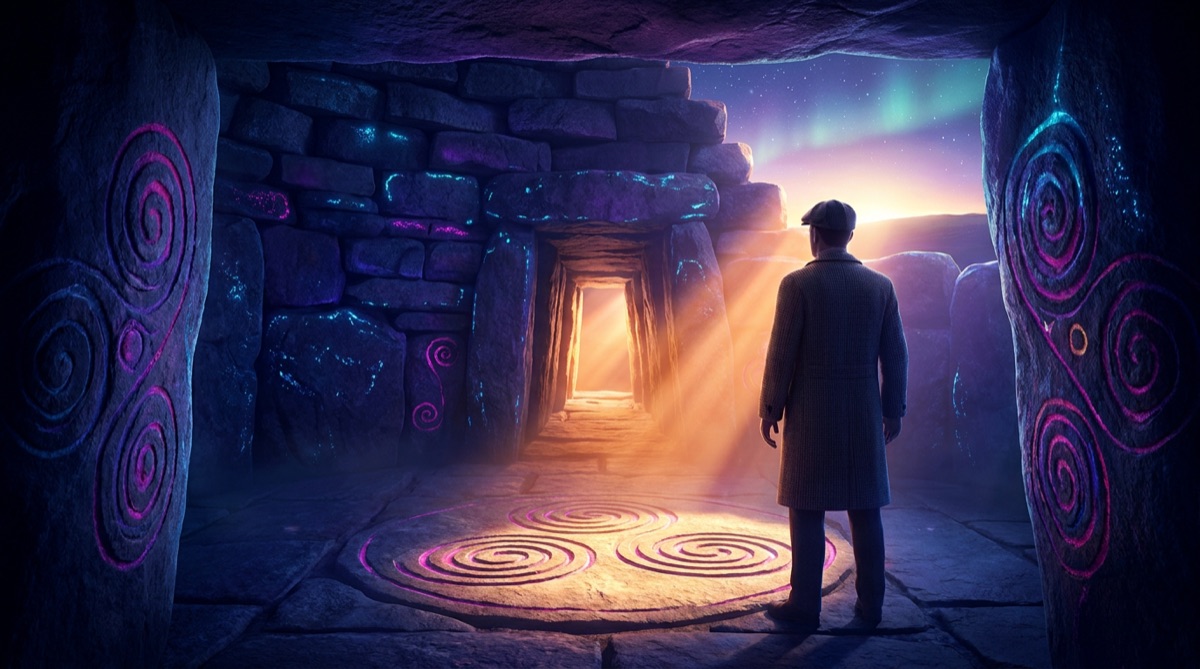
O'Kelly watches the solstice sunrise at Newgrange
On December 21, 1967, the archaeologist Michael O'Kelly, who had been excavating the mound since 1962, was the first person in centuries to see the sunlight enter through the roof-box and reach the chamber, confirming the function of that opening.
👤 Michael J. O'Kelly · 📍 Newgrange, Ireland
Sources (2)
- O'Kelly, M. J. (1982). Newgrange: Archaeology, Art and Legend. Thames & Hudson.
- National Museum of Ireland: The winter solstice at Newgrange.
- 1967
Jocelyn Bell Burnell discovers pulsars
Going through kilometers of chart paper from a Cambridge radio telescope, the student Jocelyn Bell noticed a signal that pulsed every 1.337 seconds. The pulses, confirmed in November 1967 and published in February 1968, came from rotating neutron stars: pulsars.
👤 Jocelyn Bell Burnell, Antony Hewish · 📍 Mullard Observatory, Cambridge (United Kingdom)
Sources (2)
- Hewish, A., Bell, S. J., Pilkington, J. D. H., Scott, P. F. & Collins, R. A. (1968). Observation of a Rapidly Pulsating Radio Source. Nature 217, 709–713. https://doi.org/10.1038/217709a0
- Bell Burnell, S. J. (1977). Little Green Men, White Dwarfs or Pulsars? Annals of the New York Academy of Sciences 302, 685–689.
- 1969
Apollo 11: footprints on the Moon
On July 20, 1969 Neil Armstrong and Buzz Aldrin set the Eagle module down in the Sea of Tranquility while Michael Collins orbited. They brought back 21.5 kg of rocks and left a laser reflector that is still used to measure the Earth–Moon distance to the millimeter. Six Apollo missions took twelve people to the Moon between 1969 and 1972.
👤 Neil Armstrong, Buzz Aldrin, Michael Collins, Margaret Hamilton, Katherine Johnson · 📍 Sea of Tranquility, Moon
📘 How much would you weigh on Mars? GravityMass and weightEscape velocity
Sources (2)
- NASA, “Apollo 11 Mission Overview” (nasa.gov/mission/apollo-11).
- NASA Lunar Sample Compendium, Apollo 11 samples (curator.jsc.nasa.gov/lunar).
- 1969

The Bogotá Planetarium opens
On December 22, 1969, five months after Apollo 11, the Bogotá Planetarium opened, conceived by Mayor Virgilio Barco in 1967. Since then millions of students have seen their first starry sky there; it was completely renovated in 2013.
👤 Virgilio Barco Vargas · 📍 Bogotá
📘 The night sky 🧪 Interactive planisphere
Sources (2)
- El Tiempo (2019). “El Planetario de Bogotá celebra sus 50 años” [The Bogotá Planetarium celebrates its 50 years] (eltiempo.com/bogota/el-planetario-de-bogota-celebra-sus-50-anos-359594).
- Alcaldía de Bogotá (21-03-2013). “Hoy, 21 de marzo, reabre sus puertas el Planetario de Bogotá” [Today, March 21, the Bogotá Planetarium reopens its doors] (bogota.gov.co).
- 1970 – 1980
Rubin and Ford: galaxies spin too fast
Vera Rubin and Kent Ford measured the rotation of Andromeda (1970) and of dozens of spirals (1980): the stars at the edges orbit as fast as those near the center. Visible matter is not enough to hold them; Zwicky's dark matter returned to the center of astronomy.
👤 Vera Rubin, Kent Ford, Norbert Thonnard · 📍 Carnegie Institution, Washington; Kitt Peak
📘 Vera Rubin and the galaxies that spin too fast 🧪 Galactic rotation curve Rotation curveDark matter
Sources (2)
- Rubin, V. C. & Ford, W. K. (1970). Rotation of the Andromeda Nebula from a Spectroscopic Survey of Emission Regions. ApJ 159, 379–403. https://doi.org/10.1086/150317
- Rubin, V. C., Ford, W. K. & Thonnard, N. (1980). Rotational properties of 21 SC galaxies with a large range of luminosities and radii. ApJ 238, 471–487. https://doi.org/10.1086/158003
- 1970
Venera 7: first signal from the surface of another planet
On December 15, 1970 the Soviet probe Venera 7 landed on Venus and transmitted for about 23 minutes before dying from the heat: some 475 °C and 90 atmospheres of pressure. It was the first transmission from the surface of another planet.
📍 Venus
📘 Rocky planets and giant planets Rocky planet
Sources (2)
- NSSDCA, Venera 7 (nssdc.gsfc.nasa.gov/nmc/spacecraft/display.action?id=1970-060A).
- ESA, “50 years of planetary exploration”.
- 1970
A crater on the Moon is named Garavito
In 1970 the International Astronomical Union named a 74 km crater on the far side of the Moon after Julio Garavito, in recognition of his work on lunar motion.
👤 Julio Garavito Armero · 📍 Far side of the Moon
Sources (2)
- IAU / USGS Gazetteer of Planetary Nomenclature, “Garavito” (planetarynames.wr.usgs.gov).
- Forbes Colombia (05-01-2022). “Google dedica su doodle del día al astrónomo colombiano Julio Garavito” [Google dedicates its doodle of the day to the Colombian astronomer Julio Garavito].
- 1972

David Lewis publishes We, the Navigators
After sailing with master navigators from the Carolines, Tonga and Santa Cruz, the physician and sailor David Lewis describes the complete system in writing: guide stars that rise and set, zenith stars for latitude, swells, birds and clouds. It is the first systematic study of traditional Pacific navigation.
👤 David Lewis · 📍 Western and central Pacific
Sources (1)
- Lewis, D. (1972). We, the Navigators: The Ancient Art of Landfinding in the Pacific. Australian National University Press.
- 1972 – 1973
Pioneer 10 crosses the asteroid belt and reaches Jupiter
Launched on March 2, 1972, Pioneer 10 was the first probe to cross the asteroid belt and, on December 3, 1973, to fly past Jupiter. It measured its enormous magnetic field and radiation, and carries a plaque with a message for whoever finds it.
👤 Carl Sagan, Frank Drake · 📍 Jupiter
Sources (2)
- NASA Science, “Pioneer 10” (science.nasa.gov/mission/pioneer-10).
- NSSDCA, Pioneer 10 (nssdc.gsfc.nasa.gov/nmc/spacecraft/display.action?id=1972-012A).
- 1973

The Polynesian Voyaging Society is founded
The anthropologist Ben Finney, the Hawaiian artist Herb Kawainui Kāne and the sailor Tommy Holmes create in Honolulu a society to build a double-hulled canoe and test, by sailing, whether the Polynesians could have voyaged deliberately between Hawaiʻi and Tahiti.
👤 Ben Finney, Herb Kawainui Kāne, Tommy Holmes · 📍 Honolulu, Hawaiʻi (United States)
Sources (2)
- Polynesian Voyaging Society, “History”. https://hokulea.com/history
- Finney, B. (1994). Voyage of Rediscovery. University of California Press.
- 1974
Hulse and Taylor: the binary pulsar that loses energy
At Arecibo, Russell Hulse and Joseph Taylor discovered on July 2, 1974, a pulsar in an 8-hour orbit with another neutron star. Its orbit shrinks exactly as general relativity predicts if it emits gravitational waves: the first, indirect, proof that they exist.
👤 Russell Hulse, Joseph Taylor · 📍 Arecibo Observatory, Puerto Rico
📘 Gravitational waves: from the quadrupole to GW150914 Gravitational waveNeutron star
Sources (2)
- Hulse, R. A. & Taylor, J. H. (1975). Discovery of a pulsar in a binary system. ApJ 195, L51–L53. https://doi.org/10.1086/181708
- Weisberg, J. M. & Huang, Y. (2016). Relativistic measurements from timing the binary pulsar PSR B1913+16. ApJ 829, 55. https://doi.org/10.3847/0004-637X/829/1/55
- 1975
The Aryabhata satellite
On April 19, 1975 India launched its first satellite, named after the 5th-century astronomer, with X-ray and solar physics instruments. An electrical failure shut down the experiments after a few days, but it opened the Indian space program.
📍 Kapustin Yar (USSR) / ISRO, India
Sources (2)
- ISRO, “Aryabhata”, completed missions (isro.gov.in).
- NASA HEASARC, “The Aryabhata Satellite” (heasarc.gsfc.nasa.gov).
- 1975

Launch of the Hōkūleʻa
On March 8, 1975, the Hōkūleʻa, a 19 m double-hulled canoe designed by Herb Kāne, is launched in Kāneʻohe Bay. Its name is the Hawaiian name of Arcturus, the star that passes through the zenith at the latitude of Hawaiʻi.
👤 Herb Kawainui Kāne · 📍 Kāneʻohe Bay, Oʻahu (Hawaiʻi)
📘 Celestial coordinates ZenithDeclination
Sources (1)
- Polynesian Voyaging Society, “History”. https://hokulea.com/history
- 1976
Mau Piailug guides the Hōkūleʻa from Hawaiʻi to Tahiti
Since no Hawaiian still kept the art, they turned to Mau Piailug, a navigator from the island of Satawal (Micronesia). Without instruments, using stars, swells and birds, he steered the canoe from Maui (May 1) to Papeete (June 4), about 4 000 km. Seventeen thousand people welcomed it. The accidental-drift hypothesis was buried.
👤 Mau Piailug · 📍 From Honolua (Maui) to Papeete (Tahiti)
🧪 Interactive planisphere HorizonCardinal points
Sources (2)
- Finney, B. (1979). Hōkūleʻa: The Way to Tahiti. Dodd, Mead, New York.
- Polynesian Voyaging Society, “Mau Piailug”. https://hokulea.com
- 1976
Viking 1 and 2: the first laboratories on Mars
Viking 1 landed on July 20, 1976 and Viking 2 on September 3. They sent the first photos from the Martian surface, measured the weather for years and searched for life in the soil with ambiguous results that are still debated.
📍 Chryse Planitia and Utopia Planitia, Mars
📘 Rocky planets and giant planets
Sources (2)
- NASA Science, “Viking 1” and “Viking 2” (science.nasa.gov/mission/viking-1).
- NSSDCA, Viking 1 Lander (nssdc.gsfc.nasa.gov/nmc/spacecraft/display.action?id=1975-075C).
- 1977 – 2012
Voyager 1 and 2: the grand tour and the exit into interstellar space
Voyager 2 lifted off on August 20, 1977 and Voyager 1 on September 5. Taking advantage of a planetary alignment that occurs every 175 years, they visited Jupiter, Saturn, Uranus and Neptune. On August 25, 2012 Voyager 1 crossed the heliopause: the first spacecraft in interstellar space. Both are still transmitting.
👤 Edward Stone, Carl Sagan, Gary Flandro · 📍 Outer planets and interstellar space
📘 The speed of light and the light-year 🧪 The Solar System to scale Astronomical unitEscape velocity
Sources (2)
- NASA/JPL, “Voyager Mission Status” (voyager.jpl.nasa.gov/mission/status).
- Stone, E. C. et al. (2013). Voyager 1 Observes Low-Energy Galactic Cosmic Rays in a Region Depleted of Heliospheric Ions. Science 341, 150–153. https://doi.org/10.1126/science.1236408
- 1980

Nainoa Thompson and the Hawaiian star compass
Trained by Mau Piailug and by Will Kyselka at the Bishop Museum planetarium, the Hawaiian Nainoa Thompson navigates the Hōkūleʻa to Tahiti and back. To learn, he created a star compass of 32 “houses” of the horizon, each 11.25° wide, through which the guide stars rise and set. It is the system taught today in schools across the Pacific.
👤 Nainoa Thompson, Mau Piailug, Will Kyselka · 📍 Honolulu (Hawaiʻi) and Tahiti
📘 The cardinal directions 🧪 Interactive planisphere AzimuthHorizonCardinal points
Sources (2)
- Kyselka, W. (1987). An Ocean in Mind. University of Hawaiʻi Press.
- Polynesian Voyaging Society, “The Hawaiian Star Compass”. https://hokulea.com/polynesian-wayfinding
- 1981

Urton documents living Quechua astronomy
After living in the community of Misminay, near Cusco, Gary Urton publishes At the Crossroads of the Earth and the Sky: the Milky Way as a celestial river, the dark constellations (llama, fox, toad, serpent, tinamou) and the use of the Pleiades (Qullqa, “the storehouse”) to forecast the harvest.
👤 Gary Urton · 📍 Misminay, Cusco (Peru)
📘 Stars and constellations 🧪 Interactive planisphere Constellation
Sources (1)
- Urton, G. (1981). At the Crossroads of the Earth and the Sky: An Andean Cosmology. University of Texas Press.
- 1981
Silva Celis excavates El Infiernito
Eliécer Silva Celis carries out the first systematic excavations at Monquirá (Villa de Leyva), obtains carbon-14 dates and proposes that the rows of columns formed a “sacred field” for observing the sunrise. The site becomes an archaeological park.
👤 Eliécer Silva Celis · 📍 Villa de Leyva, Boyacá (Colombia)
Sources (1)
- Silva Celis, E. (1981). Investigaciones arqueológicas en Villa de Leiva [Archaeological investigations in Villa de Leiva]. Boletín Museo del Oro 10 (Banco de la República, Bogotá).
- 1983
The Torreón of Machu Picchu as an observatory
The astronomers David Dearborn and Raymond White measure the window of the Torreón and show that it frames the sunrise at the June solstice, coinciding with an edge carved into the rock inside. It is one of the first Andean archaeoastronomical studies with published measurements and error margins.
👤 David Dearborn, Raymond White · 📍 Machu Picchu (Peru)
Sources (1)
- Dearborn, D. S. P. & White, R. E. (1983). The “Torreon” of Machu Picchu as an Observatory. Archaeoastronomy 5, S37–S49.
- 1984

Medellín Planetarium
The Jesús Emilio Ramírez González Planetarium opened on October 10, 1984, and is today part of Parque Explora. Its dome and its school programs made Medellín the country's second center of astronomy outreach.
📍 Medellín
Sources (2)
- Planetario de Medellín / Parque Explora, “Historia” (planetariomedellin.org).
- El Colombiano (2026). “Planetario de Medellín: eventos” [Medellín Planetarium: events] (elcolombiano.com).
- 1985 – 1987

The Voyage of Rediscovery
For two years the Hōkūleʻa sails around the Polynesian triangle: Tahiti, the Cook Islands, Aotearoa, Tonga, Samoa. Sailing against the trade winds, Thompson shows that the “impossible” crossings from east to west and toward New Zealand could be made by waiting for the westerly winds of spring.
👤 Nainoa Thompson, Mau Piailug · 📍 Hawaiʻi, Tahiti, Aotearoa, Tonga, Samoa
Sources (1)
- Finney, B. (1994). Voyage of Rediscovery: A Cultural Odyssey through Polynesia. University of California Press.
- 1986 – 2000

Space stations: from Mir to the International Space Station
The Soviet Mir (1986–2001) showed that it is possible to live in orbit for months. The first module of the International Space Station, Zarya, was launched on November 20, 1998, and Expedition 1 arrived on November 2, 2000. Since then there have always been human beings off the Earth.
👤 William Shepherd, Sergei Krikalev, Yuri Gidzenko · 📍 Low Earth orbit, ~400 km
📘 Universal gravitation and satellites OrbitOrbital velocityOrbital period
Sources (2)
- NASA, “International Space Station: 20 Years of Continuous Human Presence” (nasa.gov).
- ISS National Lab, “Celebrating the 20th Anniversary of the First International Space Station Module” (issnationallab.org).
- 1990
The Hubble Space Telescope
Launched on April 24, 1990 aboard the shuttle Discovery (STS-31), its mirror went up with a flaw that was corrected in 1993. From above the atmosphere it has measured the Hubble constant, photographed galaxies 13 billion light-years away and shown the public the universe as never before.
👤 Nancy Grace Roman, Lyman Spitzer · 📍 Earth orbit, ~540 km
📘 The universe is expanding Hubble constantGalaxy
Sources (2)
- NASA, “Hubble Space Telescope: Mission Overview” (science.nasa.gov/mission/hubble).
- Freedman, W. L. et al. (2001). Final Results from the Hubble Space Telescope Key Project to Measure the Hubble Constant. ApJ 553, 47–72. https://doi.org/10.1086/320638
- 1991
Adriana Ocampo and the Chicxulub crater
The planetary geologist Adriana Ocampo, born in Barranquilla in 1955 and a NASA scientist, was a co-author of the 1991 paper that identified the buried Chicxulub crater (Yucatán) with the impact that wiped out the dinosaurs; she recognized the ring of cenotes that gives it away. She later directed NASA's New Frontiers program.
👤 Adriana Ocampo · 📍 NASA / Yucatán, Mexico
Sources (2)
- Pope, K. O., Ocampo, A. C. & Duller, C. E. (1991). Mexican site for K/T impact crater? Nature 351, 105. https://doi.org/10.1038/351105a0
- Physics Today, “Adriana Ocampo” (physicstoday.aip.org/news/adriana-ocampo).
- 1995
51 Pegasi b: the first planet around another sun
Michel Mayor and Didier Queloz announced on October 6, 1995, in Florence, a planet of half a Jupiter mass that circles the star 51 Pegasi every 4.2 days. They detected it through the slight wobble of the star (radial velocity). Today thousands of exoplanets are known.
👤 Michel Mayor, Didier Queloz · 📍 Haute-Provence Observatory, France
📘 Hunting exoplanets with transits 🧪 Light curve of a transit ExoplanetRadial velocityDoppler effect
Sources (2)
- Mayor, M. & Queloz, D. (1995). A Jupiter-mass companion to a solar-type star. Nature 378, 355–359. https://doi.org/10.1038/378355a0
- Nobel Prize (2019). Press release: The Nobel Prize in Physics 2019 (nobelprize.org).
- 1996

Garavito on the 20 000-peso banknote
The Banco de la República put into circulation in 1996 the 20 000-peso banknote with the portrait of Julio Garavito and, on the reverse, the Moon with his crater. It circulated until the new family of banknotes of 2016.
👤 Julio Garavito Armero · 📍 Colombia
Sources (2)
- Banco de la República, “Billete de 20 000 pesos (1996)” [20 000-peso banknote (1996)], Museo de la Moneda / numismatic catalog (banrepcultural.org).
- Noticias RCN (05-01-2022). “¿Quién era Julio Garavito y por qué aparece en Google hoy?” [Who was Julio Garavito and why does he appear on Google today?].
- 1997
Mars Pathfinder and the first rover on Mars
On July 4, 1997 Pathfinder landed bouncing on airbags and released Sojourner, a 10 kg robot that covered about 100 meters analyzing rocks. It was the first mission to Mars since Viking and the rehearsal for all the rovers that came after.
📍 Ares Vallis, Mars
📘 Rocky planets and giant planets
Sources (2)
- NASA Science, “Mars Pathfinder” (science.nasa.gov/mission/mars-pathfinder).
- NSSDCA, Mars Pathfinder Rover (nssdc.gsfc.nasa.gov/nmc/spacecraft/display.action?id=MESURPR).
- c. 1997
Astronomy in the Tatacoa Desert
In early 1997, looking for dark skies to see Comet Hale-Bopp, the amateur astronomer Javier Fernando Rúa Restrepo arrived in the Tatacoa (Villavieja, Huila) and stayed: since then he has received thousands of visitors at the desert observatory and at his Astrosur Observatory. The Tatacoa is today the most studied sky in Colombia.
👤 Javier Fernando Rúa Restrepo · 📍 Tatacoa Desert, Villavieja (Huila)
📘 How many stars can I see? 🧪 Interactive planisphere Apparent magnitudeConstellation
Sources (2)
- Radio Nacional de Colombia, “Astronomía en el desierto de la Tatacoa: historia” [Astronomy in the Tatacoa Desert: history] (radionacional.co/actualidad/ciencia/astronomia-en-el-desierto-de-la-tatacoa-historia).
- Góez Therán, C. & Vargas Domínguez, S. (2021). Comparative Analysis of Sky Quality and Meteorological Variables During the Total Lunar Eclipse of 2014 April 15 at the Tatacoa Desert. Rev. Mex. Astron. Astrofís. 57, 57–66.
- 1998
The universe is expanding ever faster
Two teams measuring distant supernovae (Riess, Schmidt and Perlmutter) found that the expansion of the universe is accelerating, which requires a “dark energy”. The Planck satellite (final results, 2018) fixed the model: 5 % ordinary matter, 27 % dark matter and 68 % dark energy.
👤 Adam Riess, Brian Schmidt, Saul Perlmutter · 📍 Observatories in Chile and Hawaii, and the Hubble telescope
📘 Cosmological distances 🧪 Expansion of the universe Dark energyLuminosity distanceSupernova
Sources (3)
- Riess, A. G. et al. (1998). Observational Evidence from Supernovae for an Accelerating Universe and a Cosmological Constant. AJ 116, 1009–1038. https://doi.org/10.1086/300499
- Perlmutter, S. et al. (1999). Measurements of Ω and Λ from 42 High-Redshift Supernovae. ApJ 517, 565–586. https://doi.org/10.1086/307221
- Planck Collaboration (2020). Planck 2018 results. VI. Cosmological parameters. A&A 641, A6. https://doi.org/10.1051/0004-6361/201833910
- 1998
Total solar eclipse over the Colombian Caribbean
On February 26, 1998, the Moon's shadow entered through the Darién and crossed Montería, Sincelejo and Valledupar, where totality lasted about three and a half minutes. It has been the last total solar eclipse visible from Colombia.
📍 Córdoba, Sucre and Cesar
📘 Phases of the Moon and eclipses Solar eclipseOrbital nodes
Sources (2)
- NASA Eclipse Web Site, “Total Solar Eclipse of 1998 February 26” (eclipse.gsfc.nasa.gov).
- El País (Cali), “Eclipse solar en Colombia 1998: qué pasó ese día” [Solar eclipse in Colombia 1998: what happened that day] (elpais.com.co).
- 1999
Discovery of the Nebra disc
Two illegal treasure hunters with a metal detector dug up the disc together with swords and axes on the Mittelberg hill. The hoard was recovered by the police in 2002, and the birch bark on the swords was radiocarbon-dated to between 1600 and 1560 BCE. In 2020 that date was challenged, and a team of thirteen specialists reaffirmed it.
👤 Harald Meller, Ernst Pernicka · 📍 Nebra, Germany
Sources (3)
- Landesmuseum für Vorgeschichte Halle (Saale): history of the find.
- Gebhard, R. & Krause, R. (2020). Kritische Anmerkungen zum Fundkomplex der sog. Himmelsscheibe von Nebra. Archäologische Informationen 43 (proposal of a later date).
- Pernicka, E. et al. (2020). Why the Nebra Sky Disc Dates to the Early Bronze Age. Archaeologia Austriaca 104, 89–122.
- 1999 – 2000

Hōkūleʻa reaches Rapa Nui
The canoe reaches the most isolated island of the triangle, Rapa Nui, sailing without instruments from Mangareva. This completes the demonstration that the whole Polynesian triangle could be reached with traditional techniques.
👤 Nainoa Thompson · 📍 From Mangareva to Rapa Nui
Sources (1)
- Polynesian Voyaging Society, voyage archive 1999–2000. https://archive.hokulea.com
- 2000

The Pleiades forecast the rain: Orlove, Chiang and Cane
An anthropologist and two climate scientists show why a farming practice from Peru and Bolivia works: when the Pleiades look faint in June, there are high cirrus clouds associated with El Niño, and the rains of the following season will be scarce. Farmers delay the potato planting. Traditional knowledge validated with satellites.
👤 Benjamin Orlove, John Chiang, Mark Cane · 📍 Altiplano of Peru and Bolivia
🧪 Interactive planisphere Constellation
Sources (1)
- Orlove, B. S., Chiang, J. C. H. & Cane, M. A. (2000). Forecasting Andean rainfall and crop yield from the influence of El Niño on Pleiades visibility. Nature 403, 68–71. https://doi.org/10.1038/47456
- 2004 – 2017
Cassini–Huygens at Saturn
Cassini entered orbit around Saturn on July 1, 2004 and the European probe Huygens descended onto Titan on January 14, 2005, the most distant landing in history. Cassini discovered water geysers on Enceladus and studied the rings for thirteen years, until it burned up in Saturn's atmosphere on September 15, 2017.
👤 Carolyn Porco, Jean-Pierre Lebreton · 📍 Saturn, Titan and Enceladus
📘 Resonances and chaos Orbital resonanceGas giant
Sources (2)
- NASA Science, “Cassini: Mission Overview” (science.nasa.gov/mission/cassini).
- ESA, “Huygens: Titan landing” (esa.int/Science_Exploration/Space_Science/Cassini-Huygens).
- 2007
Chankillo, published in Science
Iván Ghezzi and Clive Ruggles publish the measurements of the thirteen towers: from the two observation points, the Sun travels along the row of towers over the year with a precision of a few days. It is the first solid demonstration of a horizon solar observatory in the Americas.
👤 Iván Ghezzi, Clive Ruggles · 📍 Chankillo (Peru)
Sources (1)
- Ghezzi, I. & Ruggles, C. (2007). Chankillo: A 2300-Year-Old Solar Observatory in Coastal Peru. Science 315, 1239–1243. https://doi.org/10.1126/science.1136415
- 2007

The pwo ceremony on Satawal
On March 18, 2007, on his home island, Mau Piailug initiates Nainoa Thompson and four other Hawaiian navigators as master navigators (pwo). In this way he ensured that the knowledge would not die with him.
👤 Mau Piailug, Nainoa Thompson · 📍 Satawal, Federated States of Micronesia
Sources (1)
- Polynesian Voyaging Society, “Mau Piailug”. https://hokulea.com
- 2007

Libertad 1, the first Colombian satellite
On April 17, 2007, a Dnepr rocket launched from Baikonur put into orbit Libertad 1, a 10 cm, 1 kg CubeSat built by the Universidad Sergio Arboleda. It was expected to last 50 days and transmitted telemetry for months.
👤 Universidad Sergio Arboleda · 📍 Baikonur; polar orbit
📘 Universal gravitation and satellites 🧪 Newton’s cannonball OrbitOrbital velocity
Sources (2)
- Universidad Sergio Arboleda, “Libertad 1: documento informativo” [Libertad 1: information document] (usergioarboleda.edu.co/wp-content/uploads/2018/04/LIB-1-Documento-de-inf-2.pdf).
- Joya, R. et al. (2010). El Libertad 1: the first Colombian satellite (CubeSat) overview. 61st International Astronautical Congress, IAC-10.B4.1 (iafastro.directory).
- 2008
Izquierdo reviews the Muisca calendar
The Colombian anthropologist Manuel Arturo Izquierdo Peña re-examines Duquesne's dissertation against the chronicles and linguistics: he concludes that it contains genuine ethnographic information (Simón's year of 12 moons, a cycle of 37 moons), but that the complete structure is a reconstruction and not a definitive description.
👤 Manuel Arturo Izquierdo Peña · 📍 Montreal (Canada) and Bogotá (Colombia)
Sources (2)
- Izquierdo Peña, M. A. (2008). The Muisca Calendar. Master's thesis, Université de Montréal. arXiv:0812.0574
- Izquierdo, M. A. (2011). Contributions to the study of the Muisca calendar. Proceedings IAU Symposium 278. https://doi.org/10.1017/S174392131101252X
- 2009
Kepler: thousands of planets by the transit method
Launched on March 7, 2009 (Universal Time), the Kepler telescope monitored the brightness of 150 000 stars looking for the small dips produced by a planet passing in front of them. It discovered more than 2600 confirmed exoplanets and showed that planets are more common than stars.
👤 William Borucki · 📍 Heliocentric orbit
📘 Hunting exoplanets with transits 🧪 Light curve of a transit TransitLight curveExoplanet
Sources (2)
- NASA, “Kepler's Launch” (nasa.gov/kepler/keplers-launch) and NASA Exoplanet Archive (exoplanetarchive.ipac.caltech.edu).
- Borucki, W. J. et al. (2010). Kepler Planet-Detection Mission: Introduction and First Results. Science 327, 977–980. https://doi.org/10.1126/science.1185402
- 2009

The country's first undergraduate degree in Astronomy
The Universidad de Antioquia opened in 2009 Colombia's first undergraduate program in Astronomy, coordinated by Jorge Iván Zuluaga. Until then, anyone who wanted to be an astronomer had to study physics or leave the country.
👤 Jorge Iván Zuluaga · 📍 Universidad de Antioquia, Medellín
Sources (2)
- El Palpitar (2016). “En Colombia el único pregrado en Astronomía está en la UdeA” [In Colombia the only undergraduate degree in Astronomy is at UdeA] (elpalpitar.com).
- Universidad de Antioquia, Instituto de Física, “Pregrado en Astronomía” [Undergraduate degree in Astronomy] (udea.edu.co).
- 2010

Mau Piailug dies
On July 12, 2010, the man who gave Polynesia back its art of navigation dies on Satawal at the age of 78. His decision to teach outsiders a knowledge that was traditionally secret is the reason there are dozens of trained navigators today.
👤 Mau Piailug · 📍 Satawal (Micronesia)
Sources (1)
- Polynesian Voyaging Society, “Mau Piailug”. https://hokulea.com
- 2012
Curiosity lands in Gale crater
On August 6, 2012 (UTC) a rocket-powered “sky crane” lowered the 900 kg rover Curiosity into Gale crater. It found that there was once a habitable freshwater lake there, billions of years ago. It is still operating.
📍 Gale crater, Mars
📘 Rocky planets and giant planets
Sources (2)
- NASA Science, “Curiosity Rover” (science.nasa.gov/mission/msl-curiosity).
- Grotzinger, J. P. et al. (2014). A Habitable Fluvio-Lacustrine Environment at Yellowknife Bay, Gale Crater, Mars. Science 343, 1242777. https://doi.org/10.1126/science.1242777
- 2013
Carbon-14 confirms the GMT correlation
Kennett and colleagues precisely date a wooden lintel from Tikal that carries a Maya date and show that its age matches the GMT correlation, ruling out other proposals that were off by decades or centuries.
👤 Douglas Kennett · 📍 Tikal (Guatemala)
Sources (1)
- Kennett, D. J. et al. (2013). Correlating the Ancient Maya and Modern European Calendars with High-Precision AMS 14C Dating. Scientific Reports 3, 1597. https://doi.org/10.1038/srep01597
- 2014 – 2017
Mālama Honua: around the world
The Hōkūleʻa sets sail from Hawaiʻi in May 2014 and returns to Honolulu on June 17, 2017, after some 74 000 km (40 000 nautical miles), sailing without instruments on the ocean legs. It was the first circumnavigation by a Polynesian canoe.
👤 Nainoa Thompson · 📍 Pacific, Indian and Atlantic Oceans
Sources (2)
- Polynesian Voyaging Society, “Mālama Honua Worldwide Voyage”. https://worldwidevoyage.hokulea.com/worldwide-voyage/
- Smithsonian Magazine (June 16, 2017). Traditional Polynesian Vessel to Complete Round-the-World Journey.
- 2014
Rosetta and Philae: landing on a comet
The European probe Rosetta reached comet 67P/Churyumov–Gerasimenko on August 6, 2014 after a ten-year journey, and on November 12 it released Philae, the first craft to touch down on a comet. Rosetta accompanied the comet for two years as it approached the Sun.
📍 Comet 67P/Churyumov–Gerasimenko
🧪 Keplerian orbit EccentricityPerihelion
Sources (1)
- ESA, “Rosetta: Europe's comet chaser” (esa.int/Science_Exploration/Space_Science/Rosetta).
- 2015
GW150914: two black holes are heard
On September 14, 2015, the two LIGO detectors recorded a ripple in spacetime produced by the merger of two black holes of about 36 and 29 solar masses, 1.3 billion light-years away. The announcement, on February 11, 2016, opened a new way of observing the universe.
👤 LIGO–Virgo Collaboration, Rainer Weiss, Kip Thorne, Barry Barish · 📍 Hanford (Washington) and Livingston (Louisiana)
📘 Gravitational waves: from the quadrupole to GW150914 🧪 Gravitational-wave chirp Gravitational waveBlack hole
Sources (1)
- Abbott, B. P. et al. (LIGO Scientific Collaboration and Virgo Collaboration) (2016). Observation of Gravitational Waves from a Binary Black Hole Merger. Physical Review Letters 116, 061102. https://doi.org/10.1103/PhysRevLett.116.061102
- 2015
New Horizons flies past Pluto
On July 14, 2015, after a journey of nine and a half years, New Horizons passed 12 500 km from Pluto and revealed a world with nitrogen glaciers, mountains of water ice and a bluish atmosphere. In 2019 it flew past Arrokoth, the most distant object ever visited.
👤 Alan Stern · 📍 Pluto and the Kuiper belt
📘 The Solar System to scale 🧪 The Solar System to scale Astronomical unit
Sources (2)
- NASA Science, “New Horizons” (science.nasa.gov/mission/new-horizons).
- Stern, S. A. et al. (2015). The Pluto system: Initial results from its exploration by New Horizons. Science 350, aad1815. https://doi.org/10.1126/science.aad1815
- 2016
The IAU fixes the Arabic names of the stars
The Working Group on Star Names of the International Astronomical Union approved the first official names in 2016. Dozens of them come from Arabic: Aldebaran (“the follower” of the Pleiades), Betelgeuse (“the hand of the giant”), Rigel (“the foot”), Altair (“the flying eagle”), Deneb (“the tail”), Vega (“the swooping eagle”).
📍 International Astronomical Union
📘 Stars and constellations Constellation
Sources (2)
- IAU Working Group on Star Names, Bulletins no. 1 and 2 (2016) and IAU-CSN catalog (iau.org/public/themes/naming_stars).
- Kunitzsch, P. & Smart, T. (2006). A Dictionary of Modern Star Names. Sky Publishing.
- 2017
First doctorate in Astronomy
On November 21, 2017, the Superior Council of the Universidad Nacional created Colombia's first doctorate in Astronomy, at the Observatorio Astronómico Nacional, which already offered a specialization and a master's degree.
📍 Observatorio Astronómico Nacional, Bogotá
Sources (1)
- Semana (2017). “Crean el primer doctorado en astronomía en Colombia” [The first doctorate in astronomy in Colombia is created] (semana.com/educacion/articulo/crean-el-primer-doctorado-en-astronomia-en-colombia/548789).
- 2018

FACSAT-1: the Colombian Air Force reaches space
On November 29, 2018 (04:15 UTC; November 28 in Colombia), an Indian PSLV rocket put into orbit FACSAT-1, a 3U Earth-observation CubeSat with 30 m per pixel. It completed 11 069 orbits and re-entered on June 3, 2023.
👤 Colombian Air Force · 📍 Sriharikota (India); low Earth orbit, ~500 km
📘 Universal gravitation and satellites 🧪 Newton’s cannonball OrbitOrbital period
Sources (2)
- Comando General de las Fuerzas Militares (2018). “Fuerza Aérea Colombiana pone en órbita el FACSAT-1” [Colombian Air Force puts FACSAT-1 into orbit] (cgfm.mil.co).
- Krebs, G. D. Gunter's Space Page, FACSAT 1 (space.skyrocket.de/doc_sdat/facsat-1.htm).
- 2019 – 2022
The Event Horizon Telescope photographs two black holes
An Earth-sized network of radio telescopes showed on April 10, 2019, the shadow of the black hole in the galaxy M87, and on May 12, 2022, that of Sagittarius A*, at the center of the Milky Way. Their sizes match what general relativity predicts.
👤 Event Horizon Telescope Collaboration · 📍 Worldwide network of radio telescopes (ALMA, IRAM, SMA, South Pole…)
📘 Schwarzschild geodesics: orbits and light around a black hole 🧪 Orbits around a black hole Black holeSchwarzschild radius
Sources (2)
- Event Horizon Telescope Collaboration (2019). First M87 Event Horizon Telescope Results. I. The Shadow of the Supermassive Black Hole. ApJL 875, L1. https://doi.org/10.3847/2041-8213/ab0ec7
- Event Horizon Telescope Collaboration (2022). First Sagittarius A* Event Horizon Telescope Results. I. ApJL 930, L12. https://doi.org/10.3847/2041-8213/ac6674
- 2019
Chang'e 4: first landing on the far side of the Moon
On January 3, 2019 the Chinese mission Chang'e 4 touched down in the Von Kármán crater, on the far side, and released the rover Yutu-2. Since the Earth cannot be seen from there, it used the relay satellite Queqiao, placed near the L2 Lagrange point of the Earth–Moon system.
📍 Von Kármán crater, far side of the Moon
📘 The restricted three-body problem and the Lagrange points 🧪 Lagrange points (restricted three-body problem) Lagrange point
Sources (2)
- NASA/NSSDCA, Chang'e 4 (nssdc.gsfc.nasa.gov/nmc/spacecraft/display.action?id=2018-103A).
- Li, C. et al. (2019). Chang'E-4 initial spectroscopic identification of lunar far-side mantle-derived materials. Nature 569, 378–382. https://doi.org/10.1038/s41586-019-1189-0
- 2020
The Tatacoa, Colombia's first Starlight destination
On February 26, 2020, the Tatacoa Desert received the international certification as a Starlight Tourist Destination, which recognizes the quality of its night sky and the commitment to protect it from light pollution. Scientific measurements place it among the darkest skies in the country.
📍 Tatacoa Desert, Huila
📘 Stellar magnitudes and the first idea of a logarithm Apparent magnitude
Sources (2)
- Ministerio de Comercio, Industria y Turismo (26-02-2020). “Desierto de la Tatacoa, como destino turístico sostenible” [Tatacoa Desert as a sustainable tourist destination] (mincit.gov.co/prensa/foto-noticias/desierto-tatacoa-como-destino-turistico-sostenible).
- Uchima-Tamayo, J. P. et al. (2025). A First Quantitative Characterization of Colombian Night Skies (see the references of the lesson “How many stars can I see?”).
- 2021

Chankillo, World Heritage
On July 27, 2021, UNESCO inscribes the Chankillo Archaeoastronomical Complex on the World Heritage List, the first site inscribed expressly for its astronomical function.
📍 Casma (Peru); 44th session of the Committee, Fuzhou (China) and online
Sources (1)
- UNESCO, decision 44 COM 8B.29 (2021): Chankillo Archaeoastronomical Complex. https://whc.unesco.org/es/list/1624
- 2021
Perseverance and Ingenuity: a helicopter flies on Mars
Perseverance landed in Jezero crater on February 18, 2021 to collect samples that will one day return to Earth. On April 19, 2021 the helicopter Ingenuity made the first controlled flight on another planet, in an atmosphere a hundred times thinner than ours; it flew 72 times.
👤 MiMi Aung · 📍 Jezero crater, Mars
📘 Rocky planets and giant planets
Sources (2)
- NASA Science, “Perseverance Rover” (science.nasa.gov/mission/mars-2020-perseverance).
- NASA/JPL, “Ingenuity Mars Helicopter” (science.nasa.gov/mission/mars-2020-perseverance/ingenuity-mars-helicopter).
- 2021
The James Webb Space Telescope
It lifted off on December 25, 2021 from French Guiana and unfolded in flight on its way to the L2 Lagrange point, 1.5 million km away. With a 6.5 m mirror and infrared vision, it observes the first galaxies of the universe and the atmospheres of exoplanets.
👤 NASA, ESA and CSA · 📍 Sun–Earth L2 Lagrange point
📘 The restricted three-body problem and the Lagrange points 🧪 Lagrange points (restricted three-body problem) Lagrange pointWavelength
Sources (2)
- NASA, “Webb: Launch” (science.nasa.gov/mission/webb).
- ESA, “Webb launch kit” (esa.int/Science_Exploration/Space_Science/Webb).
- 2022 – 2023
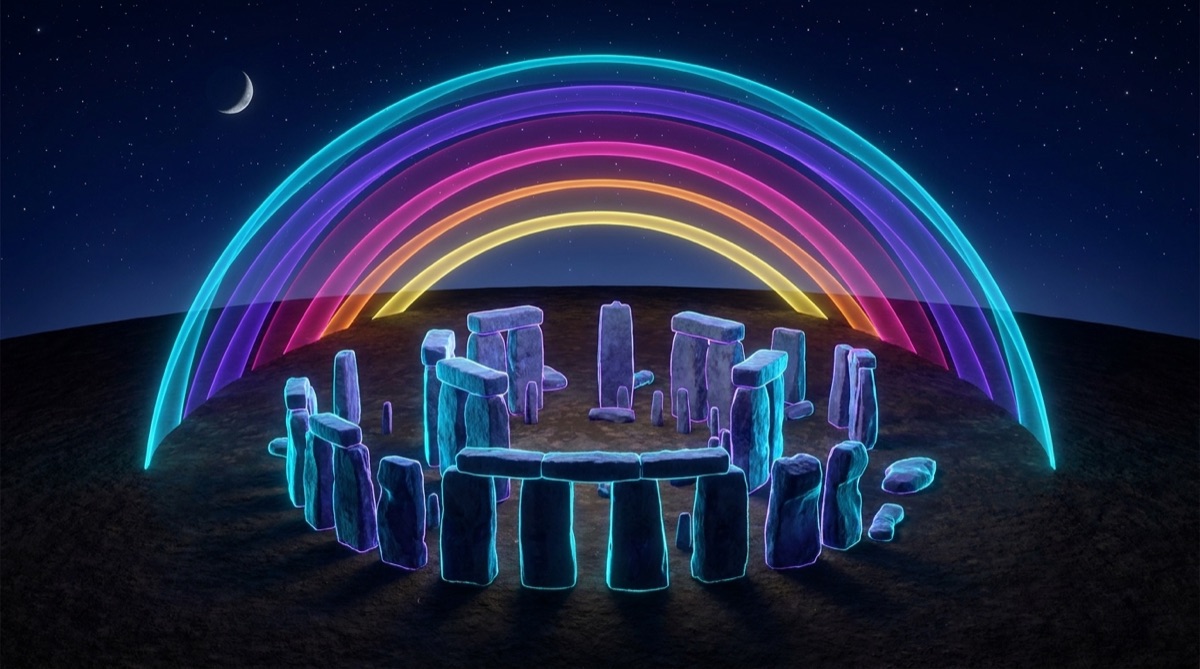
Was Stonehenge a 365.25-day calendar?
Timothy Darvill proposed that the 30 sarsens, the 5 trilithons and the 4 station stones encode a solar year of 365.25 days. Giulio Magli and Juan Antonio Belmonte replied that the proposal rests on numerology and on an astronomical precision impossible for the period. A living example of how a hypothesis is debated.
👤 Timothy Darvill, Giulio Magli, Juan Antonio Belmonte · 📍 United Kingdom, Italy and Spain
Sources (2)
- Darvill, T. (2022). Keeping time at Stonehenge. Antiquity 96(386), 319–335. https://doi.org/10.15184/aqy.2022.5
- Magli, G. & Belmonte, J. A. (2023). Archaeoastronomy and the alleged “Stonehenge calendar”. Antiquity 97(393), 745–751. https://doi.org/10.15184/aqy.2023.33
- 2022

Matariki, a national holiday in New Zealand
On June 24, 2022, New Zealand celebrates Matariki as an official public holiday for the first time, created by the Te Kāhui o Matariki Public Holiday Act with the advice of the Māori astronomer Rangi Mātāmua. It is the country's first holiday based on the Māori calendar, and it is set each year by the reappearance of the Pleiades.
👤 Rangi Mātāmua · 📍 Aotearoa (New Zealand)
🧪 Interactive planisphere Constellation
Sources (2)
- Te Kāhui o Matariki Public Holiday Act 2022 (New Zealand Parliament). https://www.legislation.govt.nz
- Ministry of Business, Innovation and Employment (NZ), “Matariki public holiday”. https://www.mbie.govt.nz
- 2022
DART: the first test of deflecting an asteroid
On September 26, 2022 the DART probe crashed at 22 000 km/h into Dimorphos, the small moon of the asteroid Didymos. The impact shortened its orbital period by about 32 minutes, far more than expected. It was the first demonstration of planetary defense.
📍 Binary asteroid Didymos–Dimorphos
📘 Kepler's three laws 🧪 Keplerian orbit Orbital period
Sources (2)
- NASA, “DART Mission” (science.nasa.gov/mission/dart).
- Thomas, C. A. et al. (2023). Orbital period change of Dimorphos due to the DART kinetic impact. Nature 616, 448–451. https://doi.org/10.1038/s41586-023-05805-2
- 2022
Artemis I: the Orion spacecraft circles the Moon without a crew
The SLS rocket lifted off on November 16, 2022 and the Orion capsule flew for 25 days, reached 432 000 km from Earth (farther than any spacecraft designed for people) and splashed down on December 11. It was the dress rehearsal for the return to the Moon.
📍 Kennedy Space Center; lunar orbit
📘 Hohmann transfers and gravity assists 🧪 Mission to Mars: Hohmann transfer Hohmann transfer
Sources (1)
- NASA, “Artemis I” (nasa.gov/mission/artemis-i).
- 2023
Chandrayaan-3: India lands near the lunar south pole
On August 23, 2023 the Vikram lander touched down at about 69° south latitude, closer to the pole than any previous mission, and India became the fourth country to land on the Moon. The rover Pragyan explored the area for one lunar day.
📍 South polar region of the Moon
Sources (2)
- ISRO, “Chandrayaan-3” (isro.gov.in/Chandrayaan3_Details.html).
- NASA/NSSDCA, Chandrayaan 3 (nssdc.gsfc.nasa.gov/nmc/spacecraft/display.action?id=2023-098A).
- 2023
FACSAT-2 “Chiribiquete”
On April 15, 2023, FACSAT-2, a 6U CubeSat named after the national park, lifted off on a Falcon 9 (Transporter-7 mission, Vandenberg). It is the first satellite with Colombian engineers taking part in its design, and it takes multispectral images of the territory.
👤 Colombian Air Force · 📍 Vandenberg (California); Sun-synchronous orbit
📘 Universal gravitation and satellites 🧪 Newton’s cannonball Orbit
Sources (2)
- El Espectador (15-04-2023). “Colombia lanzó al espacio el FACSAT-2 Chiribiquete” [Colombia launched FACSAT-2 Chiribiquete into space].
- Fuerza Aeroespacial Colombiana, “FACSAT-2 Chiribiquete” (fac.mil.co).
- 2024
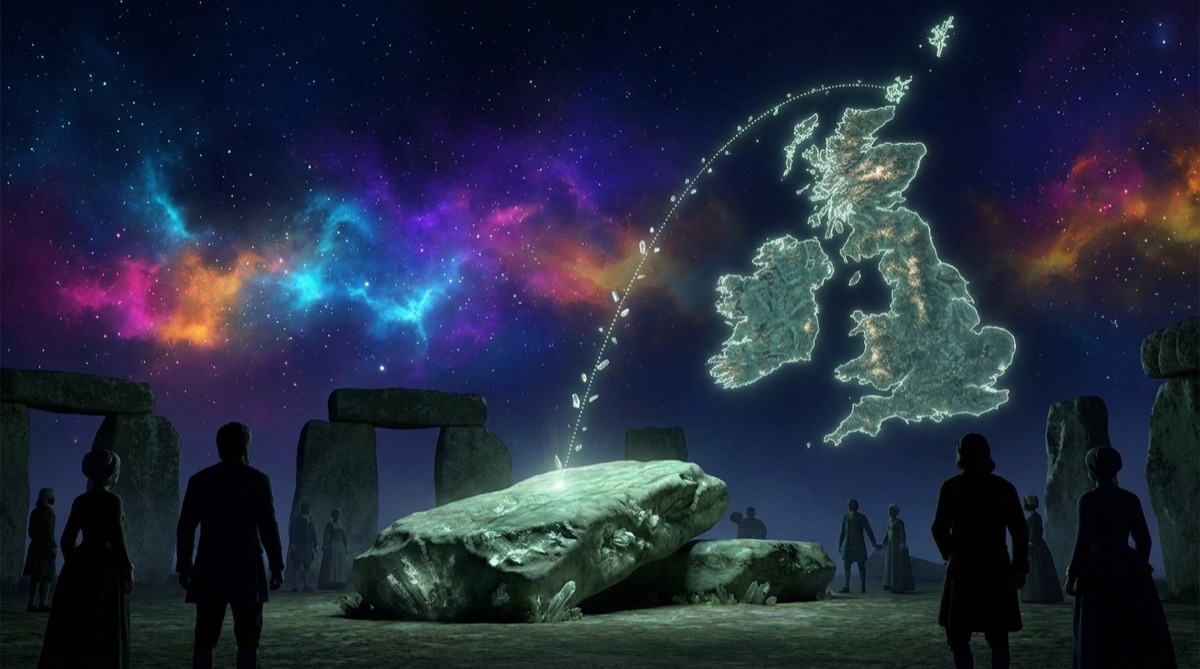
The Altar Stone of Stonehenge came from Scotland
Analysis of the minerals of the Altar Stone showed that it comes from the Orcadian Basin, in northeastern Scotland, more than 700 km from the monument, and not from Wales as was believed. The finding changes what we know about the contact networks of the people who built Stonehenge.
👤 Anthony Clarke · 📍 Curtin University, Australia, and the United Kingdom
Sources (1)
- Clarke, A. J. I. et al. (2024). A Scottish provenance for the Altar Stone of Stonehenge. Nature 632, 570–575. https://doi.org/10.1038/s41586-024-07652-1
- 2025
First images from the Vera C. Rubin Observatory
On June 23, 2025, the observatory on Cerro Pachón (Chile), with the largest digital camera ever built, showed its first images and 2104 new asteroids in just ten hours of data. For ten years it will photograph the entire southern sky every few nights.
👤 NSF–DOE Vera C. Rubin Observatory · 📍 Cerro Pachón, Chile
📘 Vera Rubin and the galaxies that spin too fast Dark matterDark energy
Sources (2)
- AURA (13-06-2025). NSF–DOE Vera C. Rubin Observatory will unveil First Look images on 23 June 2025 (aura-astronomy.org).
- Rubin Observatory, “First Look” (rubinobservatory.org/news/first-look).
- 2026
Artemis II: humanity returns to lunar orbit
On April 1, 2026 Reid Wiseman, Victor Glover, Christina Koch and Jeremy Hansen lifted off, the first human beings to travel to the Moon since 1972. Orion rounded the Moon and splashed down in the Pacific on April 10, 2026. Koch was the first woman and Hansen the first non-American to go to the Moon.
👤 Reid Wiseman, Victor Glover, Christina Koch, Jeremy Hansen · 📍 Kennedy Space Center; lunar flyby
📘 Hohmann transfers and gravity assists 🧪 Mission to Mars: Hohmann transfer Hohmann transferEscape velocity
Sources (2)
- NASA (10-04-2026). NASA's Artemis II crew splashes down in the Pacific Ocean (nasa.gov).
- NASA, “Artemis II” (nasa.gov/mission/artemis-ii).
No event matches the filters. Try removing one.
The protagonists
Behind every milestone there are people: 48 profiles with their lives, their contributions, their portraits and a timeline of their lives. In the events below, names with a profile are links.
The civilizations
-
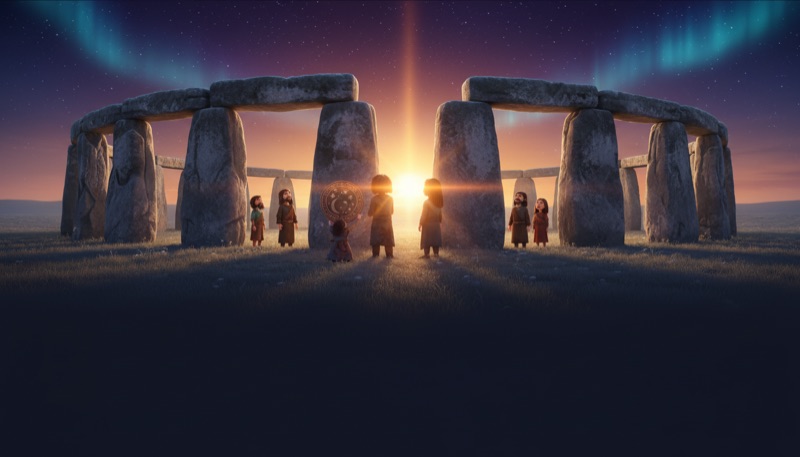
Africa, Europe and Asiaunder review
Prehistoric skies
c. 20 000 BCE – c. 1600 BCE
Before writing, communities in Africa, Europe and Asia raised stone circles, mounds and ditches that point to the solstices, and left behind objects such as the Nebra sky disc. What we know for certain and what remains a hypothesis.
20 events · 6 milestones
-
Sumer, Babylonia and Assyriaunder review
Mesopotamia
c. 3000 BCE – 79 CE
Sumerians, Babylonians and Assyrians recorded the sky on clay tablets for more than a thousand years and turned those records into mathematics: the zodiac, the Saros cycle, degrees and minutes all come from there.
22 events · 8 milestones
-
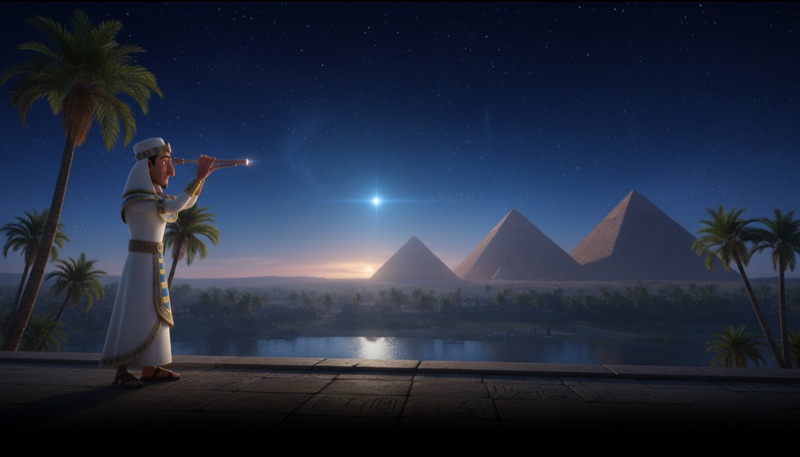
Nile Valleyunder review
Ancient Egypt
c. 3000 BCE – 30 BCE
The Nile, Sirius and a 365-day calendar that was never corrected: the Egyptians aligned pyramids with a precision of arcminutes, invented the hours and the water clock, and bequeathed, through Rome, the calendar we still use.
22 events · 8 milestones
-

China, Korea and Japanunder review
China and East Asia
c. 1200 BCE – 1700 CE
For more than three thousand years, the astronomers of the Chinese court recorded eclipses, comets, sunspots and “guest stars” with a continuity that has no equal; Korea and Japan inherited and extended that tradition.
23 events · 8 milestones
-

Indian subcontinentunder review
India
c. 1000 BCE – 1734 CE
From the lunar mansions of the Vedas to the stone observatories of Jai Singh, Indian astronomy brought together calendar, geometry and a mathematical tradition that discovered infinite series centuries before Europe.
18 events · 7 milestones
-
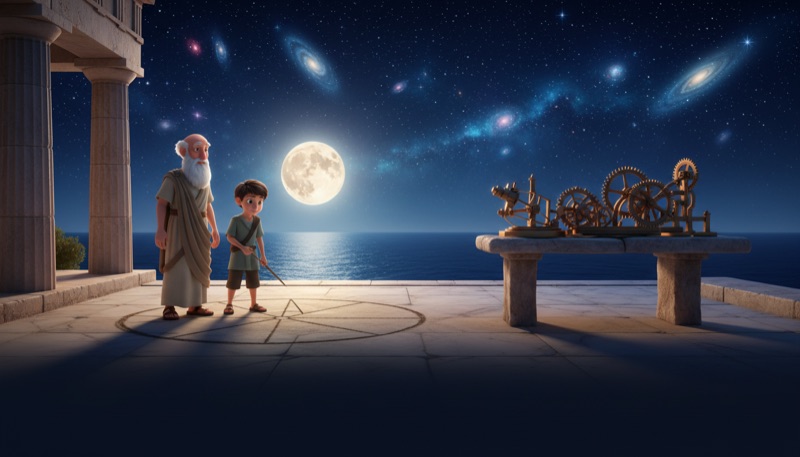
Eastern Mediterraneanunder review
Greece and the Hellenistic world
c. 600 BCE – 500 CE
The Greeks turned the sky into a geometry problem: with arguments, models and measurements they built the first astronomy that could be debated, corrected and calculated.
24 events · 8 milestones
-

Olmecs, Maya and Mexicaunder review
Mesoamerica
c. 600 BCE – 1521
Olmecs, Zapotecs, Maya and Mexica wove the most precise calendar of the ancient Americas: they counted the days from a creation date, tracked Venus and eclipses in bark-paper books and oriented whole cities toward the Sun.
19 events · 7 milestones
-

Chankillo, Incas and Muiscaunder review
The Andes
c. 300 BCE – 1550
From the thirteen towers of Chankillo to the solar pillars of Cusco and the lunar calendar of the Muisca, the Andean peoples turned the mountain horizon into a calendar and read in the Milky Way animals that still announce the rains today.
24 events · 7 milestones
-

From al-Andalus to Samarkandunder review
Islamic world
c. 770 – 1580
Between the 8th and 16th centuries, from Baghdad to Córdoba and from Cairo to Samarkand, astronomers writing in Arabic and Persian translated, measured, corrected Ptolemy and left us the astrolabe, the names of the stars and words like zenith, azimuth and algorithm.
20 events · 8 milestones
-
Pacific Oceanunder review
Polynesian navigators
c. 1000 BCE – today
Without compass or charts, the Polynesians settled a third of the planet by steering by the stars that rise and set, by those that pass overhead, and by the swells. In 1976 a canoe proved that this knowledge was no legend.
21 events · 8 milestones
-
Europeunder review
Europe: from the Middle Ages to the Scientific Revolution
c. 1230 – 1781
Between the Toledan tables and the discovery of Uranus, Europe went from copying Ptolemy to replacing him: a Sun at the center, elliptical orbits, the telescope and a law of gravitation that explained comets and tides.
25 events · 8 milestones
-
Worldwideunder review
The birth of astrophysics
1800 – today
From a thermometer placed beyond the red (1800) to the first image of a black hole: how light, and later gravitational waves, told us what stars and galaxies are made of and how they move.
25 events · 8 milestones
-
Worldwideunder review
The space age
1957 – today
From the beep of Sputnik (1957) to the return of astronauts to lunar orbit with Artemis II (2026): how we left the Earth, visited every planet and placed telescopes above the atmosphere.
25 events · 7 milestones
-

Colombiaunder review
Astronomy in Colombia
1760 – today
From Mutis's chair and the observatory of 1803, the oldest surviving one in the Americas, to the satellites Libertad 1 and FACSAT and the dark skies of the Tatacoa: two and a half centuries of watching the sky from Colombia.
24 events · 8 milestones